
“How the Mighty” Chapter 3 — Rudi
The Race to the Sea
Mounting a machine-gun
If this is what they do to empty pastures and hedges, Rudi thought, pressing himself deeper into the stinking water of a ditch, then the coastal fortifications must be taking a pounding.
The earth shuddered below, the footsteps of a giant running full speed at him. Klomp, klomp, KLOMP… He put his hands over his head, burying his face in the muck as the world exploded in earth and deafening noise.
His mother in Frankfurt must go through this every night, wondering if the cellar walls would collapse in on her.
He thought, as the mud covered him in a solid wave, of the brick walls, the rack of wine bottles his father cherished — had cherished — and the black kitten jumping onto his head in the dark, frightening him into wetting his trousers.
It seemed to him, as the pressure of mud and water increased, and he struggled for air, that most likely he had done it again, and his comrades, digging out his lifeless body, would wrinkle their noses in disgust.
“Pah, you stink!” Feldwebel Bock roared in his ear. “Kommen Sie, Scheißesser.”
The sergeant had dragged him onto the road by his feet, and his nose, apart from being full of cow dung, had encountered a cobblestone along the way. He gasped for breath, snorting out muck through his bloody nostrils, and set off after the fat little sergeant.
The lane led toward the beach, and a path branched off along the crest of the bluff serving the company’s positions. Amazingly, the bombs seemed to have missed the beach defences entirely. As Rudi panted along behind Bock, he saw the Feldwebel stop dead, gazing out over the beach.
The sea was full of ships. Rudi paused beside Bock, and together they looked at hundreds, no thousands, of craft, all headed their way. Already the first were approaching the edge of the sand, three hundred metres out with the tide.
“Heilige Scheiße,” the sergeant breathed, and glanced at Rudi, who crossed himself.
Bock took off at a run, and Rudi followed.
The squad manned a series of concrete foxholes — Ringstände, though the Allies called them Tobruks — near the top of the bluff. Each one carefully sited to have a wide field of fire, but to blend in with the terrain. One or two men could stand in the hole, firing a machine-gun or mortar, and concealed below ground were chambers for stores and reinforcements.
Some Tobruks had turrets from obsolete tanks mounted on them. Some had camouflaged overhead shelters, and some were just concrete holes. These were almost invisible until you stepped on one, a ring of sloped concrete to deflect incoming bullets and grenades. But an attacker would be dead by that time, cut down by two steel-helmeted men with a machine-gun spitting out a thousand rounds a minute.
Some were linked by tunnels, allowing safe access between the positions, but Rudi’s squad hadn’t gotten that far in their construction yet. Concrete was always at a premium.
Nevertheless, sandbagged trenches zig-zagged between the fighting holes, and the two soldiers jumped down off the skyline and into the narrow earthen passage.
Rudi followed Bock as he bent his head and entered the first of these fighting chambers. There was a man standing there, gazing out to sea, his mouth hanging open. Gefreiter Schmitt, stocky, blond, stupid: the perfect soldier.
“Why are you not firing?” Bock snapped, seizing the MG42 machine-gun and tilting it up on its mounting. “Look, they are landing!”
The first of the boxy black assault craft were dropping ramps as they grounded in the waves. Men poured out of each one and began wading ashore. To each side, guns opened up. The ripping sound of machine-guns, the bark of cannon, the crack of rifles. In the next position, a mortar banged metallically, its bomb lofting towards a pre-sighted aiming mark at the water’s edge.
Rudi craned his head to look over the sergeant’s shoulder. Bock checked the sights for range, aimed at the falling ramp of a landing boat, and opened fire on the enemy crammed inside.
“That’s the way to do it,” he shouted over the growing noise. “Short bursts, kill all the bastards at once. Don’t let the barrel grow too hot.”
He clapped Schmitt on the shoulder and left, adjusting his crotch as he bent under the rough concrete ceiling. Rudi looked at him with disgust. Killing the enemy was a duty for the Fatherland, something he must confess later to cleanse his soul. Not something to take such pleasure in.
Schmitt settled to the gun, aiming it at the next arriving boat and gesturing to Rudi for a fresh feed belt. “Hey kid, where is my milk?” He wrinkled his nose. “Also, you stink.”
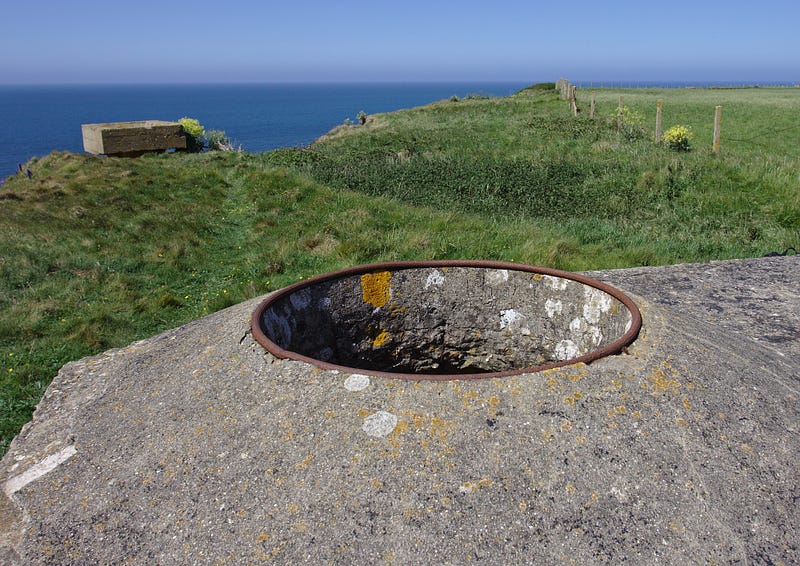
Chronologically the third chapter in my How the Mighty story. I would love to return to the beaches to examine the remaining defence positions in more detail. I took a look at Pointe du Hoc, a moonscape of craters and broken bunkers that staggers the imagination, but I did not know what I was looking at, at the time.
Likewise Omaha Beach, not quite so battered, but still I had limited time to potter around, and no grounding in how the battle had been arranged. I should return one day and get a professional tour.
Rudi, in this chapter, has cleansed his soul, gone to collect the milk from Arthéme, and been chased back to the beach by his sergeant. PFC Roland is still some way out in the Channel at this point, looking out over a lumpy sea.
This chapter is one reason why it has taken me nearly a year to write this story. The mind-boggling minutiae of the battle — all the equipment, vehicles, ranks, tactics, and often contradictory histories — absolutely overwhelmed me.
Today, the battlefield and cemetery are peaceful and poignant. I like poking around old cemeteries, reading the inscriptions, wondering about the inhabitants. When the cemetery is part of the battlefield, and at Colleville-Sur-Mer, the American Cemetery is just behind the crest of the bluff dominating the beach, the past is right there in the sigh of the wind, and if you listen carefully, the rattle of machineguns and the shouted orders float through the mind’s ear.
Britni
The whole story:


