
“Race” Is a Lie
The origins of a viral meme

For most of human history, we went without the concept of “race.” Without that invention, “racism” was impossible — both as an idea and as a social practice. This does not mean that humans didn’t sort themselves into groups, or identify their group as somehow superior to others, or use their power to force other groups into subordinate positions. But they didn’t do it on the basis of race.
The word “race” was used infrequently before the sixteenth century, and then only to describe people with a kinship connection. It’s tempting to think that this is because so few people had regular intercourse with people who didn’t look like them. But of course, this is not true. People were exposed to all kinds of “others” — especially at merchant ports and other crossroads. Even then and there, however, as “race” emerged the word still referred to people with a common language or to members of a common ethnic group, much like what would be later called a “nation”.
The origins of racialism
The idea of race in its modern sense took shape at the intersection of two trends: European colonialism, which sought to expand its influence and exploit the resources of the new lands, and the promotion of a scientific worldview that categorized things into descriptive systems. These systems were then used to justify the exploitation of non-Europeans by European colonizers.
It’s hard to treat a person as a commodity, much as one might export gold or grain. It’s much easier if you have an ideology which insists that the person is not “really” a person — he’s an “abo,” a “nigger,” a “spic,” a “chink,” a “fez,” a “wetback,” a “coon,” a “dink,” a “savage,” and so on. This, in turn, has pushed the exploited to whatever verbal retaliation they could get way with. European Christian whites became “rednecks,” “palefaces,” “peckerwoods,” “crackers,” “sheetheads,” “anglos,” “white devils”, the “boogie man,” et cetera. It’s pathetic. The list also goes far beyond these examples. The first reference I consulted went on racial epithets went on for more than five pages, single-spaced, of examples of how we Americans demean one another. Another such reference — of racial insults common in the Russian Army — is even longer.
If we can keep some perspective, maybe we can have a laugh:
But it’s easier to laugh if you are one of the victimizers, rather than the victim. I’ve been one of the lucky ones. I‘ve seldom heard any racial epithets directed at me; I’ve never heard one directed by me by someone I thought might actually be in a social position superior to mine.
Labeling is not only demeaning. It’s functional. It groups people who may have deep differences among them into simple administrative categories, and it does so for the benefit of the administrators. Native Americans consist of thousands of nations, yet for the U.S. at best they were all Indians, and at worse, they were all Savages. Africans, in Africa and in the lands they were imported to, have members of thousands of tribes and nations, yet in the eyes of the exploiters, they were all Niggers. And in each of these cases, active measures were taken to homogenize the groups to fit the myth: native Americans were forced to attend schools that rejected their various identities while promoting an unattainable assimilationist ideal. Black Americans had children ripped from their parents and couples divided by sales and transport.
At the same time, identifying “white” as a superior social category promoted divisions between poor “white trash” and the other people with whom they shared a common enemy. Holding out the possibility of success for the white man while recruiting him to keep the black man in check undermined the potential for identifying common characteristics as a class.
To this day, the American myth of individual success — especially among whites —continues to undermine the hope for social progress while it encourages a zero-sum mentality. Combined with the American tradition of Calvinism, where a limited number of the “chosen” are most often identified by wealth, a contemporary racist may see anything that helps another as a threat to himself. “America first” becomes “white first” and slides into “me first” at the expense of everyone in an inferior social position.
Racialism as “science”
Scientists of the fifteenth through nineteenth centuries, predominantly white European males, contributed to the labeling trend. What they added was the contention that what they were doing was “scientific” and “objective”.
In 1685 we find the first attempt to “scientifically” define races, François Bernier’s Nouvelle division de la terre par les différents espèces ou races qui l’habitent (“New division of Earth by the different species or races which inhabit it”). Notice that “race” was defined as analogous to “species”: physically distinct, with inherent qualities related to biology. It’s no coincidence that in the New World laws were also being developed around this time to distinguish between indentured service and slavery. By 1639 the first Virginia law was passed to formally exclude “negroes” from protection, and in 1661 slavery was made a legal category. Maintaining the walls between these categories was essential to maintaining the fiction of “racial species.” By 1691 Virginia law declared that any white who married a “Negro, mulatto, or Indian” would be banished from the colony. Slave Codes of 1705 formalized a system of slavery based on records of parentage and the physiognomy of the slave. And institutions have stubbornly clung to maintaining differences that are not real. As late as 1967 it was illegal to have an interracial marriage (“miscegenation”) in the majority of American states.
When exploitation became the norm, science was enlisted (as well as a variety of Christianity) to justify it. Carl Linnaeus, credited as the inventor of taxonomy, in 1735 formally divided the human species Homo sapiens into subgroups of europaeus, asiaticus, americanus, and afer. Behavioral tendencies were defined as a function of “race”: Homo sapiens europaeus was described as active and adventurous, whereas Homo sapiens afer was crafty and lazy.
The “science” of race was, as it still is, an ideology beyond testing. Even Thomas Jefferson, who wrote of the equality of man and described Native Americans as equals to whites, went out of his way to insist that people of African descent were of limited intelligence and overwhelming sexual appetites. And while genetic mapping and contemporary records show Jefferson bedded his slave Sally Hemmings since she was fourteen years old, fathering six children with her, he never formally granted her her freedom. How could he reconcile his actions with the assumption that “all men are created equal”?
Part of what made Ms. Hemmings so attractive to Jefferson — and allowed him to manage his cognitive dissonance — may be the blurring of categories that came because her father was white. We have no contemporary portraits or photographs of Sally Hemmings, but she was described by contemporaries as beautiful and light-skinned, with long, dark hair. When people like Ms. Hemmings fell between their assigned descriptions, they were “mixed-blood,” a development that was held to have elevated a member (and the average capabilities) of one race to the detriment of another. In recognition of her being “almost” white— and perhaps because of an agreement made between Ms. Hemmings and Jefferson when she lived in his household in Paris — Jefferson freed all of his children by Ms. Hemmings by the time of his death, and at least two of them passed for white in contemporary society. He did this for none of his other slaves. He had not “elevated” any of them by mixing his seed with theirs.
Yet Jefferson’s dilemma was even greater than his personal problems. He was a “gentleman” farmer, prospering from the coerced labor of others. In principle, Jefferson pushed for a condemnation of slavery in the first draft of the Declaration of Independence. In a section removed by the Congress as a whole Jefferson listed among the crimes of King George that
he has waged war against human nature itself, violating it’s [sic] most sacred rights of life and liberty in the persons of a distant land who never offended him, captivating and carrying them into slavery in another hemisphere, or to incur death in their transportation thither. this piratical warfare, the opprobrium of infidel powers, is the warfare of the CHRISTIAN king of Great Britian, determined to keep open a market where MEN should be bought or sold…
But when pressed, this was dropped. Too controversial, perhaps, for land where so many profited from a “market where MEN should be bought or sold.” Yet the remainder of that paragraph was kept in the Declaration, that the king “is now exciting those very people to rise up amongst us” to gain their freedom at the expense and the lives of those who now owned them.
Perhaps Jefferson saw himself to be in a prisoner’s dilemma: own slaves, and compete in a slave-owning economy against other slaveowners, or release his slaves and be crushed. If so, like so many others, Jefferson sacrificed truth for comfort. Like so many times in American history, the exploited were asked to wait until it was more convenient for the exploiters to make a transition. It’s easy to be liberal until you have to pay the price.
And so the enslaved waited.
The long road
In the 19th century, it was still taught that race was biological, essential to understanding and predicting behavior, and taken as an excuse to keep “inferiors” in their place. In the United States, despite a Civil War and a half-hearted attempt at reconstruction, nearly all of white-dominated society was dedicated to reminding blacks of what “their place” was, and enforcing it with violence. Lynching was common and remained so in the century to come.
In the early 20th century this ideology was still taught by anthropologists, and people were punished for living “above their place”. Black soldiers, returning from World War One and proudly wearing their uniforms, were beaten and lynched for acting “uppity”. “Black Wall Street,” a prosperous section of Tulsa, was burned to the ground in 1921 by a white mob — many of whom were deputized—along with police and national guardsmen. Firebombs were dropped from aircraft, in the only known case of Americans bombing other Americans from the air. Over three hundred black Americans died, and the remainder were forced into internment camps for the crime of being were too successful, moving above their assigned station. There were no prosecutions. Newspaper records were scrubbed. History books failed to mention it.
In the mid-20th century, dogs were still being released to terrorize people whose skin was not that of the masters. Simple demands for equality of recognition were met by rage and anger and fear. Rage, because it undermined many people’s understanding of the natural social order. Anger, because it forced the abuser to recognize his actions and deal with the cognitive dissonance between “all men are created equal” and “whites only”. Fear, because they knew they were not only going to lose their assumed privilege but because they knew those they had harmed had a legitimate demand for retribution. How many of those who remembered their own guilt in a lynching felt the noose tightening around their own necks?
The 1960s were years marked by an improvement in the legal status of non-whites: to vote, to use a public hospital, to eat in a restaurant, to (begin to) marry outside of their assigned racial category. All of these things were resisted. All of these things were subverted.
Today some condemn “white privilege” while others still deny it exists. A conservative Supreme Court, packed by politicians representing a minority of Americans, has taken it upon itself to subvert voting rights and protect the privileges of a wealthy few. Even the thought of considering the impact of our imaginary social categories, something which has taken lives and has produced long-lasting genetic harm, is condemned as “critical race theory” in our schools and condemned as an affront to the history and character and “calm” of this country.
Abusers like it when it’s calm: it means they aren’t being challenged.
Racists and exploiters are comfortable with the idea of “race”: it carries so much baggage, and so much of that baggage is unspoken. Even those in opposition to racism — a noble cause — and working to be proud of their history — another valuable goal — are often playing into the hands of the abusers by adopting the language of those who have exploited them. To make progress we need to take the next step.
Race is a lie
Race, the very idea of race, is a lie.
More to the point, it’s a meme. It’s a viral infection of our cognitive structures. When we accept it, it replicates. When we fight it, it also replicates.
This meme has become so viral that it is literally impossible for some people to think outside of racial categories. It has been so tied up in our other identities that to condemn it is seen as a condemnation of those identities.
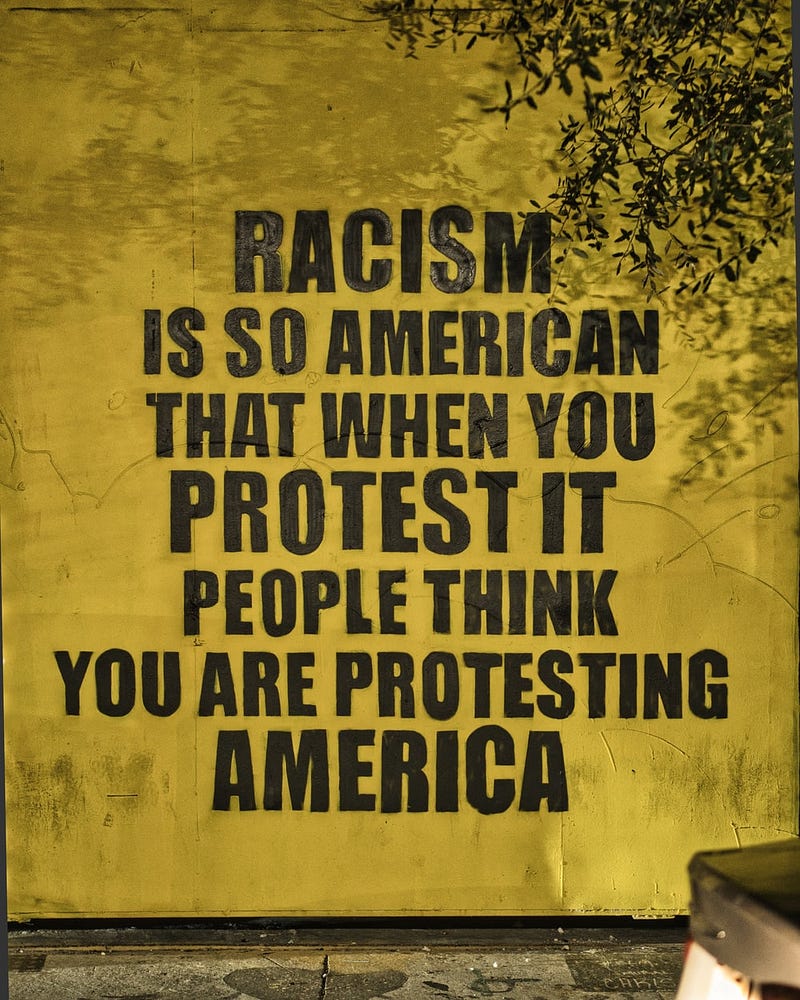
No person is born hating another on the basis of the color of their skin. No person is born thinking less of another because of the color of their skin. No person is born seeing another in a way that prioritizes skin color over age or height or handedness or health or presentation of self.
It’s time to consider a radical suggestion: make the idea of “race” something to laugh at. Make it something to deny in principle, ontologically. Outgrow it. Transcend it. File it with Zeus and Athena and the Ether and Phlogiston and Mathematical Completeness and Absolute Time and Quantum Locality and all the other things we now recognize as objects that do not reside in the real world. If someone — especially someone in a position of authority — tries to impose racial categories, laugh in their face. The only excuse to apply race as a category is to identify those who have suffered from its application in the past, in order to allocate reparations.
Too hard? Start small. For me, whenever I see one of the countless forms that ask us to divide ourselves by race, I check “other” and write in “human”. After all, we’re one species. It’s the only race we belong to, and it belongs to all of us.


