
Rabbit’s R1 takes a shot at creating an interface without an interface
Rabbit’s R1 boldly claims to offer an ‘interface without an interface’ despite having an interface.
Rabbit AI as a killer of interfaces
The promotion of Rabbit AI focuses on the complexity of traditional interfaces compared to the simplicity of just asking and receiving. Typically, you might need to click through numerous pages or use multiple apps to plan a trip. Rabbit’s small assistant promises to handle all this for you. As described, Rabbit R1 will utilize interfaces on your other devices without requiring access to your accounts.
However, the interface of Rabbit R1, as demonstrated so far, seems more conceptual. The examples of its use were clearly staged, and the presentation raised more questions than it provided answers.
While Rabbit makes bold claims, in the real world, especially among those who understand technology, there are clear concerns. The functionality of Rabbit R1 remains ambiguous, raising doubts about its ability to handle corner cases that other voice assistants struggle with, a point noted by multiple tech reviews on YouTube and media reports.
Despite these concerns, the idea of an interface-less interface, a highly intelligent assistant like Rabbit R1, is undeniably appealing. The initial order of 10,000 Rabbit R1 units sold out quickly, and even a second batch scheduled for March sold out.
We have been gradually moving towards ‘no interface’ interfaces with voice assistants, which have been improving over the years. Demand Sage reports that more than 50% of adults now use voice search daily.
Chat GPT also falls into this category of seemingly interface-less interfaces. Typically, you might have to combine knowledge from several sources on your own, but Chat GPT can do that for you in seconds. Its popularity and impact are indisputable.
So, it’s natural to assume people like using ‘no interface’ solutions. But as tasks get more complex and conversations more nuanced, it raises the question: Is it easier to explain all the nuances in speech than navigate through complex interfaces? Are we really ready for a one-interface solution as minimal as Rabbit R1? If you still need other interfaces, like a phone or laptop, what’s the point of this additional device? We haven’t even discussed the implications when such devices become ubiquitous and websites become mere databases for AI without any benefit to them. We might lose a lot of great content. Similarly how we are losing great journalism. There are many factors to consider before buying into the hype of powerful AI technology. Creators of such technology often lack a clear plan regarding how they should coexist with the individuals who serve as the database for these AI systems.
Can voice commands replace interfaces?
Voice commands are a convenient interaction pattern, but even Rabbit R1’s presentation suggests they cannot replace visual interfaces. Let’s examine the ‘no interface’ interface in Rabbit R1’s promotional material.
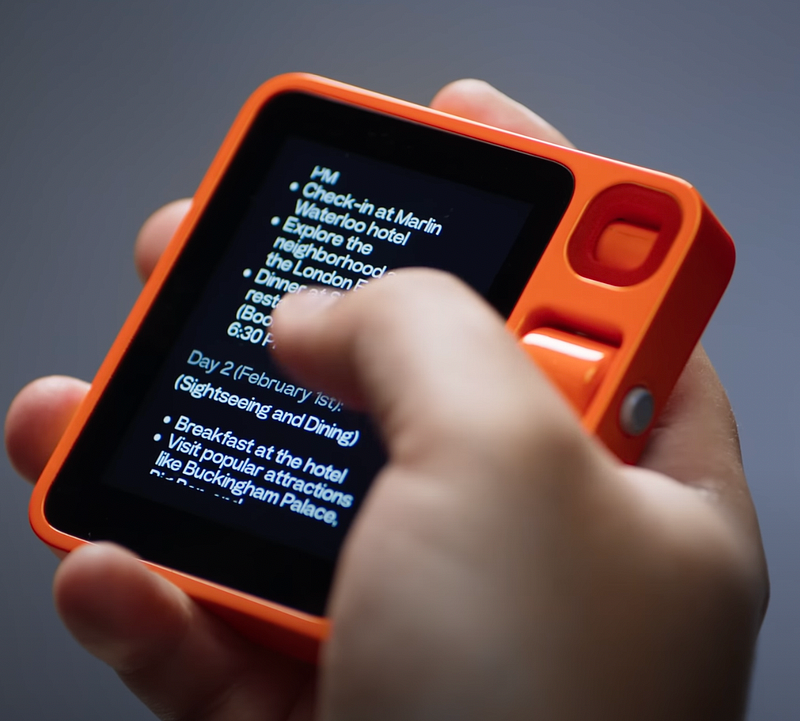
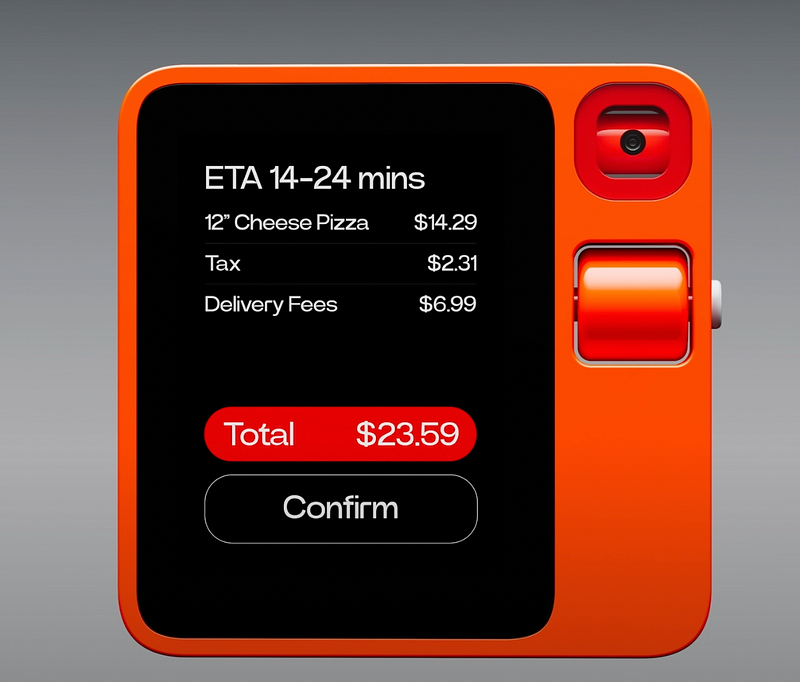
These images show a fairly basic interface, one that might need to expand to cover all possible cases. It may be AI-driven, but it still relies on visual interfaces similar to what we already have in most devices.
Connivance of such interfaces is still a question. Consider texting a ‘Happy New Year’ message to a friend group, similar to the situation mentioned in Rabbit’s promo. If you don’t have them saved as a group, is it easier to name 20 people to a voice assistant or to add them visually, possibly recalling others to include while looking at your contacts?
A fully voice-command-powered interface is still an interface. The future where you simply say ‘do that’ and it’s magically done is enticing, but this AI would likely need to ask several questions before executing a task, or worse, you might have to figure out precisely what to say. Working with a human assistant means dealing with someone who considers aspects that AI might deem unimportant.
Have you ever spoken to a friend and thought, “Well, that is nonsense, but I can kind of understand why they did that”? For instance, when discussing travel plans, some people might choose a flight with a 16-hour stopover instead of a 2-hour one, thinking they could explore a city. This nuanced decision-making is something AI might not grasp.
Interrogator interfaces are not always the best solution either. Some people might enjoy talking at length, but watch how they react when an AI asks them too many questions.
AI is about searching, not browsing
I’ve tried using AI for various tasks: fixing my grammar, helping me find information, generating images, and assisting in coding simple interfaces, and I find that AI interfaces are mostly capable in searching rather than browsing. As it stated itself.
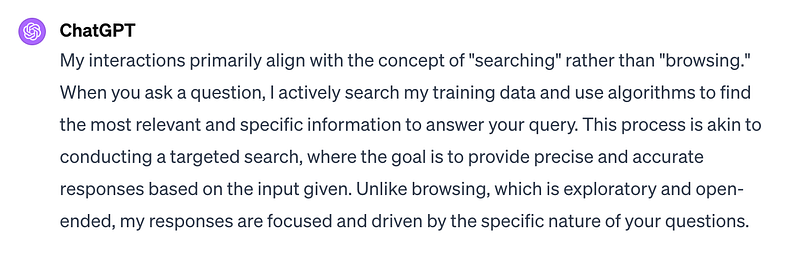
You can facilitate a sort of brainstorming session with AI, but the outputs are somewhat limited. However, browsing plays a crucial role in our interaction with interfaces. Like in the example with the New Year message, browsing your contact list might help you find someone you would also add to the list. Or, while researching an article on a website, you may discover that the site offers much more, leading to new ideas. But using AI can be like wearing blinkers, like those on horses. Personally, I’ve found that while it can reinforce your knowledge, it struggles to lead you on a path of discovering different knowledge.
Looking forward
While I genuinely look forward to AI making our lives easier, and I see many potential uses for it, AI’s strength should be in its ability to merge information from different sources, not in pretending to make interfaces obsolete. Interface designers should be more concerned about being left out of the conversation again than they should be about interfaces going away. I don’t believe it’s possible to eliminate visual interfaces entirely. Clicking may seem inconvenient compared to voice commands to some, but getting a visual response and visually assessing a situation is not going anywhere. As often said, AI might not steal your job, but people who effectively use AI will.
*Links to sources included in the article*


