
The Queen’s Gambit: A Lesson in the Drawbacks of Talent
Quick and dirty book review
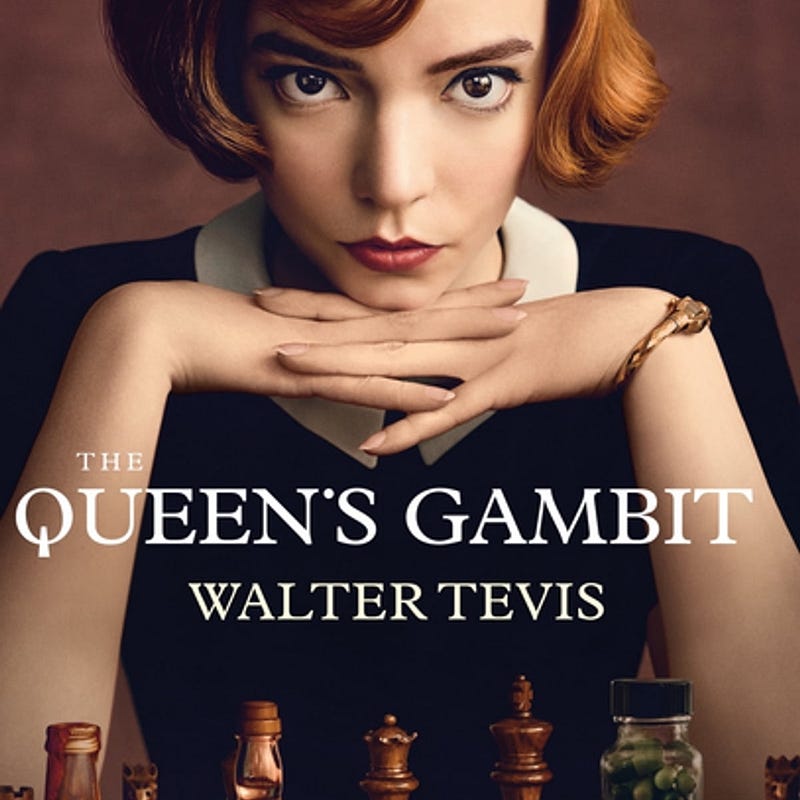
Title: The Queen’s Gambit
Author: Walter Tevis
First Published: 1983
Number of Pages: 278
My Reading Time: 7.5 hours (it felt like less)
Average StoryGraph Rating: 4.09/5
My Rating: 5/5
Synopsis: When she is sent to an orphanage at the age of eight, Beth Harmon discovers two ways to escape her surroundings, albeit fleetingly: playing chess and taking the little green pills given to her and the other children to keep them subdued. Before long, it becomes apparent that hers is a prodigious talent, and as she progresses to the top of the US chess rankings she is able to forge a new life for herself. But she can never quite overcome her urge to self-destruct. For Beth, there’s more at stake than merely winning and losing.
The Good:
- Beth, the point of view character.
We meet Beth right after her mother dies. One paragraph later, she’s in an orphanage, being fed tranquillisers twice a day. It’s hard not to root for her when, from the very beginning, she’s in an underdog position.
The narration is straightforward and dry in a way I enjoyed. It’s a “less is more” situation. The lack of artifice makes the emotions stand out.
- The stakes.
If not for Anya Taylor-Joy, the actress who plays Beth in the Netflix adaptation, I would have given this story a miss. I could not imagine myself being interested in a book and TV series about chess — it’s a good game, but not a spectator sport.
I was wrong to dismiss it.
Beth’s struggles hooked me into the story, but what got me invested was how much the game means to her. She turns it into an intrinsic part of her personality, so every loss has her feeling as if she’s losing something of herself, something essential that makes her who she is. The stakes are ever-present.
- The topics covered.
Some books go on twice as long as The Queen’s Gambit and fail to make a point. In under 300 pages, Walter Tevis makes several, and he makes them well.
Chess is the cover story, the surface-level action. Beneath the surface is an entire ecosystem of social commentary, ranging from addiction to the diversification of gender and skin colour in traditionally white and male spaces.
The main topic explored is the destructive power of talent. Beth has talent and so do many of the people she plays against, and it ruins them because it narrows their worlds. Their talent becomes the only thing they’re good at, the only thing they care about, and the only thing they have any interest in talking about. It makes it impossible for them to connect or expand.
It isn’t often that a book gives me something new to think about (which means I probably need to question my reading choices), but this one does.
- The relationships.
Beth does not do things in the “ordinary” way, and that remains true for how she interacts with people.
One of the closest relationships she has is with Mr Sheibal, the orphanage’s custodian, with whom she rarely speaks and when she does it’s only about chess. They go years without interacting, yet there’s forever the sense that they’re each other’s family.
Alma Wheatley, the woman who adopts Beth, isn’t much of a mother, but they care about each other unconditionally.
The various relationships Beth has with men aren’t healthy, but they are interesting in how they highlight her character flaws and reinforce all the ways in which she can grow.
- The ending.
No spoilers allowed, but that final scene is lovely and the perfect ending to a book that fascinated me from beginning to end.
The Not-So-Good:
- The chess.
I stand by what I said earlier. I do not consider chess to be a spectator sport, so the detailed and frequent play-by-plays of the book’s many chess games are too much.
I skipped a lot of those paragraphs, though I’m sure a chess fanatic will appreciate them more.
Have you read the book or watched the miniseries? If you have, what are your thoughts?
If you want to receive a quick and actionable writing tip once a month in your inbox, sign up here.


