
Quercus soul rooted in poetry
Lecture notes on oak symbolism
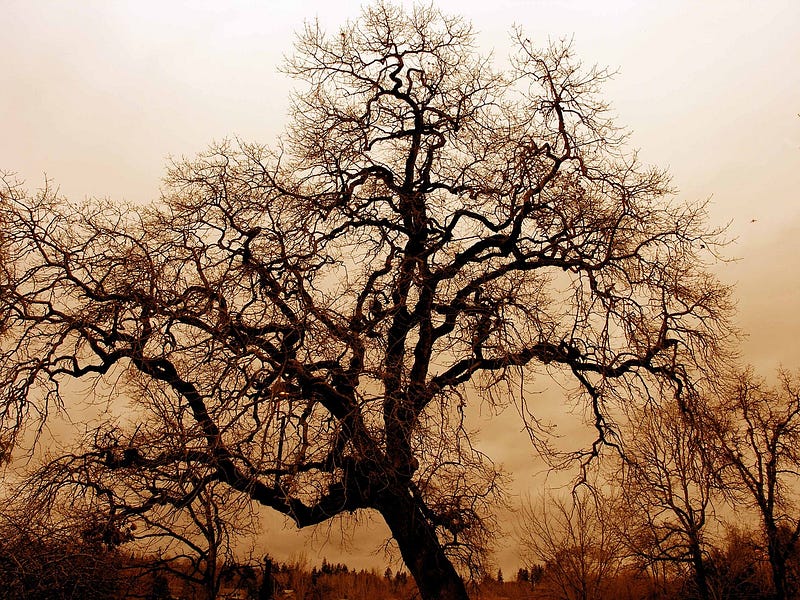
When I was thinking about today’s mini-lecture, I suddenly remembered my old poem On god trapped inside the oak, and rapidly got dazzled as I realized that oaks are one of the main motifs in Polish poetry of the 19th, 20th and 21st centuries. One can venture to say that this is a global scale phenomenon, although it must be admitted that oak is often used as an inspiration all over the world, but probably nowhere else its presence in the written language has been marked as strongly as in Poland.
It seems that we have inherited this love of oaks from the pre-Christian times, of which we do not know much, but some historical testimonies have made their way to present days thus, we can say that Slavs worshiped oaks as well as the gods. The great example of which is Slavic mythology, rich in the symbolism of these trees.
Maybe this is why oak become the main element of landscape depicted in polish poetry. While in the Romantic era, Quercus was more often the axis of events, so to say, assuming function of a symbol, rather than only aesthetic illustration. Reasons for this can be traced to the physical characteristics such as size, spread, longevity, basically everything what’s distinguishes oaks from other trees. It is difficult to get rid of the impression posed by romantic poets, indeed, there is something about oaks, perhaps hidden strength, emanating and overpowering whenever your turn your sight to it. Oaks symbolize generations, tradition, unchanging values, strength, outstanding individuality, vitality and health. It also happened, though less often, that poets reached for the opposite parallel writing about young oaks thus having in mind unstoppable strength and power of youth.
In the 20th century oak as the subject of the poem has already made its mark, it is enough to recall the poems of Boleslaw Lesmian, Zbigniew Herbert, Czeslaw Milosz, Władyslaw Broniewski, but also in sung poetry, whose master was the bard of Solidarity Jacek Kaczmarski. Oaks also entered the canon of new 21st century wave of poetry, among others in the works of Wojciech Wencel, Marcin Baran or Marcin Swietlicki.
It seems that due to their nature, oaks will occupy poets mind much longer than we get to spend in this earth, maybe even longer than Earth itself. Just imagine a poetry competition somewhere on one of the distant human colonies cast amongst the stars. Imagine people looking at old photos or movies showing oaks and making eyes like us when we watch SF movies. Imagine an oak so strong that it can bear our entire planet and the memory of it.


