
United Kingdom
Queen Elizabeth II: 1952–2022
Queen Elizabeth II: British Historical Events from 1952 to 1989.
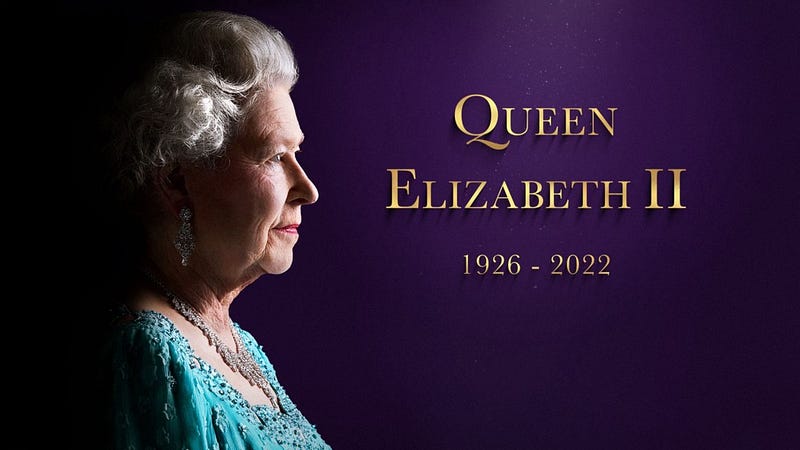
Decade: 1952–1959…
6 February 1952…
Princess Elizabeth, Duchess of Edinburgh, becomes monarch of the United Kingdom of Great Britain and Northern Ireland and the British Dominions: Canada, Australia, New Zealand, South Africa, Pakistan, and Ceylon. The princess, who is on a visit to Kenya when she hears of the death of her father, King George VI, aged 56, takes the title Elizabeth II. King George VI was born in 1895.
31 January 1953…
The North Sea flood of 1953 kills 1,836 people in the southwestern Netherlands (especially Zeeland), 307 in the United Kingdom, and several hundred at sea. The death toll included 133 individuals travelling on the ferry MV Princess Victoria in the Irish Sea.
24 March 1953…
Mary of Teck, consort of George V of the United Kingdom, dies. She was born in 1867.
6 May 1953…
Tony Blair, later the Prime Minister of the United Kingdom, is born.
2 June 1953…
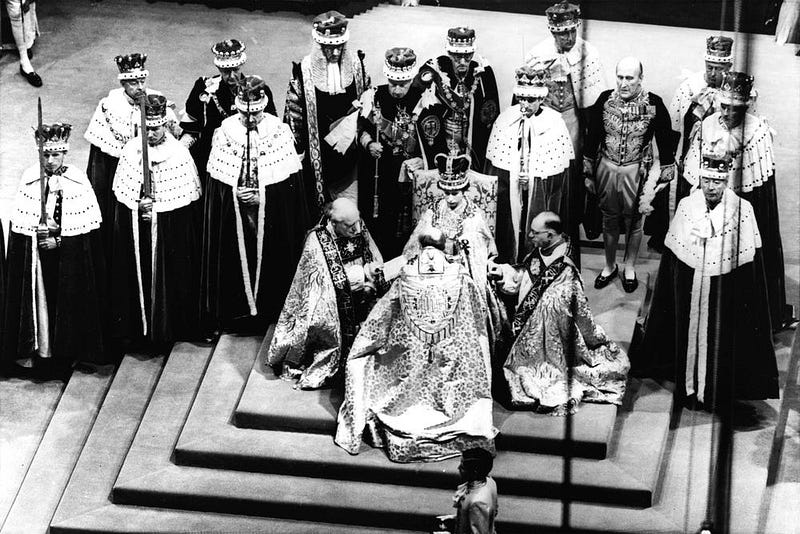
Elizabeth II is crowned Queen of the United Kingdom, Canada, Australia, New Zealand, South Africa, Pakistan, and Ceylon, at Westminster Abbey.
15 August 1953…
Overthrow of the democratically elected Prime Minister of Iran, Mohammad Mosaddegh, by Iranian military in favour of strengthening the monarchical rule of the Shah, Mohammad Reza Pahlavi, with the support of the United States Central Intelligence Agency (as “Operation Ajax”) and the United Kingdom.
2 December 1953…
The United Kingdom and Iran reform diplomatic relations.
23 October 1954…
Paris Agreement sets up the Western European Union to implement the Treaty of Brussels (1948), providing for mutual self-defence and other collaboration between Belgium, France, West Germany, Italy, Luxembourg, the Netherlands, and the United Kingdom.
Unspecified date in 1954…
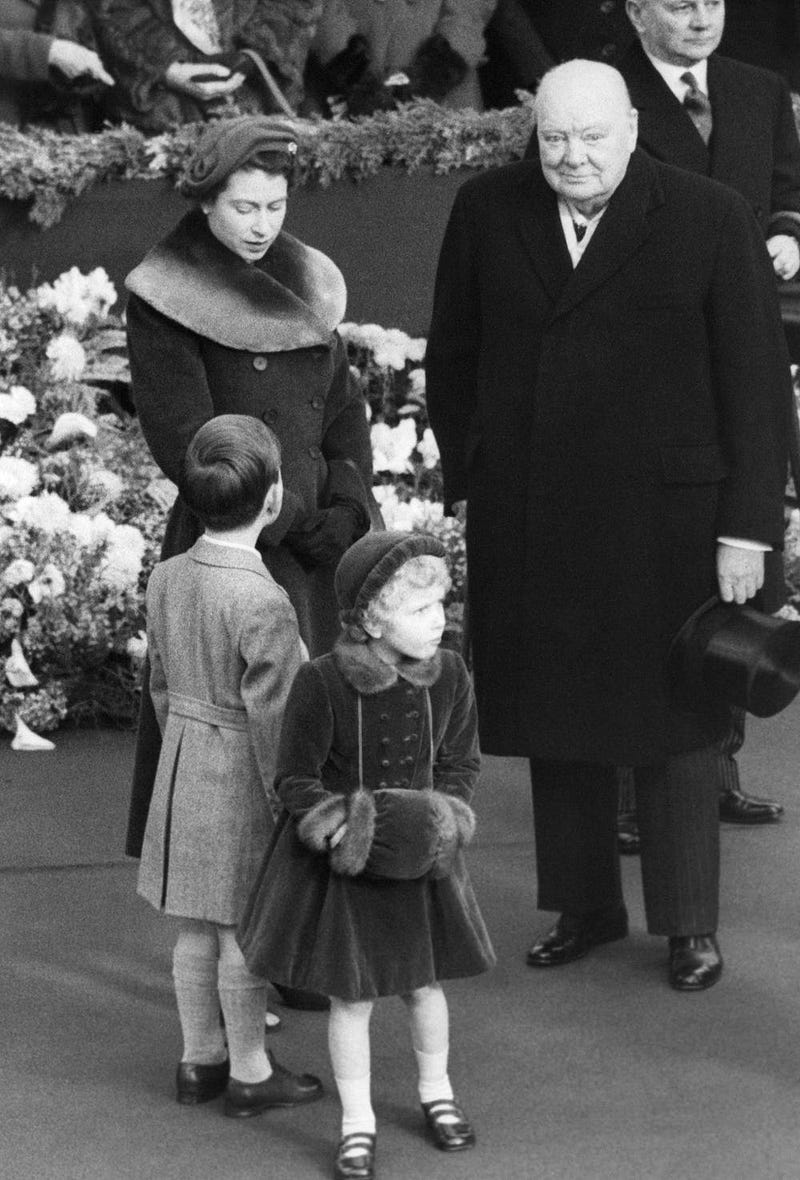
Queen Elizabeth II, since coming to the throne, has held regular audience with each prime minister.
5 April 1955…
Winston Churchill, due to ill-health, resigns as Prime Minister of the United Kingdom. He’s 80 years old.
6 April 1955…
Anthony Eden becomes Prime Minister of the United Kingdom.
5 May 1955…
West Germany, recognised by important Western countries such as France, the United Kingdom, Canada, and the United States., becomes a sovereign country.
15 May 1955…
The Austrian State Treaty, which restores Austria’s national sovereignty, is concluded between the 4 occupying powers following World War II (the United Kingdom, the United States, the Soviet Union, and France) and Austria, setting it up as a neutral country.
13 July 1955…
Ruth Ellis is hanged for murder. Ellis is the last woman executed in the United Kingdom. The execution took place in London.
18 July 1955…
Geneva Summit between the United States, Soviet Union, the United Kingdom, and France.
18 September 1955…
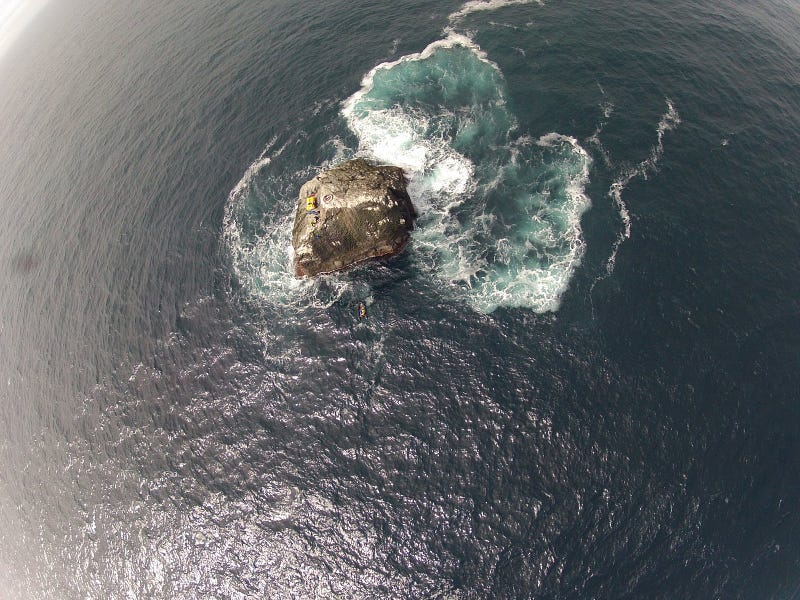
The United Kingdom formally annexes the uninhabited Atlantic Islet of Rockall.
22 September 1955…
Commercial television starts in the United Kingdom with the Independent Television Authority’s first ITV franchises beginning broadcasting in London, ending the BBC monopoly.
Unspecified date in 1955…
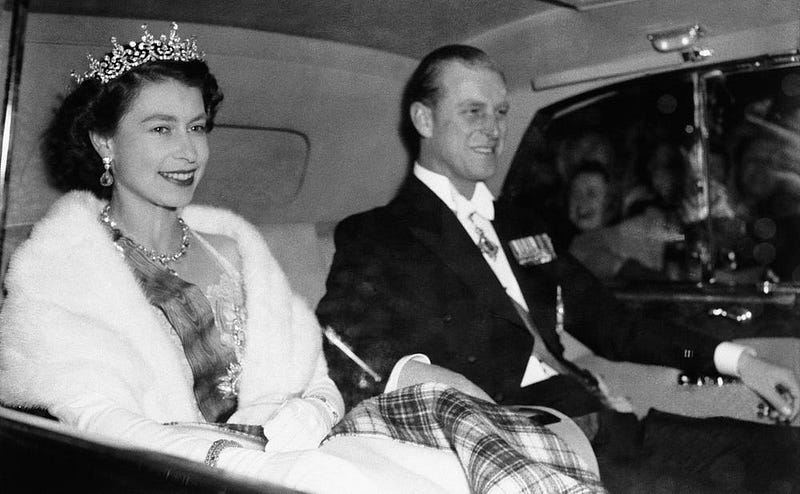
The Queen plays a key role in maintaining diplomatic relationships with other countries. Here, she arrives by car at the Portuguese Embassy in London’s Belgrave Square to attend a dinner party thrown in their honour by the visiting Portuguese president and Madame Craveiro Lopes.
Unspecified date in 1956…
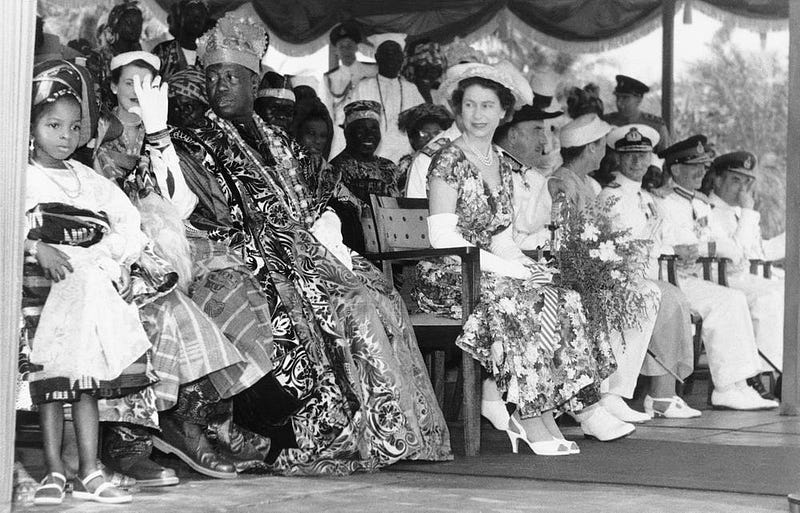
Travelling and representing Britain overseas is a key part of her job. She visited the Lagos City boundary in Nigeria on her way to the city from Ikeja Airport in 1956.
9 January 1957…
British Prime Minister Anthony Eden resigns.
10 January 1957…
Harold Macmillan becomes Prime Minister of the United Kingdom.
6 March 1957…
United Kingdom colonies Gold Coast and British Togoland become the independent nation of Ghana.
12 April 1957…
The United Kingdom announces that Singapore will gain self-rule on New Year’s Day 1958.
31 August 1957…
The Federation of Malaya gains independence from the United Kingdom, subsequently celebrated as Malaysia’s National Day. Abdul Rahman of Negeri Sembilan, Yang di-Pertuan Besar of Negeri Sembilan, becomes the first Yang di-Pertuan Agong of Malaya. The country’s new Constitution came into force on August 27. The Alliance Party and its successor are the ruling coalition until 2018.
26 July 1958…
Queen Elizabeth II of the United Kingdom announces that she is giving her son and heir apparent The Prince, Charles, the customary title of Prince of Wales. The announcement is made at the end of the 1958 British Empire and Commonwealth Games, held in Cardiff.
1 September 1958…
The first Cod War begins, between the United Kingdom and Iceland.
19 February 1959…
The United Kingdom decides to grant independence to Cyprus.
26 June 1959…
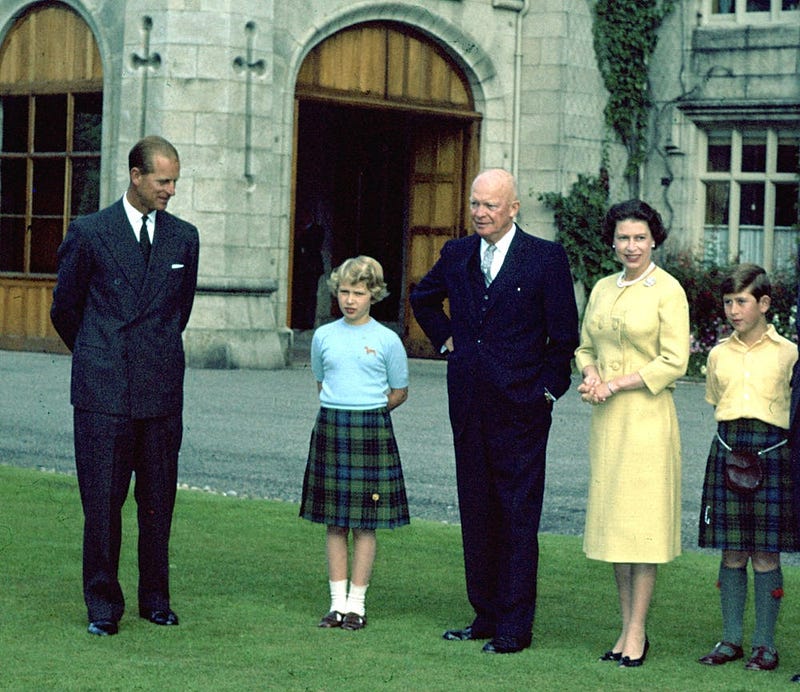
Queen Elizabeth II and United States President Dwight Eisenhower open the Saint Lawrence Seaway.
Decade: 1960–1969…
3 February 1960…
Prime Minister of the United Kingdom Harold Macmillan makes the Wind of Change speech to the South African Parliament in Cape Town. Curiously, despite little to no publicity, Macmillan first made the same speech in Accra, Gold Coast — modern-day Ghana — on Sunday, 10 January 1960.
19 February 1960…
Prince Andrew, Duke of York, British prince and second son of Elizabeth II and The Duke of Edinburgh, was born.
26 June 1960…
The State of Somaliland (the former British Somaliland protectorate) receives its independence from the United Kingdom. Five days later, it unites as scheduled with the Trust Territory of Somalia (the former Italian Somaliland), to form the Somali Republic.
16 August 1960…
The Mediterranean Island of Cyprus receives its independence from the United Kingdom.
1 October 1960…
Nigeria becomes independent from the United Kingdom, and Nnamdi Azikiwe becomes its first native-born Governor General.
Cameroon declares independence from the United Kingdom.
27 April 1961…
Sierra Leone becomes independent from the United Kingdom.
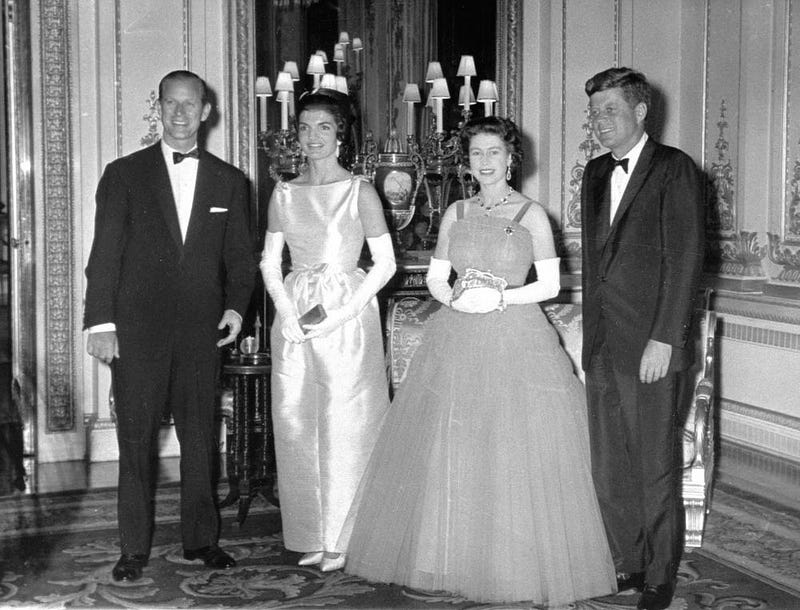
5 June 1961…
President John F. Kennedy and his wife, Jacqueline Kennedy, joined the royals at Buckingham Palace. Queen Elizabeth II enjoyed a close relationship with American presidents. The Queen, ever since taking the throne, met with every sitting US president. The only exception is President Lyndon B. Johnson.
Queen Elizabeth II, in 1963, was invited to Kennedy’s funeral following his assassination in 1963. Unfortunately, because of her pregnancy with Edward, she was unable to attend the funeral.
27 June 1961…
Kuwait requests British help against the Iraqi threat. The United Kingdom, after receiving the request, sends troops to the region.
10 August 1961…
The United Kingdom applies for membership in the European Economic Community.
9 December 1961…
Tanganyika, with Julius Nyerere as its first Prime Minister, gains independence as a Commonwealth realm. Queen Elizabeth II is formally recognised as Queen of Tanganyika. The Governor-General of Tanganyika locally represents Queen Elizabeth II.
18 April 1962…
The Commonwealth Immigration Bill in the United Kingdom removes free immigration from the citizens of member states of the Commonwealth of Nations.
13 July 1962…
United Kingdom Prime Minister Harold Macmillan, in what the press dubs “the Night of the Long Knives”, dismisses one-third of his Cabinet.
31 October 1962…
The United Nations General Assembly asks the United Kingdom to suspend enforcement of the new constitution in Southern Rhodesia (now Zimbabwe), but it comes into effect on Thursday, 1 November 1962.
24 November 1962…
The first episode of That Was the Week That Was, the groundbreaking satirical comedy program hosted by David Frost, is broadcast on BBC Television in the United Kingdom.
29 January 1963…
French President Charles de Gaulle vetoes the United Kingdom’s entry into the European Common Market.
14 February 1963…
Harold Wilson becomes leader of the opposition Labour Party in the United Kingdom. Wilson, in October 1964, becomes prime minister.
5 August 1963…
The United Kingdom, the United States, and Soviet Union sign the Partial Nuclear Test Ban Treaty.
19 October 1963…
Alec Douglas-Home succeeds Harold Macmillan as Prime Minister of the United Kingdom.
10 December 1963…
Zanzibar gains independence from the United Kingdom, as a constitutional monarchy under Sultan Jamshid bin Abdullah.
12 December 1963…
Kenya, with Jomo Kenyatta as prime minister, gains independence from the United Kingdom.
5 October 1964…
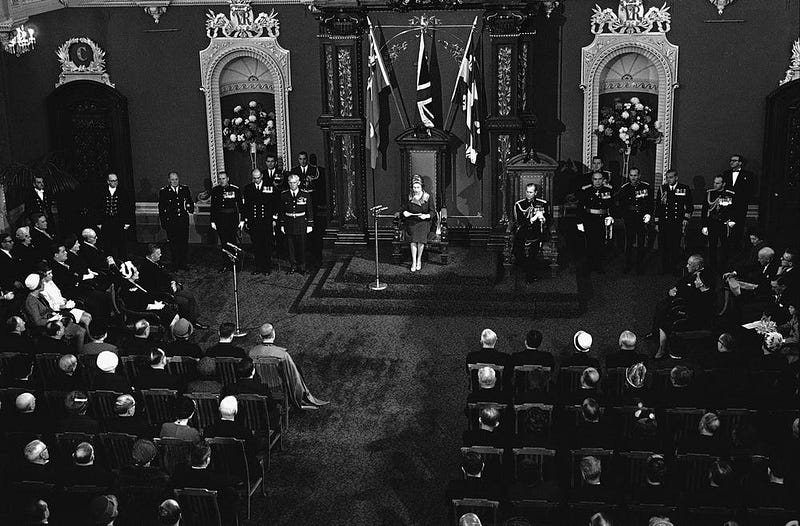
Queen Elizabeth II and The Duke of Edinburgh begin an eight-day visit to Canada.
10 March 1964…
Prince Edward, Earl of Wessex, British prince and third son of Elizabeth II and The Duke of Edinburgh, was born.
10 June 1964…
Boris Johnson, later the Prime Minister of the United Kingdom, was born in New York City, US.
24 January 1965…
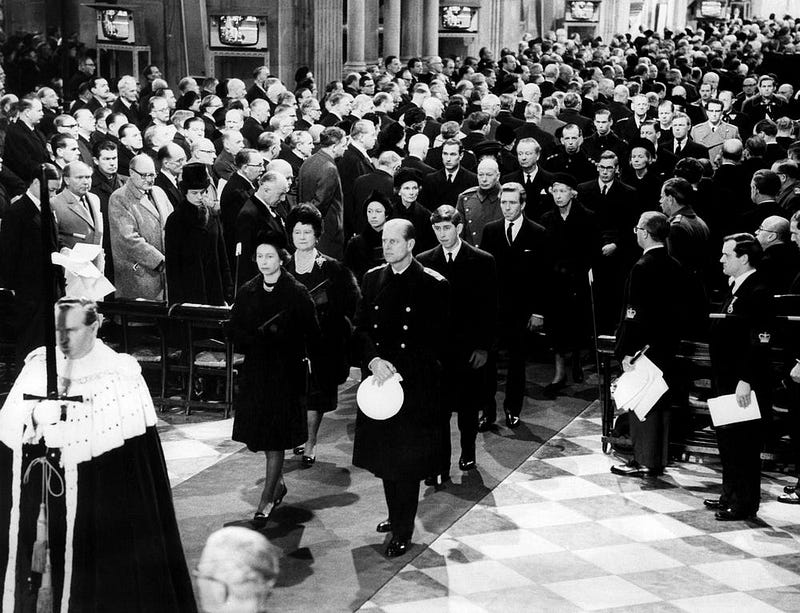
Winston Churchill died on Sunday, 24 January 1965. His funeral took place on Monday, 1 February 1965. World leaders and politicians from around the globe attended. A Guardian article from the day said: “By one o’clock the great State funeral was over, the Kings and Queens, Presidents and Prime Ministers, the generals and Politicians from the world over had paid their respects.”
18 February 1965…
The Gambia becomes independent from the United Kingdom.
30 September 1965…
Thunderbirds, now considered a classic family sci-fi series, debuts on ITV in the United Kingdom.
12 October 1965…
The U.N. General Council recommends that the United Kingdom try everything to stop a rebellion in Rhodesia.
22 October 1965…
African countries demand that the United Kingdom use force to prevent Rhodesia from declaring unilateral independence.
8 November 1965…
The British Indian Ocean Territory is created. The territory consisted of the Chagos Archipelago, Aldabra, Farquhar, and Desroches islands.
The Murder (Abolition of Death Penalty) Act 1965 is given Royal Assent. The death penalty for murder in the United Kingdom is suspended. The renewal of the Act, in 1969, made the abolition permanent.
3 December 1965…
Members of the Organization of African Unity decide to sever diplomatic relations with the United Kingdom. The decision is linked to the rebellion of Rhodesia. The organisation demanded that the British Government end the rebellion by mid-December.
15 December 1965…
Tanzania and Guinea sever diplomatic relations with the United Kingdom.
17 December 1965…
The British government begins an oil embargo against Rhodesia. The United States joins the effort.
30 December 1965…
President Kenneth Kaunda of Zambia announces that Zambia and the United Kingdom have agreed on a deadline before which the Rhodesian white government should be ousted.
31 January 1966…
The United Kingdom ceases all trade with Rhodesia.
19 February 1966…
Christopher Mayhew, the naval minister of the United Kingdom, resigns.
28 February 1966…
British Prime Minister Harold Wilson calls a General Election in the United Kingdom, to be held on Thursday, 31 March 1966.
10 March 1966…
The Frost Report, which launches the television careers of John Cleese, Ronnie Barker, Ronnie Corbett, and other writers and performers, is first televised on BBC1 in the United Kingdom.
20 March 1966…
Football’s FIFA World Cup Trophy is stolen while on exhibition in London; it is found seven days later by a mongrel dog named “Pickles” and his owner David Corbett, wrapped in newspaper in a south London Garden.
31 March 1966…
The British Labour Party led by Harold Wilson wins the 1966 United Kingdom general election, gaining a 96-seat majority. The election was called on Monday, 28 February 1966.
7 April 1966…
The United Kingdom asks the United Nations Security Council for authority to use force to stop oil tankers that violate the embargo against Rhodesia. Authority was given on Sunday, 10 April 1966.
21 April 1966…
The opening of the Parliament of the United Kingdom is televised for the first time.
16 May 1966…
The National Union of Seamen, in the United Kingdom, call a strike.
29 June 1966…
The strike by the National Union of Seamen, in the United Kingdom, is called off.
11 July 1966…
The 1966 FIFA World Cup begins in England.
16 July 1966…
Gwynfor Evans, President of Plaid Cymru, the Welsh nationalist party, becomes Member of the United Kingdom Parliament for Carmarthen, taking the previously Labour-held Welsh seat at a by-election with a majority of 2,435 on an 18 per cent swing and giving his party its first representation at Westminster in its forty-one-year history.
26 July 1966…
Lord Gardiner issues the Practice Statement in the House of Lords of the United Kingdom, stating that the House is not bound to follow its own previous precedent.
30 July 1966…
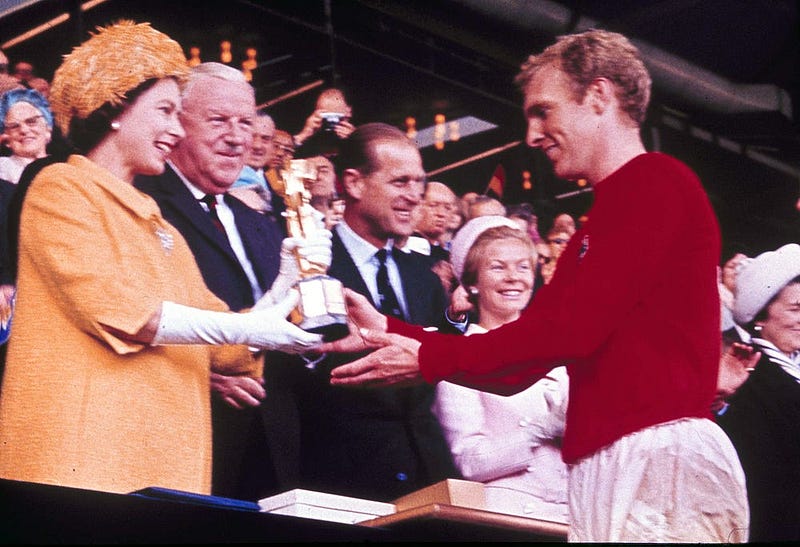
England, defeating West Germany 4–2, won the 1966 FIFA World Cup at Wembley Stadium. The final went into extra time.
30 September 1966…
The Bechuanaland Protectorate in Africa, with Seretse Khama as its first President., achieves independence from the United Kingdom as Botswana.
4 October 1966…
Basutoland becomes independent of the United Kingdom and takes the name Lesotho.
22 October 1966…
Spain demands that the United Kingdom stop military flights to Gibraltar. Britain, the following day, refuses.
5 November 1966…
Thirty-eight African states demand that the United Kingdom use force against the Rhodesian government.
30 November 1966…
Barbados achieves independence from the United Kingdom.
Christmas Day 1966…
Thunderbirds, a Marionette sci-fi series, televised its final episode on ITV with a Christmas special.
26 January 1967…
The Parliament of the United Kingdom decides to nationalise 90% of the nation’s steel industry.
27 January 1967…
The United Kingdom, the United States, and the Soviet Union and United Kingdom sign the Outer Space Treaty. The treaty prohibits weapons of mass destruction from space.
1 March 1967…
The Queen Elizabeth Hall opened in London.
8 April 1967…
Puppet on a String, performed by Sandie Shaw wins the Eurovision Song Contest 1967 for the United Kingdom. Bill Martin and Phil Coulter wrote the music and lyrics.
2 May 1967…
Harold Wilson announces that the United Kingdom has decided to apply for EEC membership.
11 May 1967…
The United Kingdom and Ireland apply officially for European Economic Community membership.
18 July 1967…
The United Kingdom announces the closing of its military bases in Malaysia and Singapore. Both Australia and the U.S. disapproved of the decision.
5 August 1967…
Pink Floyd releases their debut album The Piper at the Gates of Dawn in the United Kingdom.
15 August 1967…
The United Kingdom Marine Broadcasting Offences Act declares participation in offshore pirate radio illegal. Radio Caroline defies the Act and continues broadcasting.
30 September 1967…
BBC Radio, in the United Kingdom, completely restructures its national programming: the Light Programme is split between new national pop station Radio 1 and Radio 2. The cultural Third Programme is rebranded as Radio 3. The primarily-talk Home Service becomes Radio 4.
30 November 1967…
The People’s Republic of South Yemen becomes independent of the United Kingdom.
8 October 1967…
Clement Attlee, a well-respected British politician, dies. Attlee, born in 1883, was the 60th Prime Minister of the United Kingdom.
1 March 1968…
United Kingdom Commonwealth Immigrants Act 1968 receives Royal assent.
29 March 1969…
The United Kingdom, Spain, the Netherlands, and France, with each entry obtaining 18 votes, co-win Eurovision Song Contest 1969. The contest was held in Madrid.
24 June 1969…
The United Kingdom and Rhodesia, after the Rhodesian constitutional referendum., sever diplomatic relations.
16 July 1969…
Apollo program: Apollo 11 (Buzz Aldrin, Neil Armstrong, Michael Collins) lifts off from Cape Kennedy in Florida towards the first manned landing on the Moon.
20 July 1969…
Apollo program Moon landing: At 3:17 pm ET (20:17 UTC) Apollo 11’s Lunar Module Eagle lands on the Moon’s surface. At 10:56 pm ET (02:56 UTC July 21), an estimated 650 million people worldwide, the largest television audience for a live broadcast, watch in awe as Neil Armstrong takes his first historic steps on the surface.
24 July 1969…
Apollo 11 returns from the first successful Moon landing and the astronauts are placed in biological isolation for several days in case they may have brought back lunar germs. The airless lunar environment is later determined to rule out microscopic life.
The Soviet Union, in exchange for their spies Peter and Helen Kroger, returns British lecturer Gerald Brooke to the United Kingdom freed from a Soviet prison.
8 August 1969…
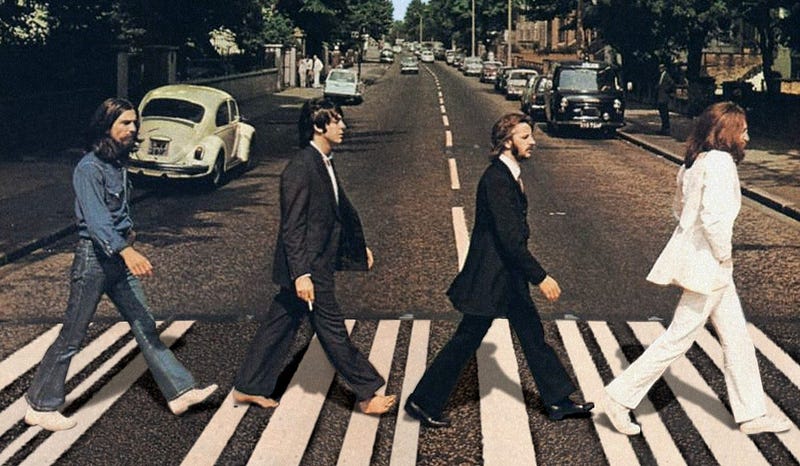
The Beatles, at 11:30, have photographer Iain Macmillan take their photo on a zebra crossing. The zebra crossing is situated on Abbey Road.
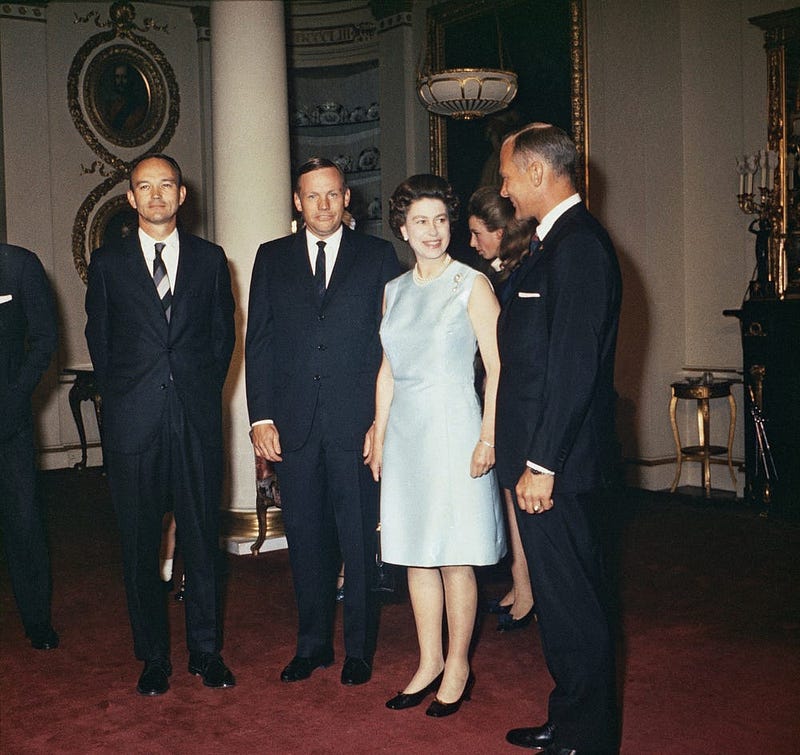
15 October 1969…
The Apollo 11 crew members Neil Armstrong, Buzz Aldrin, and Michael Collins, three months after Armstrong and Aldrin explored the lunar surface, visited Queen Elizabeth II at Buckingham Palace.
15 November 1969…
Regular colour television broadcasts begin on BBC1 and ITV in the United Kingdom.
Decade: 1970–1979…
1 March 1970…
Rhodesia, declaring itself a republic, severs its last tie with the United Kingdom.
4 June 1970…
Tonga gains independence from the United Kingdom.
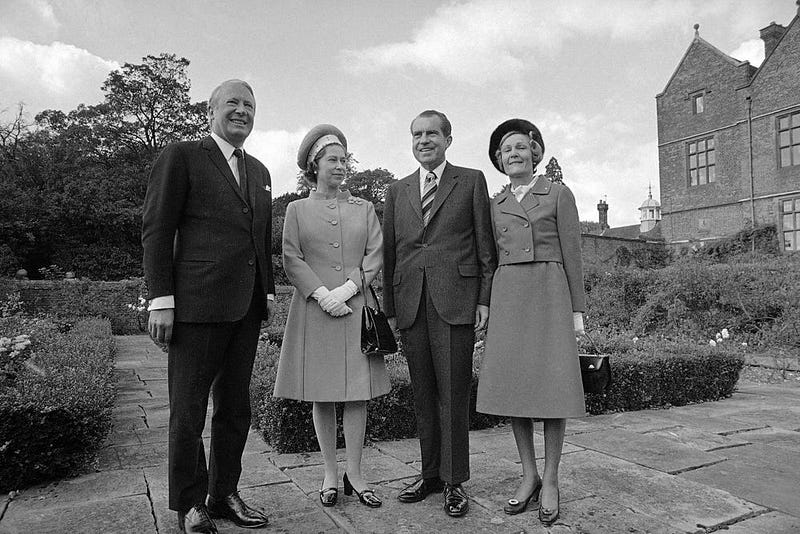
27 September 1970…
Former United States President Richard Nixon and the former First Lady Pat Nixon, visiting Italy, Yugoslavia, Spain, the United Kingdom, and Ireland, begins a tour of Europe.
15 February 1971…
Decimal Day: The United Kingdom and Ireland both switch to decimal currency.
1 April 1971…
The United Kingdom lifts all restrictions on gold ownership.
9 July 1971…
The United Kingdom increases the number of its troops in Northern Ireland to 11,000.
29 July 1971…
The United Kingdom, with the cancellation of its Black Arrow launch vehicle, opts out of the Space Race.
3 September 1971…
Qatar gains independence from the United Kingdom. Unlike most nearby emirates, Qatar declines to become part of either the United Arab Emirates or Saudi Arabia.
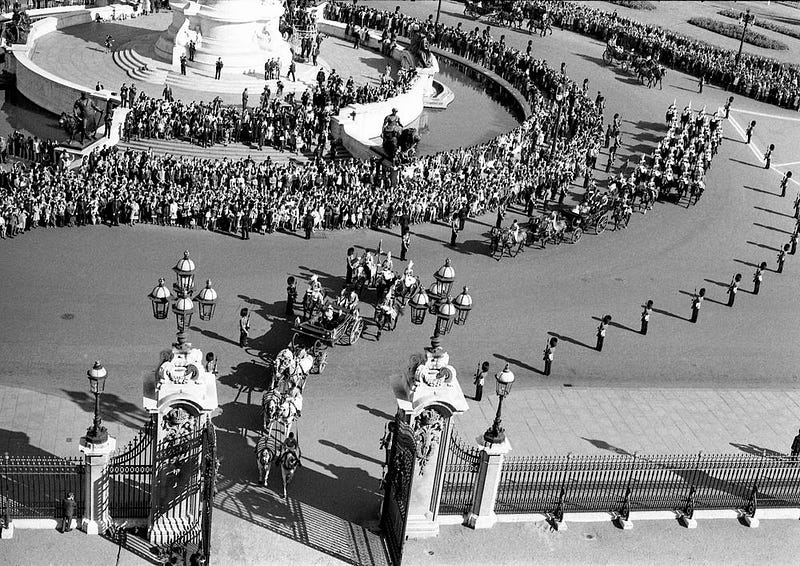
5 October 1971…
Japanese Emperor Hirohito visited Britain for four days. The Emperor and Queen Elizabeth II rode in an open Landau through the gates of Buckingham Palace in a lavish procession after his arrival at Victoria Station.
28 October 1971…
The House of Commons of the United Kingdom votes 356–244 in favour of joining the European Economic Community.
The United Kingdom, using a Black Arrow carrier rocket from Woomera, South Australia, becomes the sixth nation successfully to launch a satellite (the Prospero X-3 experimental communications satellite.) into orbit using its own launch vehicle.
18 November 1971…
Oman gains independence from the United Kingdom.
29 December 1971…
The United Kingdom gives up its military bases in Malta.
20 January 1972…
Fears are growing about the economy of the United Kingdom, prompted by unemployment exceeding one million for the first time since the Second World War, feel justified.
13 March 1972…
The United Kingdom and the People’s Republic of China, after 22 years of diplomatic relations, elevate exchanges to the ambassadorial level.
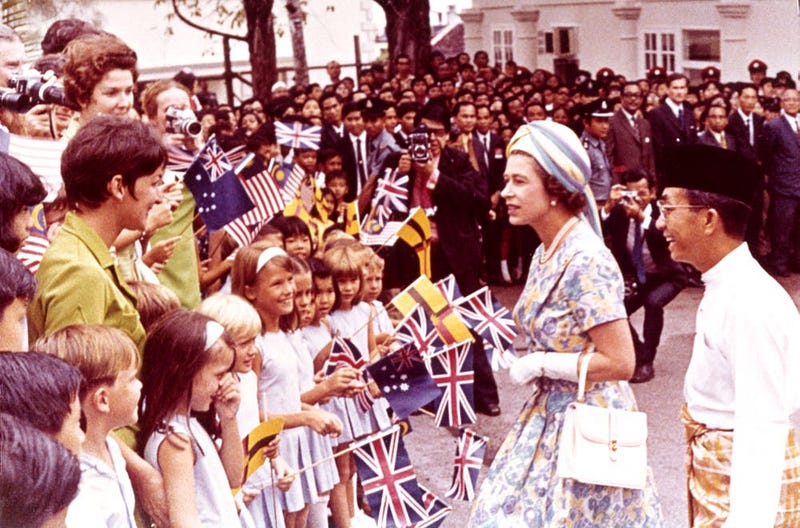
24 March 1972…
Queen Elizabeth II, from 24 March to 26 March 1972, embarked on a tour of Asia. She paid a visit to Malaysia. During the visit, Queen Elizabeth II stopped to speak with a group of school children along the way.
26 March 1972…
Queen Elizabeth II concluded her tour of Asia.
The last trolleybus system in the United Kingdom, situated in in Bradford, closes. The system, serving the West Riding of Yorkshire community, was in operation for over 60 years.
28 May 1972…
The Duke of Windsor, the former King Edward VIII of the United Kingdom, dies. The Duke of Windsor was born in 1894.
1 September 1972…
The Second Cod War begins between the United Kingdom and Iceland.
New Year’s Day 1973…
The United Kingdom, the Republic of Ireland, and Denmark enter the European Economic Community. The EEC becomes the European Union.
1 April 1973…
Value Added Tax, commonly referenced as VAT, is introduced in the United Kingdom.
26 June 1973…
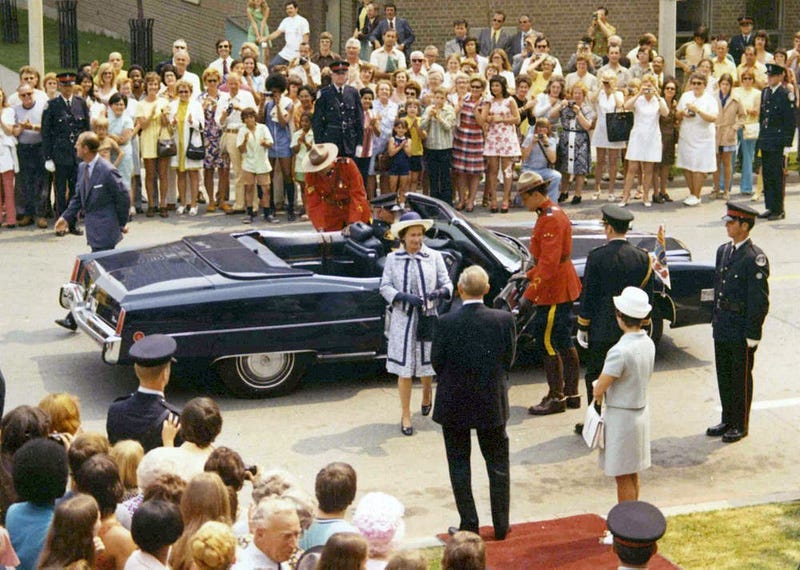
As part of an extensive tour of the province, Queen Elizabeth II opened Scarborough’s new Civic Centre, and visited Queen’s Park and Ontario Place. At High Park, she attended a Black Creek Pioneer Village exhibit and was gifted a hand-made corn broom.
4 March 1974…
The United Kingdom, following a hung parliament in the 1974 general election, sees Conservative prime minister Edward Heath unexpectedly resign. Labour’s Harold Wilson succeeds Heath. Wilson previously led the country from 1964 to 1970.
25 February 1974…
Dominic Raab, a British politician and later the Deputy Prime Minister of the United Kingdom, was born.
Thursday, 12 July 1974…
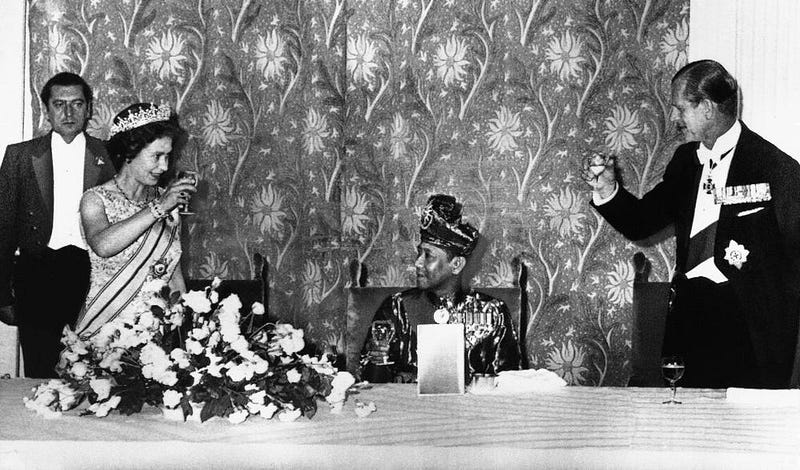
The Queen and the Duke of Edinburgh toast the King of Malaysia, seated between them in evening at Claridges in London. The dinner marked the third day of the King and Queen of Malaysia’s visit to England.
4 March 1975…
Queen Elizabeth II knights Charlie Chaplin. Chaplin, at the age of 85, was knighted at Buckingham Palace. Buckingham Palace is situated merely minutes away from the slum he grew up in. The silent film star is best known for classic films such as The Kid and The Great Dictator.
17 March 1975…
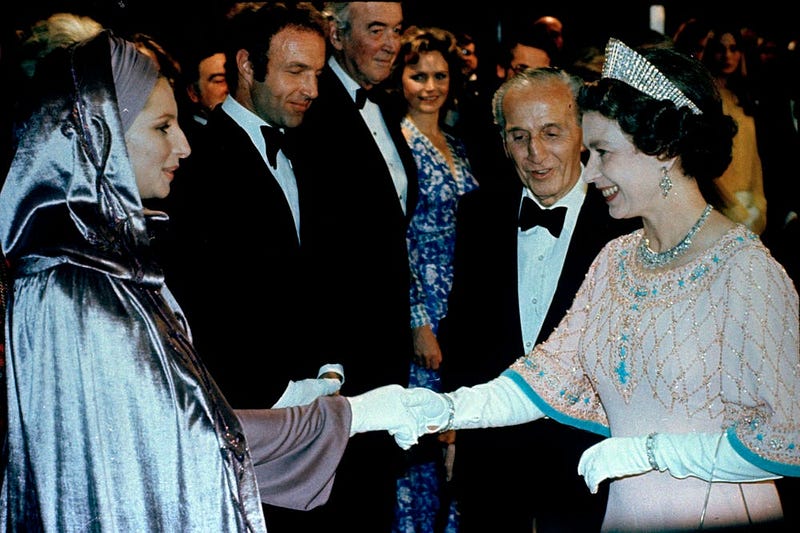
Film and music icon Barbra Streisand shakes hands with the monarch in London in 1975 at the Royal Film performance. After the presentations, the Queen saw the musical “Funny Lady,” in which Streisand is the star.
4 March 1976…
The Northern Ireland Constitutional Convention is formally dissolved. Northern Ireland is consequently ruled over by the Government of the United Kingdom in London.
16 March 1976…
Harold Wilson resigns as Prime Minister of the United Kingdom.
3 April 1976…
Brotherhood of Man, with their song Save Your Kisses for Me, wins Eurovision Song Contest 1976 for the United Kingdom.
5 April 1976…
James Callaghan becomes Prime Minister of the United Kingdom.
1 June 1976…
The United Kingdom and Iceland end the Third Cod War, with the UK accepting Iceland’s extension of its territorial waters to 200 nautical miles in exchange for defined fishing rights.
29 June 1976…
Seychelles gains independence from the United Kingdom.
3 July 1976…
The United Kingdom’s great heat wave, exasperating ongoing drought conditions, reaches its peak.
4 July 1976…
The U.S. celebrates its bicentennial, in recognition of the 200th anniversary of the 1776 adoption of the United States Declaration of Independence from the United Kingdom.
7 July 1976…
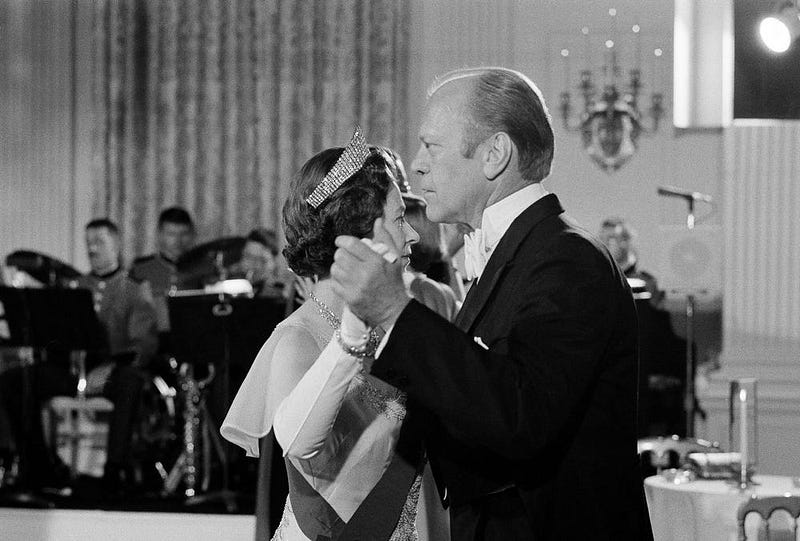
US President Gerald Ford leads Queen Elizabeth II in a dance following a State Dinner at The White House. The dinner party was thrown in honour of Her Majesty during her tour of the US.
27 July 1976…
The United Kingdom, in response to the hijacking of Air France Flight 139, breaks diplomatic relations with its former colony Uganda.
1 August 1976…
Trinidad and Tobago, replacing Queen Elizabeth II as its head of state with President Ellis Clarke., becomes a republic.
6 August 1976…
Former United Kingdom Postmaster General John Stonehouse is sentenced to 7 years’ jail for fraud, theft, and forgery.
13 September 1976…
The Muppet Show, televised on ITV, is broadcast in the United Kingdom for the first time.
4 October 1976…
The InterCity 125 high-speed train is introduced in the United Kingdom.
1 December 1976…
The Sex Pistols, as they unleash several four-letter words live on Bill Grundy’s early evening television show in the United Kingdom, achieve public notoriety.
14 January 1977…
Anthony Eden, the 62nd Prime Minister of the United Kingdom, died. Eden was born in 1897.
6 February 1977…
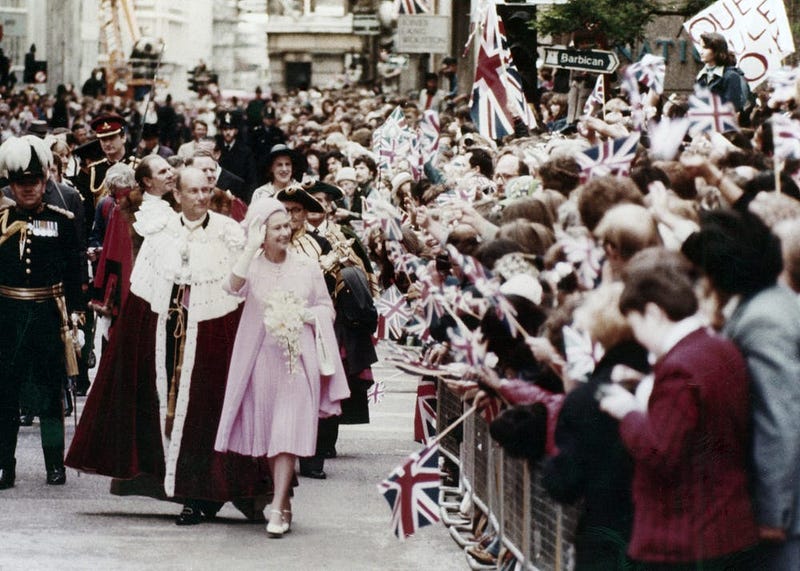
Marking the Queen’s silver jubilee — celebrating 25 years on the throne. As part of the festivities, she conducted a brief walkabout in London where she met and spoke to members of the public before attending a ceremony at St. Paul’s Cathedral.
28 February 1977…
Queen Elizabeth II opens the Parliament of New Zealand.
8 March 1977…
Queen Elizabeth II, in her official capacity as Queen of Australia, opened the Australian parliament.
7 June 1977…
Queen Elizabeth II’s 25th anniversary of her accession to the throne was marked with large-scale parties and events throughout 1977.
7 July 1978…
The Solomon Islands became independent from the United Kingdom.
1 October 1978…
Tuvalu became independent from the United Kingdom.
3 November 1978…
Dominica gains its independence from the United Kingdom.
Unspecified date in 1978…
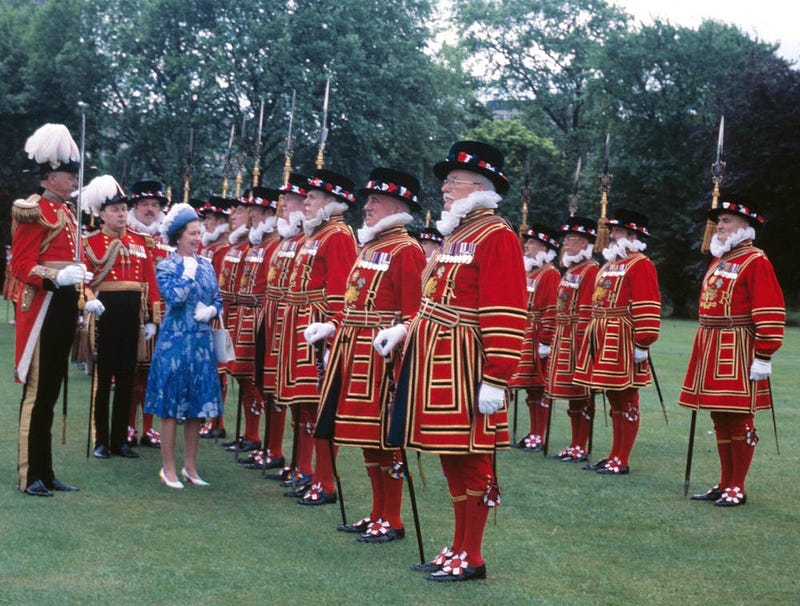
Queen Elizabeth II reviews her Yeoman of the Guard, the world’s oldest military corps, in the grounds of Buckingham Palace.
13 February 1979…
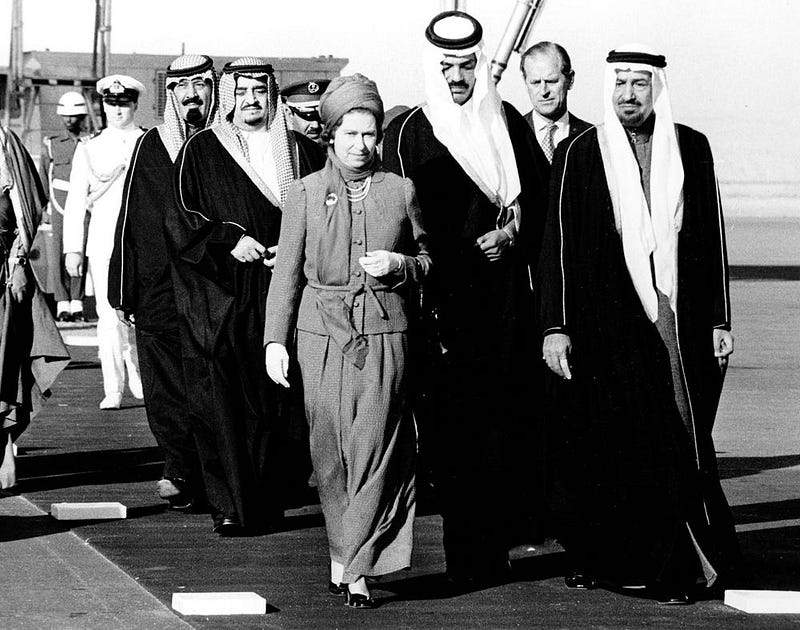
The monarch has been a regular guest of Middle Eastern leaders throughout her reign. Queen Elizabeth II, in the above image, can be seen being escorted by King Khali of Saudi Arabia, far right. The photograph, shortly after the Queen’s arrival, was taken at Riyadh Airport, Saudi Arabia.
22 February 1979…
Saint Lucia becomes independent from the United Kingdom.
3 May 1979…
The 1979 United Kingdom general election for the House of Commons takes place. The election results, giving the Conservatives a majority, see Margaret Thatcher become the nation’s first woman prime minister. The election also sees the end of James Callaghan’s Labour Party government.
12 July 1979…
The Gilbert Islands became fully independent of the United Kingdom as Kiribati.
27 August 1979…
Lord Mountbatten of Burma, in a bombing carried out by the Provisional Irish Republican Army (IRA), was killed. Two other individuals, with Mountbatten at the time, were also killed. Mountbatten, an uncle of The Duke of Edinburgh, was a British admiral and statesman.
Elsewhere, on the same day, the Warrenpoint ambush takes the lives of 18 British soldiers. Doreen Knatchbull, Baroness Brabourne, died would die in hospital the following day.
12 October 1979…
The Hitchhiker’s Guide to the Galaxy, the first novel by Douglas Adams, is published in the United Kingdom
15 November 1979…
Prime Minister Margaret Thatcher, in the House of Commons, revealed Blunt’s role as the “fourth man” of the so-called ‘Cambridge Five’. The ‘Cambridge Five’, all of which attended the University of Cambridge, were double agents for the Soviet NKVD during the Second World War. Thatcher, on 21 November 1979, gave further details.
23 November 1979…
Thomas McMahon, a member of the Provisional Irish Republican Army, is sentenced to life in prison for the assassination of Lord Mountbatten of Burma.
Decade: 1980–1989…
10 April 1980…
In Lisbon, Portugal, the governments of Spain and the United Kingdom agree to reopen the border between Gibraltar and Spain in 1985, closed since 1969.
18 April 1980…
Robert Mugabe, after Zimbabwe gains de jure independence from the United Kingdom, becomes Prime Minister.
29 April 1980…
Alfred Hitchcock, the highly accomplished British film director, dies. He was born in 1899.
24 July 1980…
Peter Sellers, the award-winning British comedian, and actor, dies. He was born in 1925.
6 October 1980…
Hattie Jacques, a British actress and a member of the legendary ‘Carry On’ team, dies. She was born in 1922.
10 October 1980…
British Prime Minister Margaret Thatcher delivers her famous “The lady’s not for turning” speech.
15 October 1980…
James Callaghan announces his resignation as leader of the British Labour Party.
17 October 1980…
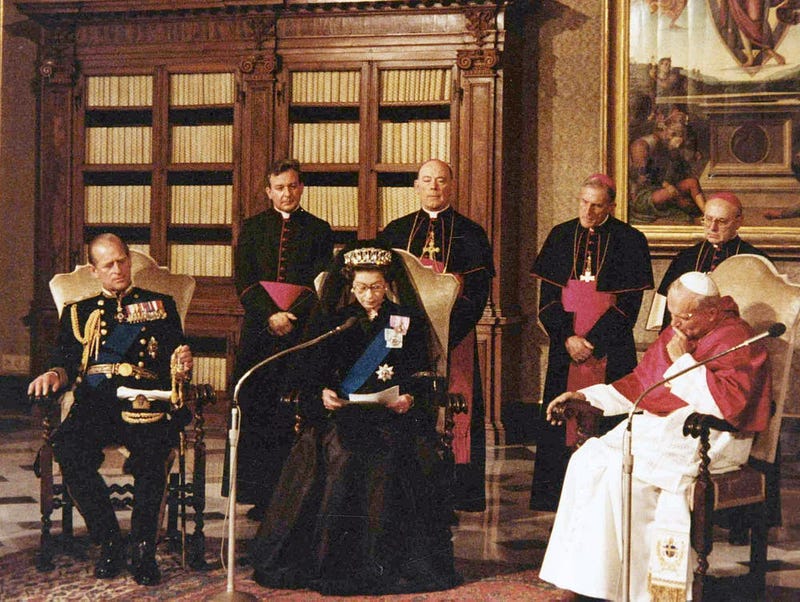
Queen Elizabeth II visited the Vatican for the first time.
13 June 1981…
Teenager Marcus Sarjeant, at the Trooping the Colour ceremony, fires six blank shots. The teenager was close to Queen Elizabeth II when the incident occurred. It startled the Queen’s horse.
29 July 1981…
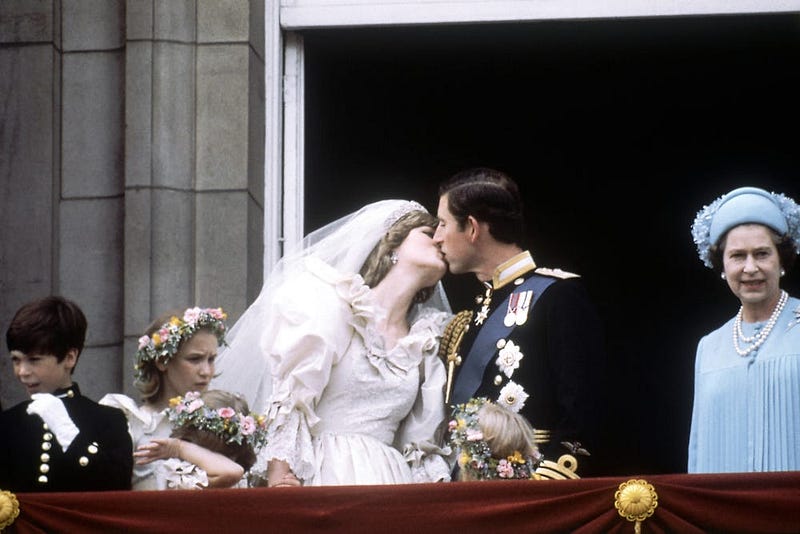
The Queen looks over the crowd of 600,000 people who lined the streets of London on the day of Charles and Diana’s wedding, while the bride and groom kiss.
7 September 1981…
British plantation company, Guthrie was taken over by the Malaysian government after successfully purchasing shares to become the major shareholder. This is famously called the ‘Dawn Raid attack’.
21 September 1981…
Belize, formerly British Honduras, gains its independence from the United Kingdom.
1 November 1981…
Antigua and Barbuda gain independence from the United Kingdom.
23 November 1981…
United Kingdom tornado outbreak, curiously, was the largest recorded tornado outbreak in European history.
26 January 1982…
Unemployment in the United Kingdom increases by 129,918 to 3,070,621, a post-war record number.
19 March 1982…
The Falklands War begins. Argentine scrap metal workers (infiltrated by marines) raise the flag of Argentina on South Georgia in the Falkland Islands, a British overseas territory.
2 April 1982…
Rex Hunt, the British governor of the Falkland Islands, surrenders the islands to Argentine forces, leading to their occupation.
17 April 1982…
Canadian Charter of Rights and Freedoms: By Proclamation of the Queen of Canada on Parliament Hill, Canada patriates its constitution, gaining full political independence from the United Kingdom; included is the country’s first entrenched bill of rights.
26 April 1982…
Falklands War: British troops retake South Georgia Island during Operation Paraquet.
2 May 1982…
The British nuclear submarine HMS Conqueror sinks the Argentine cruiser General Belgrano, killing 323 sailors. Operation Algeciras, an attempt to destroy a Royal Navy warship in Gibraltar, fails.
25 May 1982…
British ships HMS Coventry and SS Atlantic Conveyor are sunk during the Falklands War; Coventry by two A-4C Skyhawks and Atlantic Conveyor by two Exocets.
28 May 1982…
Falklands War: Battle of Goose Green: British forces defeat a larger Argentine force.
8 June 1982…
Falklands War: British supply ship RFA Sir Galahad is destroyed during the Bluff Cove Air Attacks.
14 June 1982…
Argentine surrender in the Falklands War: Argentine forces in the capital, Stanley, surrender to British forces.
20 May 1982…
The Falklands War ends with British forces retaking the South Sandwich Islands.
24 June 1982…
British Airways Flight 9 suffers a temporary four-engine flameout and damage to the exterior of the plane after flying through the otherwise undetected volcanic ash plume from Indonesia’s Mount Galunggung.
11 December 1982…
Swedish pop group ABBA make their final public performance on the British TV programme The Late, Late Breakfast Show.
Unspecified date in 1982…
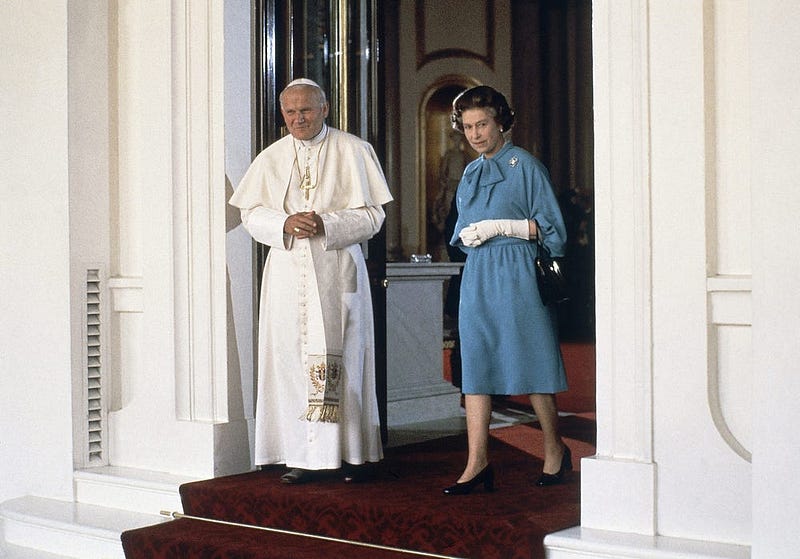
Pope John Paul II sought to overcome centuries of distrust when he became the first pope to visit British shores in 1982, preaching reconciliation between the Vatican and Anglicans even as British troops battled Catholic Argentines in the Falklands.
1 October 1983…
Neil Kinnock is elected leader of the British Labour Party.
4 October 1983…
British entrepreneur Richard Noble sets a new land speed record of 633.468 mph (1,019.468 km/h), driving Thrust2 at the Black Rock Desert, Nevada.
Unspecified date in 1983…
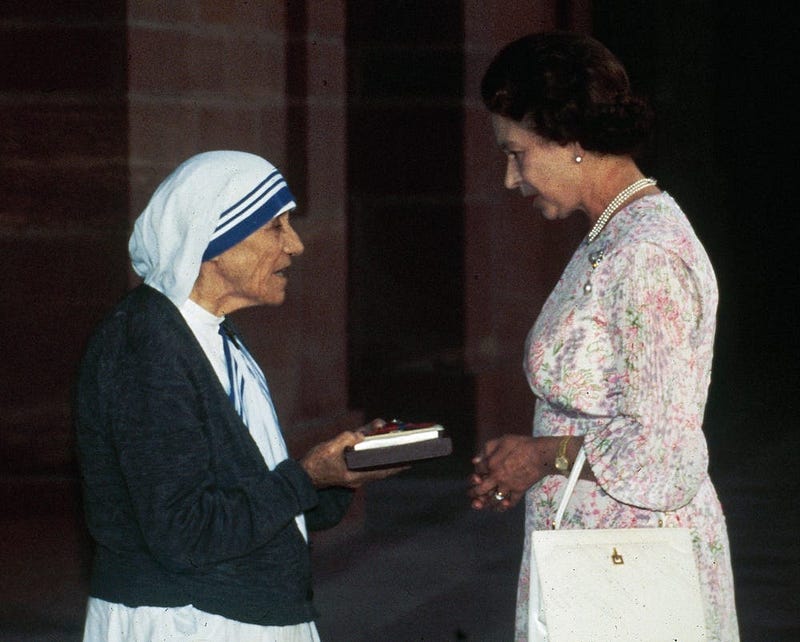
Mother Teresa of Calcutta, one of modern history’s most iconic religious figures, receives the Insignia of the Honorary Order of Merit from Queen Elizabeth II at the Rashtrapati Shavar in New Delhi.
New Year’s Day 1984…
The Bornean Sultanate of Brunei gains full independence from the United Kingdom, having become a British protectorate in 1888.
26 September 1984…
The United Kingdom and the People’s Republic of China sign the initial agreement to return Hong Kong to China in 1997.
12 October 1984…
The Provisional Irish Republican Army (PIRA) attempts to assassinate Prime Minister Margaret Thatcher and the British Cabinet in the Brighton hotel bombing. The terror attack kills five people and injures 31.
19 December 1984…
The People’s Republic of China and the United Kingdom sign the Sino-British Joint Declaration on the future of Hong Kong.
Unspecified date in 1984…
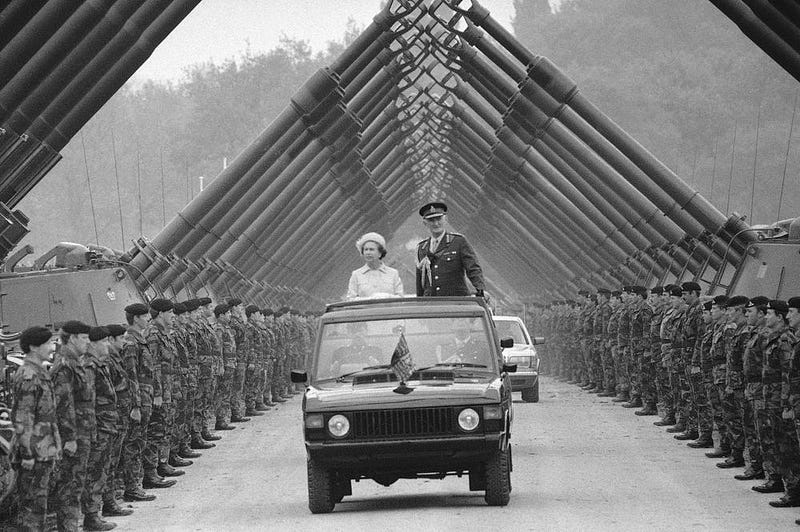
Queen Elizabeth II arrives through the avenues of guns during the second day of her review of the Royal Regiment of Artillery in East Germany at Dortmund on Wednesday, making for a dramatic picture.
16 May 1985…
Scientists of the British Antarctic Survey announce the discovery of the ozone hole.
22 May 1985…
British and Irish police foil a “mainland bombing campaign” sponsored by the Provisional Irish Republican Army which targets luxury vacation resorts.
22 August 1985…
British Airtours Flight 28M: The 737’s left engine catches fire while on its takeoff roll at Manchester Airport in the UK and 55 people are killed while trying to evacuate the aircraft.
Unspecified date in 1985…
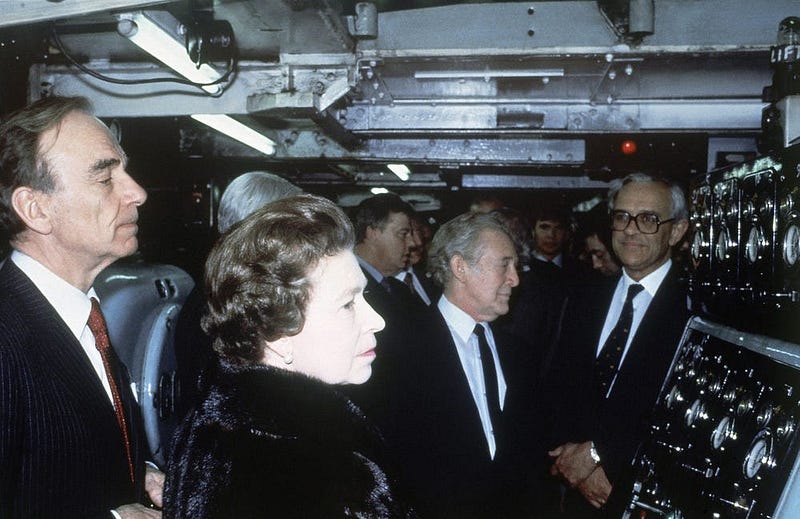
The proprietor of The Times, Rupert Murdoch, and Queen Elizabeth II look over printing operations as editions of Friday, 1 March 1985 issues of The Times newspaper go to press. The Queen’s visit marked the newspaper’s 200th anniversary.
17 April 1986…
Lebanon hostage crisis: British journalist John McCarthy is kidnapped in Beirut (he is released in August 1991) and three others are killed in retaliation for the bombing of Libya.
2 May 1986…
Expo 86, the 1986 World Exposition on Transportation and Communication, a World’s fair, opens in Vancouver, British Columbia, Canada.
29 October 1986…
British Prime Minister Margaret Thatcher officially opens the M25 Motorway, which encircles Greater London, in a ceremony on the carriageway near Potters Bar. It became Europe’s second longest orbital road upon completion. The new road provides the first and only full bypass of London.
6 November 1986…
It was reported 45 people are killed in the 1986 British International Helicopters Chinook crash.
29 December 1986…
Harold Macmillan, the former Prime Minister of the United Kingdom, dies. He was born in 1894.
Unspecified date in 1986…
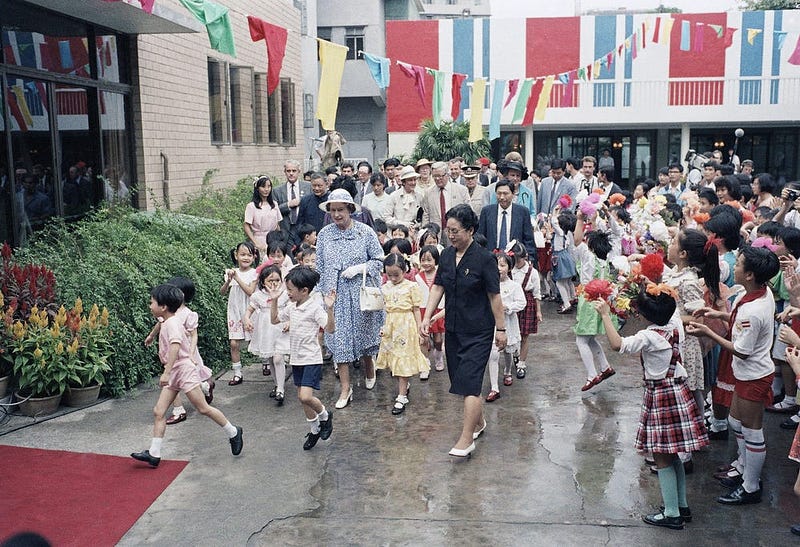
Queen Elizabeth II is followed by joyous Chinese children as she tours a children’s center in Canton during her state visit to President Li Xiannian.
11 February 1987…
British Airways is privatised and listed on the London Stock Exchange.
31 March 1987…
Margaret Thatcher, the then Prime Minister of the United Kingdom, conducts a 45-minute interview on Soviet television.
8 May 1987…
Loughgall ambush: A 24-man unit of the British Army Special Air Service (SAS) ambushed eight members of the Provisional Irish Republican Army (IRA) as they mounted an attack on a Royal Ulster Constabulary (RUC) barracks. All IRA members were killed as well as one civilian.
11 June 1987…
The Conservative Party, led by Margaret Thatcher, is re-elected for a third term at the 1987 general election.
31 July 1987…
London’s Docklands Light Railway, the first driverless railway in Great Britain, was formally opened by Queen Elizabeth II.
19 August 1987…
Hungerford massacre: Sixteen people die in an apparently motiveless mass shooting in the United Kingdom, carried out by Michael Ryan.
22 October 1987…
The pilot of a British Aerospace BAE Harrier GR5 registered ZD325 accidentally ejects from his aircraft. The jet continues to fly until it runs out of fuel and crashes into the Irish Sea.
23 October 1987…
British champion jockey Lester Piggott is jailed for three years after being convicted of tax evasion.
Unspecified date in 1987…
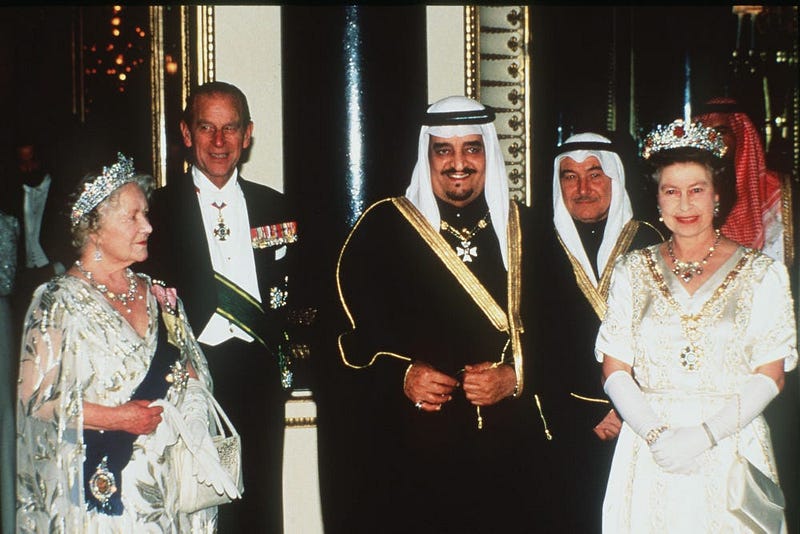
King Fahd of Saudi Arabia, who carried out a four-day state visit to Britain, with Queen Elizabeth II, The Queen Mother, and the Duke of Edinburgh, before they attended a banquet in the King’s honour at Buckingham Palace.
6 March 1988…
Operation Flavius: A Special Air Service team of the British Army shoots dead three unarmed members of a Provisional Irish Republican Army (IRA) Active service unit in Gibraltar.
19 March 1988…
Corporals killings in Belfast: Two British Army corporals are abducted, beaten and shot dead by Irish republicans after driving into the funeral cortege of IRA members killed in the Milltown Cemetery attack.
Unspecified date in 1988…
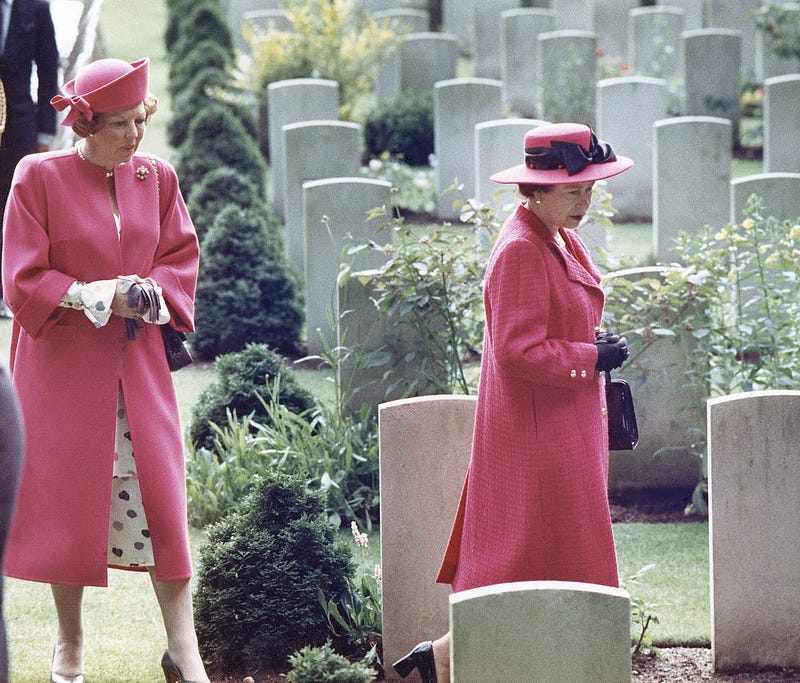
The Queen visited the Netherlands in 1988 to celebrate 300 years of friendship between the two nations. As part of her visit, she and Dutch Queen Beatrix walked through the Arnhem-Oosterbeek War Cemetery, in Oosterbeek. Many British paratroopers who died during the Second World War are buried in the cemetery.
7 March 1989…
Iran breaks off diplomatic relations with the United Kingdom over Salman Rushdie’s The Satanic Verses.
22 September 1989…
The 1989 Deal barracks bombing: An IRA bomb explodes at the Royal Marine School of Music in Deal, Kent, United Kingdom, leaving 11 people dead and a further 22 individuals injured.
Unspecified date in 1989…
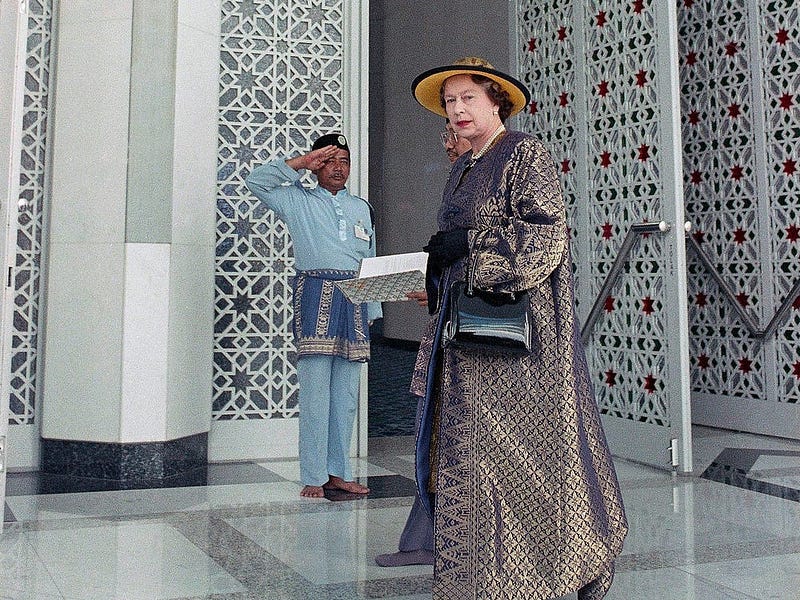
An attendant at the Sultan Salahuddin Abdul Aziz Shah Mosque salutes as Britain’s Queen Elizabeth II tours in Kuala Lumpur. The Queen wore a special cloak and slippers required inside the mosque.