
QAnon Is Terrifying. This Is Why.
It’s what motivates Trump’s base to believe in so byzantine a conspiracy
By Molly Roberts
“The Storm is coming,” say the conspiracy theorizers whose grotesque imaginings terrified the country to attention this week. Maybe they’re right.
QAnon adherents encourage those seeking the truth to “follow the White Rabbit,” but it’s hard to hop down this hole without getting totally lost in their horrorland. The simplest description of the plot line goes something like this: President Donald Trump isn’t under investigation; he is only pretending to be, as part of a countercoup to restore power to the people after more than a century of governmental control by a globalist cabal. Also, there are pedophiles.
A figure named “Q,” who supposedly possesses Q-level security clearance, disperses “crumbs” that “bakers” bring together to create a “dough” of synthesized information. (This is not how baking works, but that seems the least of our worries.) Because Q is the 17th letter in the alphabet and 17 is also a number Trump has said a few times, among other clearly-not-coincidences, he is the real deal, not an Internet troll engaged in an elaborate example of live-action role-play.
It’s obvious that this is scary, but it’s less obvious exactly why. To start, the sheer scope of the supposed conspiracy should cause alarm. By combining the tales tinfoil-hatters have told over time, these truthers have packaged everything attractive about this type of propaganda in one tantalizing product. And that means more and more people will buy what they’re selling.
Then there’s QAnon’s path to prominence — from 4chan to 8chan to more mainstream sites such as YouTube and Twitter and, finally, to a Florida Trump rally and television screens across the nation. In the cesspools where the theory first flourished, registration is either not required or not possible, and the “rules,” such as they are, look nothing like the terms of service for a site like Facebook. The intelligentsia is already at odds over how the more-established entities should regulate themselves, or be regulated. It’s even harder to have that conversation about a site like 4chan or 8chan that eschews responsibility for its content entirely.
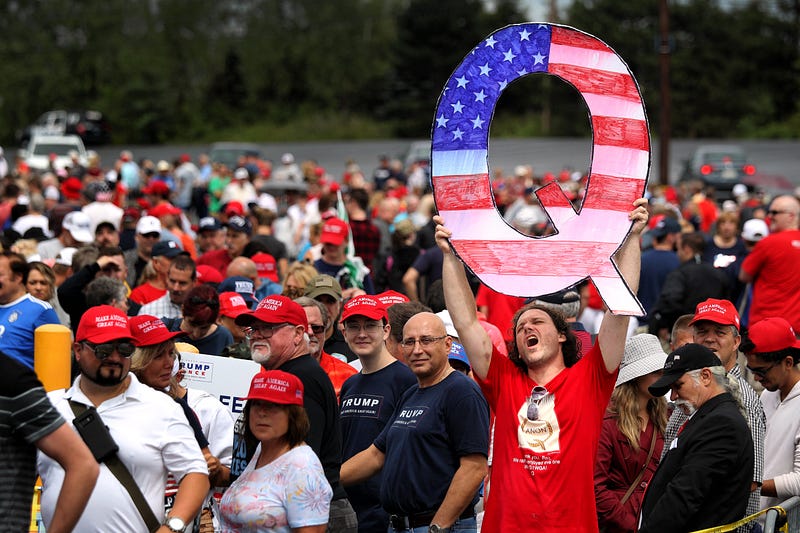
Now that it’s clear that what starts on the fringe doesn’t stay there, it is a real concern. QAnon’s lurch from online to off hasn’t manifested only in T-shirted ralliers wielding weird signs. Last week, a “baker” appeared outside Michael Avenatti’s office because Q sent him there. Others have started searching for child sex camps in the desert outside Tucson. A man in an armored truck blocked a bridge near the Hoover Dam demanding the release of a report that Q claimed the government was withholding. He had two guns.
What’s scariest of all, though, might be what motivates Trump’s base to believe in so byzantine a conspiracy. QAnon isn’t your average story of all-powerful actors exercising complete control over a helpless populace. This time, the heroes are already in charge and, still, the theorists see themselves as victims. Why, even with their man in the Oval Office, do they feel embattled?
One explanation has to do with the on-the-ground reality of this presidency. Perhaps the men and women who buy into this gibberish aren’t so confident that they’re in charge at all. The special counsel looks ever closer to proving ties between Trump and Russia and, in the meantime, Trump appears more erratic. If he really is under investigation and not just pretending to be, all his supporters’ hopes evaporate.
But this anxiety also ties into a more amorphous sense among these voters that, though the Republican Party controls Congress and the executive, the country is still rigged against them. Trumpism has always been about insecurity: As a candidate, the president played on the paranoia of Americans who thought the country they knew was being taken away from them — by immigrants, by an overreaching government, by adversaries overseas.
The “forgotten men and women of our country” didn’t stop feeling forgotten when their self-proclaimed avatar walked into the White House. There was too much dissent, too much doubt cast on his (and, by extension, their) legitimacy and ability to lead. Now, they’ll only be assuaged by the destruction of everything and everyone that stands in their way, through the mass arrest of those who they say connived against them and the installation of a state filled only with loyalists.
That’s what QAnon followers really want, after all. That’s where their “storm” motto comes from. Most Americans were puzzled when, in a meeting with military leaders months ago, Trump said, “You know what this represents? Maybe it’s the calm before the storm.” But these theorists thought they knew exactly what he was talking about. Trump was pointing at the officers’ uniforms.
The storm QAnon truthers predict will never strike because the conspiracy that obsesses them doesn’t exist. But while they wait for it, they’ll try to whip up the winds, and the rest of us will struggle to find shelter. QAnon is scary because it’s getting bigger, it’s scary because we don’t know how to stop it, and it’s scary because the people behind it won’t be stopped, and, until their illusory storm arrives, they won’t be satisfied.
© 2018, The Washington Post