
WRITING
Putting Crocodiles into Your Poetry
How to turn your poems into an adventure
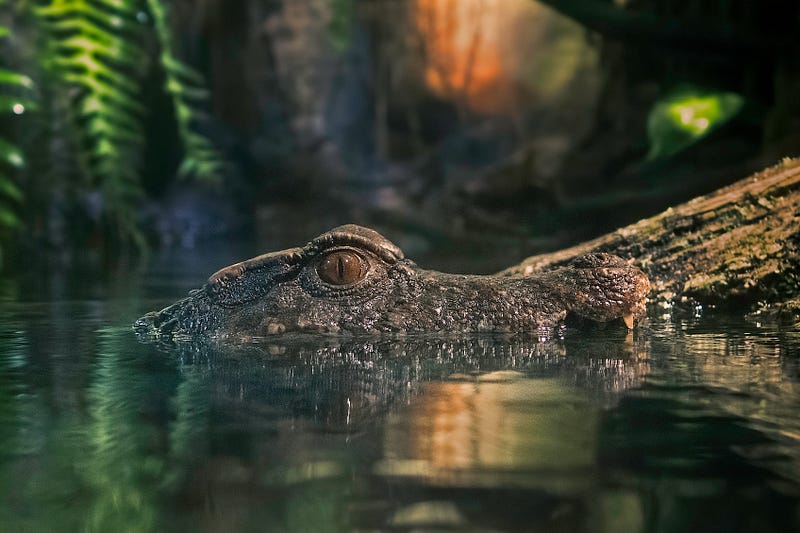
“Every poem needs a crocodile,” my college creative writing teacher told the class.
Before I go on to explain what he meant, let me talk about crocodilians. I don’t know if you have walked among these reptiles? If you have lived in Florida, most likely. I have done so a few times but will speak only one.
I was visiting a friend of mine in Gainseville, Florida, and he wanted to give me an authentic Floridian experience of capturing an alligator. His karate Sensei loved to go out in a rowboat on the river and catch them. Just for the fun of it. We were to go out at night so he could shine a light on their eyes. Otherwise, in the daylight, you might not see them.
The exciting part of this venture was wading in the river to get to his boat. At night! If I knew there lurked no alligators, the little journey in the water would not be very eventful. Refreshing in the summer heat, but not memorable.
However, alligators did inhabit these waters, and my awareness was at its peak. I was involved with every step. We did catch one, less than a yard long. The Sensei hypnotized it with the searchlight, quickly grabbed it, rolled it over on its back, and rubbed its belly to sleep. Then released it.
However, it was walking through the dark waters that I remember distinctly.
If you meet a crocodile, bear, mountain lion, poisonous snake, etc., on a journey, whatever it is, you will remember it. And if you know that you might encounter such a creature, your awareness will be on high alert.
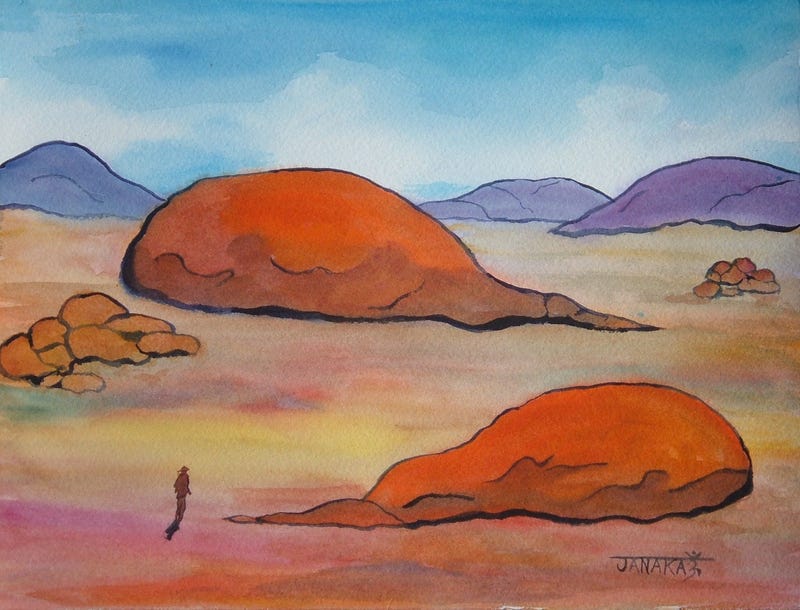
A poem is a journey. It is a gateway into the landscape of the mind of a poet. It is different than going into the prose of a writer. A writer’s landscape has well-paved trails that lead to signs describing what you are seeing, the name of flora and fauna, the history of the place. These signs can be very informative, pointing out things you might not have noticed.
But going into the landscape of the poet has no paved trails if it has any trails at all. There are crags to scale, and rope bridges over chasms. Beasts may wait around any corner, under any bush, up in any tree.
The type of poem that my teacher spoke had crocodiles. Think of the Beatles’ song, I am the Walrus. While it is about a Walrus and Eggmen, crocodiles lurk everywhere.
Sitting on a cornflake Waiting for the van to come Corporation T-shirt, stupid bloody Tuesday Man you’ve been a naughty boy You let your face grow long
There is no clear sign of what those lines mean. They make the listener pause, go back over, carefully move through them. There is a danger here — the danger of not knowing what this means. We humans like to be in the know. We are uncomfortable in the unknown.
The unknown is the wilderness. Civilization has no place there. The wilderness is the unconscious, that dark, deep place in us, where the civilized analytical mind wants nothing to do with it.
It has been nearly 40 years since that class, and I do not recall the teacher’s name. All I remember was his call for crocodiles and finding my first one in a poem. On a mooless night, I wrote.
He returned that poem with a beautiful bold circle around mooless night and wrote: CROCODILE!!!
Actually, I meant to write moonless night. But accidents can be divine, and that has stuck with me over the years. Even in my art, I like to put crocodiles.
I see a lot of poems that are, for the most part, prose, perhaps written in a beautiful cadence, that turns them into a sort of prose poem or prosetry.
I can turn that last sentence into prosetry by doing thus:
A lot of poems I see for the most part not but prose, written perhaps in a cadence swell turning them into prosetry.
No crocodiles there.
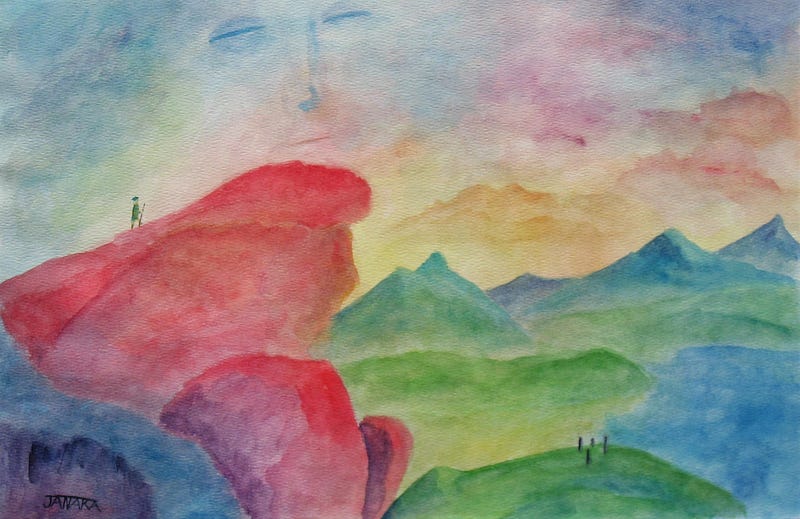
How to plant crocodiles into your poetry
What applies to good fiction writing applies to good poetry: Show, not tell. The use of metaphors, of course.
Metaphors give texture to a poem. They create exciting sights to behold in the landscape of your poetry. Example,
My life, a swirling maelstrom of broken chains, forcing me to duck in hesitation.
A non-metaphorical or non-figurative way of saying about the same thing is this:
My life has seen many changes, some painful, causing me to pause with every step of the way.
Similes are another vital tool. You are like a hurricane, popped into my head, by Neil Young. Here is the poet’s David Whyte’s figurative description of poetry, including metaphor and simile.
Good poetry begins with the lightest touch, a breeze arriving from nowhere, a whispered healing arrival, a word in your ear, a settling into things, then, like a hand in the dark, it arrests the whole body, steeling you for revelation. — THE LIGHTEST TOUCH
Non-sequiturs are fun. They come from out of left field and hit the reader on the side of the head. A crocodile hunter I met at a pub in Darwin, Australia, warned me about walking on the banks of the rivers. Crocodiles like to make mudslides on the banks and wait on the top for a creature to stroll down at the bottom, he told me. Then down they would slide, whacking the animal with their tail, to knock them into the waters. Game over.
A crocodile is a non-sequitur. They knock the reader out of the complacency of knowing where the poem is going. We like surprises, don’t we? Make sure a surprise awaits, like a present to be opened by a painted cat.
A fun exercise
I have an exercise for you, one which I use with my young and older students.
Pick 8 to 10 random words (nouns, adjectives, adverbs, verbs) from the dictionary, from any book, or article. Now write them into a poem using one word per line. The words do not have to be in any order.
A variation on that is to work in tandem with another poet, each one of you alternating lines, using one of those words in each line. There can be no communication between you. You have to work with what you are given and be flexible enough to go where the poem is leading. That is the fun part. You can change words into verbs or nouns, plural, different tenses, etc.
Here is a poem that a 5th-grade student of mine and I created through a series of letters, each time writing one line. The words were: cesspool, devout, relic, handshake, petrify, hope, letter, and stellar.
The Path of the Traveler (in tandem with Molly Seely, 5th grade)
No traveler should fall into the moody cesspool of expectations, For then they will realize their devout hesitations. These relics of falsehood that we undoubtedly adore, Those rules we handshake and cannot ignore. Leaving behind those fearful companions who seek to petrify, Stirring hope within this world, improving if only we try. Therefore dear traveler post those letters of hope Into the stellar box office.
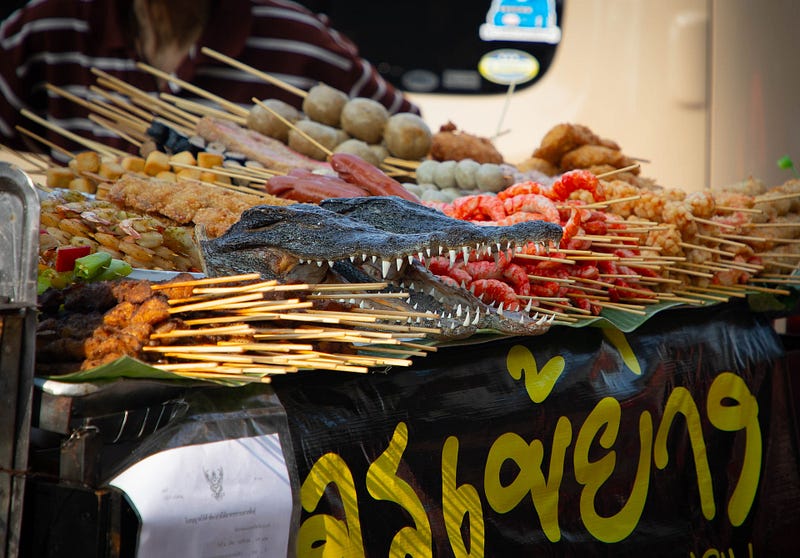
Crocodile killers
Cliches. It is difficult avoiding cliches. So much of what is to be said about any subject has been said, often with slight variations. Cliches are familiar; they are the known. They can be used to bring the reader into familiar territory, but if you just leave them there, the poem most likely will not be memorable.
It will blend in with all the other cliche poems.
I worked at a metaphysical bookstore a long time ago, and at one point, I became the music reviewer. Hundreds of CDs came my way for review. Many of them were shakuhachi flute and harp music. Each album had one minute to win me over to listen further. Most sounded the same. Few ever stood out.
Make your poem stand out. Take your reader into a memorable landscape. By setting out to do so, you will find yourself exploring the territory of your self unimagined.
A filled with smiling crocodiles, mate.