LIFE LESSONS | HISTORY IN PLAIN SIGHT
Putin’s Finger On The Nuke Button And China In The Waiting
If you keep on saying ‘uncivilized’ or ‘third world’, well that’s what you’ll get. You’ve been saying it for centuries. When are you going to stop?
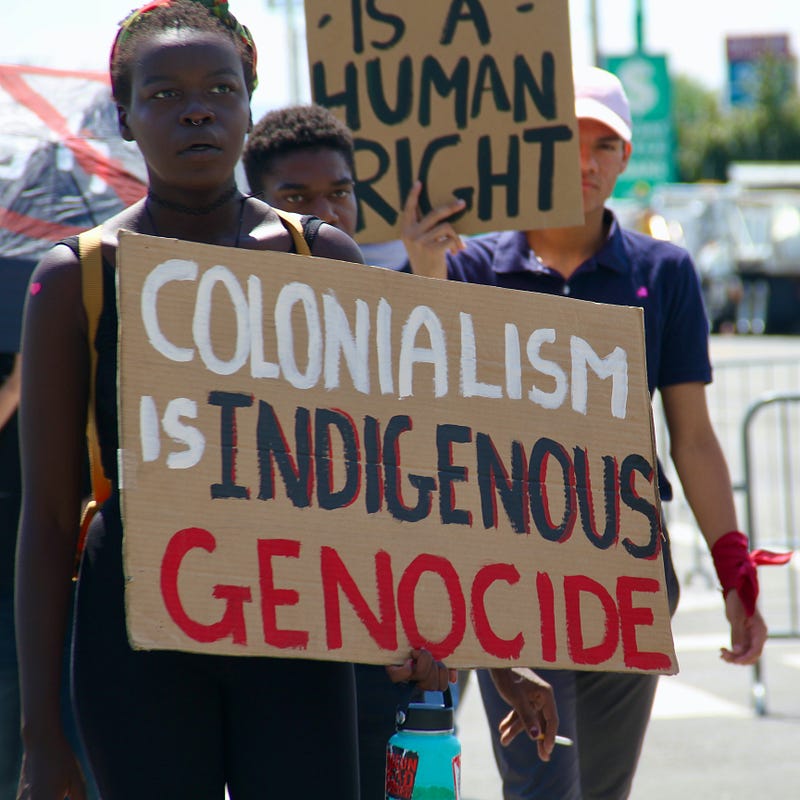
Wars are never initiated by the people ( the peasants), but always by the Masters. The people in power.
I had a hard time writing this. My heartfelt prayers to the people of Ukraine.
Your war is not between the Ukrainian people and the Russian people. There are two presidents. One fighting for the people, the other a modern-day Dictator. It should be easy to draw the distinction.
The difference between a modern-day dictator and a ‘third-world’ dictator is simply this.
You KILL the ‘third world’ dictator once he's reached his expiry date. This is not possible with the modern-day dictator since he might just take us all with him while you trying to KILL him. ‘Third World’ countries have known this for years.
Here is a story from documented history. I will leave some references at the end of this article.
This is not about the American people or the Russian people but rather the systems designed to control them.
In Africa, the Cold War served above all to impede the socioeconomic development of African states and peoples from the hour of independence through the end of the 1980s. The United States and the Soviet Union competed with one another on the continent by providing aid and ideological reinforcement to favored clients or insurgent groups.
The terms “favored clients” and “insurgent groups” is important to remember when studying the objectives of the ruling class.
In so doing they increased the scale of fighting in many conflicts whose roots were essentially indigenous. African leaders of ethnonational constituencies often found that the adoption of a particular ideological label brought increases in military aid from the corresponding superpower.
The main positive ramification of the Cold War for African peoples was that the two superpowers also sometimes competed in the provision of economic aid. Since the end of the Cold War, Soviet/Russian aid has largely evaporated, while aid from the United States has declined.
Surprisingly, neither superpower benefited substantially from the Cold War competition in Africa. The most important perceived measure of success in the competition was the establishment and maintenance of “client regimes,” yet such regimes did not act reliably in the interest of their superpower patrons.
Moreover, neither of those regimes identifying themselves as market capitalists nor those considering themselves Marxist-Leninist in orientation were able to devise practical development programs based on their putative ideologies.
Meanwhile, many moderate African leaders were alienated from both superpowers by the patterns of intervention and counter-intervention that characterized the competition. As a result, most chose to be formally nonaligned, even if they received aid from one superpower or the other.
In economic terms, most superpower investments on the continent yielded meager financial returns. Several Marxist-Leninist states, notably Angola, continued to carry on a mutually beneficial trade with the West, to the chagrin of the Soviets.
The maintenance of client regimes in power often required substantial subsidies to keep them financially afloat while they proved to be ideological failures and political embarrassments. This was the case in the United States–Congo/Zaïre relationship, for instance.
Thus, the only benefit of client regimes was often to deny a “strategic space” to the competing superpower. The rise of the superpower competition in Africa coincided with the rise of nationalist movements for independence across the continent. Until the moment of independence, the United States mostly deferred to its European (colonial) allies on questions of African politics and development and remained largely absent from the continent.
The Soviets were soon providing both rhetorical and material support to African nationalists like Algeria’s Ben Bella and Egypt’s Gamal Abdel Nasser. Soviet political support was especially important in 1956 when Nasser nationalized the Suez Canal and was subsequently attacked by Britain, France, and Israel. Despite a lack of deep ideological affinity, the anti-imperialist rhetoric, and intentions of African nationalist and Soviet leaders resonated closely during this period.
The United States lost a position of primacy in Africa to the Soviets in this period through its ambivalent attitude toward national liberation movements and its constant fretting about the communist ties of African nationalists. The United States rarely put any pressure on its European allies to hasten the pace of decolonization in Africa, while it generally gave tacit support to the apartheid regime in South Africa.
The U.S. Central Intelligence Agency (CIA) even cooperated with South African security in monitoring and undermining the activities of the African National Congress.
The Cold War competition in Africa escalated dramatically with the onset of the Congo (Kinshasa) crisis in July 1960. While both superpowers supported the United Nations peacekeeping mission to Congo, each had a different interpretation of the UN’s mandate. Accordingly, each put pressure on UN secretary-general, Dag Hammarskjold to carry out the mission in keeping with its own preferred vision.
The United States saw it as a neutral effort, designed to keep peace among warring factions; the Soviets saw it as a mission to support the elected government of Patrice Lumumba in the face of foreign intervention and internal secession (of the Katanga province). When the United States prevailed in this competition, the Soviets ceased cooperation with the UN effort and called for Hammarskjold’s dismissal.
Meanwhile, each superpower engaged in its own unilateral, clandestine interventions, which sought to promote local favorites. Ultimately the United States was the more determined intervenor.
Congo’s radical, charismatic prime minister Lumumba was murdered in January 1961 with the encouragement and support of the CIA(wake up does not mean woke. It means to start thinking for yourself, you moron).
Likewise, American operatives encouraged Joseph D. Mobutu to seize power on two occasions, in 1960, and later, permanently, in November 1965.
Beginning in the late 1950s, the superpower competition was complicated by the advent of an independent and vigorous Chinese policy on the continent. China provided some modest economic assistance and successfully presented itself as the natural leader of nonindustrialized, revolutionary African regimes. China’s impressive aid to Tanzania and Zambia in the construction of the TanZam Railway in the late 1960s pleased many nonaligned African leaders and indirectly challenged both superpowers.
(I guess we should leave it there. While the two ‘superpowers’ are still fooling their countrymen/women that they are at war, China has ever since been colonizing Africa in a completely different way. Never in Africa’s favor but with a keen eye on Africa’s resources. Is Putin playing China or is China playing Putin?)
Conclusion
China is taking control of African resources right in front of the supposedly ‘super-powers’ and they not even paying attention. They are still caught up in the cold-war mindset while Africa is bleeding.
It is 2022. Are we aware of how China has African countries by the proverbial “balls”? They confiscate whole harbor ports that are crucial to the economy of some African countries. What strategy is that? Do we even care?
You can add South America, India, and a whole lot of other countries to this. Men and women from those countries are more qualified than me to speak about what I’m referring to. Hell, I’m convinced, even the Chines people, if they could, would agree with me.
This is the time of the people. The peasants. No violence is needed. A simple gesture of majority rules.
PEACE.
IN WITH THE GOOD TIMES, OUT WITH THE BAD.
FOR OUR CHILDREN.
If you enjoy reading stories like these and want to support other writers and me, consider signing up to become a Medium member. It’s $5 a month, giving you unlimited access to incredible stories on Medium. If you sign up using my link, I’ll earn a small commission at no extra cost to you.
References
See also: Socialism in Postcolonial Africa; the Soviet Union and Africa.
Laïdi, Z. The Superpowers, and Africa: The Constraints of a Rivalry, 1960–1990, translated by Patricia Boudoin. Chicago: University of Chicago Press, 1990.
Ogunsanwo, A. China’s Policy in Africa, 1958–71. Cambridge: Cambridge University Press, 1974.
Ottaway, M. Soviet and American Influence in the Horn of Africa. New York: Praeger, 1982.
Porter, B. D. The USSR in Third World Conflicts: Soviet Arms and Diplomacy in Local Wars, 1945–1980. Cambridge: Cambridge University Press, 1984.
Schraeder, P. J. The United States Foreign Policy toward Africa: Incrementalism, Crisis, and Change. Cambridge: Cambridge University Press, 1994.