
Putin Faces Nightmare Insurgents: The Mothers of Russian Soldiers
Russians mothers have warned that an insurrection is brewing over the Kremlin’s treatment of mobilized soldiers who were sent to Ukraine.
After Russia’s first mobilization, there was no official decree to end it, On 21 September 2022, Putin announced a ‘partial mobilization’, allowing the Russian military to call up around 300,000 reservists. As Russia’s full-scale invasion of Ukraine turned into a lengthy war, the mobilization was needed to meet the Russian military’s personnel needs.
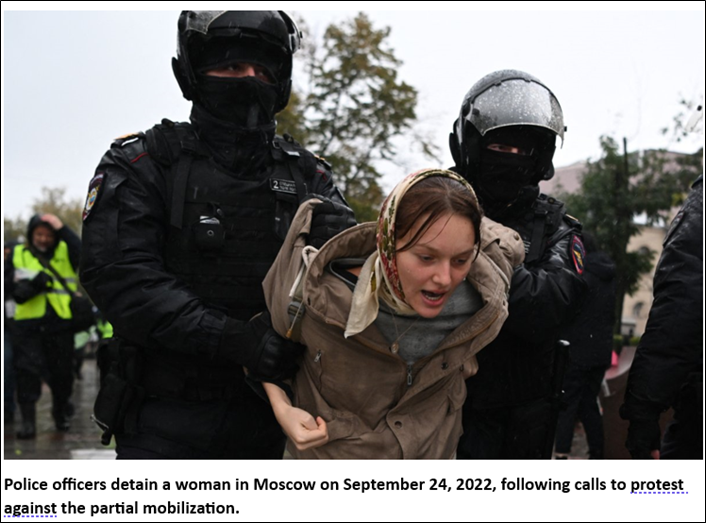
But the move was deeply unpopular. Many Russians — especially young men — fled the country to avoid being called up. Thousands were arrested for protesting against mobilization.
At first, the authorities promised to replace them with contract soldiers — you can look at Prighozin’s rebellion to judge how that went — but then they openly stated that the mobilized troops would have to fight until the “Special Military Operation” is over. The mobilized were not allowed leave — after all, it has been estimated that if they were granted this dispensation, most would never return. Ninety-eight percent of the mobilized wounded were later forced to return to service.
But the relatives of the mobilized are not accepting all this. A growing movement is demanding that they be brought home, moving from attempts at dialogue with local officials and appeals to the president to street actions and mass flash mobs. Their demands include the establishment of a one-year time limit for mobilization, or a complete transition to contractual status. The movement also demands rights to social protest and public assembly, as well as “social justice and equality in rights and duties for everyone, including the mobilized.”
An organization named the ‘Council of Mothers and Wives’ was set up following the announcement of ‘partial mobilization’. Its goal was to coordinate activities across the country by relatives of those mobilized, including pressuring the authorities to resolve issues such as men being called up illegally or being given faulty equipment.
Initially, the women participating in the movement tried to reach out to military committees and local officials, who largely ignored them. The first visible public action was participation in the ritual action held by the Communist Party (KPRF) on November 7, anniversary of the October Revolution. Three dozen women brought placards reading “Bring back our husbands.” They were instantly surrounded by police, and the KPRF leader Gennady Zyuganov promised that he would help with the return of the mobilized men. No such help was forthcoming.
Demonstrating the hopelessness of civil society mobilizing against military mobilization, the council was labelled a ‘foreign agent’ in May of this year and subsequently closed in July.
But the mothers did not leave it alone.
Since this incident, women participants in the movement have tried in vain to coordinate their own rallies in several cities. Officials opposed this, including under the absurd pretext of the COVID threat. (Progovernment and prowar rallies, organized from above, take place without similar restrictions). The maximum that the authorities did allow was an indoor rally, to which only the wives of mobilized men were allowed, and all visible agitation was tightly controlled.
More of a success was the flash mob. “Bring back my husband. I’m fucking tired” — stickers with these words were pasted by women on the rear windows of their cars. The number of women involved in the movement is rising, and they are drawing attention to their demands by attending the actions of pro-Kremlin movements in Moscow, laying flowers at monuments to patriotic heroes, and trying hundreds of letters and calls to Putin’s “Direct Line” phone-in show.
The demands to return the mobilized initially caused tension also among Russians who feared another wave of mobilization. So, the movement eventually abandoned the demand for more rotation of men in favor of a complete rejection of mobilization.
The wives’ persistence and self-organization belie myths about the passivity and almost “slave-like character” of the Russian population. Much emotional energy has been invested in spreading this myth over the past two years, including by a radically disillusioned part of the opposition public. The movement’s successes may not only help debunk this myth, but also provide the ground for a new patriotic emotion that realizes the authorities’ fears and refutes skeptics’ stereotypes.
Evidently, there is no greater enemy for the Russian family than war. As some wives put it, the “‘year of the family’ has been announced. But what family? You have destroyed thousands of families. What kind of family can we talk about?” The wives of the mobilized complain, among other things, about the psychological trauma of young children growing up without fathers, who stop talking and experience other developmental problems. It is increasingly clear that women’s struggle for their husbands’ return from the front is an adherence to “family values” in their reasonable, not twisted conservative version espoused by Putin’s patriotic propaganda.
The soldiers’ relatives, who have actively been demanding that their men be allowed home, published the appeal on the Telegram channel The Way Home on November 27. Earlier this month, the group called for there to be mass protests amid reports that soldiers are being prohibited from leaving the military.
The warning was issued by relatives of Russian men drafted under President Vladimir Putin’s partial mobilization in late 2022, amid reports that soldiers are being prohibited from leaving the military despite completing their terms.
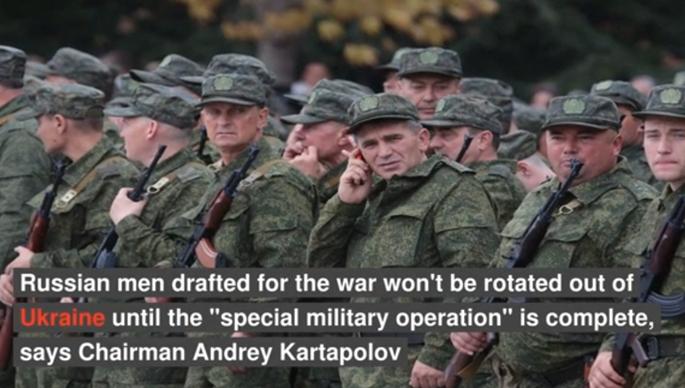
State Duma Defense Committee Chairman Andrey Kartapolov said in September 2023 that Russian men drafted for the war won’t be rotated out of Ukraine until the conflict is over. He also told Russian news outlet Fontanka in an interview published on Tuesday that “there is no need to dismiss anyone.”
“Every citizen of the Russian Federation liable for military service must be ready at any time, at the behest of the Motherland, to come and complete the task,” Kartapolov added.
The Moscow Telegraph, which has nearly 90,000 subscribers, collated several reactions from relatives of the mobilized on social media, writing: “Families of the mobilized predict an armed uprising.”
“They will achieve an armed insurrection…my husband can no longer tolerate all this,” one Telegram user quoted by the channel wrote.
“That’s exactly what my husband says,” another Telegram user responded.
Russian soldiers’ relatives have been actively demanding that their men be allowed home. Soldiers’ wives are now campaigning online for their men to be sent home.
The Russian public have been “betrayed and exterminated by our own people”, the Telegram channel The Way Home, which is made up of family members of Russian troops, said in November 2023.
“We got screwed and you’re screwed. We remember how the president promised that reservists would not be called up, that tasks in [Ukraine] were performed only by professional volunteers. And then our loved ones were taken to Ukraine,” the message said. “The promises turned out to be empty. Many will never return. Mobilization turned out to be a terrible mistake,” the group added.
“Multinational people of Russia! This is an appeal to everyone, or rather a plea for help. Our tragedy is unfolding right before your eyes, which we cannot bear alone!” the message from the soldiers’ relatives began. The appeal added that the Russian public have been “betrayed and exterminated by our own people.”
The families of Russian soldiers sent to fight in a battle for the eastern Donetsk town of Avdiivka have grilled Russian President Vladimir Putin in a letter over the “willful extermination” of troops, an investigative site has reported.
In an appeal to the Russian leader obtained by independent Russian news outlet Important Stories, more than 100 people called on Putin to look into reports that military personnel are being thrown into battle as part of “meat assaults” in a push to seize Avdiivka, even if they have injuries.
“On November 25th, they issued another decree on the spot, so that light and medium [wounded] people would be treated in the trenches,” the wife of one of the mobilized men told Important Stories. “They collect the remains and again storm.”
Another wife of a Russian soldier said she was told that troops are “walking over corpses there.”
The bodies of Russian troops killed in the fight for Avdiivka are “littering” the area, she said.
The appeal said that the “assault brigades” near Avdiivka consist of military personnel with an average age of 40 years old. The majority of troops have not been able to rotate since Putin announced his partial mobilization decree order in September 2022, the signatories said.
The RAND Corporation, an American think tank and research institute, said in a report in June 2023 that Russian personnel fighting in Ukraine will not be permitted to leave until the period of partial mobilization is ended by another decree.
“Currently, the only ways out — apart from death in combat — are reaching mandatory retirement age, medical discharge or imprisonment. Some soldiers have taken matters into their own hands by deserting,” the think tank said.
A GRU military intelligence project to create a ‘volunteer corps’ to replace the Wagner Group is reported to have run into severe problems, with crippling shortages of fuel and lubricants hampering operations in the Bakhmut and Avdiivka areas.
The VChK-OGPU Telegram channel reports that an acute lack of fuel and lubricants has affected almost all units of the ‘volunteer corps’ created by the GRU’s First Deputy Head, Lt Gen Vladimir Alekseev, particularly in the areas of active combat in Bakhmut and Avdiivka.
These problems have reportedly arisen despite the ‘volunteer corps’ being incorporated into the GRU’s organizational structure as a separate special department at the 462nd Special Purpose Training Centre (likely a spetsnaz training organization).
Alekseev is said to have reassured his subordinates that the problems are only temporary and are due to delays caused by the Russian Ministry of Defence’s leadership. However, as VChK-OGPU notes, very similar problems affected Wagner before Yevgeny Prigozhin’s rebellion.
Prior to the rebellion in June 2023, Alekseev was closely associated with Wagner and other mercenary (PMC) and volunteer groups. He was responsible for signing compulsory agreements bringing them under Russian MOD control — a key factor in the Wagner rebellion.
During the rebellion in June 2023, Alekseev was one of only two generals (the other being Sergei Surovikin) to issue a video appeal to the Wagnerites to end their uprising in June 2023.
The rebellion seriously threatened Alekseev’s position — he reportedly feared being replaced by his subordinate, General Alexander Nazarenko, but worked instead to create a new ‘volunteer corps’ to replace Wagner. It’s not clear whether this is a separate unit or is meant to be an overarching structure for existing PMCs and volunteer groups. Alekseev was recently filmed issuing awards to the Espanola unit, which recruits Russian football hooligans to fight.
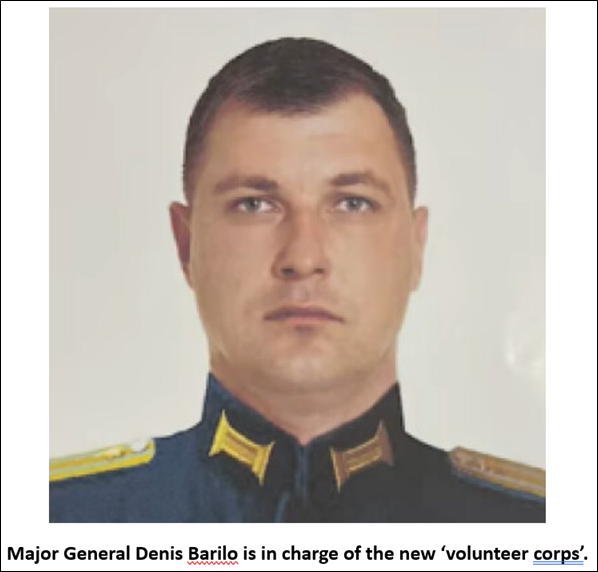
According to VChK-OGPU, an Alekseev protégé, Major General Denis Barilo — newly promoted from Colonel in command of the 55th Mountain Motor Rifle Brigade — has been put in charge of the ‘volunteer corps’. He may be the next Prigozhin.
He is going to have a problem finding volunteers to recruit. Russia, especially its “depressed” regions, is suffering from a labor shortage. The decline in the workforce is evidenced by employers who are unable to find workers because of the decrease in the number of men.
And there is a new enemy for the Council of Mothers and Wives to worry about: the women of Ukraine have launched their own campaign against the Russian invaders.
In Crimea, two girls poisoned 46 Russian military personnel and shot FSB officers.
The FSB allegedly reported: “The suspects in the death of 46 fighters resisted; unfortunately, it was not possible to detain them. The saboteurs turned out to be well armed and (we did not expect this!) Well-prepared. Plus, someone could have warned them about our visit. As soon as the special forces came to arrest them, they opened fire on them with pistols and automatic weapons.”
The girls fled in a car. Journalists learned that the saboteur’s car was abandoned on the outskirts of Yalta.
The FSB added: “We don’t know where the saboteurs are now. Three FSB officers were killed as a result of the shooting. Two more were wounded, one of them seriously. One of the criminals may also have been wounded, but it is unlikely that this wound was serious (she fled the scene of the shooting on her own). The search for the saboteurs continues.”
The media learned that on the Crimean Peninsula, girls handed over gifts to the military unit of the Russian invaders, and thanks to this, dozens of invaders were poisoned.
But the Council of Mothers and Wives is right to focus on the health of their sons and husbands on the battlefield.
The mortality rate in the Russian Armed Forces on the battlefield is 33%, which equates this figure to the mortality rate of soldiers during World War II.
The main cause of death in the Russian Armed Forces on the battlefield is blood loss from a wound in the limb.
You would think that the Russian soldiers would be able to fall back on well-tested and well-supplied health services in the event of a wound on the field. Such is not the case.
Even well-known threats are ignored. Soldiers on the battlefield are still suffering from frostbite due to poor winter conditions; their mothers have often had to crowdsource to get funds for winder gear. Russian soldiers often do not wear helmets or have helmets are old or of poor quality, and suffer from brain injuries as well as burns. Special care in-the-field is rare for to soldiers with burns on the battlefield.
The main initial “treatment” for wounded people in hospitals is amputation of the affected limbs.
Getting to the hospital is a nightmare. The bulk of the wounded soldiers of the Russian Armed Forces are evacuated only by wheeled transport to field hospitals on the border of Ukraine with Russia. Then, after first aid, the wounded wait in these field hospitals for their turn to be evacuated by helicopter or plane deep into Russia. But evacuation, as a rule, was always delayed. The initial evacuation from the battlefield is too long — on average 24 hours plus waiting for your turn to fly.
As a result, soldiers in Putin’s army have low levels of motivation and morale. The level of refusal and desertion is high. The command fights this with threats, manipulation, insults and inducing guilt in the soldier. At the mot basic level, the Russian army does not practice sanitation and hygiene. Russian units do not monitor hygiene, including occupied cities such as Mariupol. All this leads to infections and diseases and may lead to epidemics in the future.
The soldiers’ food supply is poorly organized; it is of low quality. This also leads to low morale and illness. What Russians are issued belongs to the 1950s. This plays a role in the low morale of the Russian army. They know they are getting sub-standard food, because they can see what Ukrainians are issued, from prisoners and dead bodies.
Evidence has been collected that the soldier takes out his depression and feelings of humiliation on the Ukrainian civilian population in the occupied territories, who are abused and robbed of their property.
The government absolutely does not care about the lives of its own fighters. And this the mothers know.
They may also know that women’s antiwar resistance has a long history in Russia.
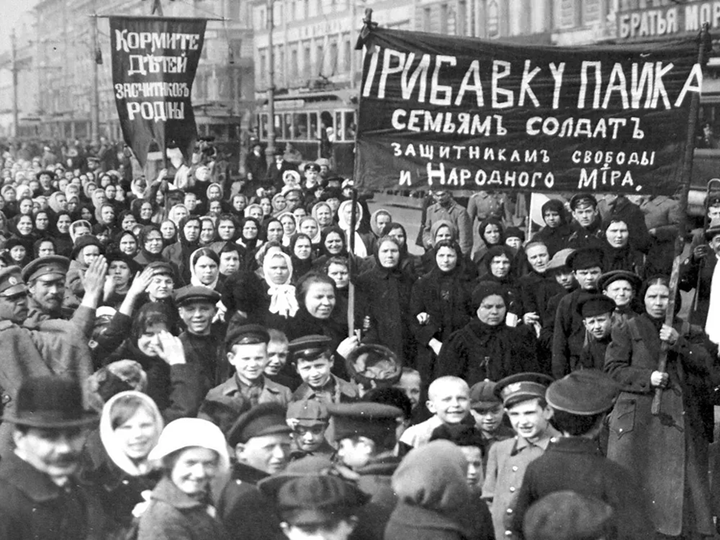
During World War I women began by asking for the payment or increase of mobilization benefits, but quickly moved to radical actions and anti-government slogans. They took to the streets, broke into administrative buildings, smashed up stores, and tried to hold up rail convoys with mobilized men. As one Russian peasant woman scolded Tsar Nicholas II: “Fuck his mother, he can give my husband back, I don’t need his pennies.” Against the “war, the high costs and the position of the woman worker,” women came out to demonstrate on March 8, 1917 (February 23 in the old calendar), giving rise to the Russian Revolution.
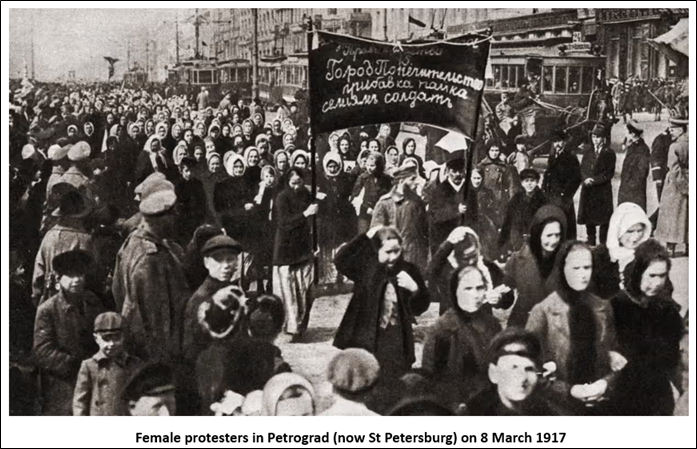
The demonstration involved tens of thousands of mainly women congregating on the Nevsky Prospekt, the principal avenue in the centre of the Russian capital, Petrograd, and banners started to appear.
The slogans on the banners were patriotic but also made forceful demands for change: “Feed the children of the defenders of the motherland,” read one; another said: “Supplement the ration of soldiers’ families, defenders of freedom and the people’s peace.”
The crowds of demonstrators were varied. The city’s governor said they consisted of “ladies from society, lots more peasant women, and student girls”.
The revolution was begun by women, not male workers.
In the afternoon the mood began to change as female textile workers from the Vyborg side of the city came out on strike in protest against shortages of bread. Joined by their menfolk, they swelled the crowds on the Nevsky, where there were calls of “Bread!” and “Down with the tsar!” By the end of the afternoon, 100,000 workers had come out on strike, and there were clashes with police.
The Tsar’s Cossacks struggled to clear the crowds on the Nevsky. They would ride up to the demonstrators, only to stop short and retreat. Later it emerged that they were mostly young reservists who had no experience of dealing with crowds. Inexperienced conscripts with no equipment…sounds familiar.
By the next day some 150,000 workers had taken to the streets. They marched from the industrial areas, crossed the bridges, and occupied the Nevksy, looting shops, and overturning trams and carriages. There were fights with the police and Cossacks on the bridges. By mid-afternoon the crowds on the Nevsky had been swollen by students, shopkeepers, office workers and spectators.
Revolutionary orators made speeches, calling for the downfall of the monarchy. Few in the vast crowd could hear what they were saying, but it did not matter: the people knew what they wanted to hear and the mere sight of this act of free speech — in full view of the police — was enough to confirm in their minds that a “revolution” was taking place.
It was this revolution — the revolution of women — which precipitated the collapse of the ruling Romanov dynasty and introduced new possibilities for the future of the Russian state.
By contrast, the Communist revolution which stole the future of freedom from Russia was a sham affair. More people died in the filming of the Russian documentary on the Communist soldiers taking over the government, than died in the actual attack itself.
And they call this “socialist realism”.
Sorry to sound so bitter, but I have a personal — if fleeting — connection with this. Premier Kerenski, after he was overthrown by the Communists in that attack, fled to other countries around the world in a campaign to warn them about what was to come.
One of the places he visited in his later years was Connecticut. He spoke at the international school that my father was running. He held my parents’ new baby in his arms.
That was me.
I am connected by touch to the Russian revolution started by the women of 1917.
I have zero memory of it, of course, but it leaves me open to feel extra sympathy for the mothers of that time. Here is a moving description of the era they lived in, from the playwright Maxim Gorky, from his first big success “The Lower Depths” (1903):
“I can’t remember a single day when I didn’t go hungry…I’ve been afraid, waking, eating and sleeping…all my life I’ve trembled-afraid I wouldn’t get another bite…all my life I’ve been in rags-all through my wretched life — and why?”
- Anna, wife of a locksmith.
I have never believed that the Russians are a soulless mass of servants. They are ordinary people who have never had a chance. They desperately want to change, in a regime where that is a death-wish.
But anyone trying to impose that on the Russians has to do so against the one force that is willing to push back: the women of Russia.
Any serious, mass anti-Putin movement will follow the paths that these women are today treading.
And if I was Putin, I would be very, very afraid.


