Geopolitics
Putin and Ali Khamenei: An Unholy Alliance
The Russia-Iran marriage made in hell is making many countries nervous and could trigger more conflict
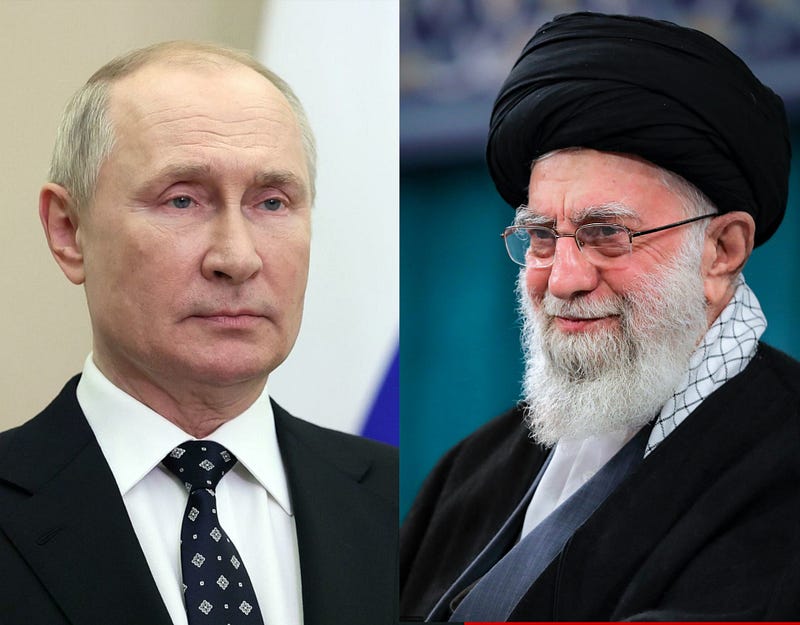
Ali Khamenei may well be smiling. He has extracted a huge price from Russia for providing drones and ballistic missiles to help Putin in his illegal, criminal and stupid war against Ukraine.
This has led to deeper and very serious geopolitical issues.
Who’s dealing?
Political purists might say that Ali Khamenei may be the Supreme Leader of Iran but it’s really the President, Ebrahim Raisi who does all the heavy political lifting and is the one who is really in the geopolitical love affair with Russia’s Putin.
Perhaps so, but nothing earth-moving ever happens in Iranian politics without the nod of the Supreme Leader. Ali Khamenei’s role as Supreme Leader is that of guardian of the Islamic Revolution. The Supreme Leader is legally considered “inviolable”, with Iranians being routinely punished for questioning or insulting him.
Therefore it’s definitely that case that he is closely engaged in the current cosy relationship that Iran and Russia have developed since Putin’s armed forces started taking a beating in the ill-conceived Ukraine War.
“Iran has become one of Russia’s top military backers,” Britain’s defense minister, Ben Wallace, recently told the UK Parliament.
I’m pretty sure that a couple of Western intelligence agencies will have a very clear picture of the deal between these devils, but they will not disclose too much for fear of risking their sources.
Israel too will have a clear idea and be very concerned, but I’ll come back to that in a moment.
The deals
The initial batch of drones was bought for cash, it has been reported.
Then,
“In return for having supplied more than 300 kamikaze drones, Russia now intends to provide Iran with advanced military components, undermining both Middle East and international security — we must expose that deal,” Mr. Wallace said.
Russia’ problems have deepened and their stock of missiles has dwindled so Iran has turned the screws. Scarcity pricing it’s called and Iran’s demands have steepened.
But now it has got worse.
Drones For Nukes? Russia Is Helping Iran With Nuclear Program ‘In Exchange’ For Missiles & UAVs
“Iran is seeking Russia’s help to bolster its nuclear program, US intelligence officials believe, as Tehran looks for a backup plan should a lasting nuclear deal with world powers fail to materialize,” CNN (4 November 2022)
The problems
Israel, Saudi Arabia and the United Arab Emirates are all threatened by Iran’s missile and asymmetric warfare capabilities. The new right-wing government in Israel has already made it clear to Moscow that it considers Iran its primary threat.
The UAV attack on Isfahan in January 2023 may have been intended as a warning to Tehran by Israel although they have not admitted responsibility.
Tolerance for Russian enhancement of Iran’s capabilities will be at a very low ebb in these three Middle Eastern states that have taken a political risk to pursue policies on Russia independent of the US and NATO.
In recent years Israel has had to work with Russia over the issues of Syria and terrorist groups, with Naftali Bennett, the previous Prime Minister visiting Putin in Sochi in 2020.
How things have changed.
Now, Israel is slowly moving off the fence in the Ukraine War, having previously been equivocal. It’s a gradual shift to the NATO side, but it’s tangible. There has even been talk of supplying Israel’s Iron Dome air defence system to Ukraine.
But Russia is still trying to keep Israel onside with diplomatic sweet talk.
Problems compounded
But here’s the rub. A recent report by Bloomberg has increased the focus on Israel’s concern about Iran’s nuclear programme, so any assistance that Moscow may provide to Iran is politically testing for Tel Aviv.
This is because:
(Bloomberg) — Iran is seeking sophisticated new air-defense systems [S-400] from Russia that Israeli officials believe will narrow the window for a potential strike on Tehran’s nuclear program, according to people familiar with the matter.
And that’s capped by a recent statement from the US Pentagon that Iran can make enough fissile material in 12 days for an atomic bomb. (Reuters)
Iran has enriched uranium to a little less than the 90 per cent needed to produce an atomic bomb, the UN’s nuclear watchdog confirmed on Tuesday.
“Discussions are still ongoing” to determine the origin of these particles, the International Atomic Energy Agency said in a confidential report seen by AFP.
“On 22 January 2023, the agency took environmental samples … at Fordow Fuel Enrichment Plant (FFEP), the analytical results of which showed the presence of high-enriched uranium particles containing up to 83.7 per cent U-235,” the report said. — The National News
It’s clear that Iran has now mastered the uranium enrichment technology.
So, Iran is close to having ‘the bomb’ and Iran may acquire advanced S-400 AA missiles from Russia to defend itself — and its nuclear installations from aerial attacks by Israel (which is no stranger to such attacks — remember Iraq’s Osirak reactor)?
Operation Opera, and related Israeli government statements following it, established the Begin Doctrine, which explicitly stated the strike was not an anomaly, but instead “a precedent for every future government in Israel” — Wikipedia
Key questions
Does Russia have any S-400 missiles to spare?
This is from a report in Yahoo News dated 23 January 2023:
Ukraine’s Defence intelligence states that Russia has up to 20% of its pre-war stockpile of high-precision missiles left, i.e., about 550 units, so it combines them with kamikaze drones and modifies S-300 and S-400 anti-aircraft missiles for surface-to-surface launches.
Source: Vadym Skibitskyi, deputy head of Ukraine’s Defence Intelligence, in an interview with Delfi [a news outlet in Estonia, Latvia, and Lithuania — ed.]
Quote: “They [Russians] have Iskanders [mobile short-range ballistic missile systems], Kh-101s, Kh-555s. According to our estimates, Russia has no more than 20% of its pre-war stockpile and what was produced during the war. This is approximately 550 units. Their potential is enough to conduct two or three massive strikes with more than 80 missiles. —
Okay, the source is probably biased. But there is another question:
Would Russia share them with Iran?
Russia’s capacity to re-supply its missile stocks from within is considerably reduced. Western sanctions have hit electronic and other critical component supplies. It is possible that some replenishment is coming through grey imports and through China and Iran (which are themselves sanctioned to some degree over electronic components).
That’s what I thought, but Russia seems still to be producing and supplying S-400s, with the latest batch being shipped recently to India.
Could they build one?
Yes, and pretty quickly too.
We know that Iran can produce enough fissile material in 12 days for a bomb.
It’s no longer ‘rocket science’ to build a basic fission weapon, but a fusion bomb would take a lot longer.
I’m sure that they have the designs ready and tested, just awaiting fissile material. The fast switches and other electronics will have been obtained years ago.
They will need specialist machining equipment for the uranium metal, but that’s probably there already.
And they have proven short range ballistic missile designs capable of delivering such a weapon - and plenty of surface to surface missiles to share with Moscow.
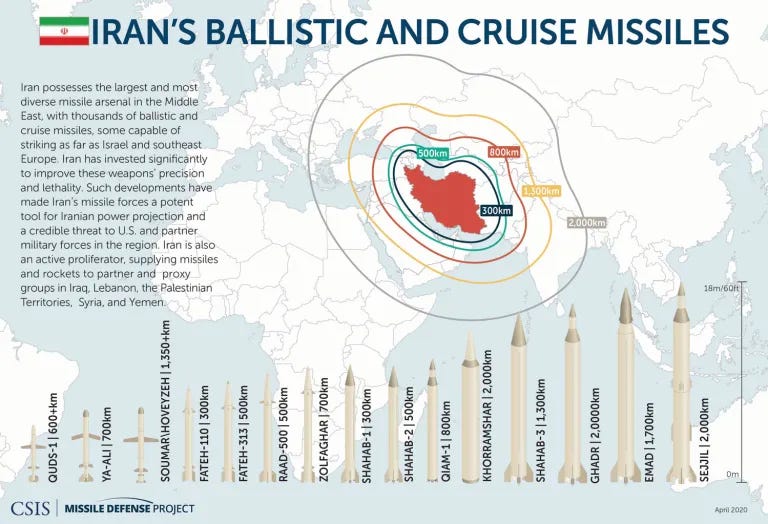
Iran possesses the largest and most diverse missile arsenal in the Middle East, with thousands of ballistic and cruise missiles, some capable of striking as far as Israel and southeast Europe. For the past decade, Iran has invested significantly to improve these weapons’ precision and lethality. — missilethreat.csis.org
Iran has done considerable design work on a nuclear weapon. In the 1990s, an arms-trafficking network led by A.Q. Khan, the father of Pakistan’s nuclear weapons program, supplied Iran with the basic designs for nuclear weapon components. In 2009, an internal IAEA assessment concluded that before 2003, Iran had accumulated “sufficient information to be able to design and produce a workable implosion nuclear device based on HEU [highly enriched uranium] as fission fuel.” — foreignpolicy.com
If push came to shove then they could probable have one ready within six months, maybe less. And testing? They will have the underground test site prepared already, they have already dug miles of tunnels as the CIA knows.
No testing? There’s no point unless you want to use it straight away and take a chance that it will work. But I’m sure they wouldn’t want to do that.
They have to test to demonstrate that their bomb works. Possession and credible deliverability is 9/10ths of the power of nuclear weapons.
They don’t even need to cross a sea to threaten Israel. The weapon could be carried in a container on a truck.
Look what a dirt-poor country like North Korea has done. And they are still sanctioned.
Israel’s attacks
Is Israel still capable of sabotaging Iran’s programme from the inside? It will take more than one assassination using an AI controlled sniper rifle.
Israel sabotaged the Siemens control software for the enrichment centrifuges with the Stuxnet worm cyber-attack in 2010. And then there was another sabotage mission in 2021 which reportedly involved an explosion in a generator and more damage to centrifuges.
Israel does not comment on these matters, but for sure is attacking on several invisible fronts.
But now we may be at a point when a larger-scale attack to destroy the Natanz or other Iranian nuclear facility might be seen as necessary.
Israel’s strike window
‘Breakout time’ is a much used phrase, and Israel was estimating this to be about one to two years, back in late 2021. That’s the time needed to produce a working and deliverable weapon once the enrichment process has been mastered and sufficient weapons-grade Uranium has been amassed.
The latest news about Iran’s enrichment progress is therefore concerning.
Can Iran’s programme be halted? Perhaps, but with serious consequences if done violently. Iran is so close now that it will take the sanctions pain to get to the winning post. Diplomacy and deals will not work, it’s much too late.
There is one other option.
Regime change
But that would require a revolution. We have seen recent public dissent growing in Iran, particularly over religious rules about headscarfs. And with recent reports of the mass poisoning of schoolgirls in Qom internal pressure is growing on the regime.
And what of a new regime?
Would they give up the nuclear option?
Conclusion
- Russia can supply S-400s AA systems to Iran if it is really pushed.
- Iran has plenty of surface-to-surface ballistic missiles to supply to Moscow.
- Iran is very close to becoming a weaponised nuclear power.
- Israel’s ‘strike window’ is closing.
- There is a clear risk that Israel will strike against Iran’s nuclear programme, and that this will be more than a cyber assault or assassination.
- It is a devilish deal between Moscow and Teheran and increases Middle East and world political tensions.
Putin and Ali Khomenei: brothers in blood.
About me: If you follow me I guarantee variety in your inbox with some unusual perspectives! I write on a wide range of topics including humor, tech, space, geopolitics and travel, together with daily news events and the minutiae of my daily life living on a boat. Yes, I really do live on a boat (some readers don’t believe that). I also write about…
…deals with the devil
If you appreciate stories like these and want to support other writers and me, consider signing up to become a Medium member. It’s only $5 a month, giving you unlimited access to incredible stories on Medium. If you sign up using my link below, I’ll earn a small commission at no extra cost to you.
Or maybe just buy me a coffee? and tell me what you liked reading (or not)…