
Put Money Behind Performance Objectives — You Reap What You Sow
How money is (not) the highest motivation factor of all. With examples from the Game of Thrones

They said that money is not the biggest motivation for performance. And it is not. But it is behind many strong motivators; hence it is a crucial component. Below I will talk about setting up your performance measurement system right and which Key Performance Indicators (KPIs) you can use in your compensation system — with some examples from Game of Thrones. In my previous story, I’ve summarized what is behind Management by Objectives (MBO), Key Performance Indicators (KPI) and Objectives and Key Results (OKR) — check it out if you don’t remember those abbreviations. Read on otherwise. I will put the financial motivation system for team leaders and business unit managers into simple terms.
I’ll stay with the Game of Thrones as an example. Quick recap: there are Seven Kingdoms, and the Wall built 8000 years ago. North or the Wall, there are bad things — wildlings, giants, White Walkers maybe. The Night Watch guards the Wall to keep the wildlings and White Walkers from crossing into the Seven Kingdoms. You are Lord Commander of the Night Watch, setting performance parameters. John has just joined the Rangers and sees how he can make more money — nothing about “I shall take no performance-based yearly bonus.” in his Oath.
Typically, your compensation consists of a fixed part, variable part (bonus), and other benefits. Other benefits can depend on your position, industry, and vary per country. As much as they are essential — you, as a leader of a team, have minimal influence on those. Free ale to all the Rangers every evening in the Night Watch! So we’ll focus on the first two components. Even if you work for a big corporation where policies regulate all the elements — you still have some influence. You do your merit review end of the year — how do you decide which behavior leads to a fixed component increase, and which influences a variable one?
- Any behavior linked to sustainable performance improvement — getting more knowledge, better soft or hard skills, learning to do the same things faster or with better quality, covering more functional areas, etc. shall be rewarded in a fixed component.
- Any behavior linked to a non-sustainable performance boost (or drop) — putting extra effort into doing one project right, contributing to a quantitative success of unit or team, etc. shall be taken into account in a variable component.
In your organization, you might want to set up a more refined policy — but at least keep this one to yourself as a rule of thumb if there is no other anchor. So our decision schema starts.
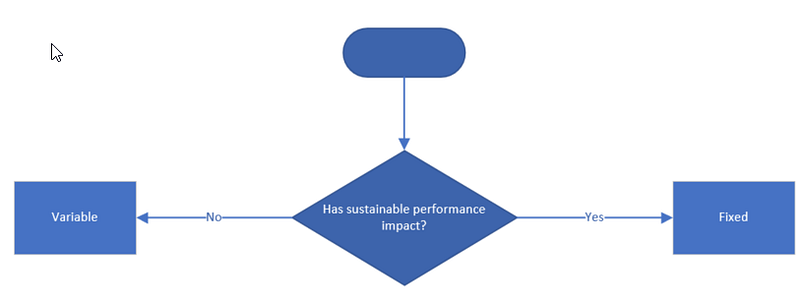
If our John fights better with his sword and fists — that is a fixed part, while if he made 20 patrol raids this year and few turned out to be very successful — that’s a variable one.
Now, while a fixed component will be a part of the yearly assessment process — you might want to link your variable compensation to performance parameters. Why? The more direct link will reward performances and will make behaviors in your group uniform. Entirely relying on line managers will create isles of various practices. Beware of things that can go wrong with simple performance measures aligned across the organization.
Some examples — let’s start with the Helpdesk unit. Would you want to decrease the initial response time and time that a ticket stays on your side? Most probably. So, let’s incorporate those parameters into performance measurement! What happens? Our helpdesk quickly answers, “We have received your logs. We will look into them”. So instead of gaining performance, you’ve just lost transparency (now you don’t even know if the ticket is on your team or waiting for the client to respond).
Are you not persuaded yet? Ok, take the Consultancy unit. Let us do more billable hours. Billable hours go up, but efficiency drops. More meetings with clients, more people in those meetings. Did you want that? You reap what you sow.
Good performance measurement should
- Be aligned with your goals (You reap what you sow)
- Be very transparent (What you see is all there is, see Daniel Kahneman’s books to learn more about this principle)
- Designed in a way that manipulating it will still lead to positive results
- Balanced with qualitative objectives
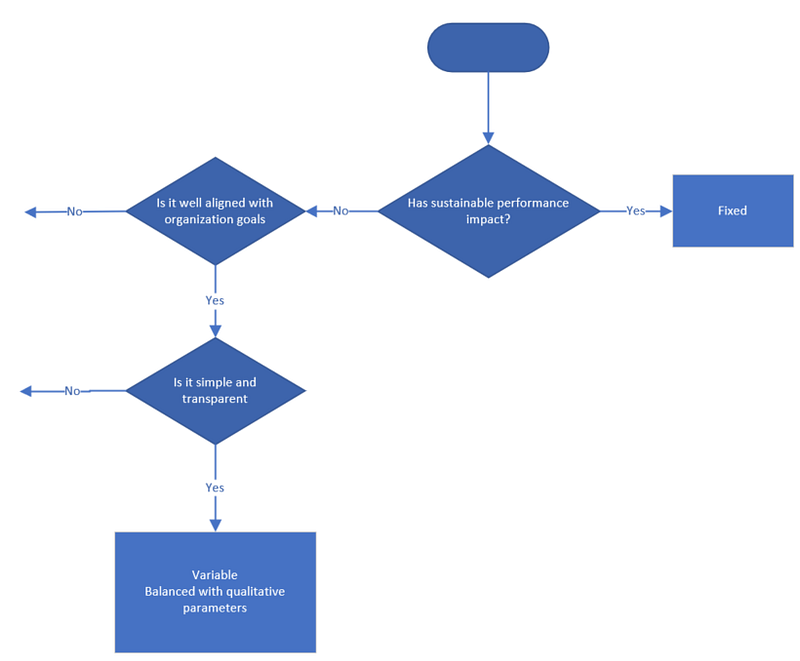
- Number of dead bodies John brings to the Wall — Nope (not aligned with organizational goals enough, will be tampered by killing peaceful villagers)
- Number of White Walkers spotted during patrols — Nope (not transparent at all)
- Area covered by patrols raids over a year — Yup (and to be balanced by qualitative parameters)
Billable hours we discussed above are not too bad — as long as clients are ready to pay for them, and we incorporate growth into qualitative objectives.
Now, let’s look at this story from John’s perspective. He likes what he is doing (primarily the ale part, killing wildlings comes handy as well). What is essential for him?
- Understanding those measurements — less to complex formulas, unless you primarily hire mathematicians — more to a simple linear relationship with something tangible.
- Being able to influence them directly — everyone hates parameters that are just imposed on them. Don’t set a goal “number of White Walkers killed” if you do not know how to kill them yet — leave that to your research unit first.
- Contradictions — do not reward and punish for the same behavior.
If you fulfill these three things, you send a clear message to your employee: that is what we value as a company. Employees might not be driven by money as a top stimulus, but this way you send them an unambiguous message. So, money is not the most significant motivation — but a performance-based motivation system influencing variable compensation is.
The message you send this way is way more precise than your typical Vision Statement. Take the Night Watch one “I am the fire that burns against the cold, the light that brings the dawn, the horn that wakes the sleepers, the shield that guards the realms of men.” — compare it to a simple “Go and kill wildlings and giants.”
Above looks simple — doing that consistently will make you a way better boss (or Lord Commander) in the eyes of your team.


