
Put A Story In Your Painting!
Viewers love finding a story
Most stories have a painting in them!
Wait! Maybe it should be every painting should have a story in them.
I believe each viewer brings their own story to a painting.
What if all three statements above are true? It might be an excellent painting.
How can you manage to do that?
You have a unique thought each time you see or think about your next idea for a painting! Write down that thought. It can slip away quickly.
When you hear a story, don’t you create a scene in your head? I create a painting in mine. Since I have started writing, I now see a story of my own developing.
Triggers could be a color you love. It could be an object that means more to you than you realize. Even a particular word can evoke a scene and become a painting or a story. That idea draws you in for a reason.
How about singing or humming a song while you paint? Hold that brush in your hand while the music plays. Direct with that brush! Do a little dance back and forth to the canvas!
When I write, I usually listen to music… just like I do when I am painting. If it isn’t music, then it is the television for my hubby, and it becomes background noise. Those background noises can break through my thoughts and here I go again.
A new thought! Quick, write it down!
Energy is contagious!
Be ready for it!
When I have an idea, see an object or scene which has a meaning, I’m all about starting a painting. I hear what the story might be from my own perspective. I can’t wait to get started.
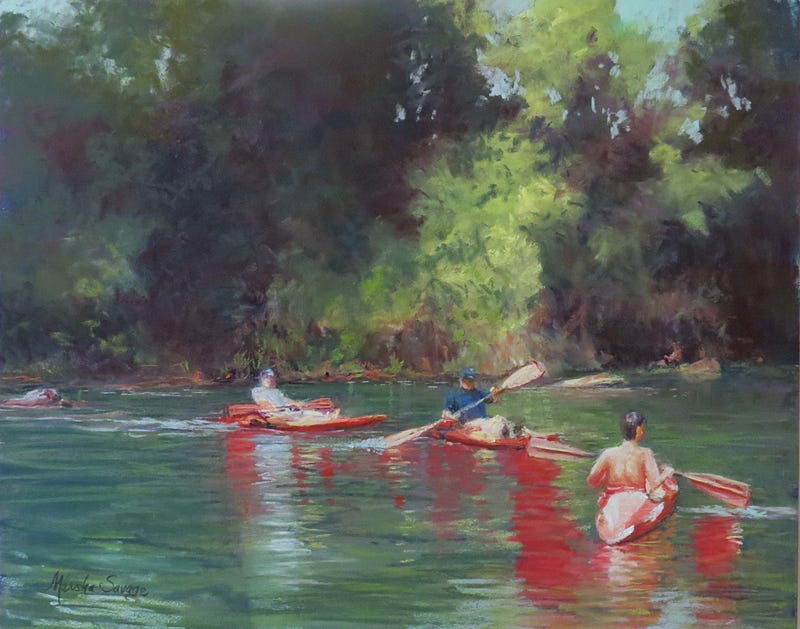
The sun’s out, the river is flowing, and here comes a raucous bunch of people in their kayaks. I take as many photos of people in the river as I can get as they are going by.
Everybody waves hello! And if I am sitting there with my easel and box of paints and brushes, they start posing for me. Lots of laughter happens. I get asked, “Hey, put me in the painting, will you?” or “How does this look?”
Now there is some energy! I can’t help but infuse the painting with it. If it is photographs, and I am using them in the studio, I try to remember! I close my eyes, and the whole scene and all the sounds of laughter come back. The energy is back. It creates that story in the painting without me trying too hard.
I sold a painting while sitting on a rock in the river to someone from out of town coming to sit and enjoy the river. They created their own story with what happened. I have a story to add to the image of the painting. What fun that was!

Do you see a story in this photograph? There is an obvious one! I know I can probably come up with more than one. I bet you can also.
There are other methods to create a story
Creating a story might mean you have a pathway of some kind in the painting. The path may not be an obvious one, such as a street, alley, path on the ground, street, river, etc.
You may have a pathway of some kind that disappears around a corner or behind another object. It creates a little mystery. You get to make up your own story here! People love a little mystery or surprise.
Where do you look first when viewing a painting?
Working your way through a painting is creating a pathway with your own mind. As the artist, you want to engage the viewer in one spot and then send them down a pathway.
Travel visually around that painting. Be involved in it!
You decide where you look first from the experiences you have in your life. Something is going to grab your attention because of who you are and where you have been. It could be as simple as your favorite color.
The artist works deliberately to create a spot you will look. Of course, it comes from their own life stories many times.
As an artist grows, they learn many different theories and use them to create a spot you look.
What do I do?
Have an intention to your work.
Writing down notes about what drew you to paint a scene is a perfect place to start. I guarantee you may have a story that goes along with what drew you to paint the artwork.
If you don’t already have a story, pick something you want to create and decide what would make a good story. Choosing items that are in some way related to the main character is a good idea.
What if you don’t have a story?
If you have something you want to paint, you should start there. The item that drew you in can be the start of a story. Think of all the times you have seen it. What emotions were present? Here is a starting point to add other elements to your painting.
If you are writing a story, go down different paths that your emotions tell you might work. Try out different scenarios… whether it is a story or a painting! Keep notes of what you try.
Painting is the same. It is not all about the image!
The story has a lot to do with the feeling evoked from viewing it.
Many times I want to paint that “something” in the feeling! I need to work on areas outside that subject and will intuitively choose items to put in. These thoughts come from experiences in my life.
Maybe those thoughts don’t come quickly.
Now what? My theory, and other artists mention, just work. We have a saying that gets repeated in many different ways but means the same thing. “Show up to work, and the work shows up.”
Be open to those little thoughts that come quickly. They leave just as quickly. Have a notebook close by. Write them down, even if only a few words to remind you.
With written notes of any kind, the ideas might flow easily. Return to these notes on the next painting also. Stories are there. Be ready to grow them.
The viewer sometimes has a story!
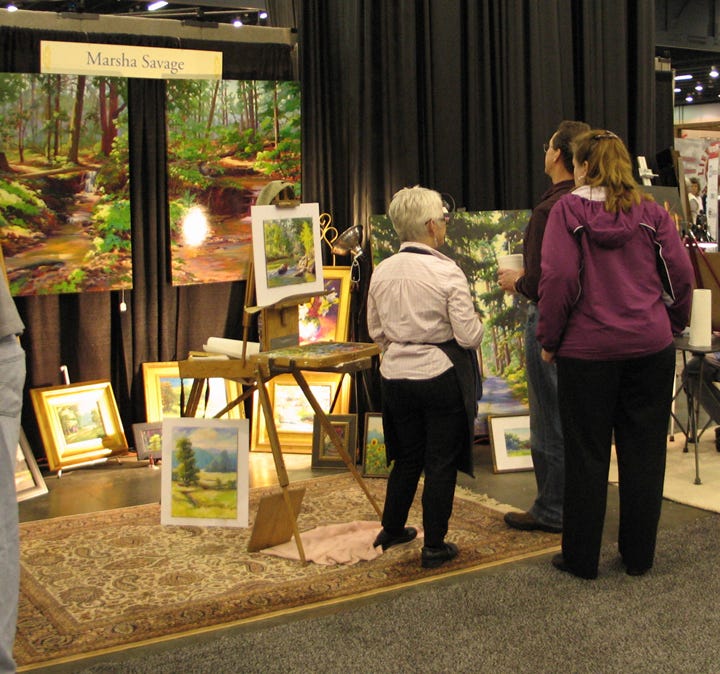
I do one important thing when I am present at a gallery opening or event where people are invited, knowing the artists will most likely be present. I listen!
I watch who is looking longer or harder at some of my paintings. I do not approach them at first. I wait a couple of minutes, especially if I see them discussing the painting. I do not want to interrupt their thoughts.
When I approach, I introduce myself first and ask their names! We usually discuss if they are local or visiting the area. My next sentence is a question for them. “Tell me what you see when looking at this painting.” I usually get a story about their experience, a unique event of their own.
One thing I do not do is tell them the story I “thought” when painting. If they are interested, it is from their own perspective. I don’t want to change that.
I love hearing what they see and what story they tell me! I love a good story.
Most people are intrigued by how a painting comes about. I know many wonder how on earth we came up with it.
If they wish, I might tell them my inspiration for the artwork but not infringing on their story.
Everybody loves a story!