
Punctum: Why We’re Drawn to Fiction
We are spectators in a wide world of never-ending fiction. In the stretched stories of news and reality television, in the novels and artwork we ingest, and in the exaggerated tales of our friends. We are surrounded by fictional worlds living on a spectrum from plausible to fantasy.
In his nonfiction work Camera Lucida, Roland Barthes explores his relationship to photographs as a spectator of the world within images. Similarly, in Jonathan Gottschall’s nonfiction The Storytelling Animal, he explores how fiction impacts his and all our lives. These two novels tackle the notion of Stadium vs. Punctum or the details the spectator brings to a work of art to make it meaningful vs. an act of simply liking a work of art. The novels explain why we enjoy art and give us an inside look at our minds on fiction. Boil these two novels down and this is the core message: We are coconspirators of all fiction.
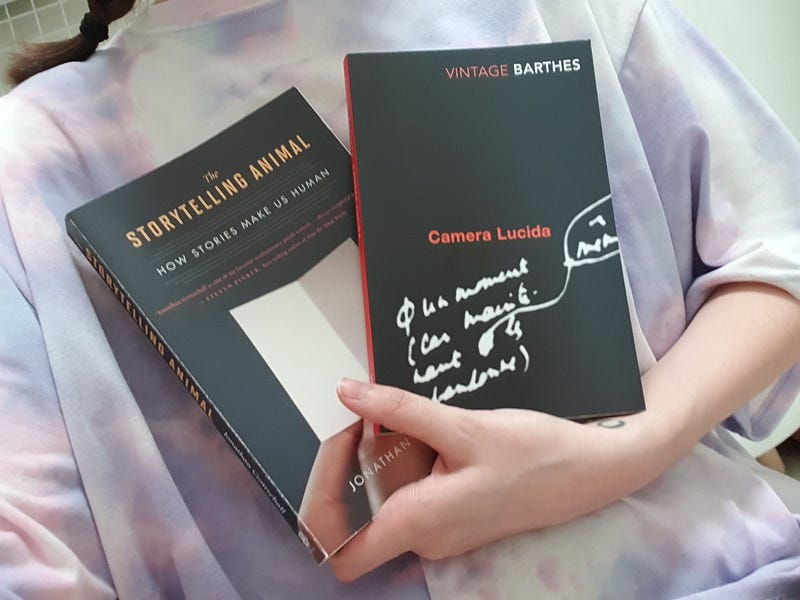
Barthes describes his theory of punctum as what the spectator brings to an image to determine the image’s worth and meaning. Our personal punctum determines whether the story serves a purpose in the spectator’s life. The punctum also affects the Stadium, which is simply the order of liking something. Barthes’s concept can be seen clearly throughout The Storytelling Animal.
Gottschall’s novel opens with an anecdote of him listening to a touching song on the radio. He was so moved by the musical story that he became succumbed to tears. Gottschall has two daughters of his own and since the touching song featured a narrative about a father letting go of his daughter on her wedding day, his sentimental, personal experience of the song was completely based on his punctum. Both novels explore how our Punctum affects how we experience art. Gottschall writes,
“How bizarre it is that when we experience a story whether in a book, a film, or a song -we allow ourselves to be invaded by the teller.” (Gottschall preface xv)
Barthes shares in this idea of storytellers or photographers being able to promote an intense response from their spectators.
To briefly discuss what a spectator is in regards to The Storytelling Animal, we must look at ourselves. The readers of fiction will unknowingly bring their own set of morals and cultural experiences that will affect the story’s meaning. In Camera Lucida Barthes explains,
“As a Spectator, I was interested in Photography only for sentimental reasons; I wanted to explore it not as a question but as a wound: I see, I feel, hence I notice, I observe, and I think.” (Barthes 21)
He says that to be moved by a piece of art, or in our case a piece of fiction, we must fully absorb the story and be even more than a passive viewer, we must become an active participant. This is an important point to clarify as we reflect on Gottschall’s work. He explored this concept of breaking that barrier between artists, art, and consumers.
Barthes’s novel explores how spectators are influenced by visual media. He uses photographs from his personal albums to express just how powerfully we can become encapsulated by a piece of art. He writes,
“No anamnesis could ever make me glimpse this time starting from myself whereas contemplating a photograph in which she is hugging me, a child, against her, I can awaken myself the rumpled softness of her crepe de Chine and the perfume of her rice powder.” (Barthes 65)
Here, Barthes describes how an image of his mother holding him not only sparks joy, but it activates his senses. He can feel the texture of his mother’s clothes and the stale smell of her cooking. The stadium here is affected by the senses themselves. We provide the punctum of memories that enhance our experience of the work. This power to have your senses activated by remarkable work is also shown in The Storytelling Animal.
Gottschall explains that consuming fiction can be an intense experience, regardless of how it is consumed. He argues that when we read or watch fiction, we experience the story with the narrator. He writes,
“These Studies of Brains on fiction are consistent with the problem simulation theory of storytelling. They suggest that when we experience fiction, our neurons are firing much as they would if we were actually faced with Sophie’s choice.” (Gottschall 63)
This quote and the Barthes quote above show similar actions from the spectator. When we look at a photograph, we are living for a moment inside of it. Feeling the textures and delighting our senses. The same can be said when reading a book or watching a movie, we become a character.
To take a moment to look at the overall function of The Storytelling Animal, we can see how elements of Punctum vs. Stadium have a powerful effect on the reader. When we enjoy fiction, oftentimes we find a deeper meaning after we’ve turned off the television or set the book down.
In Camera Lucida he describes this feeling as “a floating flash” (Barthes 53) this is when we understand the punctum of the work but as time goes by a more profound importance in meaning is revealed within us.
The Storytelling Animal had this effect on me as a reader. After I read the chapter The Riddle of Fiction and the section about how boys and girls live and experience fiction differently in their play, my first reaction was doubt. My initial punctum as a kindergarten teacher was to deny the idea that there is a fundamental difference between the sexes, especially as someone who believes firmly that our gender identities, gender expression, and biological sex are all different things. But this chapter lingered in me long after reading the novel. However, the section about children’s stories having an impact on their play and thinking was profoundly interesting. It encouraged me to look through the storybooks in my classroom and inspect what sort of harrowing or complex ideas are presented in this fiction. This experience of my Punctum of not agreeing with his broad and in my opinion outdated statements affected how I first read this chapter. But afterward, I grew my stadium towards something more neutral and of genuine interest to his views. You could say I allowed him to invade my mind, if only for a moment.
In the chapter, The Mind is a Storyteller Gottschall compares pictures and their power over us in our minds. He uses the Kuleshov experiment to express how human beings are always looking for meaning and stories in photographs. Photographs can be another form of fiction in our powerful minds. He writes,
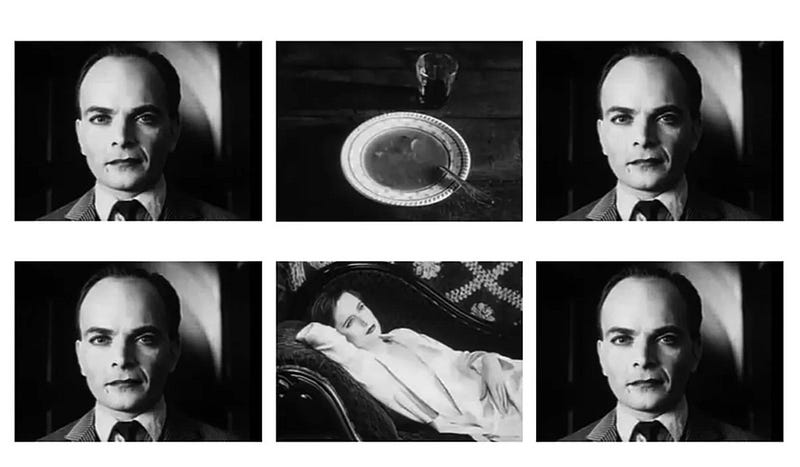
“Kuleshov’s exercise shows how unwilling we are to be without a story, and how avidly we will work to impose story structure on a meaningless montage.” (Gottschall 108)
Here we can see how both authors come together in equivalent thinking. In this trial, the spectators brought their own punctum to the experiment. This caused them to see images full of emotional expression rather than just a man with an empty gaze. Barthes argues that the reasoning behind this is that human beings are always on the quest to discover meaning in life.
“Society, it seems, mistrusts pure meaning: It wants meaning, but at the same time it wants this meaning to be surrounded by a noise which will make it less acute.” (Barthes 36)
Here he tells his readers that our punctum is always affecting the way we view art. We will always insert our own importance onto the fiction and other forms of media we ingest.
Both Barthes and Gottschall use their novels to answer the same fundamental question: Why are we drawn to stories? While the authors focus on two different mediums of storytelling, they have found the same answer. Human beings are drawn to stories because they care about what is most important to us. Barthes finds his answer after reflecting on why his mother’s photographs harbor such an intense emotional response from him. He writes,
“I had understood that henceforth I must interrogate the evidence of Photography, not from the viewpoint of pleasure, but in relation to what we romantically call love and death.” (Barthes 73)
Art is the medium in which stories come through. Artists, photographers, and authors understand that the way to create moving works is to have it be about the human experience. Gottschall explains,
“Stories universally focus on the great predicaments of the human condition. Stories about sex and love. They are about the fear of death and the challenges of life.” (Gottschall 55)
In my creative work, I focus much too hard on the potential reaction of the spectator. I am at a point in my early stages of creative writing where I feel overindulgent and that my work will not touch others who have not shared my experiences. What I’ve learned in my time with these novels is that in my work, as long as I focus on human experiences and evoke emotion that touches me, I don’t need to worry so much about the punctum and stadium of the spectator, because regardless they will bring their own meanings and feelings to the fiction. This has given me a great sense of comfort. And I hope that perhaps it provides you with some as well.

Thank you for reading ^^ Please consider “buying me a coffee” with the link below, it helps support my goal of hiring beta readers for my debut novel.