
Punctuation: It Couldn’t Be That Important, Now Could It?
The 5-million dollar comma mistake … and other gaffes that could have you questioning your priorities

My first introduction to the importance of punctuation and its spoken counterpart probably came at about nine or ten. My sister, who was three years older, and took every advantage of her brothers naïveté, would point at me with a horrified look on her face. “What’s that crawling up, your arm?” she’d scream. Or this one. Looking like she was about to vomit, she would say, “What’s that in the road, ahead?” And after seeing my terrified expression, her queries inevitably finished with howls of laughter and a final fit of coughing.
Donna’s dramatics might have been a harbinger to a career in acting. That, alas!, came to nothing. But the fact that subconsciously I wrestled for more than a day about the importance of pauses and commas might very well be why I’ve been parked here at my writing desk every day for over sixty-five freaking years, still in awe over the usually baffling, occasionally maddening, and sometimes entertaining, world of punctuation.
Take this example:
A guy is texting his buddies back home to convince them he made the right decision in going to college. Why should he be expected to take the time to worry about punctuation? Right? And who the hell edits their goddam texts anyway? So he pushes the send button, and instantly his friends are greeted with:
“English class canceled. all day to do whatever i fucking want! Yeah i love fucking college guys!”
Or this, from a magazine’s headline:
“Rachel Ray finds inspiration in cooking her family and her dog.”
Want a couple more? Try these on for size:
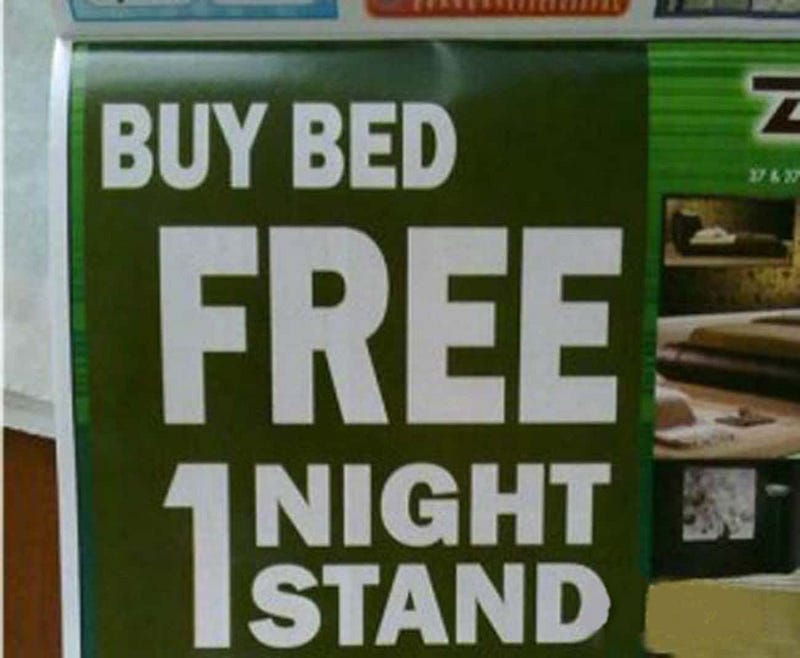
Supporting the above furniture store certainly comes with its perks! But it may not be the best store if your toddler is tugging on your arm, wanting to use the facilities:
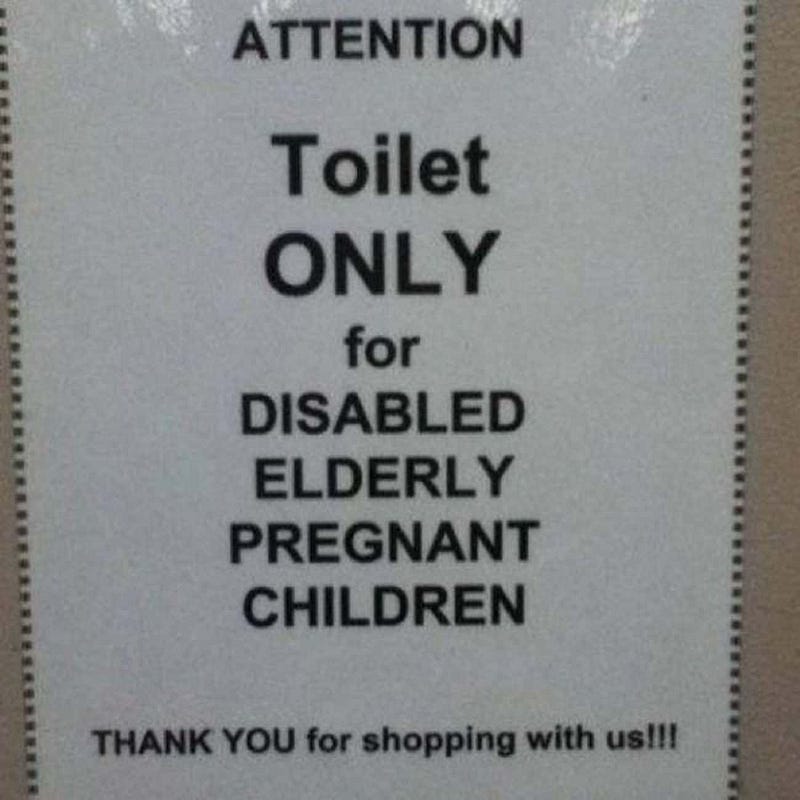
Making a case for punctuation
If all communication were spoken, you’d have little need for punctuation. For a comma, you would merely pause at the appropriate parts of your sentence; you pause a little longer for a semicolon. A full pause that a period provides can be long enough for you to whisk away that fly that keeps landing on your lip … before your listener ambles off. If you want to end your sentence as a question, you would simply inflect the final syllable. If it were a skill we had to learn, I can’t think of a better teacher than Victor Borge and his 2-minute Phonetic Punctuation tutorial.
Happily, the school system doesn’t need to test us on any of this, though. It comes to us complete with life’s start-up equipment. Some intrepid folks may want to pursue public speaking as their life’s passion, and you can find today’s standard bearers of the spoken word’s effectiveness on college lecture circuits or on TED™.
But alas! you and I, and a couple of others, have adopted the solitary task of reducing the spoken word to squiggles and scratches on a sheet of paper or a screen.
Being a writer, however — being an effective writer, I mean — comes with responsibilities. If you’re gonna play the game, you’re gonna play by the rules: Thus spake the Prescriptivist ….
Still … still, there remain a few rebels out there, shaking their fist at the gods and wailing, “I ain’t gonna follow no rules — no rule gonna slow me down!” Thus spake the Descriptivist ….
Of course, I’m describing the furthest extreme of the spectrum for the rule-keeper and the rebel. What really defines and separates the two?
Prescriptivism and Descriptivism defined
- A Prescriptivist advocates for following exacting rules for how one should speak and write properly.
- A Descriptivist believes that the process of speaking and writing should be described by how one actually does speak and write, sans value judgement and normative rules.
The two camps have been engaged in pitched warfare going at least as far back as Geoffrey Chaucer, and “The Canterbury Tales”.
The moment their bickering came to a costly head
Perhaps it was a subtler version of the Descriptivist rebel who penned the following law in the state of Maine regarding overtime wages. It read that there would be no overtime allowable for the following activities:
“The canning, processing, preserving, freezing, drying, marketing, storing, packing for shipment or distribution of: (1) Agricultural produce; (2) Meat and fish products; and (3) Perishable foods.”
Don’t look for something funny in the wording of this law. Punctuation here turned out to be a very serious, very un-funny problem. Within that short statement was a 5-million dollar mistake that sent management and labor to the courts, battling each other over a comma — or its lack!
The offending word above was the miniscule “or” in “packing for shipment or distribution …”. And the argument ran thus:
The paraphrased law states the drivers would not get overtime if they packed the product for shipment, then delivered it. The drivers may not have packed any of the three types of product, but they sure as hell delivered them. And they weren’t going to let punk management tell them they wouldn’t get paid overtime wages for it. No sirree!
And so they took management to court.
For those interested in results, it turned out the court originally voted in favor of the drivers. However, before the drivers had time to spend the overtime pay, the ruling was reversed by the district court, with the statement:
“… despite the absent comma, the Maine legislature unambiguously intended for the last term in the exemption’s list of activities to identify an exempt activity in its own right. … But, we conclude that the exemption’s scope is actually not so clear in this regard.”¹ [The use of bold in some of the text is mine]
I’m not an attorney, and truth be told, I’m not entirely sure I understand the argument, but really, the outcome isn’t important for our purposes. What is important is how the misplacement of a solitary comma — the Oxford comma — can lead to such dire results.
The Oxford comma was, and still is, one more bullet being shot back and forth between the Prescriptivist and the Descriptivist.
That 5-million dollar battle in Maine was fought in the economic and legal arena, but it mirrored every bit as fierce a battle on the academic, intellectual, and specifically, on the grammatical level — a war that has been going on between the Prescriptivists and the Descriptivists for centuries.
The role that these two combatants play in the history of linguistics is too vast a subject for this article. Here, I’ll be content if I can demonstrate each one’s view on punctuation, and not all of punctuation (which would still be too heady a task), but narrowed down to the comma — more specifically, the Oxford comma, aka the serial comma.
The Oxford comma battle line
England’s Oxford University Press lined up their forces in 1905, fired the first bullet and gave the call to charge against conventional grammar by making an incontrovertible statement about the last comma in a series. Proudly they announced it would be hereafter called “The Oxford comma”.
The Oxford comma defenders say that by not putting a comma after the penultimate word in a series, then both words become combined in the reader’s mind. And they use the example:
I packed my bag and in it, I put: a book, my toothbrush, a white towel, my laptop, water and juice. Water and juice, in the Prescriptivist mind, become a mix, and the total number of items on the list become 5, instead of the intended 6.
Without the Oxford comma, the reader is left to untangle the meaning in a sentence like the one below, in the Times™ (whether it’s the New York Times or the L.A. Times isn’t disclosed):
“Highlights of his global tour include encounters with Nelson Mandela, an 800-year-old demigod and a dildo collector”.²
It’s a tossup whether Nelson Mandela would be more offended by being described as 800-years-old or owning a dildo collection.
The Associated Press (AP) Style Guide takes a definitive stand against the Oxford comma by saying that if the sentence’s meaning is clear without the final comma in a series, then leave it out. If it’s not clear, then include it.
But showing their true stripes as a Descriptivist, this is what AP says about punctuation in general:
“[Punctuation] marks should clarify meaning and, like shouting, should be employed sparingly. Skillful phrasing avoids ambiguity, insures correct interpretation and lessens need for punctuation. When punctuation is used, it should be employed solely to bring out what is intended. If punctuation does not clarify it should be omitted.”³
Parting thoughts
It appears that you and I are left with the final question: Where do we stand regarding the Oxford comma?
Do you stand with the Prescriptivists from Oxford University in saying that the Linguistic world without law is tyranny. Our language cannot survive with ambiguity. Removing the Oxford comma from its rightful place in the sentence admits to this ambiguity — ergo, anarchy!⁴
Or are you on the side of the Associated Press’s Descriptivists, who after listening to the opposition say, “Give us a freaking break! Do you take us to be ignorant jackasses, who cannot distinguish — on an as-it-occurs basis — whether a comma can be unambiguously left out of a serial sentence? Can’t you see that codifying every aspect of language robs it of its natural juices, its vitality?”⁵
So, I ask you, where do you stand?
As writers, we’re not obligated to side with either camp. But we ought to cherish the principles underlying what they’re doing — for the fact that they are fighting for nothing less than the vitality of our language. We don’t have to fall into their ranks, to shed blood with them, but we’d better the hell be happy that these groups exist and are raising their lance and shield for our language.
If we passed an embattled grammatist from either camp on the street, would it hurt us to lift our hand in salute and say, “Thank you for your service!”?
References and Notes
¹ https://muckrack.com/blog/2022/05/04/oxford-comma ² https://www.oxbridgeediting.co.uk/blog/funny-grammar-mistakes-commas/ ³ AP Stylebook, 1953 Edition ⁴ and ⁵ [In my summary of the Prescriptivists and the Descriptivists above, I am not speaking as an authority on either the Oxford University Press or the AP Stylebook, though I am trying to articulate each one’s position of strength. I admit to having a little fun while doing so.]


