
Publishing to Larger Publications Isn’t Necessary to Make It on Medium
Create your own today.

Last month, I decided not to submit to larger publications and publish to publications where I’m the editor to see if it made any difference in my overall stats.
My New Medium Strategy for the next 30 Days at Least
A new recipe to making in on Medium.
medium.com
No. It didn’t at all; it was a total wash. And this really surprised me.
I was shocked to find that getting accepted and published in the larger publications makes little difference for my Medium journey.
As one reader commented aptly,
“Exposure on popular Medium publications is usually overrated… It’s not uncommon to hear crickets where you expect a screaming crowd.”
Exactly.
A good story is a good story and will be found, whether it’s published in your own publication or a larger one.
Two Caveats.
One — you need curation wherever you publish. Curation is still the gold standard and makes the greatest impact on whether a story is seen across Medium. The more topics a story is curated in, the more people will have a chance to see it.
Two — if you have a low follower count, this may not hold true.
I have 5K followers, this makes me less dependant on larger publications. I don’t know if the same advice can be applied to a new writer with few followers. That said, once you have built up your follower count and the follower count for a publication you create, it makes little difference.
My Views, Reads, Read Ratio, and Fans were about the same; Fans and Responses were slightly higher when a story was published in my publication.
It may make more sense to put effort into a publication you create.
When a person chooses to follow your publication, they are really buying into you as a writer and not the many writers that more extensive publications offer.
True Fans.
When a follower makes the conscious decision to follow you, they know what they’re getting, they know what kind of content you offer, what topics you investigate, and are familiar with your personality as a writer; basically, they know what they’ll get from your writing style.
They made the active choice to click “follow” next to your profile, so you are what they want — this makes them a true fan.
When readers choose to follow a large publication, they’re following what the editors of that publication curate for that reader.
Many larger publications say they are about one thing, but often they can be kind of vague. For many publications, it is sort of a mishmash of writers writing about all sorts of stuff. Despite the guidelines they provide, the editors often don’t follow their own policies.
Also, I’ ve had titles changed to make them less appealing; this irks me.
I was pleasantly surprised that it didn’t make much of a difference where I publish, but rather, if I’m curated. It was pretty much a wash. This indicates the followers of my publications are reading and following for a reason.
I will still submit to larger publications to find followers I wouldn’t be able to reach, but I’m putting less emphasis on it and more effort into building my own.
I’m also giving thought to creating another publication where I allow other writers to publish. I’m not sure I have that kind of time to edit and read submissions.
Let’s now talk about the Medium stats page.
Up until this point, I didn’t pay much attention to my stats. I think it hampers a new writer from writing. Stats can be a bit discouraging in the beginning.
Even now, for this piece, I found my stats depressing.
About 5% of my stories drive my income, and the rest don’t earn much. That is a lot of writing for nada.
However, once you have a few followers and you know what to look for, stats can help you determine which content resonates with your audience, then you can breakdown what works.
It is the headline, the content, or the image?
Most likely, it is a combination of those three. But you get a better idea of what content to create.
Overview of Medium stats page.
Once you have a readership, there’s a lot you can learn from your stats page if you know what to look for.
You can get to your stats page by clicking your profile and navigating to “Stats.”
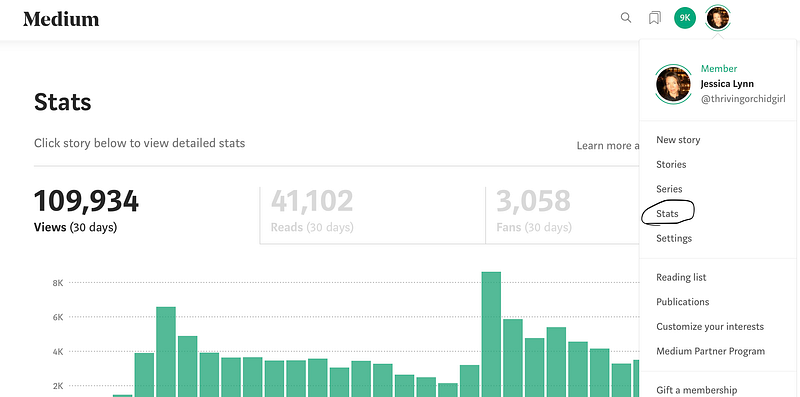
When you go to your stats page, you will see a chart, like mine above, for the last 30 days.
- Views are the number of visitors who clicked on a story’s page.
- Reads tell you how many viewers have read the entire story (an estimate).
- Read Ratio is the percentage of those viewing an article who actually read it. It’s the relationship between “Views” and “Reads.”
- Fans represent the number of unique readers who clapped for your story.
- Details — for each story you’ve published, you can click “Details” to better understand that story’s audience.
Here are View, Reads, Read Ratio, and Fans for five of my stories, plus one Newsletter.
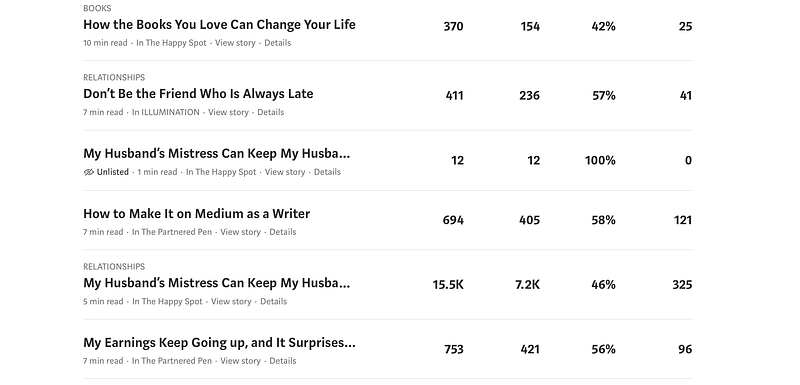
Reads are the most important number for me because that is how Medium determines payout amount.
To make money on Medium, you want the Reads and Read Ratio stats to be high. A high read ratio means people are actually reading your story. This is how you get paid — reading time.
As you scroll down, you will see your stories in reverse chronological order. If a story is curated, the topic or topics in which it was curated will appear at the top of the story (in all caps).
By clicking “Details” on an individual story, you can see the stats for that story.
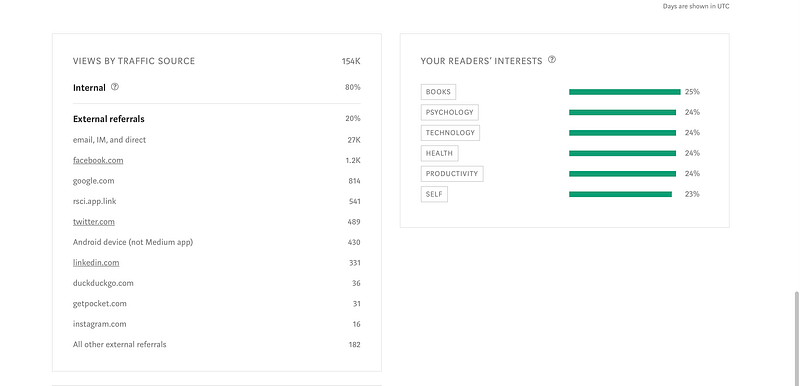
This is where “Your Readers’ Interests” can be found. This stat can help you understand your audience more fully; you’ll see a chart that shows the topics that the readers of this story are most interested in and where the traffic came from.
Most traffic comes from Medium internally, but you can see external traffic also. This tells you if sharing your work on social media, like Medium-centric Facebook groups, is paying off.
Don’t obsess over stats.
There is a lot you can learn from your stats, but don’t obsess.
I don’t like stats. I like statistics in general; it was one of my favorite classes in college; I like other stats but not when they’re tied directly to my creativity.
Yes, I write for money. I like money, no, I love money. I love the mental freedom money provides and how the security of having money in the bank makes me sleep well, but that can’t be the primary motivator for writing, or I wouldn’t write.
You need the love of writing to write because it isn’t an easy gig.
I write because I love it. It helps me process the world around me; it helps me know myself; it keeps me sane, similar to the effect exercise and meditation has on my mind. I write to process emotions and thoughts to organize them in my brain.
I’d write to be free. And I would write for free.
Don’t obsess over stats; use them as a guide.
In the year plus I’ve been on Medium, I’ve spent about an hour total looking at my stats.
Some months I don’t even go on the stats page. This is unusual. I’m aware it’s a possibility I’m shooting myself in the foot by not looking at my stats, but I would rather focus on becoming a better writer.
The only metric I’m interested in is if I’m being curated at a high rate. When I see that I am, I keep writing.
If stats are measly in the beginning, it can discourage you from writing and publishing.
Establishing a publishing habit before you start digging into your stats is helpful and more inspiring. The first comment I received on one of my stories kept me writing for months.
Writing is hard, daily writing even harder.
If you don’t have an established daily writing habit, measly stats can affect your writing and confidence.
Ignore them until you have traction.
You can choose to order your stories by Views, Fans, Reads, or Read Ratio.
This is really interesting.
When I chose to organize my stats page by “Reads,” the top seven stories were all curated, confirming what I thought, curation matters more than any single thing on Medium.
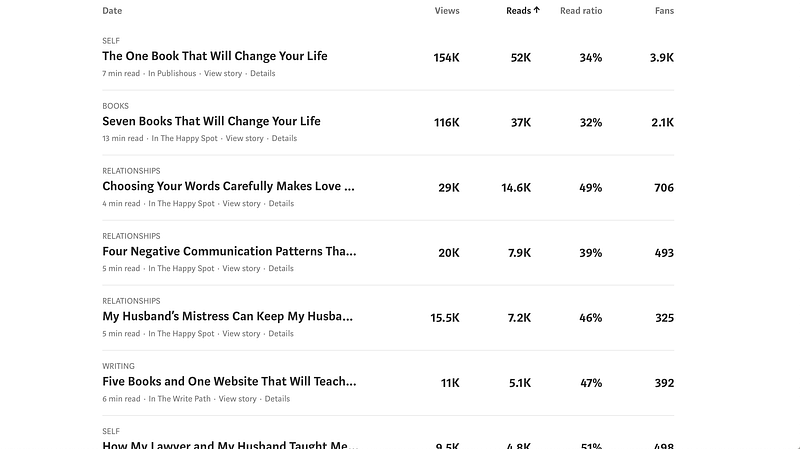
Curated stories have longevity — longer legs — than uncurated ones. The more topics a story is curated in, the more views.
Five out of my top ten earning stories were published in my own publication. And that is what the numbers below bear out.
For me, larger publications (although I have yet to get into Forge and Human Parts) don’t equate to more views.
A good story is a good story, no matter where it’s published.
Curation matters more.
It’s important to note, others may have different results and will have a different experience.
My experiment by the numbers.
I compared my stats for the two months in question.
I compared the stats from August 18 to September 18, when I didn’t publish to larger pubs, to the dates July 21 to August 21, when I did post to larger publications. (I couldn’t choose August 18 because I took the numbers from the email Medium sends to each writer each week).
Results: For me, it was pretty much a wash. You have to take into consideration I have over 5K followers on Medium and counting.
Larger publications plus my own: July 21 — August 21
- Views — 100.2
- Reads — 34.9
- Fans — 1.6
- Responses — 153
Publishing only in my two publications: August 18 — September 18
- Views — 91.7
- Reads — 34.7
- Fans — 2.6
- Responses — 216
Upshot.
I received 1,000 more fans when I was posted to my own publication and more responses.
Views and Reads are pretty much the same, with 10K more views with larger publications in the mix, but they didn’t translate to more reads.
It’s a total wash.
To make the experiment purer and more valid, I need to commit to a month I only publish to large publications and not to my own. I’m not sure I’m willing to do that.
I may attempt this in November and reevaluate this experiment.
Stay tuned.
More Medium…
Jessica is a writer, an online entrepreneur, and a recovering Type A personality. She lives in Los Angeles with her extrovert daughter, two dogs, and two cats.


