
Publishing Industry
Trends, Insights, Disillusions, and Possible Pathways (There is still hope)
We (the writers) all dream of being published, right?
Even if we are too timid to admit it openly or are given to shyness that permits only muttering into one’s chin — ‘one day, maybe,’ while feeling the warmth of dreaded blush traveling into our cheeks — the truth is every writer needs (and wants) a reader.
Preferably more than one or two, friends and family excluded, for those folks have little choice but to cheer the struggling writer on or risk being written about. I once heard that any family is ruined when a writer is born into it! I will leave it to you, dear readers and writers, to decide whether or not you agree with that notion.
The sheer proliferation of platforms like the one on which I’ve written, and you are reading these lines confirms that all who write seek those who read.
But how and where are those highly sought-after readers to be found?
While, especially to the younger among us, it may sound like a fairy-tale, there was a time (and not so very long ago) when the road from a writer’s desk to bookshelves and readers was relatively straightforward.
Writers sat in their solitary rooms, obscure cafes or even prison cells, penning the stories and poems that will become timeless masterpieces by the flickering light of candles, or gas-lamps, or unreliable lightbulbs, before submitting them to the publishers that usually frequented the same obscure cafes or clubs as the said writers.
The great(est) literary master — F.M. Dostoevsky, struggling to feed his gambling habit from his engineering and translating work, decided to write a novel to raise money.
In a letter to his brother Mikhail, he wrote: ‘It’s simply a case of my novel covering all. If I fail in this, I’ll hang myself.’ Less than two years later, he wrote to Mikhail that he was ‘seriously satisfied,’ with his novel.
A friend with whom Dostoevsky shared an apartment suggested giving the manuscript to a poet (Nikolay Nekrasov) who was working on publishing an anthology. After Dostoyevsky handed his 112-page debut to Nikolay, the three men spent the night reading and discussing the piece, concluding that it must be shown to Vissarion Belinsky, the most influential literary critic of the time, the very next morning.
Despite Dostoevsky’s scepticism, Vissarion loved the novel, and the ‘Poor Folk’ was published in the Almanack St. Petersburg Collection on the 15th of January 1846. The rest, as the saying goes, is the history in the history books. (That’s me trying to avoid the cliche).
There are many similar examples.
Mighty literary dame — V. Woolf, published her first novel, ‘The Voyage Out,’ in 1915 through her half-brother’s publishing house, Gerald Duckworth and Company.
While the Duckworth’s reader, Edward Garnett, wrote an encouraging report on the novel, neither this nor the family connections could alleviate Woolf’s anxieties that made her hypersensitive to any form of criticism. Despite that, her second novel ‘Night and Day,’ was also published by Duckworth.
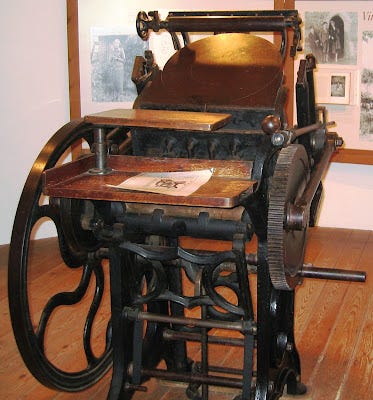
As it was becoming more and more obvious that the process of submitting work to a publisher filled the delicate writer with horror and misery, Virginia and Leonard Woolf set up their own press (Hogarth Press) in 1917. Owning their press meant they could publish whatever they liked. In 1922 Hogarth’s Press published Virginia’s third novel ‘Jacob’s Room,’ enabling her to develop her, at the time, experimental style.
Now, if you think that arrival of the internet has given us all chance to ‘own our presses and develop our own unique, experimental, or otherwise, styles’… I am not so sure.
Prior to the relatively recent arrival of OpenAI, every word on the World Wide Web was (mainly) written by a human in possession of a keyboard. Unsurprisingly, many have seized the opportunity for what it was or, to some extent, still is — an easily accessible and lucrative marketplace. Hence the proliferation of endless platforms, portals, blogs, sites, etc. Not that anything is necessarily wrong with any of it; after all, this is how any free or unregulated marketplace functions — make your own luck.
It sounds ‘free and fair’ for all, doesn’t it?
Well, no.
As there is no such thing as ‘free and fair’ for all in real life outside the internet, neither is it in the virtual one. After all, the members of the same species inhabit both worlds.
Owning to seemingly endless demand and an almost guaranteed success, as professed by those selling ‘how to’ achieve the said success, the interest in ‘becoming a writer’ reached never-before-seen heights and the marketplace responded accordingly.
Countless and mostly overpriced writing courses sprang up in just about every English-speaking university worth its salt. In return for the hefty fees, the said universities provide the privilege of their facilities where wide-eyed, wanna-be-writers mostly sit around the tables and discuss each other’s work, encouraged gently by one of the university’s teaching staff, at the end of which they are released into the wide world where to try their luck amongst zillions of other similar graduates. Stroke of financial genius, don’t you think?
As humans are creatures of habit and imitation, a multitude of courses, consultants, coaches, and gurus soon become available to any aspiring writer, on and offline, covering everything from writing the first word to seeing one’s book published in some form. The need to immortalise one’s thoughts in writing has never been stronger or more widely spread. You could be forgiven for believing that a hidden writing genius sleeps inside each of us. Perhaps it does.
But I rather think something else is far more likely. Namely, the same shenanigans the good old marketplace has always recognised as its most profitable commodity — the peddling of dreams. The method is the same as it always was — by the time we realised that, for instance, our hair hadn’t grown any thicker or glossier, the money we shelled out for the expensive pomade had long changed hands.
Granted — by the time we realise there isn’t and never had been a sleeping Hemingway, or any other great writer, inside us, we are likely better writers than when we started the course or purchased some other aid, but the fundamental principle remains the same — cashing in on people’s desires. In this instance — a desire to be heard, seen, noticed.
Because, at its core, publishing a book (or any other piece of writing) is asking someone, preferably many people, to stop whatever they are doing and listen (read) what the writer has to say.
No more, no less. This applies to this article and any other piece of writing I (and you) ever wrote and published somewhere that is not our under-the-lock-and-key diary. It is the fundamental human desire to be noticed. To matter, at least somewhere, to someone, somehow.
It is what, apart from revenue, drives the hyperproduction of writing, especially online. As the time and space for real-life connections shrink in favour of web-based ones, the writing follows suit, content writing especially.
Meanwhile, traditional publishing is becoming more and more opaque, some say, in an attempt to prevent collapsing under the sheer number of manuscripts received daily/weekly/monthly. Yes, the courses work as intended, and every year a new generation of hopeful writers is unleashed, hoping for publication.
As a result, it is no longer enough to tirelessly research agents/publishers, religiously craft query letters and synopsis to their individual specifications… Sorry, but no. That is nowhere near enough.
Although nobody openly admits to it — if you are serious about your manuscript and wish it to be seen by an agent — you better have money to spend.
Yes, that’s right, and no, you will not be asked to pay for an agent to read your letter or synopsis — that would be far too crude. Nothing like that.
Instead, you will be gently nudged or reminded of all the helpful courses and resources the agency offers. From ‘how to write a query letter, synopsis, get published’ to ‘face-to-face chat with an agent’ and access to their ‘most-up-to-date databases of agents, editors, book-doctors, mentors, tutors.’ Each is priced accordingly. Depending on what you select, the cost can and often does run in thousands.
This is not to say that those resources are not helpful. Most of them are very helpful indeed. Getting feedback directly from an agent is hugely valuable to any writer, especially new(ish) ones. It is how representation is secured. Providing one can pay for it. It also means that an agent who is getting paid for a one-on-one conversation is likely engaging with the writing in a way that they otherwise may not. They may not even see it under the slash pile.
But, and it is a rather big BUT — does that mean mostly, or even only, the writings of those that can afford the price tag will be seen by agents?
I have come across a very pricy novel-writing course that promotes itself as a ‘place from which the agency running it will be seeking new clients.’
Is there interest? You bet! There is a waiting list despite the hefty fee. In essence, it is a paid pitching opportunity. Many of those paying for it are probably not publishable to start with. I suspect the truly hopeful ones are the ones from whom the most revenue is generated. And I bet the agency knows it too.
Hair-growing pomade, anyone?
Luckily, there are still those, albeit few and far between, who, like the marvellous Jane Friedman offer free resources on their sites from which the chart below has been sourced as a helpful, up-to-date resource I found very useful, and you might too.
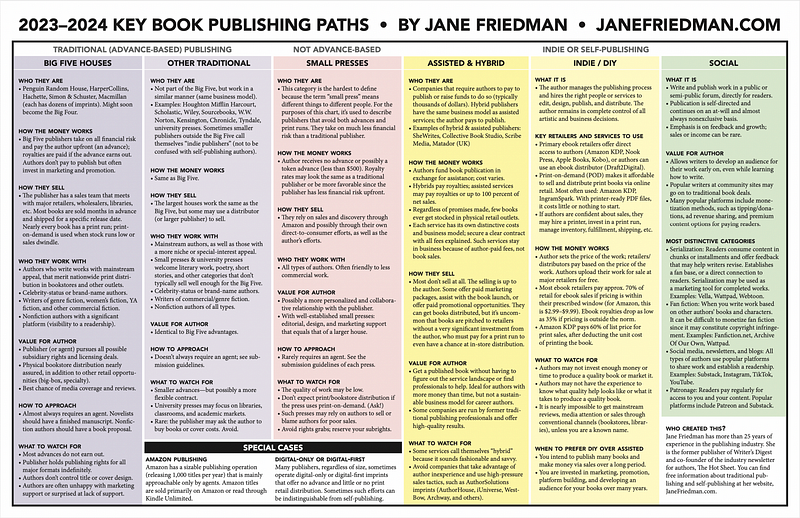
Let me know in the comments if you found it helpful and about your own experiences with publishing.
Thank you for reading.


