
Public School Teachers Pay Zero Income Taxes!
Want to Increase Teacher Recruitment and Quality?
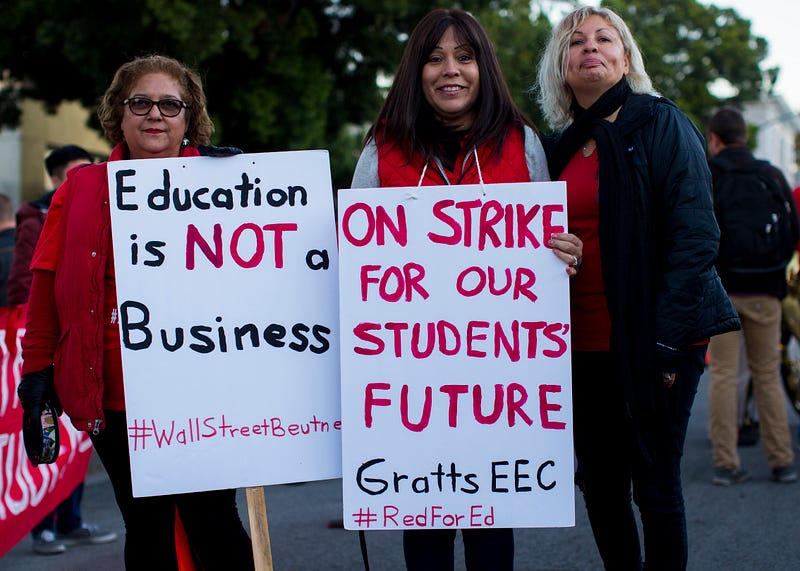
Do I even need to regal you with the depressing stories of teachers quitting their jobs because they can’t afford to live on only a teacher’s salary? Do I have to narrate the journey of the teacher working two jobs during the school year? And then working full time during their short-lived “summer vacation?” Do I have to produce the stats on the woefully low starting salary that can be in the range of $30K in some states?
I know. It is disheartening. So…
How about we skip right over the teachers who are quitting by the droves and the classrooms that do NOT have a certified teacher to instruct children? I do want to scream “I’m as mad as hell, and I can’t take it anymore!” — but, of course, the parents dealing with this issue are the ones who are tearing what’s left of their hair out.
Naturally, they are parents who live in districts with far too little funding because the state allocates money for districts based on the taxes they contribute. Jonathan Kozal makes that case over and over in his books, beginning with Savage Inequalities and The Shame of America.
So rather than terrifying you with horror stories about the public schools being savaged by political forces that keep the money flowing to the least needy, like the charter schools that cherry-pick the students and get public funds and little regulations, I like to offer a fairly simple first step.
All full-time public school teachers should pay no federal or state income taxes. None. Nada. Zero.
Let’s consider the advantages: their salary would increase by the thousands. Their once-a-month paycheck would likely jump at least $1,000 to $2,000 dollars — basically the cost of their rent (since the youngest teachers can’t possibly afford a mortgage for a house). And politicians would not have to raise taxes to pay for it (at least not obviously).
I know what you are thinking. But then the federal government and the state governments would be in deficit. True of the states, but the federal government is already in deficit. The federal government can recoup the loss of income in many ways — a 2% additional tax on the top earners would flush the federal bank accounts. I guarantee that teachers are nowhere near that level.
How can I justify NOT waiving federal or state income taxes for private school teachers? Answer, “teaching positions at private schools are not typically classified as government jobs.” Sorry, if you don’t work for the government’s public schools, you do not get the perks of avoiding income taxes. You already get the students who enrolled for religious reasons or wealth considerations — that’s your bonus.
As for the state governments that cannot operate in a deficit, two things to consider. First, the state governments foot most of the bill for education, so they have a lot of financial responsibility. Surprisingly, many states already do NOT have an income tax. This includes some of the worst offenders that supply poor salaries for teachers. As of 2022, Alaska, Florida, Nevada, New Hampshire, South Dakota, Tennessee, Texas, Washington, and Wyoming are the only states that do not levy a state income tax. Texas and Florida stand out as states that reach the zenith of teachers’ dissatisfaction. Remember: follow the money. Where there is a lack of income for the state coffers, there will be a school with little funding to staff its schools.
So would teachers in those aforementioned states not receive much help financially? Consider the fact that their federal income tax would be waived, and that is a bigger financial relief compared to the amount paid for state income tax. I am quite sure they would be very happy. If not, they will move to another state where they will reap the reward of not paying ANY income tax.
Second, states with income taxes will have to raise taxes for those whose income is in the highest bracket. For the states with no income tax, they will be pressed to raise either property tax to offset the decrease in federal funds. Remember, these states ALREADY do not get revenue from a state income tax FROM ANYONE, so it is just the nominal federal funds that they will have to make up for with their own revenue. THAT MONEY WILL NOT BE COMING FROM THEIR PUBLIC SCHOOL TEACHERS!
Here is the part of my essay that will blow your mind; a progressive state is already moving in my direction. Seriously. California, for example, reported in the Sacramento Bee:
“Senate Bill 807, introduced by Democratic Sens. Henry Stern of Los Angeles and Cathleen Galgiani of Stockton, offers an incentive for teachers to remain in the classroom. After teaching for five years, California educators would be exempt from paying a state income tax.”
Let’s imagine what this will do for the teaching profession. Democratic Senators Henry Stern of Los Angeles commented on the impact on teacher recruitment and job satisfaction: “[Stern said] it would lead to higher teacher retention rates and better trained teachers, factors that would contribute to a stronger state economy. ‘The teaching profession is critical to California’s economic success and impacts every vocation and profession in the state.’”
Who would be most affected by the California proposal? “Ongoing studies from the Learning Policy Institute, a Palo Alto-based research and policy organization, have consistently found the teacher shortage is the most severe in special education, math, science and bilingual education, and in rural and inner city regions.”
Now for the bad news. The bill did not pass. According to EdSource in 2017: “But the bill likely faces opposition in the legislature and from Gov. Jerry Brown, who indicated in his initial 2017–18 budget proposal that California can’t afford new initiatives to tackle the state’s ongoing shortage of qualified teachers. Governor Jerry Brown, at the time the bill was brought up in 1917.”
I love Jerry Brown. He probably was correct in his assessment in 2017. The same source took a stab at the financial impact on California as an example. “The initial language of the bill doesn’t include cost estimates. However, EdVoice, a nonprofit education advocacy group that supports the bill, estimates that it could cost the state $608.5 million annually in lost tax revenue, and an additional $9 million to pay for tax credits for teaching candidates to cover fees for credentialing programs or master’s degrees.”
However, all those figures must be reconsidered when one peers into the six years of turmoil that follow. It was before Trump’s attack on public education with Betsy DeVos, and more significantly, it precedes the COVID-19 pandemic. I have a good feeling the now-retired Brown would be of a different mind as he looks at the current landscape in education.
So this idea to waive all income taxes for public school teachers is a dramatic change in how we support America’s teachers. But consider this: just waiving the state income tax ( for teachers with five years in the classroom) would be a huge bonus for the teachers: “For typical teachers with five or more years of experience, not paying state income taxes would be equal to a 4 to 6 percent pay raise, according to EdVoice estimates.”
Do I even have to ask the question: How can we continue the status quo when we undervalue the teachers’ salaries and then tax them on top of the fact that they are already working for the public good as government employees?
Yes. I suppose these questions need to be asked to the governors and congressional representatives, senators, and presidential candidates. Of course, too many of them have their children in private schools, just like Betsy DeVos — so what do they really care?
Sometimes I feel like I am spitting in the wind.
Robert Pacilio is the former San Diego County 1998 Teacher of the Year and the author of several books on teaching. He also trained teachers for 17 years as a core adjunct professor for National University and Teach for America.