
Psychology-Based Strategies for Increasing the Motivation to Learn
Nurturing Self-Management in the Classroom

Various researchers (Cruz & Cullinan, 2001; Maslow, 1987; Ointrich & Schrunk, 2002) have demonstrated a strong positive correlation between motivation and achievement. Motivated learners approach tasks eagerly, exert high levels of effort, and persist in the face of difficulty. When students lack adequate motivation, they often become restless and disruptive in the classroom as well. Borrowing from the behaviorist and social learning theory perspectives, teachers can employ various strategies to encourage positive classroom behavior, increase motivation and facilitate student achievement.
Shaping
Shaping refers to “a process that involves reinforcing learners for making gradual progress toward a terminal behavioral goal” (Fetsco & McClure, 2005, p. 43). The process involves setting goals for students and reinforcing successively closer and closer approximations to that behavior. As a new level of performance is achieved, the target goal is successively adjusted to a higher level. The process typically involves five steps, including: (1) Identifying the desired target or terminal goal; (2) Identifying sub-goals, referred to as successive approximations, that progressively move the student toward the terminal goal; (3) Identifying the current level of student functioning in terms of the identified successive approximations; (4) Assisting the student’s progress through the successive approximations by providing reinforcement for each progressive step toward the terminal goal; and (5) Continuing the process until the terminal goal is reached. Shaping has been identified as particularly effective for skills requiring persistence, endurance, increased levels of accuracy and greater speed or extensive practice to master (Shunk, 2004; Woolfolk, 2003). However, it also represents a relatively time-consuming strategy that requires constant monitoring.
In applying this strategy to increase reluctant or disruptive students’ motivation and effort in their learning process, the teacher would work with them to set a final goal of consistently turning in all homework assignments (e.g., five math homework assignments completed each week). Initially, any response that resembles the goal would be reinforced. If the initial rate of performance reflected an average of one completed assignment each week, the successive approximations would bridge the gap between the current level of one and the terminal goal of five. The teacher would use shaping by reinforcing students for improving on the number of completed assignments submitted. This may begin as reinforcement for completing two assignments. Once this rate is relatively stable, reinforcement would be given for the completion of three assignments (no longer reinforcing for levels below this) and so on until the terminal goal is reached and maintained.
To address disruptive behavior, a similar process would be initiated whereby students would be progressively reinforced for longer and longer periods of independent work without interruption. At the onset this might be implemented by reinforcing five minutes of quiet work without interruption. Gradually, as students respond to the reinforcement the time would increase until the behavior reflected the desired level.
Vicarious Reinforcement
The process of vicarious reinforcement refers to increasing the probability or frequency that a behavior will be repeated based upon the individual observing another person being reinforced for that behavior (Ormrod, 2004). Bandura (1986) argued that learners were not entirely dependent upon immediate environmental experiences to modify their behavior. He posited that vicarious consequences which are observed and interpreted rather than being experienced directly by the learner, can act as strong mediators of behavior, serving to elicit new reactions, reinforce previously learned responses, or influence inhibitions.
The classroom represents a myriad of opportunities for teachers capitalize upon the phenomena of vicarious reinforcement and influence the behavior of select students and the larger group. Social praise or reward can serve as a strong motivator for children of all ages. In applying this strategy, the teacher can provide opportunities for students to witness a target behavior being reinforced when performed by other children. Specifically, while in a target student’s presence, the teacher can praise or assign privileges to other students who remain on task, complete assignments and do not cause disruptions. In this way, the target behavior is not only modeled but also reinforced through a desire to receive the same rewards.
Premack Principle
The Premack Principle of operant conditioning was originally identified by David Premack in 1965. According to this principle, also known as Grandma’s Rule or activity reinforcers, a more frequent or more preferred behavior can represent an effective positive reinforcer for a less frequent or less preferred activity (Ormrod, 2004; Schunk, 2004). In general, students will be more motivated to perform a particular activity if they know that they will be able to partake in a more desirable activity as a consequence. Thus, if more desirable behaviors are made contingent upon less desirable behaviors, then the lower probability behaviors are more likely to occur. In order for the Premack Principle to be effective, the low frequency behavior must occur first.
In applying this strategy, the teacher would identify preferred activities that would represent a high frequency behavior for target students. Perhaps they love animals and enjoy the task of feeding the class hamster. Alternately, perhaps they enjoy free time in the school library. When these high frequency behaviors are identified, the teacher may set up conditions such that the students are allowed to engage in these favored activities once they complete an assignment or remain undisruptive for a certain period of time. In this way, students may be persuaded to bargain, so to speak, for the privilege of engaging in the preferred activities.
Self-Monitoring
Self-monitoring refers to the behavior management process by which students identify and record occurrences of identified target behaviors as part of a broader process of self-management. As such, it represents both an assessment and an intervention strategy. As an aspect of a behavior modification program, the self-monitoring activities are considered reactive effects, whereby the process of monitoring and assessing the behavior leads to its reduction (Fetsco & McClure, 2005; Schunk, 2004).
The process of self-monitoring involves a series of steps, including: the selection and definition of a target behavior; observation of the behavior to determine a baseline; development of a self-monitoring system appropriate for the behavior to be observed; determination of a recording system; and instruction of students on the details of the process. The program should be monitored regularly to assess compliance and effectiveness. The eventual goal is the development of an independent, self-monitoring student as teacher involvement is gradually phased out of the process (Fetsco & McClure, 2005; Schunk, 2004).
This strategy would be particularly appropriate in addressing disruptive behaviors. Initially, the teacher should work with a student to specifically identify the undesirable behaviors and determine the level at which they are currently occurring — e.g., the student disrupts other students during independent work time an average of seven times each day. The teacher should also specifically and precisely identify the alternative desired behavior, which represents the ultimate target goal.
In formulating a plan success, the teacher and the student would then develop a system for recording every occurrence of a disruptive behavior. This recording process should be specifically defined — e.g., “Mark down on your scorecard every time you are talking during independent seatwork time.” Given the nature and extent of the disruptive behavior, it would most likely be necessary for this system to initially operate as a prompted recording scheme, whereby the student is provided with a visual or auditory prompt to remind them to self-monitor. At a later time, if sufficient progress is made, the monitoring can be changed to an unprompted system where the student self-monitors by their own volition, but most students will probably not be ready for that level of independence initially. A similar system for monitoring a student’s focus on assignments could be set up either independently or integrated into the abovementioned program. Figure 1 represents an example of an on-task self-monitoring system.
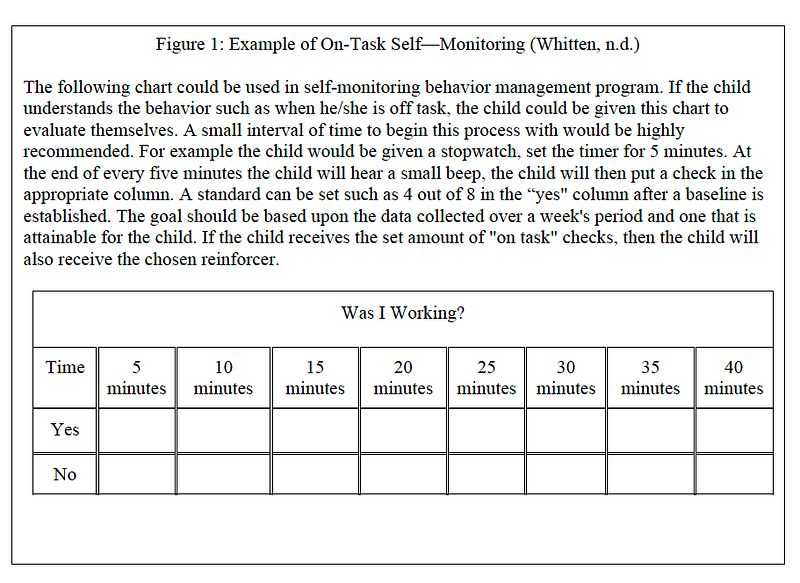
The self-monitoring strategy can be utilized both to decrease undesirable behaviors and to increase desirable behavior. As with many of the behaviorist-oriented techniques, this strategy is often most effective when used in conjunction with other techniques as part of a comprehensive behavior management program. In addition to the obvious progression toward the target behaviors, self-monitoring has also been shown to increase the intrinsic interest in coursework and classroom activity by making students aware of and responsible for their own behavior, learning process and metacognition (Benware & Deci, 1984).
Self-Imposed Contingency
Self-imposed contingencies refer to techniques of self-regulation whereby students impose upon themselves reinforcements (and/or punishments) contingent upon the accomplishment or maintenance of identified appropriate (or inappropriate) behaviors. These self-reinforcers or self-punishers can manifest in various forms from internal self-talk to more tangible rewards. As such, this strategy can represent one of the final steps in the series of a self-management program that includes learner participation in determining target behaviors, setting criteria for success, self-monitoring and self-evaluating to determine when criteria are met and the selection of reinforcers — with the ultimate target being the internalized sense of accomplishment that results from setting and meeting challenging goals (Fetsco & McClure, Jones & Jones, 2001).
It is generally considered important for students to learn to reinforce their own behaviors in order to become effective self-regulated learners. Employing techniques of self-imposed contingencies represents another step in facilitating the internalization of standards of behavior and performance. Bandura (1986) argued that providing oneself rewards for accomplishments leads to higher levels of performance than merely setting the goals and tracking progress. However, other researchers (Alberto & Troutman, 1999; Jones & Jones, 2001) have cautioned that learners have a tendency to set relatively lenient criteria for success when not adequately monitored. If this occurs, they argue, the inflated reinforcement becomes meaningless and lowers achievement levels. This difficulty can be addressed through the use of cooperative goal-setting or contracting that realistically guides students toward individual goals that correspond to their level of ability while at the same time providing stimulating challenges.
As students’ success plans progress, they can gradually work toward the implementation of self-imposed contingency practices. Modeled after the earlier steps where the students and the teacher created objectives for self-monitoring and self-evaluation, they can be encouraged (perhaps through shaping) to assess and reinforce their own success. Specifically, this could be implemented by awarding tokens (where a token economy system is used), points or stickers on a chart or claiming small rewards or privileges. The system can be managed by a contract between the teacher and the students that is periodically reviewed and, if necessary, modified. In this way, students can become more fully engaged in participating, not only in the primary learning task (e.g. the math curriculum), but also in the process of her acquisition of skills and behavior strategies. This will engage the natural striving for autonomy and independence that children exert even as toddlers with their first insistence of “I can do it myself!”
Conclusion
Self-management, with regard to learning, refers to an individual’s efforts at maintaining control of his/her learning process. An important goal of overall classroom management is assisting students in self-management by facilitating the internalization of rules, procedures and strategies that enhance learning. By supporting students in developing their ability to understand, control and evaluate their own learning, teachers promote the development of responsibility and lay the foundations for successful lifelong learning.
References
Alberto, P. & Troutman, A. (1999). Applied behavior analysis for teaching (2nd ed.). Upper Saddle River, NJ: Prentice Hall.
Bandura, A. (1986). Social foundations of thought and action: A social cognitive theory. Englewood Cliffs, NJ: Prentice Hall.
Benware, C. A. & Deci, E. L. (1984). Quality of learning with an active versus passive motivational set. American Educational Research Journal, 24(4), 755–765.
Cruz, L. & Cullinan, D. (2001). Awarding points using levels to help children improve behavior. Teaching Exceptional Children, 33(3), 16–23.
Fetsco, T. & McClure, J. (2005). Educational psychology: An integrated approach to classroom decisions. New York: Pearson.
Jones, V. F. & Jones, S. (2001). Comprehensive classroom management: Creating communities of support and solving problems (6th ed.). Boston: Allyn & Bacon.
Ormrod, J. E. (2004). Human learning (4th ed.). Upper Saddle River, NJ: Merrill Prentice Hall.
Maslow, A. (1987). Motivation and personality (3rd ed.). New York: Harper & Row.
Pintrich, P. R. & Schrunk, D. H. (2002). Motivation in education, (2nd ed.). Upper Saddle River, NJ: Prentice Hall.
Schunk, D. H. (2004). Learning theories: An educational perspective, (4th ed.). Upper Saddle River, NJ: Pearson.
Whitten, E. (n.d.). Behavior strategy management index. Retrieved October 17, 2005 from Western Michigan University Department of Educational Studies web site: http://homepages.wmich.edu/~whitten/champaign_project/behavior.html#selfmanagement
Woolfolk, A. (2003). Educational psychology (9th ed.). Boston: Allyn & Bacon.


