
Proud Mary
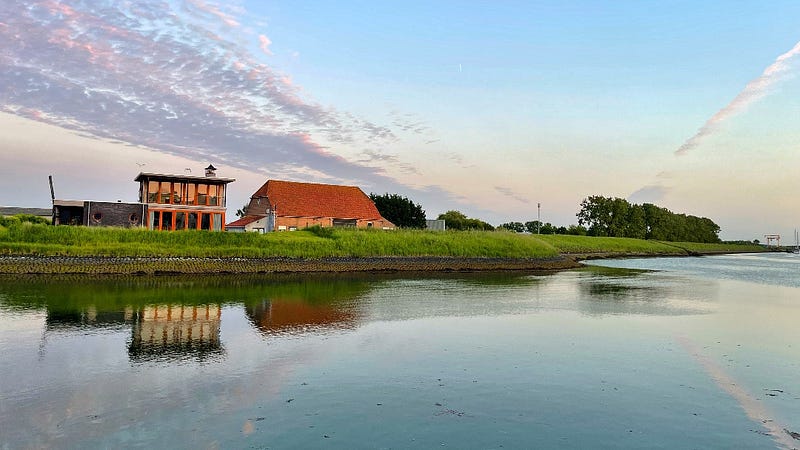
This evening, I enjoyed the sunset in the harbor of Zierikzee, the modern one, not the harbor museum in the center of town with its classic ships. I had a few beers in a small cafe while marveling at the spectacular change of hues in the southwestern sky.
I walked to the waterfront and took this photo to remember the colors, the reflection, and what photographers like to call empty space. Little did I know that amidst this breathtaking moment, the news would break about the passing of the legendary Tina Turner.
Reflecting on this unexpected coincidence, I couldn’t help but draw a connection between the name of this Dutch town and Zürichsee, in Switzerland, that Tina Turner called home. She had settled in the lakeside village of Küsnacht, embracing the serene surroundings and the privacy they offered. After a tumultuous past, it was here that Tina Turner created a new chapter in her life that turned out to be the last.
Nothing in my life resembles hers, except perhaps a longing for a quiet, beautiful place where you can escape it all, a dream that seems to grow in more people’s hearts when they grow older. She found it close to the Zürichsee, as I did in a village near Zierikzee, where I’m now writing these late-night thoughts.
There is naturally a song in my head right now, likely millions of people hum this evening tones of “Private Dancer” or “What’s love got to do with it.” But, for me, it is “Proud Mary,” one of the first songs I ever liked. I remember looking up each word in my mother’s dictionary since I didn’t speak English.
Parts of songtexts still appear as snippets in my writing; the first thousand words or so I ever learned in English were not at school, but I found them in songtexts. (Bruce’s “No Surrender” comes to mind since I might claim in this regard that I learned more from a three-minute record than I ever learned at school).
Listening to the music of the ‘70s didn’t only influence my English; it formed me in many other ways, which is why I wish that more songs would have powerful lyrics for Generation Z on issues like climate change and inequality.
And then, If I may, one more memory, a recent one. Again, Proud Mary singing in the back of my head while driving down from a small desert town towards a river I followed from its source to the border, seeing the lush green area on both sides of the river as a ribbon of life far ahead of me in the brownish Arizonan desert. And then searching for the song on Spotify at the next stop. This was just about a month ago.
John Fogerty, who wrote the song, clarified “Proud Mary” ‘s meaning in a Rolling Stone interview five years ago:
“I wrote the song about a mythical riverboat, cruising on a mythical river, in a mythical time. Perhaps, the setting was ‘back in time’ on the Mississippi River. It was obviously a metaphor about leaving painful, stressful things behind for a more tranquil and meaningful life.”