
Protozoa Tetrahymena, Champions of Adaptability
Philosophical perspective on when changing sex is a matter of survival
As long as I can remember, I’ve been fascinated by the tension between change and permanence. How do we find a balance between adapting to new circumstances while staying grounded in unchanging truths? As a spiritual seeker, this question has been a guiding light in my life. When I first encountered the Vedanta philosophy of ancient India, I was struck by its insights into the soul’s infinite adaptability despite its union with the Divine. This concept resonated with my observation of life’s paradoxical nature.
Like the humble protozoa that alter their very genetics to thrive in their environment, yet retain their essence, we too must navigate the dance between evolving outer forms and honouring inner wisdom. I wrote this piece to share my amateur musings on this mystery.
By weaving together examples from biology and spirituality, I hoped to shed light on the play between multiplicity and oneness that underlies both science and faith. This symphonic dance has brought me solace and inspiration during difficult times of transition.
My wish is that these reflections may speak to others who, like me, are learning to flow with life’s currents while remaining anchored in stillness. I write to process my questions, not proclaim truths. The harmony we seek lives in our capacity to adapt and change while listening to the eternal song of the Divine that resonates in all things. I am glad to share these faltering steps on my journey.
Anukūlatā
The ability to adapt to the environment is a fundamental characteristic of the living world. From the simple amoeba to the human being, every organism manifests in more or less complex ways this chameleonic aptitude to conform to circumstances guarantees its survival and continuation.
This extraordinary property emerges in an even more surprising way if, from the merely physiological dimension, we move to the psychic and spiritual one of existence. It is here that the Indian philosophy Vedanta introduces us to the concept of “anukūlatā”, translatable as “adaptability” or “aptitude to conform”. With this term, one refers to the ability of ātman — the spiritual essence that resides in every creature — to model itself in ever-new and unpredictable ways to the ephemeral containers that from time to time host it on its cosmic pilgrimage.
Adaptability
A magnificent description of this adaptability is found in the Katha Upanishad:
“When that golden-formed Lord is seen, the maker of all things, the God of gods, the Lord of beings, then the Sage, transcending virtue and sin, reaches the supreme equanimity”.
The realized ātman, although transcending the changing phenomenal qualities, fully conforms to the universal Brahman with perfect adequacy.
Elsewhere, in the Svetasvatara Upanishad, it is stated:
“As large beings enter small ones and, following them, although immersed [in them], still live outside them, so the Ātman remains outside the things in which it enters”.
Here emerges the clear idea of a spiritual principle which, while fully adapting to the ephemeral multiplicity of forms, never identifies with them because it transcends their limits.
The Bhagavad Gita, a sublime poem, finally completes the picture by highlighting the relationship between this infinite adaptability of the ātman and the enlightened knowledge of its true nature:
“Four types of virtuous men worship Me, O Arjuna: he who suffers, he who seeks the truth, he who desires the fruits of action and the enlightened sage”.
It is the latter — the jñāni — who, by deeply knowing the Ultimate Reality, can perfectly conform the individual nature to the Cosmic Brahman from which it emanates.
But how does spiritual realization allow this wonderful adaptive attitude of the ātman towards the Whole?
The Vedanta Philosophy’s answer is simple and at the same time shocking: ultimately, ātman and Brahman are One. The apparent phenomenal multiplicity we perceive is simply due to māyā, the power of cosmic illusion that veils our vision of Ultimate Reality.
This is why he who tears this veil through the knowledge of the Self, immediately realizes his total identity with the Divine Principle that permeates everything. And from this Awakening, the perfect “conformability” of individual consciousness to the Universal One spontaneously springs forth.
Protozoa Tetrahymena
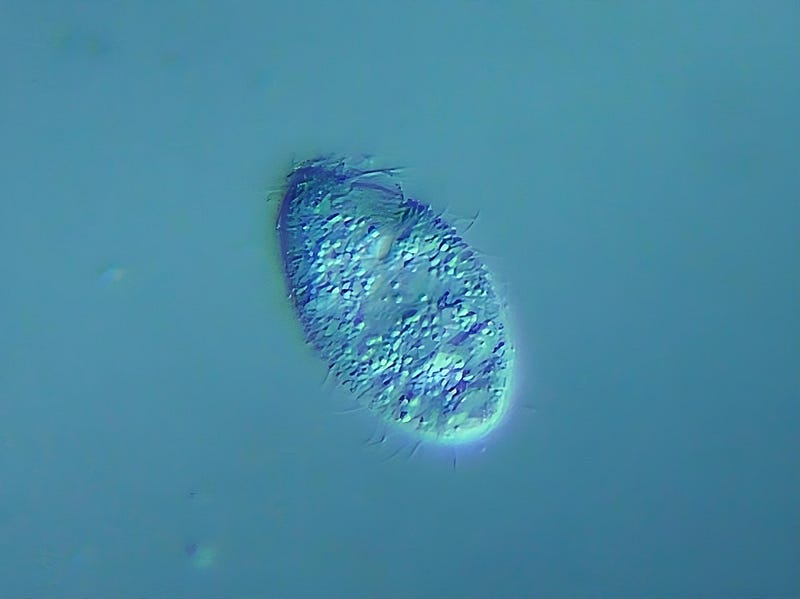
An extraordinary parallel is possible here with the adaptive behaviour of certain microorganisms. The ciliated protozoa of the genus Tetrahymena are unicellular microorganisms that have filiform appendages, cilia, on their cell membrane, thanks to which they move and feed. An interesting feature of these protozoa is their ability to modify their chromosomal makeup and sex in response to adverse environmental conditions.
For example, in the face of nutritional stresses such as nutrient deficiency, Tetrahymena activate complex mechanisms of reorganization of their DNA which lead to the elimination of some of the superfluous chromosomes. This generates a more agile and simplified genotype, able to subsist with fewer resources. This process is made possible by the fact that the DNA of ciliated protozoa is contained entirely in the cell micronucleus, an easily reshapeable structure.
Tetrahymena’s genetic adaptability
Let me explain how…Tetrahymena have two nuclei inside their cells:
- The micronucleus contains all of their DNA — this is like the master copy.
- The macronucleus contains a modified form of DNA used to run the cell.
When Tetrahymena reproduce, the old macronucleus gets destroyed. A new macronucleus forms using a copy of the micronucleus DNA.
Here’s the cool part — the DNA gets reorganized and changed while this is happening!
It’s like cutting and pasting DNA:
- Unneeded sequences get chopped out — so the DNA gets smaller.
- Useful genes get copied many times — this makes more important proteins.
- The DNA breaks into smaller chromosomes that work better.
So in the end, the new macronucleus DNA is optimized for whatever conditions the cell is in. By rearranging their DNA, Tetrahymena adapt to their environment!
The cell gets a DNA makeover, just like getting a haircut and new clothes that fit better for summer. The cell keeps its essential self (the micronucleus DNA) but changes its appearance and function.
This ability makes Tetrahymena super adaptable survivors. Their DNA flexibility allows rapid change to handle anything life throws at them!
In addition, genetically identical individuals of Tetrahymena living in isolated groups can change sex in response to local cell density: if individuals of one sex are scarce in a group, some protozoa of the other sex will begin to produce gametes (reproductive cells) of the opposite type, thus making a change in phenotypic sex. This guarantees greater reproductive possibilities and therefore survival of the colony.
Also in this case, such “sexual plasticity” is allowed by the simple yet versatile cell structure of Tetrahymena, whose cellular organelles and mechanisms of gene regulation can undergo rapid reconfigurations. Ultimately, the elementary organization of the cell body paradoxically allows considerable ability to “recombine” in response to environmental stimuli.
Harmony
The perpetual harmony of Nature rests on a paradox: the mutability of forms that cloaks the Immutable. Like the waves that ripple the ocean’s surface leaving its tranquil depths intact, every being flows in the great River of Existence through continuous exterior remodelings, yet preserving its Essence incorruptible.
Whether it is the simple protozoan that reconfigures its genotype to adapt to the environment, or the psyche that in mystical ecstasy conforms to the Face of divinity, everywhere Life knows how to adapt its manifold phenomenality to the deep call of the Origin. Like the sap that rises from the roots to the tree’s canopy taking on myriad forms on the branches before returning to the ground, the Spirit spreads out into the field of experience through infinite disguises to return to its primordial abode.
Listening to this music, letting oneself be ravished by it in one’s innermost being and dancing in perfect consonance with It: this is the supreme Harmony, the very seal of the Spirit that never ceases to adapt every form to the restoring embrace of the Infinite.


