
Protesting for Pringles
And the post office
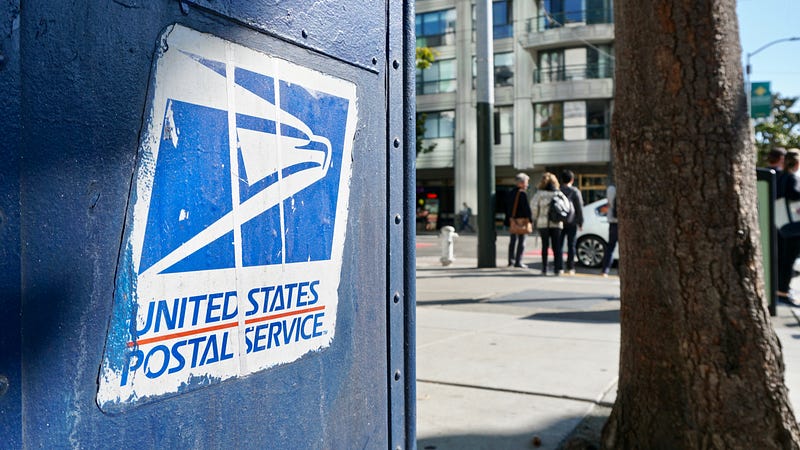
I grew up on Ohio, but went away to college, in Texas. When I did, my mom used to send Pringles cans full of chocolate chip cookies. They had to travel over a thousand miles to get to me. Everyone in the dorm was curious about the strange tubes I got in the mail. Once I popped the top, they became infinitely jealous.
Those repurposed Pringles tubes made it from Ohio to Dallas quickly enough for the cookies to still be fresh. I thought of them on Saturday when I was standing in front of the main post office in my hometown of Bellingham, Washington in the August sun. I was part of the protest in favor of the post office. I did not organize the protest: I was just one of about 100 people there to show their support.
The people supporting the post office were largely mature adults. Oh, there were some folks who looked like college students here and there, but I saw a lot of gray hair, and a lot of white hair. These were the mothers and fathers, the grandmothers and grandfathers of Bellingham, Washington. The man standing nearest me had traveled from nearby Lummi Island to take part in the protest.
This was very much a protest of the pandemic era: everyone was wearing masks, and people made sure to practice social distancing. However, they did cluster in twos and threes, talking as they protested. I heard some people talking about unrelated issues, like friends they had in common. Most people talked about other issues that were somewhat related, like the recent Democratic convention, or just how bad President Trump is.
An awful lot of the discussions touched on the post office at some point. I heard people trying to get clear on just why the Trump-appointed Postmaster General had done what he had done to the postal service. People were repeating bits of analyses and new stories, preferring one another to Louis DeJoy’s Senate testimony, and so on.
I showed up empty-handed at the protest, because I only decided at the last minute that I could take a break from my work day to show my support. Most people brought signs, and held them or waved them. A few people brought noisemakers, like small bullhorns or pot lids to clang together as impromptu cymbals.
People spread out front of the post office. Most were directly in front of it, but a few people on the other side of the street, and a few spread across the street to the next corners. This meant the protesters bracketed people who were turning towards or away from the post office, as well as flanking people driving through downtown.
Most people who drove by responded positively. There was lots of honking and waving, and a fair number of people slowed to open their windows, smile, and give a big thumbs up. A few people stared pointedly ahead, ignoring the protesters as best they could. Two or three looked actively irritated, perhaps because once in a while protesters were crossing the street in the crosswalk, and they had to wait longer than usual to drive past. Perhaps they opposed the protest.
As I stood there, sweating a bit, waving at cars, and after a while, holding a borrowed sign, I thought about how surreal it all ways, and how characteristic of life in the Trump regime.
I’m sure I wasn’t alone in this, because I saw a lot of spontaneously shaken heads — and heard bits of conversations starting with “I never thought I’d have to defend the post office…” or “Do you think he knows what this postal slowdown is costing people?” “He” in this case usually referred to the impeached president, though sometimes it meant DeJoy.
People mentioned waste (the destroyed sorting machines), fairness (mainly the lack of fairness), economic costs (late fees, spoilage, etc.), and, repeatedly, human suffering (due to things like prescription drugs being delayed). People talked about Trump’s tyranny, and his attempt to steal the election.
For my part, I found myself musing over matters that were both more domestic and more historical. I thought of all the birthday cards arriving late. I thought about Fruit of the Month club mailings, and all the starfruit and kiwi rotting on their long, long way. I thought about my mom’s cookies, which would now be stale when they reached me.
As for the historical elements, I thought about how the great Ben Franklin had been appointed the first Postmaster General in 1775. I thought about how the young Abe Lincoln had, at 24, been postmaster of New Salem, Illinois. I thought about how the Founding Fathers had thought the post office so central to a free republic they wrote the power to establish post offices into the Constitution.
And I wondered what kind of world Trump lives in that he was willing to break with all of these precious traditions, domestic and historical.
I know one thing: it isn’t my world.
Author also publishes on http://beattytales.com/