
Proposing the Forecasted Elastic Allocation Token
Incentivizing Value Creation With Bonding Curves
By Will Payne and Kyle Tut
Edit: Full white paper here
Besides for the majestic #Bufficorn, the most noticeable trend of #ETHDenver is the proliferation of TCRs and Curation Markets through the Ethereum community. Being an area of active development and theoretical implementations, there are still a lot of questions about what TCRs and Curation Markets are and can be.
One of the biggest hurdles we experienced internally was developing consistent language to describe what we were trying to build. Additionally, we didn’t know if TCRs and CMs would even fit within the GRANT proposal funding application we were building. And how do bonding curves play into all of this? From that abstract fuzziness, we developed a nascent proposal riffing on what we knew of TCRs, CMs, Bonding Curves, mechanism design and prediction markets that we are calling the Forecasted Elastic Allocation Token (FEAT).
For context, our goal was to solve public research funding. Our dapp, GRANT, provides transparency and accountability for every party involved in public and private research funding. The current funding mechanisms are inefficient and centralized, resulting in a huge disconnect between “public” science and the ultimate benefactors in the community. GRANT allows participants to create proposals and receive funding utilizing IPFS to help validate proposal completions.
As we were building out the app, we started to realize something: we were really solving a mechanism to marry tokens and the real-world value created and curated by the network. We wanted to avoid ICOs and pyramid schemes; our intention was to focus on value creation and to use blockchain as a mechanism to hand that value back to the public (or, in this case, those participating in the network).
Inadvertently, we also began incorporating many aspects of prediction markets into our dApp design as well. Before we knew it, we had a true coalescence of TCRs, curation markets, and predictions markets.
FEAT Main Features
The rest of this post dives into the theory and implementation of FEAT. Below are a few headlining features.
- Continuous token model utilizing bonding curves
- Focus on value creation, not price discovery
- Forecasted Elastic Allocated Tokens minted as valueless allocation votes for curator(s)
- Proposals funded with ETH from FEAT vault
- Proposal completion token generation events
- Value discovery markets
- Dissolution events triggered by value divergence
Incentivize Value Creation With Bonding Curves
Fundamentally, FEAT is a paradigm shift compared to other implementations of bonding curves. FEAT uses the bonding curve to incentivize value creation, not price discovery. FEAT may even abstract out the need to discover price by focusing exclusively on value creation.
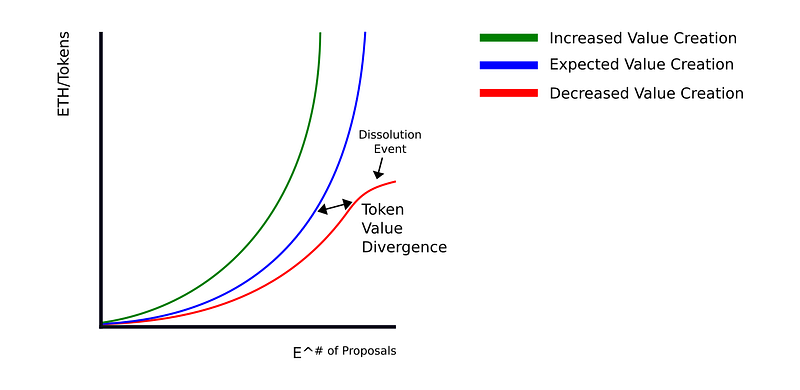
The x-axis of FEAT’s bonding curve is an exponential of proposals being funded and completed within the GRANT system. The y-axis is equivalent to total ETH/Token to represent the value that is being created by the curators of that FEAT.
With FEAT, the predetermined bonding curve (blue) is the “expected” value creation of any proposal that was sourced and funded by curators within that FEAT. As with other continuous token models using bonding curves, FEAT’s ETH requirement for each additional token increases with the curve as more and more buyers purchase tokens.
Any value created beyond the expected value (green), shows that the curators of that FEAT are outperforming projected value creation for their proposals. This leads to curators being incentivized to buy more tokens to capture the positive difference in value being created.
Dissolution Event
Underperforming FEATs (red) show that curators aren’t sourcing successful proposals or, by design, can’t keep pace with the exponential growth of the bonding curve. As the FEAT underperforms relative to the expected bonding curve, its value divergence becomes so great that it triggers an automated dissolution event.
A dissolution event is the liquidation of all ETH held by the FEAT vault back to the curators. This liquidation is done using the LIFO method to return ETH back to funders. LIFO was employed to prevent FEAT from being a pyramid scheme by preventing early curators from benefiting without providing value into the system. Curators who bought in last, get all of their ETH back first, while early curators are left with only the revenue generated from providing value through curation fees.
Additionally, dissolution events prevent FEATs from growing through bubbles. With exponential expectations created as each new token is bought, bubble type behavior would quickly trigger a dissolution event. Furthermore, dissolution events incentivize FEATs to only attract experts to curate. If too many non-experts buy into the system to curate, value creation will quickly diverge from the expected curve and trigger a dissolution event. Most interestingly, the dissolution mechanism forces decentralization and prevents any one FEAT from becoming large enough to consolidate power.
FEAT Mechanism
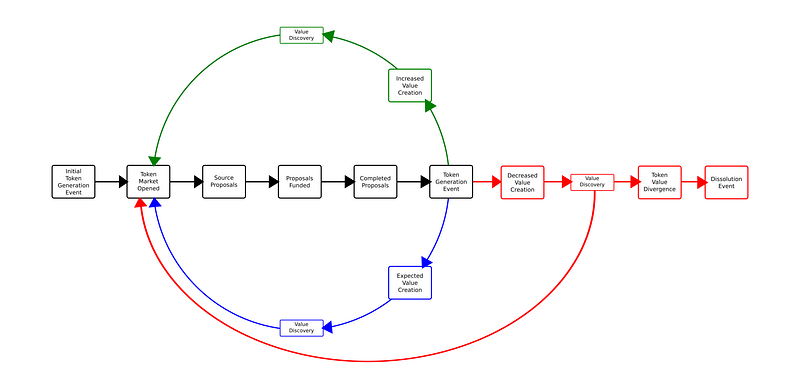
FEATs are initiated by a token generation event funded by “founding” curators. These curators deposit ETH into the FEAT vault and in return get an allocation token that enables the curators to fund proposals. Once initiated and tokens dispersed, a market opens for those tokens to help fund proposals.
Once the market on the tokens open, curators can start soliciting and sourcing proposals to fund. If the curators find a proposal that they wish to fund, they can allocate their FEATs to the proposal. Once allocated, the proposal will be funded with ETH through the FEAT vault based on proposal completion.
On completion, tokens are automatically generated and dispersed to the curators. If their funded proposals have created real value as determined by the market through value discovery, the curators will be able to sell their new tokens to generate funds for more proposals. If their proposals didn’t create real value, their new tokens will lead to the acceleration of a dissolution event.
Once tokens have found their value, curators can start sourcing and funding new proposals.
Curation Fee
To generate recurring revenue for curators, fees are taken from the ETH allocated to fund the proposal grants. This fee scheme enables curators to earn revenue for the act of sourcing funding and capital allocation. The more successful a curator is at creating value, the more funding that they will be able to earn from.
The curation fee is what counterbalances economic loss by early curator funding against a dissolution event. The fee provides revenue that exponential scales with value creation. ROI should happen with a relatively low amount of proposals.
Additional Thoughts
This is just an initial run through of the concept. Math specificity (like the specific dissolution trigger or the curator fee) and other issues have not been fully addressed. This was a secondary focus as we built the GRANT dapp at ETHDenver. We look forward to fleshing it out more to create a framework to work from.