avatarJIN

Free AI web copilot to create summaries, insights and extended knowledge, download it at here

10091

Abstract

ant to understand the various models and tools it offers.</p><ol><li><b>Pre-designed prompts </b>— Prompt Library provides a collection of pre-designed prompts that can be used for various purposes such as personal assistants for writing emails, writing professional papers, role-playing, and learning skills. These prompts can be customized to meet your specific needs, and the library also provides resources to help you craft your own prompts.</li><li><b>Prompt Creator</b> — The Prompt Creator is a tool that enables you to work with ChatGPT to create and customize prompts for your specific needs. By providing a brief description of the task you want to accomplish, ChatGPT can ask questions and help you create a clear and specific prompt that meets your needs.</li><li><b>Completions endpoint </b>— The Completions endpoint is a powerful feature of the Prompt Library that can be used for a wide variety of tasks. It provides a simple interface to any of the models offered by OpenAI and can be applied to virtually any task that involves understanding or generating natural language, code, or images.</li></ol><p id="8de5">The Prompt Creator is a powerful tool that can help you create custom prompts with ease. It works by leveraging the advanced natural language processing capabilities of ChatGPT to assist you in defining and refining the prompt for your specific needs. Whether you need help crafting a prompt for a personal assistant, writing professional papers, or any other natural language task, the Prompt Creator can provide valuable assistance in getting the job done quickly and efficiently. With the Prompt Creator, you can take full advantage of the capabilities of Prompt Library to build powerful natural language applications that meet your needs.</p><p id="6806">The main idea is to use a method of communication between the user and ChatGPT where the user first provides a brief description of the task they want to accomplish. After that, ChatGPT will ask questions to the user in order to better understand the requirements and to help the user specify and customize their needs. This method is particularly useful when the task is complex, and the user is unsure of what aspects to consider or lacks expertise in completing the task. Through multiple rounds of questions and answers, ChatGPT can help the user take into account all the necessary aspects of the task and create a clear and specific prompt. This way, ChatGPT can generate better answers that meet the user’s needs.</p><p id="8341"><b>My Prompt:</b></p><figure id="0037"><img src="https://cdn-images-1.readmedium.com/v2/resize:fit:800/1*aVnB4zpLYKsUIoeH0zysOQ.png"><figcaption>Image Credit: <b>Author</b></figcaption></figure><p id="f359"><b>ChatGPT’s Response:</b></p><figure id="4560"><img src="https://cdn-images-1.readmedium.com/v2/resize:fit:800/1*d8GD6V5A-X-XnpslMa4_Dg.png"><figcaption>Image Credit: <b>Author</b></figcaption></figure><p id="d791"><b>My Prompt:</b></p><figure id="6018"><img src="https://cdn-images-1.readmedium.com/v2/resize:fit:800/1*R8L56WaSgc3lhi2pakqCIQ.png"><figcaption>Image Credit: <b>Author</b></figcaption></figure><p id="a916"><b>ChatGPT’s Response:</b></p><figure id="ea83"><img src="https://cdn-images-1.readmedium.com/v2/resize:fit:800/1*noe8iZujrDd9LAzVrjMFeg.png"><figcaption>Image Credit: <b>Author</b></figcaption></figure><p id="f60a"><b>My Prompt:</b></p><figure id="648a"><img src="https://cdn-images-1.readmedium.com/v2/resize:fit:800/1*VOIeWAUL3yqrsqiTC9Diow.png"><figcaption>Image Credit: <b>Author</b></figcaption></figure><p id="3c5c"><b>ChatGPT’s Response:</b></p><figure id="adfb"><img src="https://cdn-images-1.readmedium.com/v2/resize:fit:800/1*CglFrUqbPtGwDLNQB5oRuw.png"><figcaption>Image Credit: <b>Author</b></figcaption></figure><p id="e3b4"><b>My Prompt:</b></p><figure id="6d17"><img src="https://cdn-images-1.readmedium.com/v2/resize:fit:800/1*BDRyEOAj0enMQr0617Z5bg.png"><figcaption>Image Credit: <b>Author</b></figcaption></figure><p id="2f17"><b>ChatGPT’s Response:</b></p><figure id="450f"><img src="https://cdn-images-1.readmedium.com/v2/resize:fit:800/1*cI5VWmPY-JSSqb7Wqw7QzQ.png"><figcaption>Image Credit: <b>Author</b></figcaption></figure><p id="1cc6"><b>My Prompt:</b></p><figure id="7221"><img src="https://cdn-images-1.readmedium.com/v2/resize:fit:800/1*JieQqogWgk6K1MqHUj0QDQ.png"><figcaption>Image Credit: <b>Author</b></figcaption></figure><p id="b868"><b>ChatGPT’s Response:</b></p><figure id="1609"><img src="https://cdn-images-1.readmedium.com/v2/resize:fit:800/1*Ahl9K_JbRrKjub1JrI75mw.png"><figcaption>Image Credit: <b>Author</b></figcaption></figure><p id="d8be"><b>My Prompt</b></p><figure id="a76d"><img src="https://cdn-images-1.readmedium.com/v2/resize:fit:800/1*adXwbKcxSp7cwXoGJBiydQ.png"><figcaption>Image Credit: <b>Author</b></figcaption></figure><p id="fbd0"><b>ChatGPT’s Response:</b></p><figure id="8b4c"><img src="https://cdn-images-1.readmedium.com/v2/resize:fit:800/1*qxwtHU-xd_VOHnwbsbzwYw.png"><figcaption>Image Credit: <b>Author</b></figcaption></figure><p id="f7c8"><b>My prompt:</b></p><figure id="6b63"><img src="https://cdn-images-1.readmedium.com/v2/resize:fit:800/1*Rt7H-gsVEDXocQs16GYD-w.png"><figcaption>Image Credit: <b>Author</b></figcaption></figure><p id="9a93"><b>ChatGPT’s Response:</b></p><figure id="ff28"><img src="https://cdn-images-1.readmedium.com/v2/resize:fit:800/1*YiavF3GX9cN8uKPS1XKkHA.png"><figcaption>Image Credit: <b>Author</b></figcaption></figure><p id="803d"><b>My Prompt:</b></p><figure id="e3b5"><img src="https://cdn-images-1.readmedium.com/v2/resize:fit:800/1*9Ae0zfUuUJ1wxaJfGF_gVg.png"><figcaption></figcaption></figure><p id="da8c"><b>ChatGPT’s Response:</b></p><figure id="8d28"><img src="https://cdn-images-1.readmedium.com/v2/resize:fit:800/1*ZCXLltFQ4CQxoh0yob0g9Q.png"><figcaption>Image Credit: <b>Author</b></figcaption></figure><p id="42a4"><b>My Prompt:</b></p><figure id="bba0"><img src="https://cdn-images-1.readmedium.com/v2/resize:fit:800/1*Wfn0cHMFHKy7Vbq4FBosNw.png"><figcaption>Image Credit: <b>Author</b></figcaption></figure><p id="c43e"><b>ChatGPT’s response:</b></p><figure id="ef5b"><img src="https://cdn-images-1.readmedium.com/v2/resize:fit:800/1*n5xjbVpVNsYRPMifrjPnBA.png"><figcaption>Image Credit: <b>Author</b></figcaption></figure><p id="22aa"><b>My Prompt:</b></p><figure id="a718"><img src="https://cdn-images-1.readmedium.com/v2/resize:fit:800/1*DTdwKk00tL6M6ALqgw20aw.png"><figcaption>Image Credit: <b>Author</b></figcaption></figure><p id="fa73"><b>ChatGPT’s Response:</b></p><figure id="c943"><img src="https://cdn-images-1.readmedium.com/v2/resize:fit:800/1*q0pwBSjLuvTLDEdnJJ5lTw.png"><figcaption>Image Credit: <b>Author</b></figcaption></figure><p id="3e91"><b>My Prompt:</b></p><figure id="3b2a"><img src="https://cdn-images-1.readmedium.com/v2/resize:fit:800/1*uJC10NIDD_Z1AcsfNKPeaQ.png"><figcaption>Image Credit: <b>Author</b></figcaption></figure><p id="a5d4"><b>ChatGPT’s Response:</b></p><figure id="3826"><img src="https://cdn-images-1.readmedium.com/v2/resize:fit:800/1*GPjnEi_h65ZT_hOj8cgMMg.png"><figcaption>Image Credit: <b>Author</b></figcaption></figure><p id="2f11"><b>My Prompt:</b></p><figure id="3347"><img src="https://cdn-images-1.readmedium.com/v2/resize:fit:800/1*2rWPNkxrKCev3tTkLQoXWA.png"><figcaption>Image Credit: <b>Author</b></figcaption></figure><p id="9a25"><b>ChatGPT’s Response:</b></p><figure id="d857"><img src="https://cdn-images-1.readmedium.com/v2/resize:fit:800/1*rRSc93bVuxl7K9RwiYqwCw.png"><figcaption>Image Credit: <b>Author</b></figcaption></figure><p id="136a">ChatGPT helped me refine my prompt by providing specific guidelines for the article to be written. These guidelines included writing a comprehensive step-by-step guide to learning PyTorch for sentiment analysis in the finance industry. The guide should assume that the audience has no prior experience in Python or deep learning but has a good mathematical background in calculus and linear algebra. The guide should cover the fundamentals of machine learning, including supervised and unsupervised learning, and introduce PyTorch’s basics, including tensor manipulation and autograd. The guide should then focus on sentiment analysis in finance, covering pre-processing financial news articles from Yahoo Finance, generating word embeddings, and training a neural network model for sentiment analysis in the finance industry. It should also provide tips on best practices for building neural network models for natural language processing in finance and how to evaluate model performance. The guide should use PyCharm as the primary development environment and the latest version of PyTorch. The language should be tailored toward the finance industry, but the terminology should be kept as general as possible. The tutorial should not include any specific exercises or quizzes. It should be a comprehensive and easy-to-follow step-by-step guide written in a formal style and providing detailed explanations. Additionally, the guide should include examples of how sentiment analysis can be applied in the finance industry.</p><p id="a16a">To gather more information, ChatGPT recommended asking questions at the end, such as the target audience’s background and whether the article’s content should focus on a specific field or be more generalized.</p><p id="878b">As a novice with limited experience, writing a comprehensive article for the first time can be challenging. However, this prompt has helped me identify the key aspects I should consider to produce a high-quality article. This process has been a valuable exercise in critical thinking.</p><p id="79ae">Furthermore, this prompt is particularly useful for situations that involve relatively complex tasks where one has limited experience or professional knowledge, making it challenging to accurately describe the requirements. In such cases, ChatGPT can provide a more personalized and customized answer. However, for simpler tasks like language translation and writing emails, you may not need to utilize this prompt. It is essential to trust that Ch

Options

atGPT has the necessary capability to comprehend your vague prompt and complete general tasks with ease.</p><p id="5d6e"><b>Finalized Version:</b></p><p id="db5d"><b>Introduction</b></p><p id="4e18">In recent years, sentiment analysis has become an essential tool for analyzing financial markets. In this tutorial, we will walk you through the process of learning PyTorch, a powerful deep-learning framework, to perform sentiment analysis on financial news articles. This tutorial assumes no prior experience in Python or deep learning but a good mathematical background in calculus and linear algebra.</p><p id="0db1"><b>Section 1: Machine Learning Fundamentals</b></p><p id="8c5b">In this section, we will cover the fundamentals of machine learning, including supervised and unsupervised learning, and introduce PyTorch’s basics, including tensor manipulation and autograd.</p><p id="0865"><b>1.1 Supervised Learning</b></p><ul><li>Define supervised learning and provide examples of supervised learning problems.</li><li>Explain the concept of training and testing data.</li><li>Introduce PyTorch’s tensor manipulation functions.</li></ul><p id="0a93"><b>1.2 Unsupervised Learning</b></p><ul><li>Define unsupervised learning and provide examples of unsupervised learning problems.</li><li>Explain the concept of clustering and dimensionality reduction.</li><li>Introduce PyTorch’s tensor manipulation functions for unsupervised learning.</li></ul><p id="97ba"><b>1.3 PyTorch Basics</b></p><ul><li>Introduce PyTorch’s tensor data structure.</li><li>Explain tensor operations, including element-wise operations, matrix multiplication, and broadcasting.</li><li>Introduce PyTorch’s autograd functionality for automatic differentiation.</li></ul><p id="309f"><b>Section 2: Sentiment Analysis in Finance</b></p><p id="5897">In this section, we will focus on sentiment analysis in finance, covering pre-processing financial news articles from Yahoo Finance, generating word embeddings, and training a neural network model for sentiment analysis in the finance industry.</p><p id="1c61"><b>2.1 Pre-processing Financial News Articles from Yahoo Finance</b></p><ul><li>Define pre-processing and its importance in natural language processing.</li><li>Introduce PyTorch’s torch text library for text data processing.</li><li>Explain how to extract financial news articles from Yahoo Finance.</li></ul><p id="fa9e"><b>2.2 Generating Word Embeddings</b></p><ul><li>Define word embeddings and their importance in natural language processing.</li><li>Introduce PyTorch’s embedding layer and the concept of one-hot encoding.</li><li>Explain how to train a word embedding model.</li></ul><p id="f1a8"><b>2.3 Training a Neural Network Model for Sentiment Analysis in Finance</b></p><ul><li>Define sentiment analysis and its importance in financial markets.</li><li>Introduce PyTorch’s neural network modules, including the fully connected and recurrent neural network modules.</li><li>Explain how to train a neural network model for sentiment analysis in finance.</li></ul><p id="08b7"><b>Section 3: Best Practices for Building Neural Network Models for Natural Language Processing in Finance</b></p><p id="560e">In this section, we will provide tips on best practices for building neural network models for natural language processing in finance and how to evaluate model performance.</p><p id="3e78"><b>3.1 Best Practices for Building Neural Network Models for Natural Language Processing in Finance</b></p><ul><li>Explain how to select appropriate neural network architecture.</li><li>Introduce transfer learning for natural language processing in finance.</li><li>Explain regularization techniques, including the dropout and weight decay.</li></ul><p id="7874"><b>3.2 Evaluating Model Performance</b></p><ul><li>Define evaluation metrics for sentiment analysis, including accuracy, precision, recall, and F1-score.</li><li>Explain how to implement a validation set for model evaluation.</li><li>Provide tips on how to fine-tune the model to improve performance.</li></ul><p id="5307"><b>Conclusion</b></p><p id="65a8">In conclusion, we have provided a comprehensive step-by-step guide to learning PyTorch for sentiment analysis in the finance industry. We have covered the fundamentals of machine learning, PyTorch basics, sentiment analysis in finance, best practices for building neural network models for natural language processing in finance and evaluating model performance. We hope that this tutorial has provided you with a strong foundation for performing sentiment analysis on financial news articles using PyTorch.</p><p id="b62d">References</p><div id="f2e3" class="link-block"> <a href="https://eventsquid.zendesk.com/hc/en-us/articles/360021336751-Custom-Prompt-Essentials"> <div> <div> <h2>Custom Prompt Essentials</h2> <div><h3>You can also view the following two videos on Custom Prompt creation, which go dive more deeply into ways of using…</h3></div> <div><p>eventsquid.zendesk.com</p></div> </div> <div> <div style="background-image: url(https://miro.readmedium.com/v2/resize:fit:320/0*qp6caL2VxDHDAE_Q)"></div> </div> </div> </a> </div><div id="9843" class="link-block"> <a href="https://becomeawritertoday.com/how-to-create-a-writing-prompt/"> <div> <div> <h2>How To Create A Writing Prompt: Step-by-Step</h2> <div><h3>Writer's block can be a serious problem for many writers. Even the best writing has to come from somewhere, and when…</h3></div> <div><p>becomeawritertoday.com</p></div> </div> <div> <div style="background-image: url(https://miro.readmedium.com/v2/resize:fit:320/0*4cf-7EVWZDOYqfZN)"></div> </div> </div> </a> </div><div id="e69d" class="link-block"> <a href="https://learnprompting.org/"> <div> <div> <h2>Learn Prompting: Your Guide to Communicating with AI</h2> <div><h3>Your Guide to Communicating with Artificial Intelligence Learn how to use ChatGPT and other AI tools to accomplish your…</h3></div> <div><p>learnprompting.org</p></div> </div> <div> <div style="background-image: url(https://miro.readmedium.com/v2/resize:fit:320/0*F2No7V0nvVzRlL6x)"></div> </div> </div> </a> </div><div id="42e4" class="link-block"> <a href="https://help.openai.com/en/articles/6654000-best-practices-for-prompt-engineering-with-openai-api"> <div> <div> <h2>Best practices for prompt engineering with OpenAI API | OpenAI Help Center</h2> <div><h3>💡 If you're just getting started with OpenAI API, we recommend reading the Introduction and Quickstart tutorials…</h3></div> <div><p>help.openai.com</p></div> </div> <div> <div style="background-image: url(https://miro.readmedium.com/v2/resize:fit:320/)"></div> </div> </div> </a> </div><div id="16de" class="link-block"> <a href="https://promptlib.substack.com/p/welcome-to-promptlib-ai-prompt-library"> <div> <div> <h2>Welcome to Promptlib - AI Prompt Library Launch & GPT-4 Release</h2> <div><h3>Welcome to the first edition of the Promptlib newsletter! We're thrilled to have you on board as we embark on a mission…</h3></div> <div><p>promptlib.substack.com</p></div> </div> <div> <div style="background-image: url(https://miro.readmedium.com/v2/resize:fit:320/0*sj0wU3eGysOCGo0C)"></div> </div> </div> </a> </div><div id="64fd" class="link-block"> <a href="https://github.com/MicrosoftDocs/terminal/blob/main/TerminalDocs/tutorials/custom-prompt-setup.md"> <div> <div> <h2>terminal/custom-prompt-setup.md at main · MicrosoftDocs/terminal</h2> <div><h3>This tutorial provides some resources and direction to help you customize your command prompt for PowerShell or Windows…</h3></div> <div><p>github.com</p></div> </div> <div> <div style="background-image: url(https://miro.readmedium.com/v2/resize:fit:320/0*rGf2CdaINPHelEYg)"></div> </div> </div> </a> </div><p id="aa37"><b><i>If you’ve found any of my articles helpful or useful then please consider throwing a coffee my way to help support my work or give me patronage😊, by using</i></b></p><p id="63cf"><a href="https://www.patreon.com/jinlowmedium"><b>Patreon</b></a></p><p id="13b0"><a href="https://ko-fi.com/jinlowmedium"><b>Ko-fi.com</b></a></p><p id="2a00"><a href="https://www.buymeacoffee.com/jinlowmedium"><b>buymeacoffee</b></a></p><p id="abca"><i>Last but not least, if you are not a Medium Member yet and plan to become one, I kindly ask you to do so using the following link. I will receive a portion of your membership fee at no additional cost to you.</i></p><div id="642e" class="link-block"> <a href="https://jinlow.medium.com/membership"> <div> <div> <h2>Join Medium with my referral link — JIN</h2> <div><h3>As a Medium member, a portion of your membership fee goes to writers you read, and you get full access to every story…</h3></div> <div><p>jinlow.medium.com</p></div> </div> <div> <div style="background-image: url(https://miro.readmedium.com/v2/resize:fit:320/0*jLJ0HNErg4baV7B4)"></div> </div> </div> </a> </div></article></body>

Photo by Sanket Mishra on Unsplash

Prompt Library — Revolutionizing Natural Language Processing with OpenAI

Explore the Capabilities of Prompt Library and Learn How to Create Custom Prompts with the Prompt Creator

Thank you for being a part of this journey with me, and I hope to continue providing value to you for years to come! Giving tips by supporting me.

Hello friend, I hope you’re doing well! I’m writing to you today because I am truly passionate about sharing my knowledge and helping others learn. If you’ve found my articles to be valuable and they’ve made a positive impact on your life, I would be overjoyed if you could support me as a referred member. Your support not only helps me financially but also motivates me to continue creating content that makes a difference in people’s lives. Thank you from the bottom of my heart for considering supporting me. It means the world to me to have your support on this journey.

It’s important to us that you know we may earn a commission from qualifying purchases, but please know that it doesn’t affect the price you pay. We’re grateful for your support and trust, and we promise to continue providing you with the best recommendations and information possible.

https://amzn.to/3Mf6KZd

Unlocking the Power of Natural Language Processing with Prompt Library

As software engineers and IT enthusiasts, we’re always on the lookout for tools and technologies that can make our lives easier. And when it comes to natural language processing (NLP), there’s no better tool than Prompt Library. Developed using the latest advances in artificial intelligence and machine learning, Prompt Library is a state-of-the-art library that has revolutionized the way we interact with machines.

In this article, we’ll take a deep dive into Prompt Library, exploring its capabilities and providing concrete examples of how it can be used. Whether you’re an avid reader or a software engineer looking to build the next generation of NLP applications, this article is for you. So let’s get started!

The Value of Prompt Library

A prompt Library is a powerful tool that enables you to build powerful chatbots, virtual assistants, and other natural language applications with ease. It provides a simple and intuitive API that allows you to quickly integrate natural language capabilities into your applications without the need for extensive coding and training. With Prompt Library, you can leverage the latest advances in machine learning and artificial intelligence to create sophisticated applications that can understand and respond to natural language.

Introduction

OpenAI’s prompt library is a collection of pre-designed prompts that can be used for various purposes such as personal assistants for writing emails, writing professional papers, role-playing, and learning skills. The OpenAI Python library provides convenient access to the OpenAI API from applications written in the Python language and includes a pre-defined set of classes for API resources that initialize themselves dynamically from API responses which makes it compatible with a wide range of versions of the OpenAI API. When crafting prompts, it is recommended to put instructions at the beginning of the prompt and use ### or “”” to separate the instruction and context. For those who are new to using the OpenAI API, there are several resources available including a Quickstart Tutorial and Completion Guide, as well as an Examples page to find prompt templates most similar to the desired use case, which can then be tweaked as needed.

To use the OpenAI API, the Python library can be installed and bindings can be used along with a secret key to run various commands. The completions endpoint is a powerful feature of the OpenAI API that can be used for a wide variety of tasks, providing a simple interface to any of the models offered by OpenAI. OpenAI’s API can be applied to virtually any task that involves understanding or generating natural language, code, or images, and the models can be used for everything from content generation to problem-solving.

As for prompts for personal assistants for writing emails, writing professional papers, role-playing, and learning skills, there are no pre-defined prompts available for such specific use cases. However, the OpenAI API provides a spectrum of models with different levels of power suitable for different tasks, as well as the ability to fine-tune custom models. Thus, users can create their own prompts for various purposes, including those listed in the query.

Application Scenarios

  1. Chatbots and virtual assistants — Create chatbots and virtual assistants that can understand and respond to natural language. By leveraging the power of machine learning and artificial intelligence, you can create sophisticated applications that can learn from user interactions and improve over time.
  2. Content generation — Whether you’re writing marketing copy, social media posts, or other types of content, Prompt Library can help you generate high-quality content quickly and easily. By using pre-designed prompts or customizing your own, you can create content that is tailored to your specific needs.
  3. Problem-solving —There are countless applications for natural language processing in problem-solving, from customer service to technical support. With Prompt Library, you can create applications that can understand and respond to user inquiries, helping to solve problems quickly and efficiently.

Using Prompt Library

To make the most of Prompt Library, it’s important to understand the various models and tools it offers.

  1. Pre-designed prompts — Prompt Library provides a collection of pre-designed prompts that can be used for various purposes such as personal assistants for writing emails, writing professional papers, role-playing, and learning skills. These prompts can be customized to meet your specific needs, and the library also provides resources to help you craft your own prompts.
  2. Prompt Creator — The Prompt Creator is a tool that enables you to work with ChatGPT to create and customize prompts for your specific needs. By providing a brief description of the task you want to accomplish, ChatGPT can ask questions and help you create a clear and specific prompt that meets your needs.
  3. Completions endpoint — The Completions endpoint is a powerful feature of the Prompt Library that can be used for a wide variety of tasks. It provides a simple interface to any of the models offered by OpenAI and can be applied to virtually any task that involves understanding or generating natural language, code, or images.

The Prompt Creator is a powerful tool that can help you create custom prompts with ease. It works by leveraging the advanced natural language processing capabilities of ChatGPT to assist you in defining and refining the prompt for your specific needs. Whether you need help crafting a prompt for a personal assistant, writing professional papers, or any other natural language task, the Prompt Creator can provide valuable assistance in getting the job done quickly and efficiently. With the Prompt Creator, you can take full advantage of the capabilities of Prompt Library to build powerful natural language applications that meet your needs.

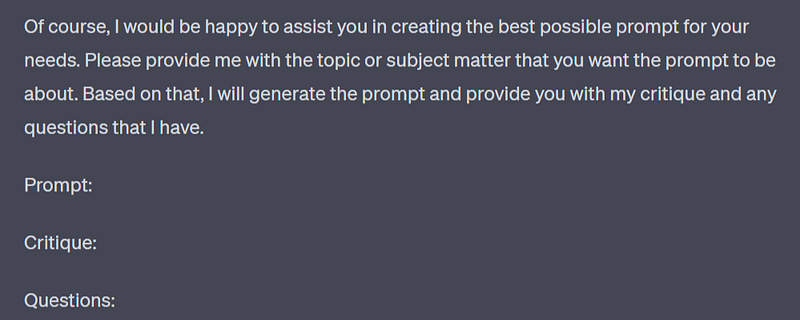
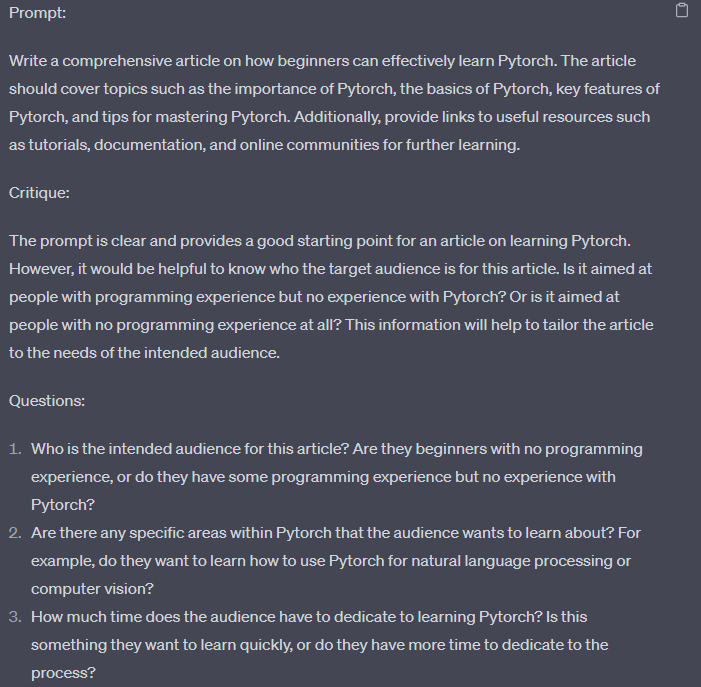
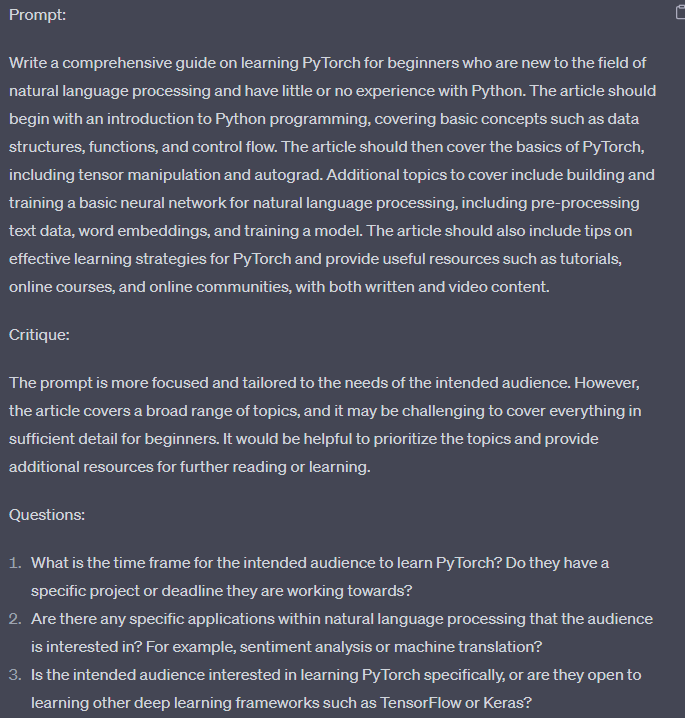
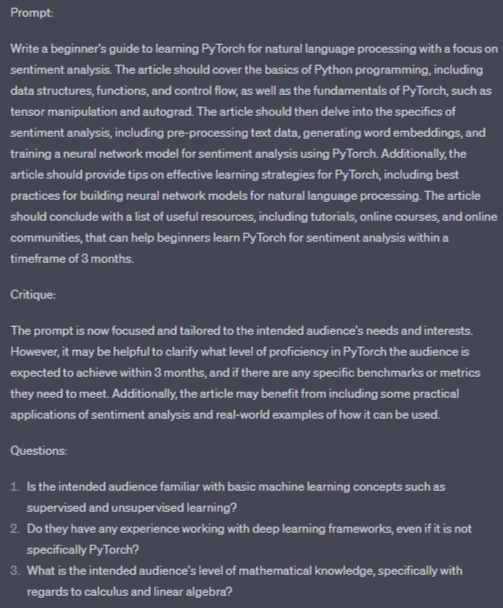
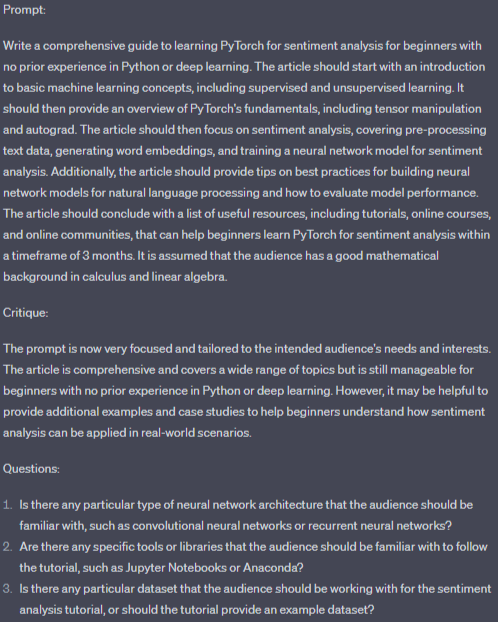
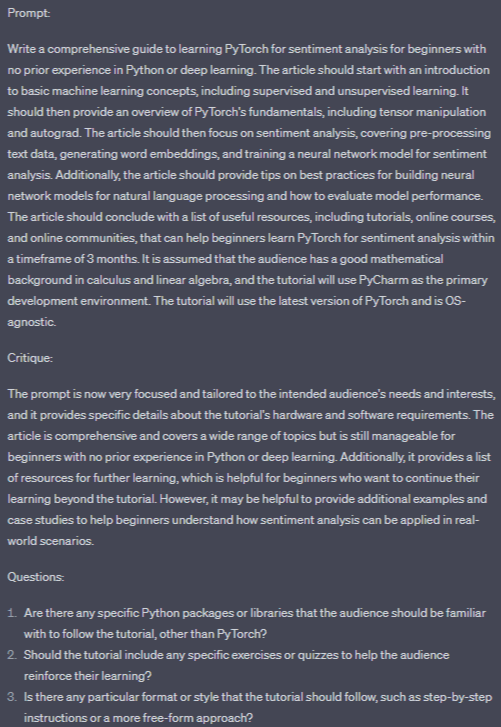
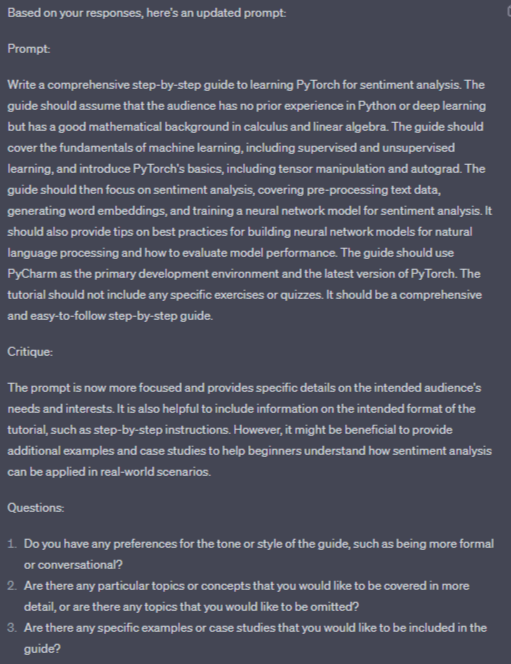
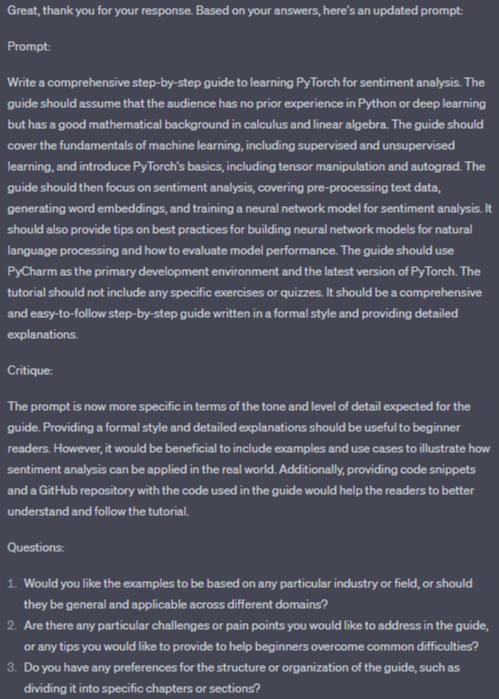
The main idea is to use a method of communication between the user and ChatGPT where the user first provides a brief description of the task they want to accomplish. After that, ChatGPT will ask questions to the user in order to better understand the requirements and to help the user specify and customize their needs. This method is particularly useful when the task is complex, and the user is unsure of what aspects to consider or lacks expertise in completing the task. Through multiple rounds of questions and answers, ChatGPT can help the user take into account all the necessary aspects of the task and create a clear and specific prompt. This way, ChatGPT can generate better answers that meet the user’s needs.

My Prompt:
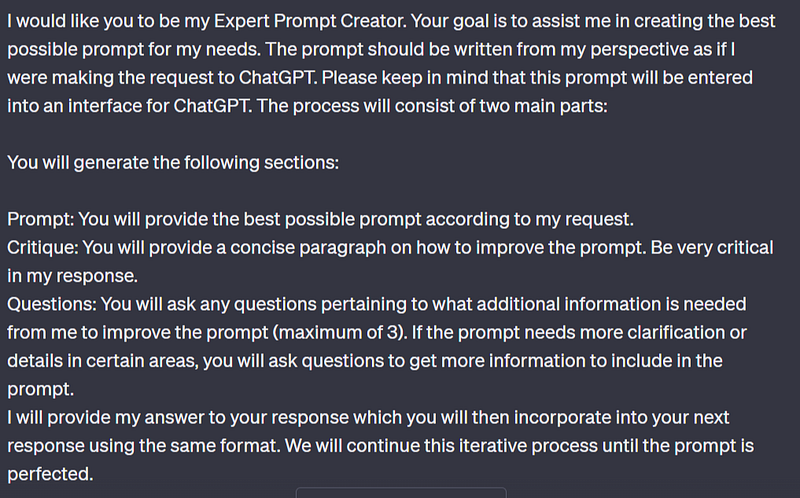
Image Credit: Author

ChatGPT’s Response:

Image Credit: Author

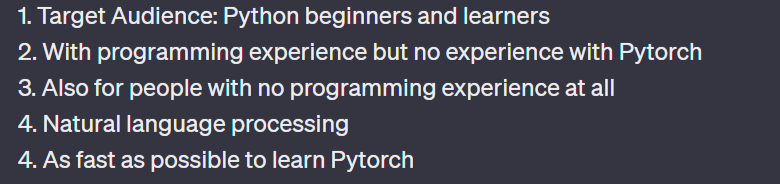
My Prompt:

Image Credit: Author

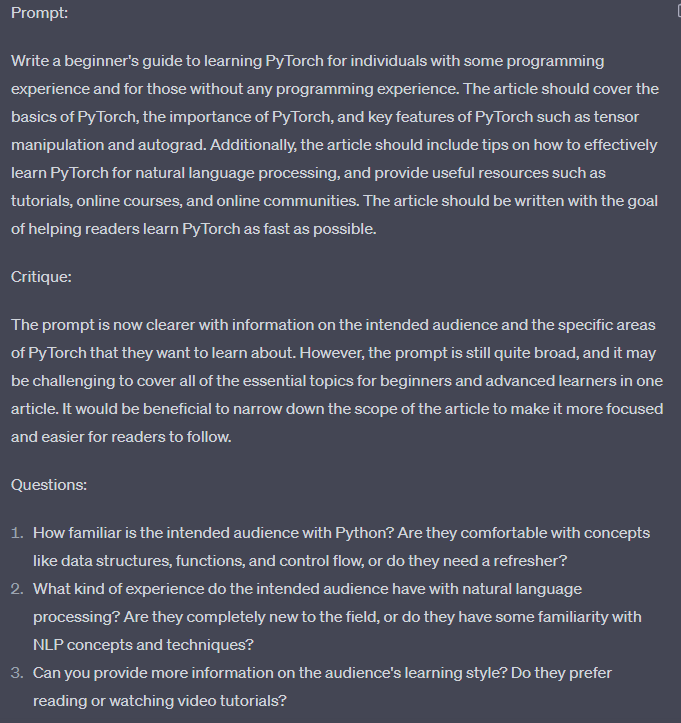
ChatGPT’s Response:

Image Credit: Author

My Prompt:

Image Credit: Author

ChatGPT’s Response:

Image Credit: Author

My Prompt:

Image Credit: Author

ChatGPT’s Response:

Image Credit: Author

My Prompt:

Image Credit: Author

ChatGPT’s Response:

Image Credit: Author

My Prompt

Image Credit: Author

ChatGPT’s Response:

Image Credit: Author

My prompt:

Image Credit: Author

ChatGPT’s Response:

Image Credit: Author

My Prompt:

ChatGPT’s Response:

Image Credit: Author

My Prompt:

Image Credit: Author

ChatGPT’s response:

Image Credit: Author

My Prompt:

Image Credit: Author

ChatGPT’s Response:

Image Credit: Author

My Prompt:

Image Credit: Author

ChatGPT’s Response:

Image Credit: Author

My Prompt:

Image Credit: Author

ChatGPT’s Response:

Image Credit: Author

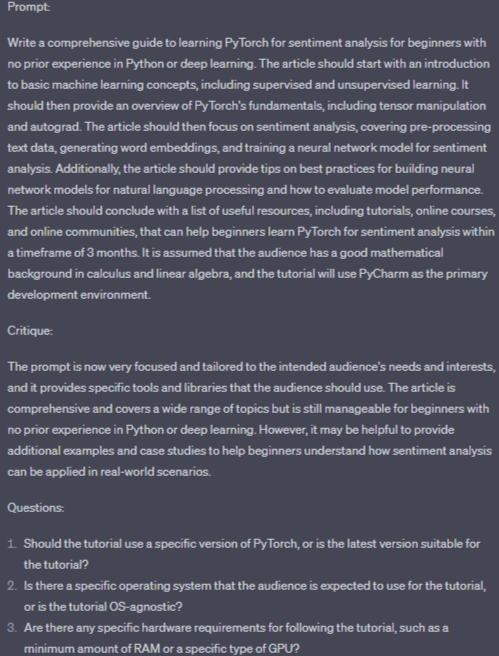
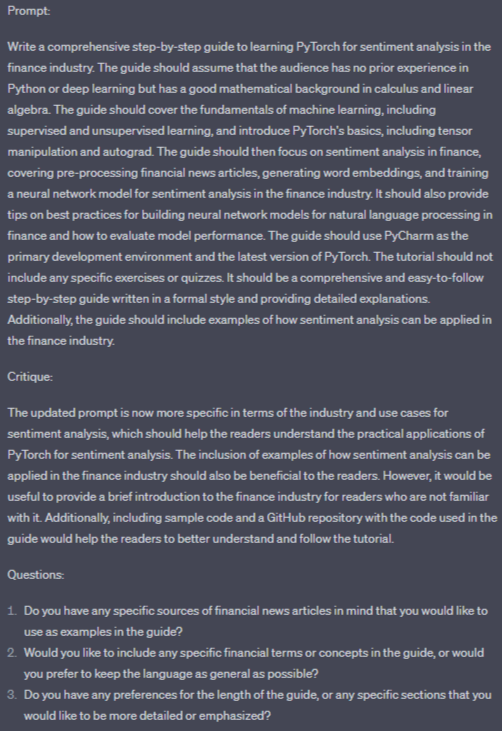
ChatGPT helped me refine my prompt by providing specific guidelines for the article to be written. These guidelines included writing a comprehensive step-by-step guide to learning PyTorch for sentiment analysis in the finance industry. The guide should assume that the audience has no prior experience in Python or deep learning but has a good mathematical background in calculus and linear algebra. The guide should cover the fundamentals of machine learning, including supervised and unsupervised learning, and introduce PyTorch’s basics, including tensor manipulation and autograd. The guide should then focus on sentiment analysis in finance, covering pre-processing financial news articles from Yahoo Finance, generating word embeddings, and training a neural network model for sentiment analysis in the finance industry. It should also provide tips on best practices for building neural network models for natural language processing in finance and how to evaluate model performance. The guide should use PyCharm as the primary development environment and the latest version of PyTorch. The language should be tailored toward the finance industry, but the terminology should be kept as general as possible. The tutorial should not include any specific exercises or quizzes. It should be a comprehensive and easy-to-follow step-by-step guide written in a formal style and providing detailed explanations. Additionally, the guide should include examples of how sentiment analysis can be applied in the finance industry.

To gather more information, ChatGPT recommended asking questions at the end, such as the target audience’s background and whether the article’s content should focus on a specific field or be more generalized.

As a novice with limited experience, writing a comprehensive article for the first time can be challenging. However, this prompt has helped me identify the key aspects I should consider to produce a high-quality article. This process has been a valuable exercise in critical thinking.

Furthermore, this prompt is particularly useful for situations that involve relatively complex tasks where one has limited experience or professional knowledge, making it challenging to accurately describe the requirements. In such cases, ChatGPT can provide a more personalized and customized answer. However, for simpler tasks like language translation and writing emails, you may not need to utilize this prompt. It is essential to trust that ChatGPT has the necessary capability to comprehend your vague prompt and complete general tasks with ease.

Finalized Version:

Introduction

In recent years, sentiment analysis has become an essential tool for analyzing financial markets. In this tutorial, we will walk you through the process of learning PyTorch, a powerful deep-learning framework, to perform sentiment analysis on financial news articles. This tutorial assumes no prior experience in Python or deep learning but a good mathematical background in calculus and linear algebra.

Section 1: Machine Learning Fundamentals

In this section, we will cover the fundamentals of machine learning, including supervised and unsupervised learning, and introduce PyTorch’s basics, including tensor manipulation and autograd.

1.1 Supervised Learning

  • Define supervised learning and provide examples of supervised learning problems.
  • Explain the concept of training and testing data.
  • Introduce PyTorch’s tensor manipulation functions.

1.2 Unsupervised Learning

  • Define unsupervised learning and provide examples of unsupervised learning problems.
  • Explain the concept of clustering and dimensionality reduction.
  • Introduce PyTorch’s tensor manipulation functions for unsupervised learning.

1.3 PyTorch Basics

  • Introduce PyTorch’s tensor data structure.
  • Explain tensor operations, including element-wise operations, matrix multiplication, and broadcasting.
  • Introduce PyTorch’s autograd functionality for automatic differentiation.

Section 2: Sentiment Analysis in Finance

In this section, we will focus on sentiment analysis in finance, covering pre-processing financial news articles from Yahoo Finance, generating word embeddings, and training a neural network model for sentiment analysis in the finance industry.

2.1 Pre-processing Financial News Articles from Yahoo Finance

  • Define pre-processing and its importance in natural language processing.
  • Introduce PyTorch’s torch text library for text data processing.
  • Explain how to extract financial news articles from Yahoo Finance.

2.2 Generating Word Embeddings

  • Define word embeddings and their importance in natural language processing.
  • Introduce PyTorch’s embedding layer and the concept of one-hot encoding.
  • Explain how to train a word embedding model.

2.3 Training a Neural Network Model for Sentiment Analysis in Finance

  • Define sentiment analysis and its importance in financial markets.
  • Introduce PyTorch’s neural network modules, including the fully connected and recurrent neural network modules.
  • Explain how to train a neural network model for sentiment analysis in finance.

Section 3: Best Practices for Building Neural Network Models for Natural Language Processing in Finance

In this section, we will provide tips on best practices for building neural network models for natural language processing in finance and how to evaluate model performance.

3.1 Best Practices for Building Neural Network Models for Natural Language Processing in Finance

  • Explain how to select appropriate neural network architecture.
  • Introduce transfer learning for natural language processing in finance.
  • Explain regularization techniques, including the dropout and weight decay.

3.2 Evaluating Model Performance

  • Define evaluation metrics for sentiment analysis, including accuracy, precision, recall, and F1-score.
  • Explain how to implement a validation set for model evaluation.
  • Provide tips on how to fine-tune the model to improve performance.

Conclusion

In conclusion, we have provided a comprehensive step-by-step guide to learning PyTorch for sentiment analysis in the finance industry. We have covered the fundamentals of machine learning, PyTorch basics, sentiment analysis in finance, best practices for building neural network models for natural language processing in finance and evaluating model performance. We hope that this tutorial has provided you with a strong foundation for performing sentiment analysis on financial news articles using PyTorch.

References

If you’ve found any of my articles helpful or useful then please consider throwing a coffee my way to help support my work or give me patronage😊, by using

Patreon

Ko-fi.com

buymeacoffee

Last but not least, if you are not a Medium Member yet and plan to become one, I kindly ask you to do so using the following link. I will receive a portion of your membership fee at no additional cost to you.

Artificial Intelligence
Prompt
ChatGPT
Naturallanguageprocessing
OpenAI
Recommended from ReadMedium