
Prolatism — How Work Became the New Religion of Millions

In the Early Digital age, we live to work. The new metropolitan standard of work, characterised by a focus on quick role turnover, agile methods and a service-oriented outcome, has seen more workers charting overtime than ever before. Particularly in management and the professions, working longer for little to no additional compensation is the new normal. It was so even prior to the beginning of the COVID pandemic. Since then, people work longer hours on average, with a blurring of the traditional bounds of the working week. Given the way in which COVID has proved that remote working can be as productive as in-office work, perhaps we should not expect this elasticity of working time to right itself anytime soon.
In our time, which in its insistence on pleasure and productivity is forcefully utilitarian in character, work has, quite aside from its practical dimensions, taken on an interesting new form, and it has taken the professional with it. Before our age of rampant academic inflation [1], and mounting competition for entry into the professions (both East and West), there was a considerably greater degree of disconnection between classes of worker. If, as late as the 1980s, you had a degree, you had a job; if you didn’t, it was probably because you didn’t want one. For many decades, the model of the middle class seemed relatively secure.
Perhaps owing to a reduction in this security, we have seen the average person’s investment in their own professional development deepen. Success in today’s world of work requires considerably more cultivation of self than it might’ve thirty years ago, and this easily becomes a kind of consuming pursuit. Conditioning for these kinds of attitudes often begins a good while before people are even of professional age.
This depth of identification with, if not a particular job, then with oneself as a professional entity has become an almost religious pursuit for the upwardly-mobile. For such people, career trajectory becomes the orienting principle of their lives, much as patriotism was for equivalent persons in the two hundred or so years since 1750. It is, to a greater and more fixed extent than anything else, who and what they ‘are’. Like patriotism, it is cultivated first by persons in position of authority, and then gatekept by one’s peers.
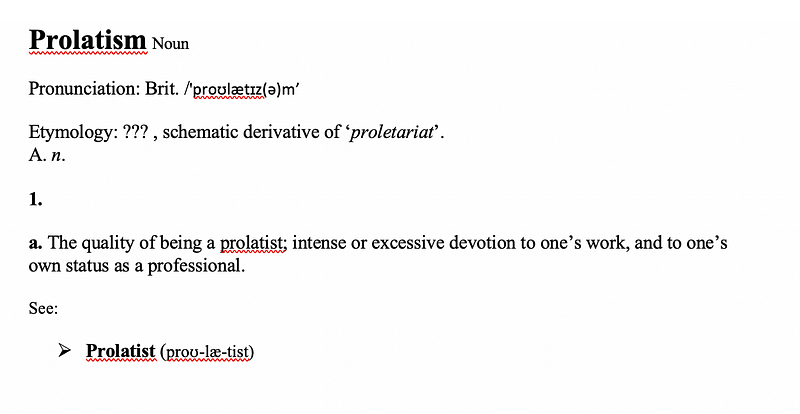
For the moment, we’ll call this curious new attachment ‘prolatism’.
Prolatism?
Professions were formerly bound by the limits of craft. Society was largely organised around tiers of skilled work, with a product lifecycle running roughly to the tune of craft, followed by fabrication, followed by use. As Arendt noted, with greater automation of process and mechanisation, craft has been supplanted by labour, whose lifecycle runs in the order of “metabolism, maintenance, [then] consumption.” This state of affairs is not unknown historically to those lower on the socioeconomic ladder. It might be considered sign of a certain moral laxity among the professions, and particularly the media, that only now that labour is becoming the register of previously craft-driven professional classes that those classes have begun to take notice. Given the ever-increasing rate of technological development, this currency change from craft to labour is happening more quickly and more broadly across industry sectors.
The lack of unionised protection enjoyed by the professions [2], coupled with intense competition, stimulates prolatism which, as seen above, manifests in an intense, or even excessive, devotion to work. It is not that professional devotion is intrinsically negative — this needn’t be the case. It is, rather, the fact that the utility of such a complete attachment to work is questionable. It is also the fact that, in practical terms, a broad class of ultra-competitive persons whose primary devotion is to their profession — which is to say, to themselves, in the most limited sense — may have less than desirable outcomes for both individuals and the societies they comprise.
A Portrait of a Prolatist

It is most straightforward to get into an enjoyable kind of prolatism if one’s passions, and so one’s preferred line work, meet with the prevailing tenor of the age. As such, the ‘happiest’ prolatists of our day are wartime consiglieres [3], financiers, executives in big tech, branders-of-self (otherwise known as influencers) and single-issue controversialists. It is these people whom are most rewarded, socioculturally, by living and breathing their work, and it is by their example — as invoked, as exhibited, or as both invoked and exhibited — that a large number of the rest of us are compelled into a kind of prolatism, a never-ending bid to enlarge our individual market value, to increase our visibility, and deepen our immersion in the pursuits of ‘getting ahead’.
Despite our age’s contempt for religious concerns — where they are not vanities suitable for professional gain, or the indulgence of narcissism (for it would appear a great many sportspeople and eminent entertainers believe in a thoroughly materialistic God whom is, furthermore, materialistically partisan in trivial matters) — prolatism shows that religious instincts are, unless tamed with acute precision, native to human nature, for the basic pillars of prolatism are founded upon shows of piety.
It is good for both the psychological wellbeing of individuals, and the productive health of nations, for us to be conscientious about our work — whatever it is. Cultivating such habits is the surest way that, in the instance we find ourselves unenthusiastic about our position of employment, we might find a new one better suited to us. However, there is a considerable difference between taking pride in work, and sublimating selfhood to it, both in terms of self-estimation, and how many hours in the day we give over to it.
There must be a counter-movement of those who, while thoroughly able, conscientious and applied in whatever occupation they hold, can stand apart from their work — and stand firm, not in passivity, not simply because one is apathetic to what one does or to life itself, or because there is something good on the telly. No, to stand apart from work in inner life, to hold and nurture concepts and pursuits beyond what it is we do to make our living — after all, one whom is sublimated entirely to their living tends to become materialistic and minded towards consumption (not for the sake of what’s consumed, but for the fact of being able to consume it). Such materialism and consumption gives work further cultural capital, and compels employers to create an even more pervasive mood of prolatism among the public in order to sustain it.

It could be asserted thus that prolatism is harmful to our collective status as both workers and consumers. Attitudinally, a prolatist whom is not entrepreneurial, or does not occupy an executive berth in a company, is, in a non-pejorative sense, servile — and a servile workforce is one which enjoys less bargaining power, and as a result of this lowered bargaining power, will tend to work for less in the way of financial reward. This, I think, is definitive certainly of the millennial generation, who are approaching their peak spending years.
The current body of the workforce which corresponds to the description above is larger and cumulatively richer than any before it. We can see that they are also more likely to consume without any kind of ethical compact guiding their buying choices. They are, for example, very happy to patronise companies such as Uber and Amazon, despite the depressive effect these buying choices have on the bargaining power of these neighbouring sectors of the workforce. There has not yet been a free-produce movement for our own crises of wage servitude.
This indiscriminate approach to what is consumed is precisely what enables executive corruption at the highest levels of the prolatist church — the house of big tech. Those in this echelon whom are, if not capable of malfeasance personally, then of integrating some form of it into their business strategies, can do so in the knowledge that their market’s most powerful weapon — their buying power, and the refusal to supply it — will hardly be used against them. What’s more, because buying power patterns determine the market almost single-handedly, the more money is spent through unethical channels, the more appealing unethical business is made to seem to the arriving entrepreneurial class.
The centrality of attitude, and particularly a servile one, to prolatism cannot be understated — consider musicians. Musicians, over the last twenty years, have seen the relative security (of an admittedly zany and unpromised kind) of their industry beset by all kinds of legalised piracy, as one potentially lucrative revenue stream after another was made barren for them, developments enabled primarily by the same musicians’ own audience base. It is only now that their field has been essentially Sovietised, only now that the demands of their new corporate masters have become more explicit, and almost terminally egregious, that there has been even the faintest of collective murmurings in the direction of unionising. There has been no actioned sympathy from the broader mass of their audience at all.
The primary emotional tenor of prolatism is cynicism — to draw up another religious parallel it is not, in its way, a much different kind of cynicism than that which Platonists subscribed to. It roots in a suspicion of the world and a haughty boredom with an expansive sense of life. It is, too, as clever in self-defence as it is in legal play and systems-building — it quite capably takes all manner of activities which alone offer an alternative to a life obsessed with work (particularly the quest for greater physical fitness), and reshapes them too with the same competitive, easily quantisable qualities of prolatism.

And, in this way, prolatism is symptomatic — symptomatic of the world in which we now live, which is a world between. We are long past the day on which the reign of religion over the minds of humankind ceased to be absolute — but we have yet to develop a kind of moral directive capable of filling the gap religion once provided. Oddly, as it pervades historically in so many of our most eminent individuals (albeit many individuals persecuted in their own times), developing secular morality on a mass scale may be the ultimate achievement of human society, when it is eventually attained.
For a time, patriotism and science looked poised to take over from the church. In the Early Digital landscape, initiated into the first throes proper of post-nationalism, patriotism has been replaced by prolatism (though not, as we have seen, without a considerable fight-back from patriotism), and science, insofar as it too is now considered as much from a utilitarian perspective as with an eye toward broader aims, by commercialism.
We have, in other words, merely swapped superstitions. Prior epochs, in Western history and beyond, have segued into better, more liveable forms once the greater mass of people realised the influence of their decision-making, and had a broad- and good-natured-enough view of life to exercise that influence thoughtfully. We will see how long it takes for a similar change to move us out of our current age, the age of the prolatist.
[1] See credentialism.
[2] Trade unionism was initially devised to form associations of individual labourers, and thus increase the bargaining power enjoyed by the overall workforce. Unions were once considered fundamental for the prevention of the reduction of an unskilled worker’s wage — such wage reduction was made all the easier by advances in mechanisation. Because members of the professions held skills of their own, their bargaining power was relatively hard to reduce, negating the need for unionisation along similar lines. However, mechanisation through software, combined with the vicissitudes of the online economy, is now progressing to such a point as even many professionals need fear for the security of their occupations and average wage.
[3] This is a facetious but, in the moment, irresistible shorthand for any kind of policy intellectual, cultural gatekepeer, or other operative sociocultural spaces whom can find profit and power in official opposition to something.