

Millennials’ Insecurities with Professionalism
How the overuse of the exclamation point reveals the insecurities of millennials
Growing up in the No Child Left Behind (NCLB) standardized test era, the memorization of “information and isolated facts” was grounded into our millennial knowledge toolbox. The purpose of this strict mastery was to ensure that this generation could be “measured through standardized test results” that reflected our school’s performance and ability. If you were enduring school during 2002–2015, you understand the rigid memorization strategies that were put into place in the hopes that we would perform at an advanced level during state testing. In my opinion, millennials were tested to a fault.
We will not go into the negative psychological effects and the consequential bias towards low-income communities that stemmed from this educational policy, but I do want to bring up this educational time to reminisce on the repetitional practice and mastery of academic concepts. To this day, I can recall the specific lessons of repetition and memorization in my middle school and high school classes.
Academic writing and the proper use of punctuation marks was drilled into us. Regardless, I recently have found myself doubting the usage of certain punctuations within my professional writing. The main accomplice of my punctuation mistrust can be found in my work emails.
Reflecting on the fact that I am a part of the millennial generation, I can’t help but question the linguistic style choices of my formal and informal communication.
Millennial Work Emails: Evidence of Exclamation Point Overuse in Written Communication
To understand the communication style of millennials, it is important to understand the general characteristics associated with the millennial professional.
- Tech-savvy
- Family-centric
- Achievement-oriented
- Team-oriented
- Craves attention
- Prone to job-hopping
As a millennial professional working in education, I notice myself and other younger (mainly female) coworkers communicating in a similar style and tone. Embedded in our work emails with each other and with parents/guardians, there is an overuse of exclamation points as a general trend.
Here is an example:
Good afternoon,
Thank you so much for reaching out! I am so thankful that you took the time to seek information and advice on how to deal with your son’s inattentiveness during class time while we are in the digital learning format.
I wanted to take a moment to actually praise *name*! Despite his recent, low attendance, he is an excellent student who has shown himself to work hard when motivated. There is no doubt in my mind that he will get those grades up as soon as he can! I am proud to have him in my class…
Despite the fact that the parents responded positively and kindly, I was burdened with slight embarrassment. After sending this email, I reviewed and counted all of the exclamation points that I included. In this particular email, I included a total of nine (9!) exclamation points.
An Analysis of the Overuse of the Exclamation Point
A popular quote that trended for a while amongst millennials was the phrase, “Adulting is hard.”
Gen Z now cringes at this term, but it truly resonated with us. We had mugs, car stickers, t-shirts, Facebook posts, and online forums inspired by this motto. We used this term as self-deprecating humor to conceal our ambivalence about growing up. In my opinion, this term originates from a deep-rooted entanglement of self-doubt and lack of confidence around the idea of being seen as an adult.
This idea of an apprehensive generation is influenced by the work of Amy Johnson in her thesis titled, “Adulting is Hard: Anxiety and Insecurity in the Millennial Generation’s Coming of Age Process”. In her research, she declares that millennials received “constant criticism from members of older generations” and they were blamed for many of the cultural and economic issues that transpired.
An evident sample of how millennials are perceived can be found with a simple search of: Millennials are killing the…
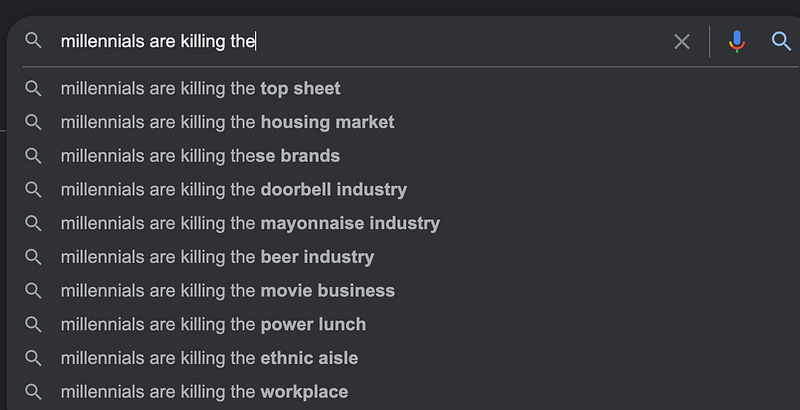
Dawning from the compliance of being the impeccable test-taker, a millennial stepping into adulthood and facing the brunt of aggressive criticisms has caused an abiding hesitancy in us. We are fearful that we will not be seen as qualified, and even more importantly, we are fearful that we will not be liked. This leads to our emotional fragility, and we will communicate in the way that we will be perceived as eager and kind. This is to avoid the emotional consequences of negative miscommunication or being rejected.
Consider the characteristics of the working millennial mentioned earlier. There is a compelling connection between the positive attributes of being team-oriented and attention-craving while also being insecure and anxious about being perceived as a proficient employee. As a young professional, we need to be heard, accepted, and approved of by our superiors, which cycles us back to the infamous exclamation point.
Millennial’s Exclamation Point Usage Conclusion
If the original intent of an exclamation point is to exclaim an important point, then millennials must be attempting to underscore the positive, emotional undertones of their written communication. In contemporary practice, the general use of an exclamation point can be used to show “friendliness or enthusiasm”. Overuse of this punctuation can lead to the reader interpreting the writer as someone who is “flighty” and not serious.
We are in the constant pursuit of being appreciated for the work we produce. With the excessive use of the exclamation point, we are sprinkling in subconscious reminders to our audience that, “Hey! I promise I am enthusiastic! I want to get the job done! I am excited about this!”
It is hard to blame millennials for their desire to be recognized in the workplace as an ego booster to combat their emotional fragility.
As a millennial myself, we need to acknowledge this insecure trait and begin to establish our confidence in the workplace. We need to empower ourselves to claim our professionalism without feeling the perpetual need to display toxic positivity. Take ownership of your credibility and take away those exclamation points. Period.