
Professional Email Etiquette for Students: The Difference Between a Good or Bad First Impression
Learning to write good emails can be the difference between getting what you want in your career, and missing out on opportunities!

It’s estimated that roughly 347 billion emails are sent and received each day.
Furthermore, that number is only expected to increase.
Along with corporate professionals, angry supermarket customers and those pesky little newsletters you can’t ever seem to get rid of, sending emails is a common task that many high achieving students do on a daily basis.
Whether that’s to arrange meetings for the school club or council that they lead, or to reach out to a university's scholarship committee, many students will find themselves needing to send emails on very regularly.
However, in my time in high school, and even in university, I came to notice that a lot of people, and in particularly the students, didn’t actually know how to write proper, professional-sounding emails.
Emails that would signal to the recipient that you’re smart, articulate, and should be taken seriously.
You see, often, when we send emails, what we write leaves a lasting impression on whoever we’re reaching out to or connecting with.
Whether it’s a follow up from a networking event, or asking for some help from the college professors, the emails we write can have direct impacts on what people think of us.
That’s why having professional email etiquette is so important, and why I’ll be giving you some actionable tips you can use to ensure you never run into problems with your email writing again.
So if you’d like to invest just a few minutes of your time to ensure you can learn how to write good emails that send a strong, positive signal to whoever you’re talking to that you mean business and that you’re someone they should respect, or your emails look anything like the image below; keep reading.
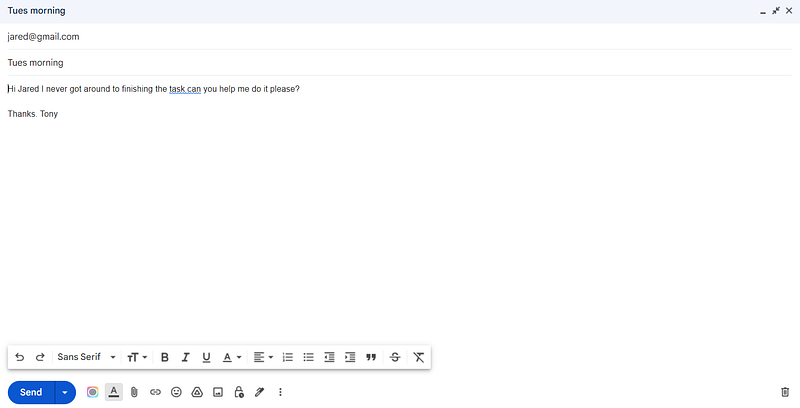
Proofread Before Hitting ‘Send’
This is probably the most important tip I could ever give you on writing good emails that make people think highly of you.
Perhaps one of the biggest issues with people, and especially students writing emails is that they simply don’t write with good grammar and spelling.
Yes, emails are generally conversational, but that doesn’t mean you can use things like ‘lol or ‘haha’.
On top of this, you always need to make sure that whatever you’re writing is written with perfect grammar.
Do you know the difference between ‘there’ and ‘their’?
What about ‘your’ and “you’re”?
If need be, use a spelling and grammar checker please.
Emails that have spelling and grammar mistakes instantly send off a signal to the recipient that you might not be as smart as they initially thought you were, or that you shouldn’t be taken seriously if you can’t even get your basic grammar and spelling right.
Use a Professional-Sounding Email Address
You should use an email address that reflects your professionalism when communicating with professors, employers, and other professionals.
Email addresses with nicknames or unrelated terms may not be taken seriously, even if you’re a student.
Just keep it as plain and simple as possible, and email addresses like ‘[firstname].[lastname]@[emailprovider].com’ are a good choice.
I know you might have a poplar name with the email already taken, but find a way to work around it, such as by adding a middle name initial into it, or modifying your name (such as by using ‘Rob’ instead of ‘Robert’).
Whatever you do, please don’t go with something like: ‘[email protected]’.
Keep Your Subject Line Clear and Appropriate
You should only ever use your subject line to summarize the content of your email so that the recipient knows what to expect.
It should be concise and get straight to the point.
The subject should not be vague, such as “I have a question”, or “Tuesday”.

Instead, it should be something like: “Clarification for the Meeting Venue on Tuesday.”
Something like this is going to instantly let the recipient know what you’re emailing about, and make you sound a lot more respectable.
Use a Proper Greeting
You should always begin your email with a polite greeting.
Now, you might think this is stupid of me to say, and that anyone knows to begin emails with a greeting.
Oh, trust me, I’ve seen some pretty shocking things, even from high school teachers and qualified university students.
This is especially important when it comes to professors or professionals; use their titles and last names (for example, “Dear Professor Brown” or “Hello Mr. Davis”).
As a student, most of the time, things probably won’t be so serious or formal, so using ‘Hi’ is going to be acceptable.
Write Clearly and Concisely
Always make sure your emails are well-structured and easy to read.
Don’t ‘waffle’ too much, and don’t talk about anything that’s not going to be relevant.
Again, you’d think this is something that everyone should know or is common sense, but you’d be surprised.
Tone is Important
Choosing the right tonality to write with is also an extremely important aspect of writing good emails that people respect.
Make sure you choose your words carefully when writing an email, as it can sometimes be misinterpreted.
Don’t use overly informal/casual language, slang, or all caps, which may be interpreted as shouting or aggressive tonality.

Just because you’re not using the words ‘lol’ or ‘pls’ doesn’t mean that your email is going to sound rude and too serious.
Close Appropriately
You should close your emails with formal or academic closings, such as the classics like ‘Sincerely,’ ‘Best regards,’ or ‘Yours truly.’
As a student, casual closings like ‘Thanks’ or ‘Cheers’ are okay.
In fact, going too formal might sound a bit off.
However, please never use closings that aren’t commonly used or are unorthodox, such as things like: ‘Later’ or ‘Bye’.
Just don’t do it.
Be Respectful of Response Times
After sending your brilliant emails, it’s equally as important to be patient and give/allow the recipient appropriate time to respond before sending follow-up emails.
In a professional setting, it is generally considered good practice to wait 24 to 48 hours, exclusive of any weekends, before sending follow-up emails.
To Conclude
Writing good emails can mean the difference between someone thinking highly of you and having respect for you, and not giving you or what you have to offer a second thought.
Just like how we would care about how we dress and act around the people that we want to impress, we should care about the way we write our emails, and make use of professional email etiquette.
Use these actionable tips I’ve shared with you today, and your emails will be sounding brilliant almost immediately!
If you’d like to learn more about excelling as a student in all areas of life, beyond simply your academics, check out the rest of the Medium publication, Grad Excel!
Other than that, best of luck to you, and happy writing emails!