avatarErik Rittenberry

Summary

The text reflects on the frenzied consumerism observed during Black Friday shopping, contrasting it with the neglect of deeper cultural and spiritual values, and mourns the death of poet Robert Bly as a symbol of society's disregard for profound art and thought.

Abstract

The article "Prisoners of Plenty" paints a grim picture of consumer culture on the day after Thanksgiving, where individuals are depicted as obsessively seeking discounted material goods, often at the expense of their humanity and decency. This mass consumption is portrayed as a hollow pursuit, one that overshadows the richness of poetry and philosophy as represented by the works of Proust, Emerson, and the recently deceased American poet Robert Bly. The piece critiques the superficiality of a society that prioritizes material wealth over intellectual and spiritual enrichment, suggesting that the true essence of life is being lost to the artificial gratification of consumerism. It laments the ignorance of the masses to the beauty and depth that lies beyond advertisements and the fleeting promise of happiness through possessions, while also highlighting the irony of a culture that claims to uphold values like citizenship and patriotism, yet remains blind to its own spiritual emptiness.

Opinions

  • The author views the post-Thanksgiving consumer frenzy as a dehumanizing process that strips individuals of their decency in the pursuit of material goods.
  • The essay suggests that society's preoccupation with consumption is a form of servitude to the status quo, where the act of buying is the sole function and purpose of individuals.
  • The author expresses a sense of loss over the public's lack of interest in reading and appreciating the works of great thinkers and poets like Proust, Emerson, and Robert Bly, implying that such neglect is a symptom of cultural decay.
  • The death of Robert Bly is used as a metaphor for the societal disregard for the sacred and poetic aspects of life, which the author believes are essential for a fulfilling existence.
  • The piece criticizes the American Dream as having devolved into an endless cycle of consumerism, leading to an emotional wasteland filled with shopping centers and prisons, devoid of genuine human connection.
  • The author sees the average person as a "prisoner of plenty," entrapped by an abundance of material possessions that ultimately sever them from their spiritual self.
  • The text implies that the modern world, characterized by crowds, consumption, congestion, and chaos, has reached a state where the pursuit of material wealth has eclipsed the pursuit of wisdom and beauty.

Prisoners of Plenty

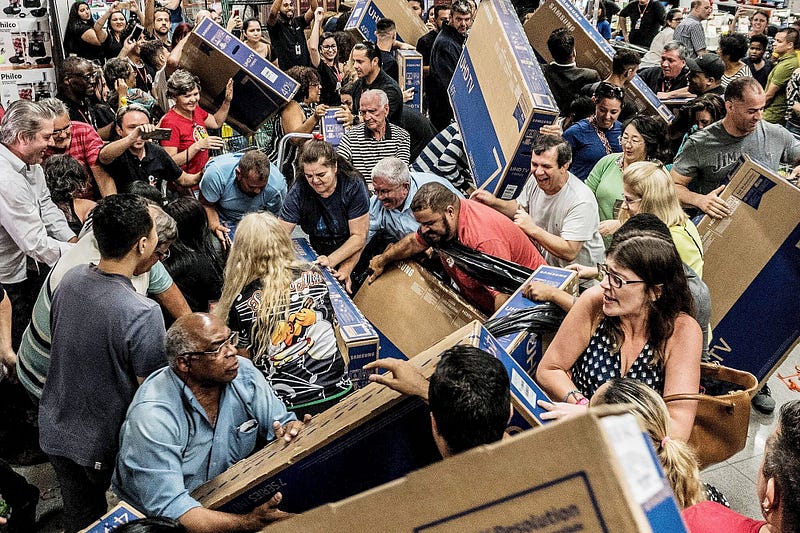
It’s Friday, the day after thanksgiving and bloated bodies, infused with fierce anticipation of scoring even more trinkets and gadgets at a discount on credit, have been up since 1 am, perhaps earlier, standing in long lines in the dark in front of stores.

Some even bring tents to get an earlier advantage. . As soon as the doors open, they’ll eagerly make their way in, nudging and pushing and slobbering, stripped of the remaining remnants of human decency, with the sole intention of possessing another object they think will bring them happiness or improve upon their inner despondency.

Sanctimonious servants of the status quo, forever kneeling at the altar of heedless consumption, their only function.

And Proust and Emerson remain unread and the wildflowers on the side of the road remain unnoticed as with the stars that hang in the night.

One of the last great American poets died this week at the ripe old age of 94.

Robert Bly.

However, like his words, his death is of no consequence to the early morning consumers elbowing their way to the TV section.

They have never read anything or pondered on anything beyond the advertisements suggested to them.

“Reclaiming the sacred in our lives naturally brings us close once more to the wellsprings of poetry,” writes the poet. But our ears are no longer equipped to hear his cry.

The very few important figures in the western world have always been ignored. And everything that is beautiful and profound has been buried beneath the ruins of false progress and the illusion of security.

Children of a hollowed-out empire, habitual flesh with a childlike understanding of what’s going on in the world, they continue their relentless quest to satisfy their synthetic appetites, relinquishing their lives to an insidious system that sustains itself merely by their submission, their fidelity.

They deem this — good citizenship. Patriotism.

The American Dream at last, an endless commercial, an emotional wasteland plagued with shopping centers, quick-marts, theme parks, and prisons, the sunny afternoon suburban streets as desolate as the souls who inhabit them, the good folks bustling and bantering, gorging themselves to death on Netflix and the never-ending news cycle, spouting facts to conceal their illiteracy.

Crowds Consumption Congestion Chaos

The epitome of modernity.

Prisoners of plenty, severed from the spirit.

Thanks so much for reading. You can find me around the internet at the following: Blog: https://erikrittenberry.wordpress.com/ Facebook: https://www.facebook.com/erik.rittenberry Instagram: https://www.instagram.com/erik_rittenberry/

Society
Mindfulness
Poetry
Black Friday
Spirituality
Recommended from ReadMedium