
Priorities
Our Sinking Ship
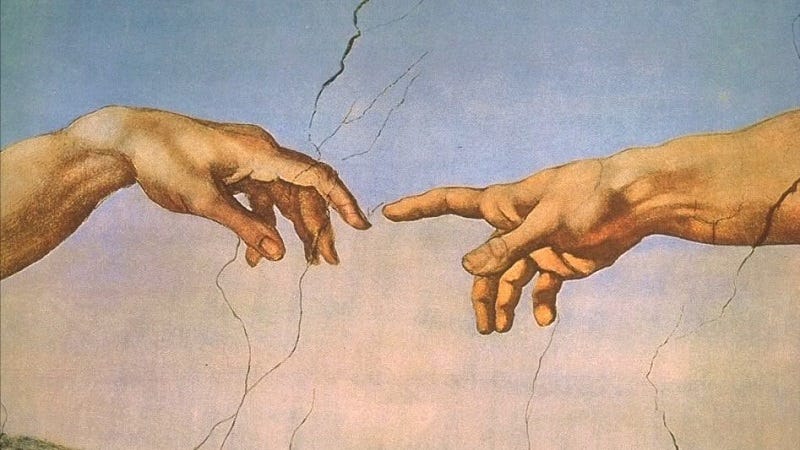
The arts — rearranging deck chairs when we should be learning how to fly
for song and art and story and sex make for sumptuous prison walls
Denise Levertov once said, “What the imagination seizes as beauty must be truth.” To me, that is such a wonderful thought, and possibly, possibly true. On some level: the soul sees beauty as truth.
But not all the way true; in fact, nowhere near the absolute and nowhere near-mystical / historical truth. For the sugar-deprived prisoner, even the smallest piece of candy is a welcome (perhaps even prayed-for) explosion of sensual pleasure.
Art and its often undeniable (candy-like) beauty, seen from certain standpoints, mine sometimes included, is in fact an elaborate prettying up of our cell walls.
I once mused that the perfect prison would be one that you did not want to leave. Earth, in many respects, I believe, is that prison.
Many great men, and I’m thinking of the Buddha, of Lao Tze, of Jesus of Nazareth, of Shankara, and of a handful of others, have seen our world for what it is: a spirit prison; and then devoted their lives to opening eyes to this fact. An often thankless task.
They nailed Jesus to a cross; Lao Tze, at the end of his tether, fled the city for the distant unknown, others — with the patience of the saints they were — stuck with the task, un-killed, until a ripe age (the Buddha reportedly died at eighty). Many of the Christian mystics — Eckhart comes to mind, also lived long lives; Eckhard was nearly seventy when he died.
Adi Sankara, however, is believed to have died aged thirty-two, at Kedarnath in the northern Indian state of Uttarakhand, a Hindu pilgrimage site in the Himalayas. Texts say that he was last seen by his disciples behind the Kedarnath temple, heading up into the Himalayas until he was no longer seen. No one ever managed to trace him. Taking, I’m assuming, the route of Lao Tze (but not before he had left a wide and deep legacy still alive and breathing today).
While the true saints are few and far between, the artists, by comparison, have proliferated through the centuries and still do — casting their beautiful spells (on cell walls) to distract us.
This planet must have struck several icebergs, still, it struggles on, barely afloat and, yes, leaning heavily to port while the stern now sits far lower than the bow, slowly sinking. Meanwhile, humanity — and our many artists along with it — rearrange the sliding deckchairs and are very, very serious about this.
We should be learning how to fly. Flight is a possibility though denied or disbelieved by the many. Too much work, too stressful. Much easier to just kick back, break open another beer and pack of popcorn and watch the screen, perhaps we’re not sinking after all, as long as the pictures keep coming — they wouldn’t come, would they, were we really sinking?
Good luck with that deluded optimism.
And our popular music. Every four days or so when I drive to the store (to gather food) and back I sometimes turn on the local radio station to again be moved by how one song sounds just like the next: the heavy beat, the simple melody — sometimes spoken more than sung, the incipit lyrics that in a good ninety-odd percent of the time have to do with procreation, seriously.
Not too long ago, or perhaps it was long ago, the mantra ran: “Sex, drugs, and Rock’n’roll”, capturing all the meaning in life, at least during the adolescent, coagulating days of lives. And one reads of the sexual excesses of some of these pop heroes that seem to keep the biography genre alive and happily flourishing. Not that I’ve read any of these sensational accounts of debauchery, but from a review or two one can gather that touring, some musicians went from stage to sex to stage to sex and quite often more sex at the back of the stage, between the drug-top-ups.
Whatever it takes, we must learn how to fly.
© Wolfstuff
P.S. If you like what you’ve read here and would like to contribute to the creative motion, as it were, you can do so via PayPal: here.


