
INTERVIEW
Printed Books Will Always Work
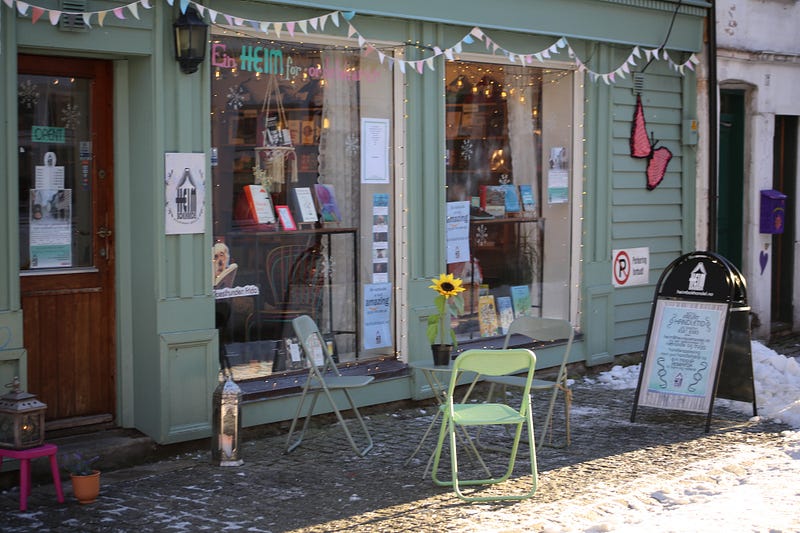
Heim Bokhandel (Home Bookstore) is a new, upstream bookstore that was established in Bergen, Norway, a little over a year ago. The bookstore had a difficult birth due to the Covid-19 epidemic that broke out after only two months of operation. I decided to do an interview with Beate Helle in Heim Bokhandel.
What is Heim Bokhandel?
Øivind H. Solheim: I have understood that Heim should be a literary alternative. — What is Heim Bokhandel?
Beate Helle: We are an independent bookstore, we focus on books outside the mainstream bookstore. We want to be a literary alternative to the mainstream bookstore. This means that we heartily pick the books we want to sell.
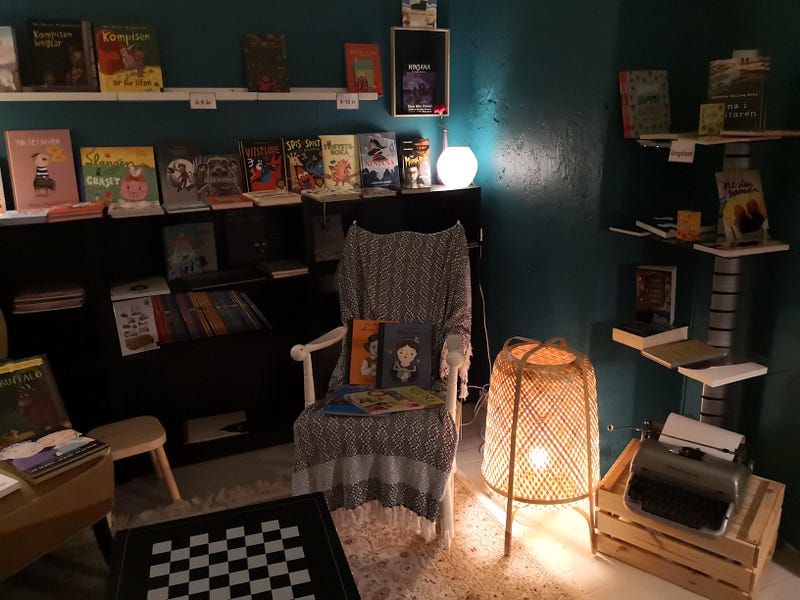
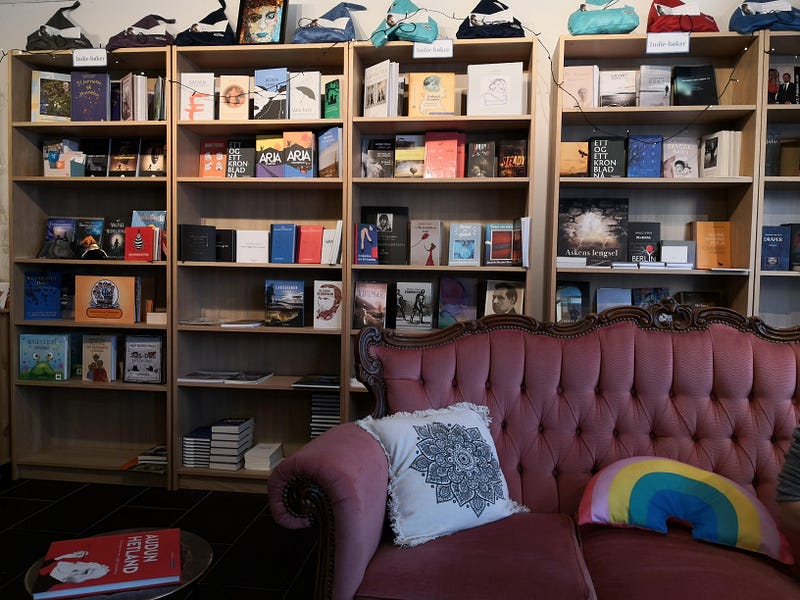
And then we focus a lot on indie books, ie books published by the author himself at micro-publishers. So now we have about 50 authors in here who sell their books through us.
We put some focus on Nynorsk — it is a bit difficult to find a rich selection in mainstream bookstores. And we are also very fond of poetry, so we also put some focus on poetry. But we have a rich selection of all kinds of literature, within fiction.
Why did you start Heim Bokhandel?
We thought that when the bookstore in Norway becomes very mainstream, very streamlined, it opens up a void for literature that may not be included in the mainstream. — We thought we would fill this void.
We have chosen to be an independent bookstore and pick books that we think are worth passing on.
When I came in here today, general manager May told me that she had started reading my debut novel, The Abyss (Stupet). I have never experienced this before in a bookstore.
We read the books, have probably skimmed most of the books in the bookstore and can give very good advice. And it works. After the Christmas shopping now e.g. we have exchanged only 3 book gifts.
The Heim Bokhandel team
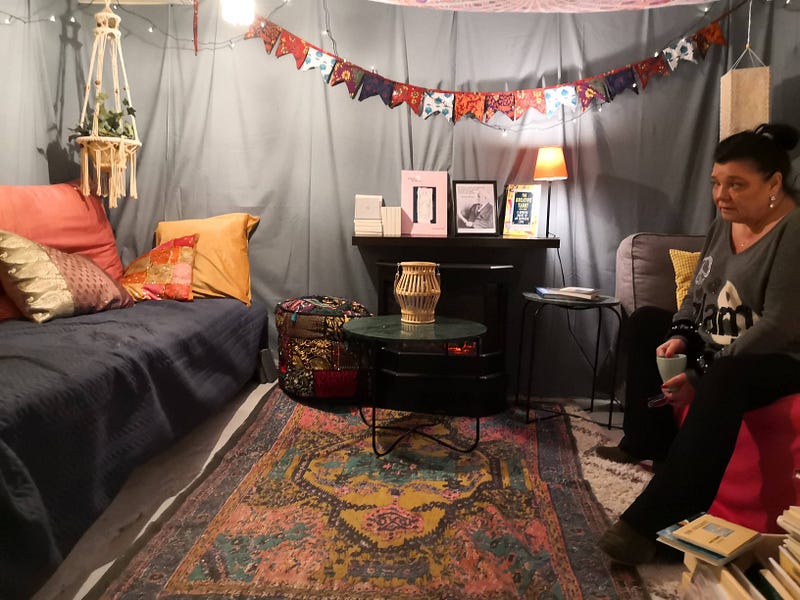
We at Heim Bokhandel, we are:
- May, general manager, has a bachelor’s degree in literary studies.
- Einar, multi-artist.
- Beate, lawyer and poet.
- Kjetil, pedagogue.
Everyone writes themselves. Several have published themselves.
The concept is bigger than just the bookstore.
The bookstore is one foot. Then we have courses, writing courses, and we have small events with poetry readings, with music, we have meeting with authors.
And we have — yes, let’s call it small philosophical evenings, which are about life issues, like how do you get courage for everything, sort of?
Some people are very brave. — What is courage? — What is relational courage? which is something other than jumping in parachute courage. It is about this — having the courage to do everything, or finding their courage, the kind of life considerations or what I should call it.
Who do you address?
We address everyone who loves words. Word lovers. And we may not appeal so much to academia, but to most people (but they live in China, so it’s a bit far), but I must say then, that we are a bit populist perhaps, that we are a home. The name is not randomly selected.
What makes books so special?
There’s something about the whole thing, there’s the visual, there’s the tactile, there’s the smell, true, the smell of a new book, the sound of a book. You hold the author in your hands, there is something about us being sensual beings, it is deprived of us through the web. There is a sense, in height two — there is sight, hearing — and then there is everything else then.
And it’s not the same to see a thing with and without smell. Everyone who has Parkinson’s, for example, who loses their sense of smell — knows what it means, how big it is, how important it is for your entire sensory experience. And all this a book offers.
Books, physical books will always work, simply because we are human.
Yes it’s very strange. But it’s like that, I experience that it’s like that.
And I think that in this pandemic we have been forced so much online — on Zoom, on Teams and on these platforms where we have had meetings and — how poor we become, how tired we become.
Yes, there are many who say it, they get tired of it…
… of screen. And how flat and shallow… — it is a flattening of the human.
This could be such a night on life issues. It is important to put words to such things. And they’re a bit of the reason we’re here.
Write to be understood, or write for recognition
Two things — this with the academicization of literature. Two different ways to write.
What do you mean by academicization?
Then I think that there are some ways of writing that are considered in a way that is a little more valuable. Do you write to be understood, or do you write for recognition? There are two different ways to write. And when I say academicization then I think of writing for the recognition, and not necessarily to be understood by the many.
It is really the same debate as insta-poetry vs «proper» poetry. Trygve Skaug is the poet in Norway who sells by far the most poetry. He sells extremely much more than the next on the list. And why does he do that. — Yes, he is an insta-poet. His poetry is very very simple. He is so simple that those who write for recognition, they say that this is shit, it is just rubbish. But it is not. You can not say that and cut off so many people who read his poetry, who buy his poetry. And who benefits greatly from it.
— To say that it’s crap — it’s not.
Am I farsighted now? The farther away from me you disappear, the more space you take up my field of vision.
Yes, he writes very easily.
Yes, it’s about seeing, putting it into words.
To fall for you is a simple matter. Everyone does.
I have chosen instead to raise me up for you. If you only knew how well I really sat.
But then — he is cut off because he writes to be understood. He does not write for recognition.
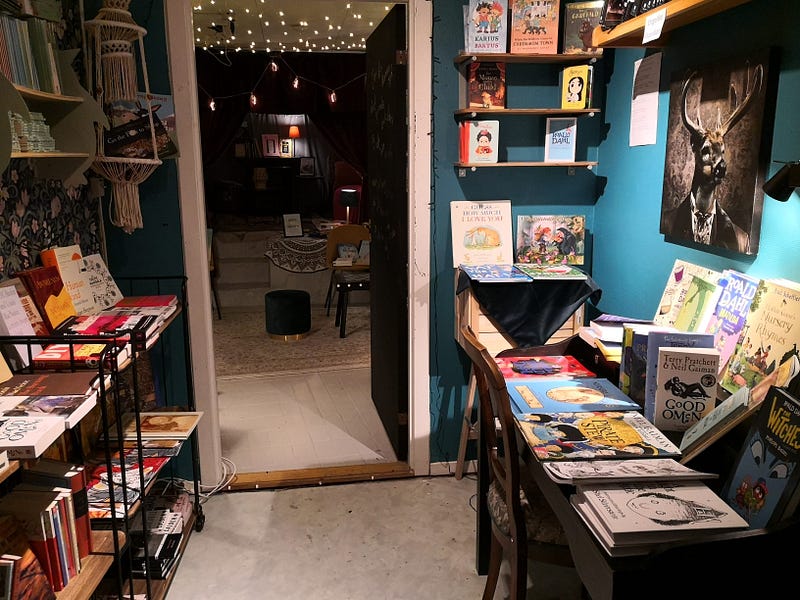
But we are there for word lovers, even those who write for recognition, I had almost said. It may be an artificial distinction, but it was to illustrate, when you ask about academicization… it is more complex… so we now have both. In the same way that we have both classical music here and concerts here, country music and shows and poetry. They cover the whole picture, they complement each other very well.
It’s a bit like a home, we do not cut anyone off.
When did you start?
We had a slightly slippery opening, but officially — it was in December 2019.
So you have been active for a little over a year then.
The store has been active for one year, yes. We got the pandemic in the middle of nowhere.
What you see
We could have had a gathering here and talk about what you see — which is just about seeing — what can you see when you see? You must not think that I see what you see.
And what I see that you do not see, and the other way. And how conscious are you of what you see? You can practice seeing the small, and smaller and smaller.
— Have you really looked at this?
— Have you tasted that one properly?
Yes, you are in the process of actively processing the input.
Yes. Active processing, how conscious you are. You practice seeing the small — it is active processing, someone has to point to things, then it happens… it is extremely important.
That is why it is so important to talk about small events, about life-things. Learning, or philosophy of life or whatever we may call it.
What is listening? What is active listening, active and passive listening? How do I know you are an active listener? How do you know that you are an active listener? — What do you see when you see, and things like that.
There are really very few of these types of offers.
Yes, what is happening today, really? In other words, television has lost its appeal to younger people than my generation.
When I talk to young people here — especially recently in the Christmas shopping, there has been a lot — they do not go home, you know. They’re so hungry for that kind of talk.
We can talk to them about the difference between being confident and having self-confidence, for example, which they have never thought of — because that’s it. You can be very confident and still have a low self-esteem. And vice versa — you can have a high degree of confidence in yourself, even if you are not confident.
“We thrive when we realize that we are human”
So that’s a bit of the idea of Heim Bokhandel — to make it possible with interpersonal contact between people and increase contact and stimulate dialogue?
… Yes, stimulate dialogue, stimulate writing, stimulate reading, stimulate language.
— There’s something about the language. If we do not have the language, what do we have then? Then we have nothing.
Opinions do not jump from head to head, they must go from person to person via a language, and if that language becomes narrower and narrower with fewer denominations — then we degenerate.
So reading, talking together, pointing, being clear, it’s something we have to practice as human beings, so it’s absolutely vital. Then the home is a small contribution there.
We thrive when we realize that we are human beings. It’s enough to think it’s a nice day. The web is just something in addition to the other things.
And I think people have discovered that now in the pandemic, how dependent we are on each other and how dependent we are on our senses.
We cater to most people. We appeal to everyone who loves words — word lovers.
We may not turn so much to academia, but we are a little popular perhaps, we are a home. The name is not randomly selected.
“A quiet amusement park”
Here we have a local insta-poet, Kristin Straume. She has sold a lot. Very simple things — I like to call it utility poetry.
Do not talk ugly about others to me Then I just wonder what you say about me to them
I’m grateful that I did not get emotional Then it was necessary that I stayed emotion-boiling
It can actually go well The world needs me. It can actually go well.
— We are an offer when everything is closed and you can not have an experience like before. This is how a bookstore is an offer when everything is closed, when you can not go out and experience refills — then a bookstore like Heim Bokhandel is a fantastic offer, both to meet others and to feel the experience itself — because we are a bit like a quiet amusement park here.
We see it — it’s the case that all the books have their stories — they are stuffed with experiences inside them.
How does Heim bookstore reach people?
We just started up here, it was word of mouth. And then we were early — we got a big article in one of the main newspapers of Bergen, Bergens Tidende, on two pages and it helped to get known locally.
And then we have taken strategic steps online. Both on Facebook and Insta.
We have a Facebook group with 600 members, Heim poesi.
We choose this week’s poem on Heim poesi. And we hang them up in the window here, and people follow that.
But for the physical store, the most important, it is probably the word that goes from person to person.
What kind of experiences does Heim bokhandel have with meeting the author in the shop, open stage once a month, reading poetry, etc?
We have had a number of authors who have read here — yes, we have had successful gatherings here. And then we had poetry on Valentine’s Day — about witches, and it worked out very well. And book baths with us have been successful.
But we have really noticed the shutdown. Shut up, quiet now. People come by for a cup of coffee, stop by and read some poems. — Revenues go down, we earn little.
Heim Bokhandel has books for children — what types of books?
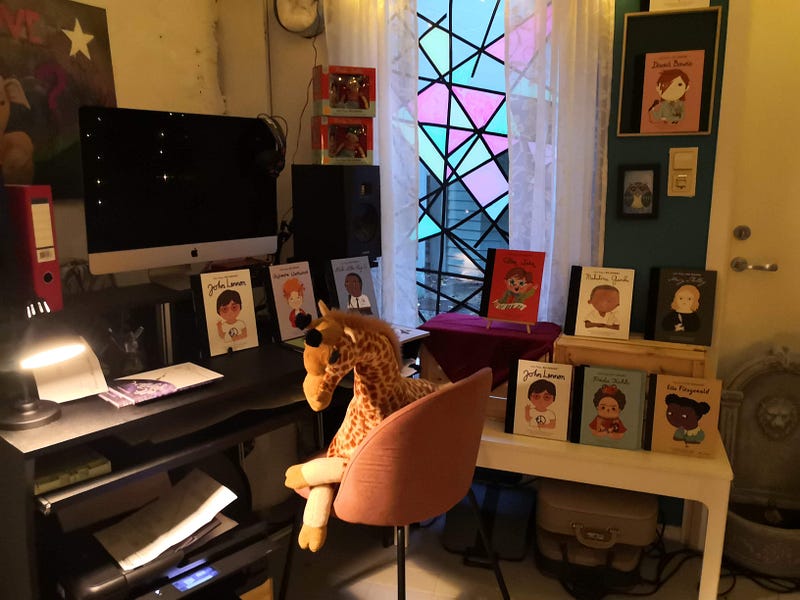
Yes, we have a large children’s book department. There are as many varied books as there are people.
You have about 50 adult writers, was that what you said?
No, I said indie writers. You can get most of their books here. Or on their website. And we have some Icelandic books — we have an Icelander on the team. And then we have English books, an English department. And very young people who buy these. We also have some children’s books in English.
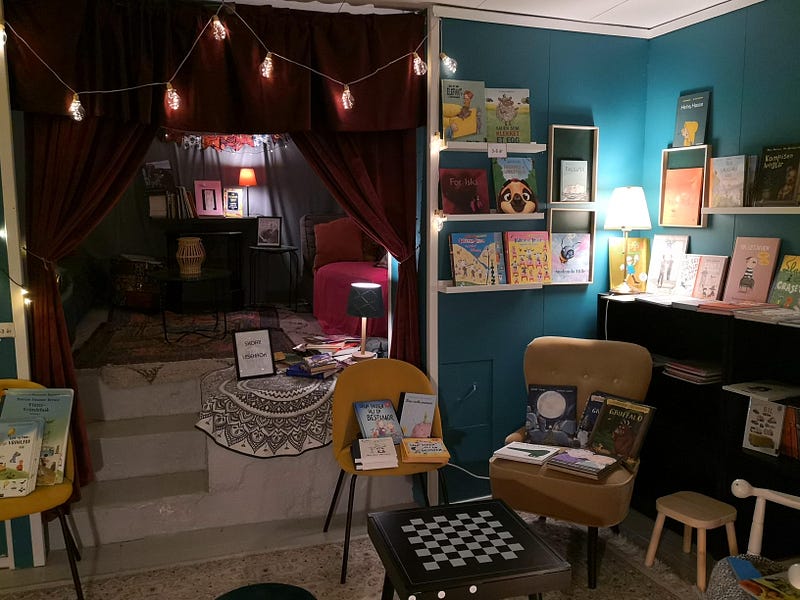
Here the parents come with small children and relax after kindergarten, and young people sit here and do homework, and we have two authors who sit here and write.
Oh! Yes, there is a whole creative environment here!
Yes, and the other day we had a visit from a group from a kindergarten. They had been playing in the snow, wondering if they could come in.
“Variation in culture, not unification”
What people are most interested in, what kind of books are most in demand?
We do not have the most demand for anything because we do not promote special books. As you can see, we do not have a single advertising poster.
And we try to lead people in the direction that means something to each individual, and then we sell as many varied books as there are people.
— not advertising.
So, we do not have advertising — we do not push books, we do not have the top 20.
“Unifying culturalism”
And this is a countercultural institution?
I do not know if I want to say countercultural, we are cultural — variation in culture is culture, not unification. I would say that unifying is countercultural.
Yes well said.
I do not accept saying that we are countercultural. We are the culture.
Yes, interesting. In my youth — and probably in yours too — then that was exactly what it was — then it was “In” to be countercultural, it was to stand outside…
… Yes mainstream, but it’s the wrong way to use the term, I think. Yes this is interesting.
The human in man
We safeguard the human in man, we safeguard the diversity of culture, and that is what culture is. There is diversity. It contradicts unification, in a way. Unification is in conflict with diversity in culture.
Text & photos © Øivind H. Solheim , @oivind47, hiker, teacher, author of novels, poetry, articles, essays, short fiction and experimental writing. [email protected]