Prime Minister of the Tibetan Exile Government
I visited India and Nepal for the first time on a Buddhist pilgrimage led by Shantum Seth in 2007. The following — which I wrote in a travel journal in Dharamshala, India — is from my 2008 trip, about a year later.
Most of us trekked past the Dalai Lama’s compound on a steep and rocky path, to visit the Tibetan prime minister, or more properly, Samdhong Rinpoche, the head of the Central Tibetan Administration. We would meet him in the Exile Government’s library.
Wearing an ankle-length Tibetan chupa I frequently hiked up, I hiked on steep and rocky terrain while carrying two bags and a cushion. I wore leggings underneath the chupa; unless it’s a hot summer day, I typically wear leggings under a skirt or dress. Fortunately, Rachel was walking with me and took my cushion and a bag.
While Rachel was perfectly kind and nonjudgmental, a vicious voice in my head criticized me for shopping frivolously; if I hadn’t bought shawls, a cushion, and a hat, I wouldn’t have so much to carry. I thought I would refrain from shopping so much on this trip, since shopping seems so consumerist and materialist and, well, not very Buddhist.
But why beat myself up about that? I’m a maximal bohemian, not a minimalist, and I collect art… and apparently shawls and hats, too.
During this walk to the prime minister’s appointment, Rachel and I were passing a cliff that ran along our left side; I looked up at it to see a high wall, and I saw the tops of trees behind the wall. I saw movement and thought it was a dog, but within seconds I realized it was the beret-clad head of an Indian soldier. That was a bit startling, and I mentioned it to Rachel. She said that’s the compound of the Dalai Lama’s house. I hopped up in a futile and silly hope of a glimpse of the house and said, “Oh, I don’t suppose we can see it.”
“No, I doubt it,” Rachel said.
“Maybe with a pogo stick.” I giggled.
“If you use a pogo stick to get a look at the Dalai Lama’s palace, then you’ll most certainly be arrested.”
I laughed.
Rachel then told me about an incident that happened probably within the last decade — it was when our landlady, the Rani, was still the M. P. (Member of Parliament) for the region. A taxi driver (all the taxi drivers in Dharamshala are Indian) had a disagreement with a Tibetan, and this resulted in the Tibetan stabbing the driver, and the driver died from the wound. The Rani made a public statement in which she warned the Dalai Lama and asked that he keep Tibetan misfits (as in dangerous misfits) out of Dharamshala. The Dalai Lama disagreed with her and people accused her of being anti-Tibetan. Shortly after that, a couple of Chinese spies were caught working for the Dalai Lama’s staff, and he realized the Rani was right.
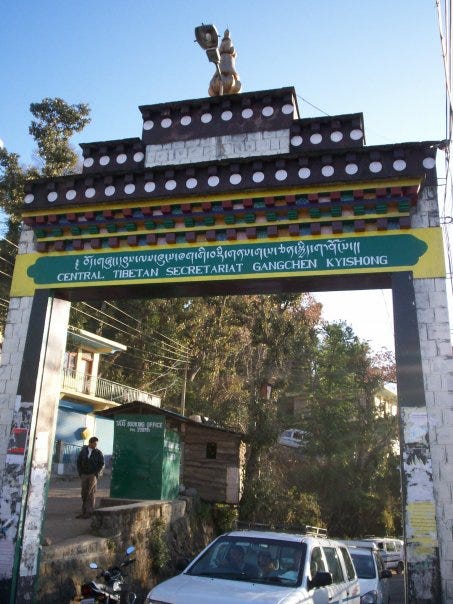
We passed under a Tibetan-looking gateway, walked down a narrow road, and arrived in a square with a central Tibetan-style white stupa in a gazebo. Around the outskirts of the little square stood dark, long buildings. One long, brown building included a sign over the entrance with the words “Tibetan Government in Exile.” These buildings look like they were built after the Dalai Lama arrived in India in 1959.
We followed Shantum inside and gathered into a reception room with many chairs, a bookcase, and a large photo of the Dalai Lama on one wall.
The Tibetan Prime Minister, Lakhoor, or Samdhong Rinpoche, is an old monk in the customary red and yellow robes. Members of our group presented him with five khatas, sheen white scarves with long silky fringe. The prime minister went around the room while we stood, and we exchanged a little bow while he grasped each of our hands. We all sat down, and I was the only one sitting on the floor, although I thought Shantum had said something about sitting on the floor. As the youngest I felt like sitting on the floor, and I’m generally more comfortable sitting Indian-style than Western-style. Maybe it’s thanks to past-life experiences.
Since nobody else took their shoes off, I didn’t take my footwear off. Sitting cross-legged while wearing hiking boots is… not comfortable. I would have been fine with just socks, and eventually I sat with my legs stretched in front of me. Shantum noticed after we had been interviewing the Prime Minister for some time, and he interrupted the discussion to ask me not to sit with my feet facing the Prime Minister, who qualifies as a meditation teacher. The Tibetan Prime Minister, Lakhoor, reassured me that he didn’t mind, but I shifted positions anyway and was careful not to sit in that position again.
Until Shantum mentioned it, I hadn’t thought of the Buddha story in which King Bimbisara complained to the Buddha that his soldiers or courtiers slept with their feet facing him and their heads facing the Buddha, thus showing respect to the Buddha and disrespect to their king. Oops. I imagined explaining this to Shantum later. It seems the foot-related belief dating to the Buddha’s time is a continuing tradition in Indian and Tibetan culture.
“Shantum has been a great friend of mine for a long time,” Lakhoor said.
Someone mentioned the rumors that there won’t be another Dalai Lama. “Usually Dalai Lamas do not appoint successors; they inherit by reincarnation.” He said this involves Buddhist rituals. I remembered how the regent had had a vision, while he gazed into a sacred turquoise lake, of the house where the Fourteenth Dalai Lama was born, and that was a great help in finding the new ruler. I’ve also read how the Dalai Lama’s choice of the current Panchen Lama involved the tradition of divination with balls of barley dough containing hidden messages.
The Dalai Lama believes the Tibetan people should decide whether to continue the Dalai Lama institution. They do not generally agree with his solution to eliminate the position. If the Fourteenth should die, how will a committee search for the Fifteenth with the continuing Chinese occupation? Like the Panchen Lama, they could end up with two Dalai Lamas. Or perhaps instead of reincarnation, it will be an appointed position; that is one possibility.
Q: Is your vision that Tibet will become completely free of Chinese governing? Will it be like Hong Kong?
A: Our vision is clear. Our policy on the future of Tibet has been since 1979; (scribble) for dialogue meant not complete independence. His Holiness has maintained the position of the Middle Path. Maintain genuine autonomy with China — Five Point Peace Program: how to give autonomy to the entirety of the Tibetan people. Not exactly the Hong Kong model, it involves a little more autonomy — but unfortunately the Chinese government is not moving to implement the national autonomy provisions, of the constitution charter; now there is no autonomy.
Motivations to stay under China (but with autonomy) are: 1) Diplomatic missions to other countries, 2) Defense, and 3) Political policy.
I might add economy, since I visited Ireland in 2005, and thanks to its membership in the European Union, Ireland is prospering and has no resemblance to a so-called Third World Country anymore.
With autonomy but still under China, Tibet could keep the culture, and such things as healthcare would be Tibet’s own. Tibet would make its own law and its own revolutions (maybe the word was resolutions) — almost independence — “so we are seeking that.” Sooner or later China must agree to this and say, “Yes, we shall implement it faithfully.”
Q: What would be the best policy for the West to help implement what you just described?
A: That Western countries do not adopt a policy of Chinese market. Important but very cheeky question! Democracy: the Tibet issue is very dear to our heart. If the economy is valued over all these things, then I don’t think there’s no hope for issues like Tibet, human rights, environment. “If you respect democracy, you should not support dictators.”
Q: Do you think that future Chinese politicians will be more Tibet-friendly?
A: Younger Chinese politicians are much more liberal than previous generations. Now even China has more exposure to the rest of the world thanks to technology [the Internet]. So we are very hopeful. It is better than ten years before, it will better in ten years. This is a very big issue.
Q: I ask as a Jew, the Israelis left their homeland — how does it affect Tibetans to be refugees?
A: Religion — Buddhism — is changing. Religion is basic fundamental principle, there will be dharma, there is no in between. Tibetans in exile until now, their religion is not diminishing. The latest generation is more exposed to science and modern education, and more understanding of dharma, which is consistent with science, so understanding of dharma is increasing.
Q: If the 14th Dalai Lama decides there won’t be a 15th, does he decide for himself or say there won’t be a search?
A: He can’t say that he won’t reincarnate. He will have to reincarnate, but the problem is how it will be handled — thanks to the Chinese, it is now a political instead of religious question.
Q: Do you encourage Westerners to travel to Tibet?
A: We always encourage the free world to visit Tibet. That makes a lot of difference. [This made me feel good about the fact that I’m about to go there, and I have every intention of writing a detailed journal in Tibet.]
Q: How do you balance your spiritual and political life?
A: The Dalai Lama asked his people to select their own prime minister, and he was hoping they would choose a young and dynamic person, preferably a lady, and they chose an old monk. [We laughed heartily at this.] I don’t have to deal with defense, etc., just the Tibetan people’s livelihood, and try to communicate with the Chinese government. The position is not much political — mostly a social work situation which is compatible with spirituality.
Q: We’re aware there’s a march [from Tibet to Dharamshala thanks to the upcoming Tibet Uprising Day] planned, and I wonder if the government approves?
A: That is the responsibility of nongovernmental organizations, and we like their intentions, but we don’t know if the result will be good.
The land and people vary in (scribble) and separate consideration. We are looking back to returning to our homeland. The land is important to all the people born in India; they are not taking Indian citizenship. Because of Western countries, we must assimilate.
Shantum said Thich Nhat Hanh is coming to visit in December and asked, “Would it be appropriate for him to meet with His Holiness?”
Lakhoor said, “I’m afraid he might be away from India at that time.” The prime minister, however, assured Shantum that he at least will meet with Thich Nhat Hanh. Shantum mentioned that Thich Nhat Hanh’s visit will be important for reviving Buddhism in India.
As she moved forward, Rachel asked, “May I take a close-up picture? I have an old-fashioned camera.”
“My face is also old-fashioned,” the prime minister said.
My travel memoir Every Day is Magical: A Buddhist Pilgrimage in India and Nepal is available on Amazon here:


