
Prillephant 🐘
the elephant that survived KonMari-mania
‘To keep, or not to keep, that is the question: Whether ’tis cleansing of the soul to discard The gifts and gadgets of modern-day excess Or to dwell deep within a shrine of mem’ries.’
If you listen to Marie Kondo, she will have you believe that simplifying your life by reducing the clutter in your home and work spaces is the way to go, but even she acknowledges that it’s easier said than done.
To keep or not to keep?
It’s a question I’ve asked myself a bazillion times while in the throes of recurring bouts of KonMari-mania.
Most of the time, the answer has been a no-brainer.
- homemade Cabbage Patch doll — trash it
- invoice book circa 1996 — shred it
- linen skirt (what is it about linen and wrinkles?) — charity bin it
- Swarovski collectable (cute, but not my thing) — Marketplace it
- husband’s briefs — cull to the ‘best of’ dozen and ori-KonMari (that’s my term for Marie Kondo’s method of folding items into small rectangles and filing vertically in a drawer, box or shelf — ori being Japanese for ‘fold’)
Taking care of the modern-day excesses is easy. It’s what to do with the shrine of mem’ries — the sentimental keepsakes — that causes the headaches. That’s when the ‘to keep or not to keep’ decider is about as useful as a pair of dozy whippets.
Marie Kondo’s solution to the shrine of mem’ries dilemma is to ask yourself the ‘Does this spark joy?’ question (p41 - The Life-changing Magic of Tidying Up), or as the ‘other declutterer’, Joshua Becker suggests, ‘Does it help me fulfill my purpose?’
Does this spark joy?
Does it help me fulfill my purpose?
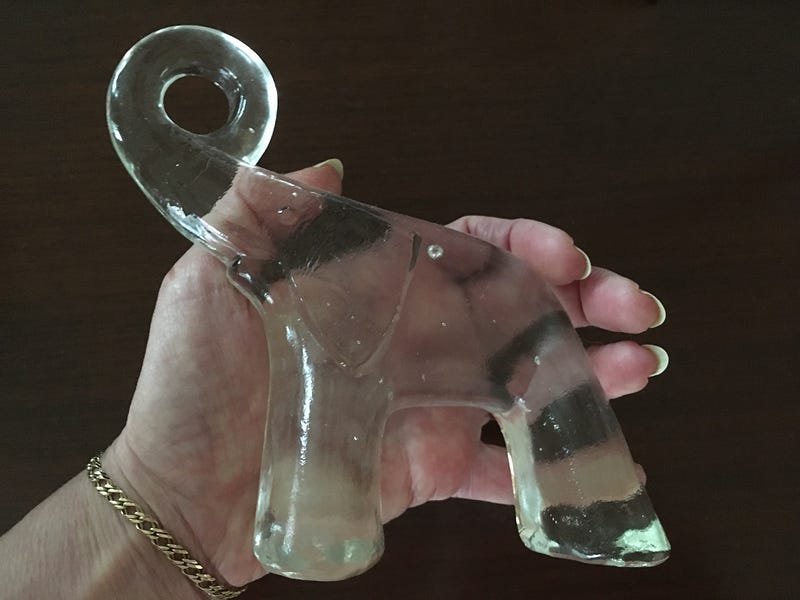
I found myself asking Prillephant these questions as I held her in my hand during a recent attack of KonMari-mania.
🐘 Let me tell you about Prillephant 🐘
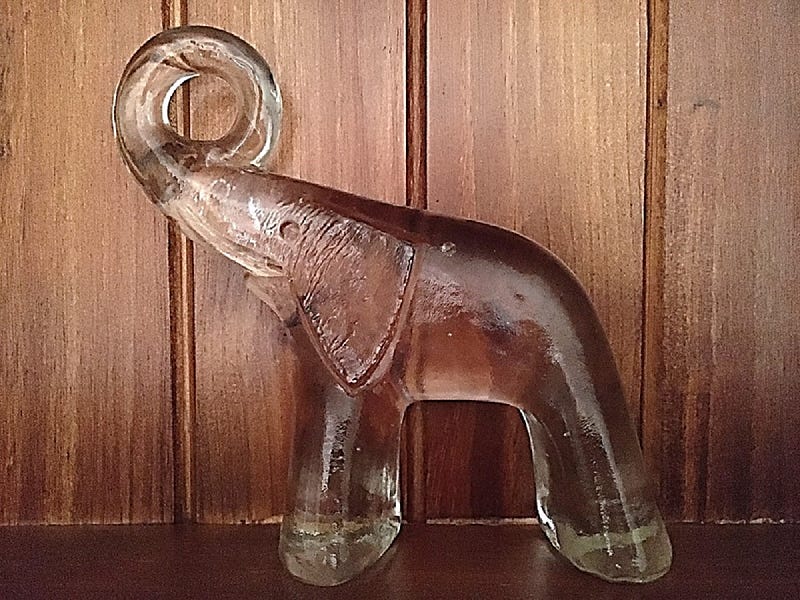
Prillephant (pronounced: prill-uh-funt), as you may have gathered from the header photo, is a clear glass elephant figurine. The name is a portmanteau; a blending of ‘Prill’ and ‘elephant’. Prill, short for Priscilla, was the preferred name of the woman who gave me the elephant nearly 40 years ago.
Elephants, as we all know, have enormous ears with the pinnae (ear flaps) of African elephants being even larger than those of their Asian cousins. Judging by the size of Prillephant’s ears, I’d say she’s of the African persuasion. Either way, if those ears had functioned, Prillephant would have been an ear-witness to all sorts of curious conversations. Moreover, if there’s any truth to the idiom, ‘a memory like an elephant’, chances are she would have remembered every last one of those conversations.
You see, Prillephant is a working elephant. She’s spent much of her life discretely monitoring proceedings from the vantage point of my desk, filing cabinet or bookcase as I’ve gone about the business of being a speech pathologist. I say ‘discretely’ because I don’t recall anyone noticing her; if they did, they never mentioned it.
I thought about this as I held Prillephant in my hand and put her through the first stage of the KonMari test: to keep or not to keep. I understood why Prillephant hadn’t attracted much attention. She was rather plain-looking and she didn’t actually do anything. The idea that maybe the time had come for us to part company was front of brain. I looked at the box of oddments destined for the thrift shop and seriously considered slipping Prillephant in among them.
But then I thought about the original Prill. It struck me that in terms of being noticeable, Prillephant would have to be the exact opposite of her namesake. The original Prill was precisely that: original. As in unique.
If I had to choose one word to describe Prill, it would be zany. Zany in personality. Zany in the way she behaved. Zany in the way she dressed. Zany in a Pippi Longstocking sort of way.
And loud. Extremely loud. Especially her laugh. I can still remember her laugh. It’s not one that you easily forget. Her laugh was, shall we say, not very feminine. It was robust and forceful. A discordant guffaw that filled the room. A combination of snorts and trumpets. A bit like a… dare I say it? … an elephant. Prill laughed a lot. Once she started, it was hard for her to stop.
Prill was super sociable. She talked to anyone and everyone. She amazed me with the stories she told of the people she’d randomly struck up conversations with on the tram rides around town. Nevertheless, I felt sorry for her because I knew that behind the layer of effusive bon amie was a lonely woman desperate to find the man of her dreams and live happily ever after. I hoped for her sake that she wouldn’t spend her life ‘left on the shelf’ like a…glass elephant.
Prill had the transparency of glass. She wore her heart on her sleeve. There was an innocence about her that made her overly trusting which in turn made her vulnerable. Vulnerable to being taken advantage of by the unscrupulous predators that mingle among us. Taking in a stray cat now and then was one thing but Prill was easy prey for many an opportunist and swindler.
Prill was stubborn and set in her ways but there was a brittleness about her too. A sense that if you pushed her too hard she would shatter into a million pieces and be gone forever. People misjudged her. They failed to see the sensitive, intelligent creature within. They let their first impressions deceive them into thinking she was something less than she was. They saw that she was imperfect but didn’t understand why.
Prill had trouble controlling herself. She was clumsy. Unco-ordinated. Lacked finesse. People looked at her and thought she was inebriated. People listened to her and thought she was inebriated. People who knew her looked at her and saw she was brain-damaged. I knew her. I saw her.
Prill was referred to me by her neurosurgeon via the neurology outpatient clinic at the inner-city hospital I worked at. I was a young speech pathologist not long out of college. Prill was a few years older than me and, as fate would have it, had experienced much more in her life than I had in mine. Two years prior to our meeting, Prill had been involved in a horrific automobile accident. It hadn’t killed her, but it had changed the course of her life forever. She’d suffered a TBI — a traumatic brain injury. Specifically, a coup contrecoup closed head injury that had left her with permanent diffuse brain damage to her cerebellum, brainstem and frontal lobes. From a speech pathology perspective, she had ataxic dysarthria that affected her articulation, voice, intonation, swallowing and respiration. Her gait, upper limb and eye movements were similarly impaired. The frontal lobe damage had altered her personality but not her aptitude to keep going and make the most of what she still had.
Prill worked hard on the speech therapy exercises I gave her. I would like to think they made a difference even if it were simply to maintain a level of functionality, confidence and independence. Her positivity in the face of so many challenges was truly inspiring and something I have never forgotten.
I felt the weight of Prillephant as she lay in the palm of my hand patiently waiting as I put her through the KonMari keep test.
“Prillephant, do you spark joy?” I asked her.
“Do you help me fulfill my purpose?”
Like the wise, old elephant she is, she didn’t need me to tell her the answer…
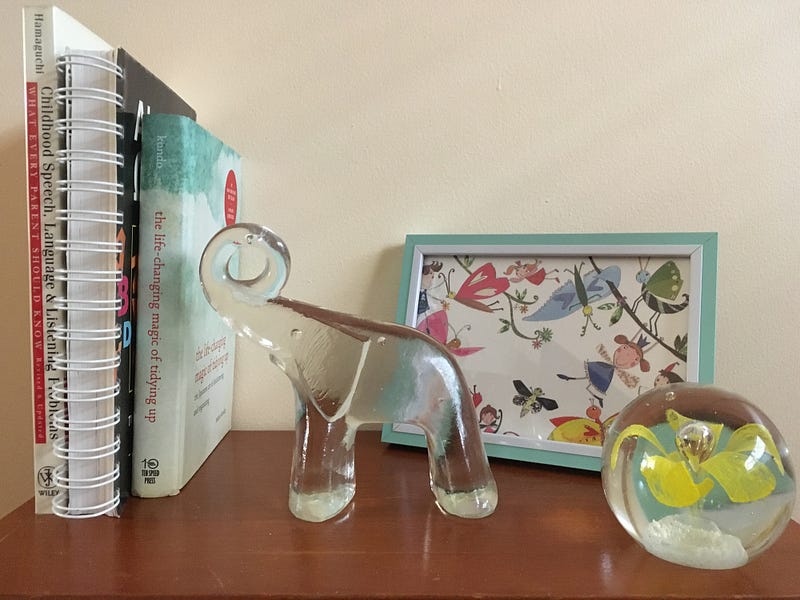
…and neither do you. 😉
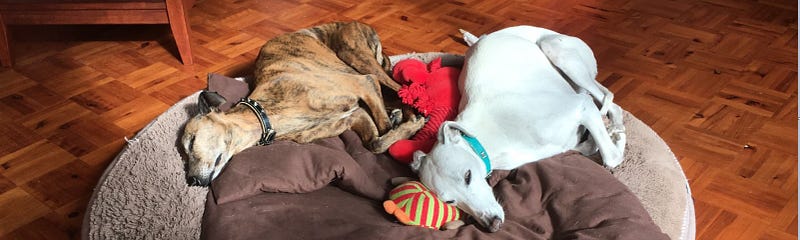
P.S. Despite being the laziest dogs on the planet, the ‘Siesta Sisters’ survived the KonMari keep test as well!
P.S.S. In case you’re wondering, everything in this story is true. Thank you for reading. 🙏 💕
✨ Here’s your invitation to join Medium where you’ll have unlimited access to every article, including mine. 👉 Click here to use my referral link. 👈 As this is part of an affiliate program, I will receive a percentage of your membership fee. Thank you. 🙏