
Earn Big Stock Market Returns Successfully by Overcoming These 2 Challenges
Price of life-changing market returns
We all know that nothing is free. So then, why do we expect to receive massive returns from our investments without paying the price?
We want to double our money in a year without paying the price of market volatility, fear, and uncertainty.
We want to retire early but don't want to pay the price of living frugally.
But, on the other hand, we are willing to pay the price if we want to buy a guitar or a car or a computer.
The price that we pay usually determines what we will get. Then, why do we avoid paying the price when it comes to investing?
There is a psychological explanation to it, and understanding it will change your outlook toward investing. Let's have a look.
Our brain reacts differently toward "fee" and "fine."
Over time, we trained our brains to pay the fee and avoid the fines.
Just experiment with it on you. Most of us will be willing to pay a fee to avail of a service or buy a product; however, we will try our best to avoid fines.
We are happy to pay tens of thousands to buy a car but avoid paying a few dollars as traffic fines.
The day we started understanding the world around us, we associated paying a fine with punishment.
If you Overspeed, you have to pay a fine as punishment. If you are late on your monthly credit payment, you have to pay a fine as punishment.
Our psyche goes so deep down that whenever we hear the term fine, we think someone punished us for wrongdoing.
One can also look at it another way. When you pay and get something of equal worth, you feel good. However, you feel bad if you pay and do not get the expected value.
And in the worst-case scenario, if you pay and do not get anything in return, you feel fear and pain. And the human mind is programmed over time to avoid actions that cause fear and pain.
The same mindset comes into play when you lose money in the stock market; or other words, you do not get what you expected in return.
Your brain sends signals of fear, pain, and that you are paying a fine for doing something wrong. It is how our brain works.
However, by being aware of this fact and enough practice, we can train our brains to become better investors.
Before we look into how to train our brains, let us first understand the price we have to pay to receive life-changing market returns.
Price of life-changing market returns
You cannot expect high returns without getting hit by the market’s downward movement time after time
Most investors with even a little experience know that market volatility is unavoidable.
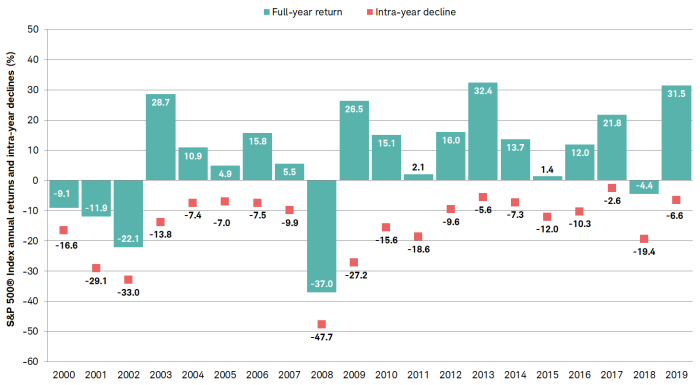
The below graph illustrates the volatile nature of the stock market perfectly.
From 2000 to 2019 market has gone at least 10% down in 11 out of 20 years, which is 55% of the time. Besides that market has tripled during this period.
This shows that you cannot expect high returns over time without getting hit by the market's downward movement time after time. Whether you like it or not; it is the price you have to pay.
The fear of losing money makes it difficult to hold your investment for the long term.
It is easy to say hold your investment long-term to achieve the best market returns. However, staying true to it in the face of market volatility is not easy.
The fear of losing money, suspicion of whether you are making the right decision, and worrying that it may ruin your kids' future makes it really difficult to stay on course.
Again, it is the price you have to pay to enjoy life-changing returns.
Unfortunately, the brain treats it as a fine instead of a fee, resulting in most investors underperforming the broad market index funds like S&P500.
The price does not come with a label
On top of it, the price you have to pay to get the desired returns does not come with a label, which makes it even more challenging to process.
For example, if someone told you to pay $100 to double your money, it would be so easy, right. But, instead, you are told to hold your investment for the long term. I know it's not what you wanted to hear.
The higher the price, the higher the return
Following it is the fact that the higher the price, the higher the reward (in most cases).
In other words, the higher the risk, fear, and uncertainty, the higher the return.
For example, the price of spending a day in Disneyland is $104, and in return, you will have a lifetime memory.
But, you can decide whether to pay that price or not. You can even go to another amusement park whose entry is just $10 or stay at home for free.
In both cases, you may have a good time; however, you usually get what you pay for.
So, how to train your brain that market volatility, fear, uncertainty, and anxiety are the prices you have to pay to get the desired returns.
Train your brain to pay the price
The first step to training your brain is to make it aware that there is a price on the desired return, which you have to pay to get it.
The next step is to tell yourself that the price you are paying is a "fee" and not a "fine."
By doing these two simple steps, you will start training your brain in the direction that stops you from making decisions that may hurt your return on investments.
Decisions like selling during a market crash, trying to time the market, buying stock due to market hype, etc.
As discussed above, the higher the price, the higher the reward. Similarly, you can choose to invest in low to high-risk investing products.
However, now you know that a price is associated with each option. And based on whether you are willing to pay that price, you can expect a comparable outcome.
Paying the price does not guarantee the reward
Another aspect that you should be aware of is that paying the price does not guarantee the desired return.
For example, the day you go to Disneyland might rain, which may ruin the experience. So, such unexpected events may happen; however, they are seldom.
Let us take a recent example. Suppose in 2020; someone wanted to retire and use the investments to plan a world tour.
Then the unexpected event (Corona) happens, and the person loses half of their initial gains.
They paid the price and went through the horrors of uncertainty, bear markets, etc.; however, they didn't receive the desired return.
Many people must have found themselves in this situation during the Corona pandemic.
So, life sometimes throws surprises at us, and irrespective of how much you plan, such events can catch you by surprise.
All set to pay the price
I hope you will start looking at market volatility from a new perspective, and it will help you be a better investor. The article is inspired by the book "The Psychology of Money" by Morgan Housel. It's a fantastic book, and I will highly recommend everyone to read it.
I hope you enjoyed reading this article. If you did, then help Master Investment grow by sharing it with your friends. If you are looking for ways to support me. Well, buy me a cup of coffee from here. :-)
Suppose you are interested in knowing which stocks I am buying and selling and want to access my complete portfolio. Then consider joining the master investors community by clicking here.


