
Protecting Mother Earth From CoVid
How to mind our PPEs

Out on walks with my canine buddy Dali, I collected plastic trash from sidewalks, took their photos, and post on Litterati — from NYC to San Francisco and even Ottawa, Canada to La Paz, Mexico. For years, long before Covid, I’d been focused on informing and inspiring myself and others to do better for mother earth. After all, we’re slammed in the face with the results of decades of neglect towards our planet — from air pollution to microplastic-filled seafood to disappearing wildlife to plastic bags in trees in the middle of nowhere… and so much more. Every day we see preventable damage to nature that landed there via human hands.
And still, it was getting hopeful, and I think, for the most part, it still is. People are making changes to their lifestyles focused on reducing waste, more people are becoming aware of the dangers of plastics in food products, large consumer goods manufacturers are beginning to slowly but surely respond by changing their packaging and/or practices, and more governments are taking action to implement meaningful policy changes.
And then Covid hit. It seemed like all we had learned didn’t matter anymore, we were in an emergency state, and nobody had the time to consider our impact on Mother Nature. I wrote earlier about how industry lobbyists pressured States and cities to ban reusables through false claims.
With Covid, we all also began using personal protective equipment (PPE), particularly masks and gloves. There’s an increasing amount of data that masks dramatically reduce our chance of spreading and contracting the virus—a hopeful and wonderful finding.
Yet, while protecting ourselves, we managed to turn all PPEs into an environmental disaster. OceansAsia — a non-profit based in Hong Kong dedicated to creating a healthy environment for all marine life — announced 52 Billion masks would be used across the planet in 2020, an over 20,000% increase in volume from the previous year! That is not a typo — 20,000% is the growth from a $.765 Billion market to a $166 Billion one — practically overnight. According to the World Health Organization, this is a conservative estimate. Once again, we fail to consider the full life-cycle of a solution and create an unprecedented threat to our environment. Today, face masks can be seen on every street, park, wildlife refuge, estuary, and particularly littering the roadsides.
We indeed have waste collection systems — contrary to what many would want you to believe; they have not been effectively created or thought through — we’ve allowed waste management to get out of control. As the public, we fell into what I dub the savior elves syndrome — we don’t have to do anything; some elves magically take care of doing the right thing. Unfortunately, elves are still fiction. Nobody’s picking up the waste that gets thrown onto the street or blown out of overflowing bins, nor are they able to recycle everything that gets placed into a blue bin, nor can they sort out and clean even all the right things places into the blue bin. (PSA: Please do not place any PPE products into curbside pickup recycling bins in the US).
The Impact
We see these types of photos that don’t require much commentary.

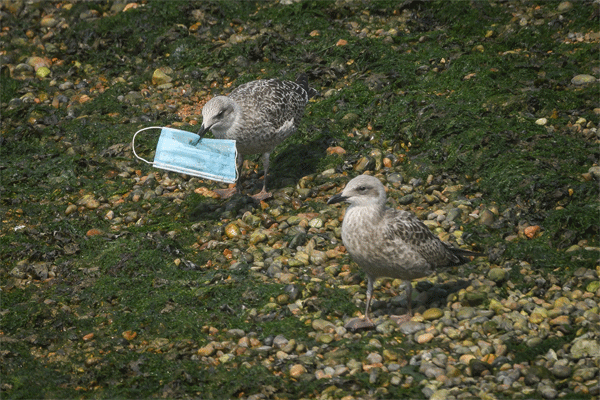
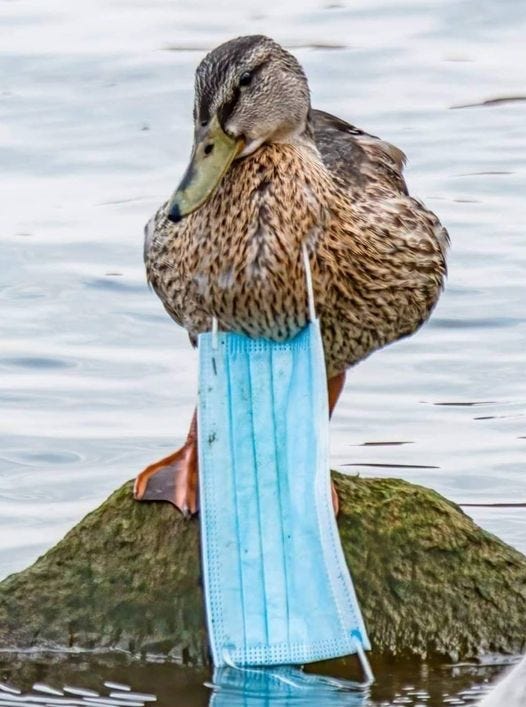
Aside from entangling and choking wildlife, we’re also causing costly infrastructure damages in our own municipalities. Philadelphia, Texas, and Tennessee are just a few States who have raised the concern to national levels. Global conservationists warn us of the increased amount of plastic waste entering the already threatened Ocean.
We’re not only harming the environment, but cleaning-up drains and clogs also are costly and translate to higher taxes and fees for us as residents — we do pay for our behavior in every way possible.
So what can we do?
Use reusable masks -
Unless if you’re working at a hospital, pharmacy, etc., where you might be coming into close contact with high-risk individuals or those with the virus, using reusable masks is an effective alternative, according to the CDC. Once again, if we look elsewhere that this practice has worked for decades, we can find some comfort in Japan's practice. Every Japanese person has a reusable mask they wear every year. Tokyo has one of the densest population statistics globally, yet, even with Covid, they’ve been able to keep things under control.
As I tell everybody about their reusable bags, you can wash and sanitize the masks as many times as you’d like. I have 3 masks and also use bandanas when outside and wash them regularly.
Dispose of single-use masks responsibly -
If you go to a doctor’s office or the hospital, most establishments in the US will provide you a disposable mask to wear on-premises. Disposing of these masks properly is the responsibility of both the provider (doctor’s office, hospital, etc.) and the person who uses them. The provider should ensure there is a proper enclosed bin — with a lid — where these items can be safely disposed of and ensure the bin is then properly emptied, hopefully through the municipal waste management system. Please do NOT place your masks or gloves, or any other PPEs, into the blue recycling bins as they’ve caused much concern for recycling center workers around the country.
Encourage the use of available mask recycling services -
Unfortunately, since the recycling infrastructure and systems lack in most countries, including the US, there are very few options available for recycling PPEs. Fortunately, one of the most effective of these solutions is TerraCycle. Anybody can purchase a Safety Equipment and Protective Gear Zero Waste Box, fill-it up and send it back to TerraCycle — all for $148. Though it seems expensive, the cost is easily offset by partnering with grocery stores, restaurants, office buildings, etc., and filling the box. TerraCycle makes it possible for you to set up a recycling system for your community.
Create informative campaigns for the proper disposal of PPEs -
Governments and NGOs can come together to create campaigns for the general public focused on educating and informing on the importance of proper disposal and the proper steps. Government Organizations in Tennessee partnered with Keep Tennessee beautiful to add PPEs to their #nobodytrashestennessee campaign to inform about alternatives and proper disposal solutions. Surfrider in Kauai joined forces with the Hawaiian government educating the public about the importance of keeping PPEs off their beaches. In their, Don't Mess with Texas campaign, Texas added Public Service Announcements with celebrities highlighting the harm of littered PPEs as well as their proper disposal options. And the NGO Break Free From Plastic — has launched a social media campaign and shared all its resources to spread the word about using reusable masks over disposable PPEs.
Create policies that incentivize the return and collection of PPEs -
Governments can create policies that make it cost-efficient to dispose of PPEs properly. The goal is to keep the PPEs out of the environment. Solutions like properly sorting and collecting them and using new proven technologies remain an option for governments to use effectively.
Organize and participate in local beach clean-ups -
There’s an undeniable increase in the number of PPEs we all see in our environment — from beaches to storm drains. Everybody can make a difference by picking up what’s in the wrong place and disposing of them appropriately in an enclosed dumpster or trash bin.
We all have choices, and we all have the power to make the smart ones. I hope you invest in reusable masks. In 2021 — the century where we originally depicted humanity in flying space cars — I’m hopeful we’ll be able to solve a problem without creating another long-term detriment. We can continue to care for Mother Earth while we’re also prioritizing human health during the pandemic.
I’m looking forward to the day when we return to our “normal” neighborhood walks with my Dali and not having to collect any PPEs.


