avatarMatt Williams-Spooner, Ph.D.

Free AI web copilot to create summaries, insights and extended knowledge, download it at here

5623

Abstract

o interesting, but it turns out that BMR also determines the ceiling for sustained metabolic activity.</p><p id="a340"><a href="https://www.science.org/doi/pdf/10.1126/sciadv.aaw0341">The magic number is ~2.5 x BMR</a>. For reasons that researchers are still puzzling out, ~2.5 x BMR seems to set a fairly hard limit on sustained metabolic activity.</p><h1 id="7c56">The energetics of pregnancy</h1><p id="7816">Since ~2.5 x BMR is the ceiling for sustained metabolic activity, where does pregnancy stand in terms of BMR?</p><p id="5196">Astoundingly, pregnancy clocks in at <a href="https://www.cambridge.org/core/services/aop-cambridge-core/content/view/BAD009E9B4B9C4EF1E70DE2F298E83AE/S136898000500131Xa.pdf/energy-requirements-during-pregnancy-and-lactation.pdf">2.2 x BMR</a> — verging on the upper limit of what’s humanly possible. <a href="https://www.science.org/doi/pdf/10.1126/sciadv.aaw0341">A recent and groundbreaking study</a> helped to show just how crazy this is.</p><p id="cccf">The researchers measured energy use among people in the Race Across the USA. For 140 days, the people ran roughly a marathon a day, six days a week.</p><figure id="4240"><img src="https://cdn-images-1.readmedium.com/v2/resize:fit:800/0*Xu8fs0uuNmhdny3z"><figcaption>Marathon runners. Source: <a href="https://unsplash.com/photos/people-walking-on-street-during-daytime-TqOFeBqnqrI">Unsplash</a></figcaption></figure><p id="fdbf">Endurance sports don’t get much more extreme than this, so how did their energy use compare to pregnancy? Their metabolic rate was about 2.4 x BMR, right at the limit of human endurance.</p><p id="d8ba">Cynics may point out that 2.2 x BMR is slightly <i>lower</i> than 2.4 and say that pregnancy actually requires slightly <i>less</i> energy than extreme endurance sports.</p><p id="ae23">But to the cynics, I say, there’s a twist!</p><p id="f971">The details are technical and boring, but the key point is that <a href="https://www.science.org/doi/pdf/10.1126/sciadv.aaw0341">our body seems to track our long-term metabolic demands</a> and <a href="https://readmedium.com/new-discoveries-that-redefine-our-view-of-diet-weight-gain-exercise-and-health-2ffe4f2bcd3b">tries to keep our overall energy use within a narrow range</a>.</p><p id="d7da">It’s happy to splurge in the short term. But if we regularly make large withdrawals from the energy bank, our metabolic accountant soon cuts spending to keep us out of energetic debt.</p><p id="2991">The Race Across the USA was wild, but even at 140 days, it was only half the average length of pregnancy: 280 days (40 weeks). The runners also took off one day a week, and mums don’t get the same luxury.</p><figure id="6164"><img src="https://cdn-images-1.readmedium.com/v2/resize:fit:800/0*FgbM48s5N3cynCrT.png"><figcaption>Average timeline of pregnancy. Source: <a href="https://upload.wikimedia.org/wikipedia/commons/thumb/9/90/Pregnancy_timeline.svg/2560px-Pregnancy_timeline.svg.png">Wikimedia Commons</a></figcaption></figure><p id="f9e7">When you take these differences into account, pregnancy is easily on par with extreme endurance sports. As <a href="https://www.tlc.com/style---self-care/being-pregnant-takes-the-same-endurance-as-extreme-sports--study">the study’s senior author, Herman Pontzer, said when interviewed</a>:</p><p id="bd3e" type="7">“Pregnancy is the longest duration, highest energy expenditure thing that humans can do. Mothers probably aren’t surprised by this.”</p><h2 id="b681">Energetic tug of war between mum and baby</h2><p id="1fc6">You may be wondering about the metabolic relationship between mum and baby during all this.</p><p id="b23c">If you’re like me, you probably imagined teamwork full of cooperation and metabolic high-fives, but <a href="https://link.springer.com/chapter/10.1007/978-3-030-76000-7_9">the truth isn’t quite so rosy</a>.</p><p id="106a">Of course, there’s a lot of cooperation between mums and their babies, but their energetic relationship is also defined by <a href="https://link.springer.com/chapter/10.1007/978-3-030-76000-7_9">a tug-of-war over resources</a>. Growing babies try to take as much as they can, and mums try to only give as much as they can afford.</p><figure id="8ae2"><img src="https://cdn-images-1.readmedium.com/v2/resize:fit:800/1*[email protected]"><figcaption>Pregnancy is a tug of war over resources between mum and baby. Self-made image</figcaption></figure><p id="9d3a">In his book <i>Behave</i>, the Stanford scientist Robert Sapolsky explains how greedy babies can even cause ‘gestational diabetes’.</p><p id="d0af">Cunningly, babies release a hormone that makes mums less responsive to insulin. This reduces maternal access to sugar from the blood, leaving more energy for the baby but driving the mum towards poor health.</p><p id="74af">In a dastardly move, <a href="https://www.cell.com/cell-metabolism/fulltext/S1550-4131(23)00217-6?_returnURL=https%3A%2F%2Flinkinghub.elsevier.com%2Fretrieve%2Fpii%2FS1550413123002176%3Fshowall%3Dtrue">research in mice</a> suggests that genes from dad also get in on the act. These ‘imprinted genes’ help babies to steal energy from mum, tipping the metabolic scales.</p><h2 id="db47">How energetic demands influence the timing of childbirth</h2><p id="8311">As it turns out, this energetic tug of war may also explain the timing of childbirth. Until recently, we thought the width of the pelvis drove humans towards earlier births.</p><p id="98a9">As humans evolved, our pelvis became narrower while our heads became much larger. This is partly why human childbirth is so painful.</p><p id="4d59">Human

Options

babies are also pretty useless, especially right after they’re born. This makes us an ‘altricial’ species, polite jargon meaning we’re functionally hopeless when we’re born.</p><figure id="434c"><img src="https://cdn-images-1.readmedium.com/v2/resize:fit:800/0*FpQwWc86UFuoAiQH.png"><figcaption>Examples of altricial and precocial species of bird. Source: <a href="https://upload.wikimedia.org/wikipedia/commons/thumb/4/4a/Altricial_VS_Precocial_birds_diagram.png/1280px-Altricial_VS_Precocial_birds_diagram.png">Wikimedia Commons</a></figcaption></figure><p id="3933">In contrast, ‘<a href="https://vetmed.illinois.edu/wildlifeencounters/grade5_8/lesson2/babies.html#:~:text=Precocial%20animals%20are%20born%20with,ducks%2C%20horses%2C%20and%20deer.">precocial’ species like horses, deer and ducks</a> can usually move around and follow mum within minutes of being born.</p><p id="fae3">For these reasons, common wisdom is that narrower pelvises and wider heads put evolutionary pressure for earlier births, giving us ~40-week pregnancies and newborns with the body control of a drunk potato.</p><p id="2207">But more recent evidence suggests that <a href="https://www.pnas.org/doi/abs/10.1073/pnas.1205282109">the main factor is whether mum can supply enough energy for herself and the growing baby</a>. This means that childbirth usually occurs when babies demand more energy than mums can provide.</p><h2 id="10a4">Maternal health during pregnancy and health outcomes for babies</h2><p id="6ca2">Clearly, pregnancy is a delicate metabolic dance. Mums are in a difficult position, trying to satisfy the energetic needs of greedy babies without compromising their own health.</p><p id="ccef">Mums often prioritise the health of growing babies. Undernourished pregnant women illustrate this well, as many even <a href="https://jphysiolanthropol.biomedcentral.com/articles/10.1186/s40101-023-00318-3">suppress their BMR in order to maximise energy supply to their baby</a>.</p><p id="2c8f">However, pregnancy isn’t zero-sum, and baby health is deeply entwined with maternal health. For example, a recent study in <i>Nature</i> found that <a href="https://www.nature.com/articles/d41586-024-00270-x#:~:text=The%20study%20is%20one%20of,mothers%2C%20babies%20and%20their%20health.&amp;text=Mothers%20with%20higher%20blood%20pressure,mothers%20with%20lower%20blood%20pressure.">high maternal blood pressure during pregnancy leads to lighter and shorter babies</a>.</p><h1 id="f1e4">Conclusions and Takeaways</h1><p id="9cfb">That was a lot of information, so let’s sum up and draw some practical conclusions. Pregnancy is easily one of the most metabolically demanding things a human being can do. It shouldn’t need to be said, but to all the past, present, and future mothers, thank you for your unbelievably hard work.</p><figure id="b9ec"><img src="https://cdn-images-1.readmedium.com/v2/resize:fit:800/0*IhGIKWeorvz9jpvF"><figcaption>Source: <a href="https://unsplash.com/photos/pregnant-near-door-son4VHt4Ld0">Unsplash</a></figcaption></figure><p id="5682">Since pregnancy costs lots of energy — and babies and dads seem to collude in stealing energy from mums — pregnant women need plenty of resources at their disposal.</p><p id="2985" type="7">This means eating lots of food and limiting energy use through physical activity. I say limiting, but certainly not eliminating, as pregnant women also need to stay active in order to stay healthy.</p><p id="e6c9">But especially in the third trimester, when babies’ energetic demands are most extreme, physical work should be kept to a healthy minimum. Pregnant women are already running a metabolic marathon per day – no need to go nuts.</p><p id="9f73">If physical work is unavoidable — as is the case for many people — then eating lots of food is all the more important. Our biology is tough and versatile, so long as we provide the fuel it needs to do its work.</p><p id="e700">Lastly, I want to highlight the power of looking at life and health from a metabolic point of view. Metabolism is one of the main factors that distinguishes us from machines, and we must understand our energetic/metabolic needs in order to understand ourselves.</p><p id="0ba7">Pregnancy is a striking example of this, but it’s also true for all other aspects of life. Since we depend on our metabolism, we need to treat it kindly.</p><p id="ccd2" type="7">Eat healthy foods that cover your nutritional needs. In the age of junk food, we’ve forgotten the old saying that “you are what you eat,” but this is evergreen advice that we should take very seriously.</p><p id="15d2">Thanks to decades of tireless research, we’ve made important strides in understanding the key principles behind life and health. And while there’s always more to learn, many of the tools to build healthier lives are already in our hands — we just need to use them.</p><p id="940a">Good health and thanks for reading!</p><div id="7a2d" class="link-block"> <a href="https://medium.com/@mattwilliamsspooner/subscribe"> <div> <div> <h2>Like this content? Get an email whenever Matt Williams-Spooner, Ph.D. publishes.</h2> <div><h3>Like this content? Get an email whenever Matt Williams-Spooner, Ph.D. publishes. By signing up, you will create a…</h3></div> <div><p>medium.com</p></div> </div> <div> <div style="background-image: url(https://miro.readmedium.com/v2/resize:fit:320/0*WbUxa5O-LfFCca5U)"></div> </div> </div> </a> </div></article></body>

PREGNANCY, METABOLISM & HEALTH

Pregnancy Requires as Much Energy as Extreme Endurance Sports

How pregnancy affects metabolism, and advice from metabolic science to support maternal health during gestation

Source: Unsplash

Pregnancy is one of the most intense things a person can do, but exactly how intense are we talking? How much energy would you guess pregnancy costs? What would you compare it to?

A recent answer shocked scientists but won’t surprise mothers or anyone who read the title: pregnancy requires as much energy as extreme endurance sports.

A research team discovered this when studying metabolism and energy use among extreme endurance athletes. And when you look at pregnancy through the lens of energy and metabolism, you find lots of other interesting answers as well.

Today, we’ll break down the key points about the energetics of pregnancy. We’ll talk about the costs of pregnancy and how it involves an energetic tug-of-war between mum and baby.

We’ll also cover recent discoveries about how maternal health during pregnancy affects babies and finish with some implications for health, diet, and exercise during pregnancy.

A crash course on the biology of metabolism and energy

In my opinion, you don’t need to know the biological details to understand the key points we’ll discuss. But if you know them, they do give a more complete picture.

If you don’t want the details, skip to the next main section. But if you’d like a mercifully brief crash course on the biology of metabolism and energy, read on.

What are metabolism and energy?

In living organisms, metabolism is the process that creates energy, while energy itself is the universal energy currency ATP — or adenosine triphosphate, for the aficionados in the crowd.

In all known organisms, the ATP molecule is essential for the basic functions that keep us alive. All cells create ATP locally, and any cell without ATP will stop working and die.
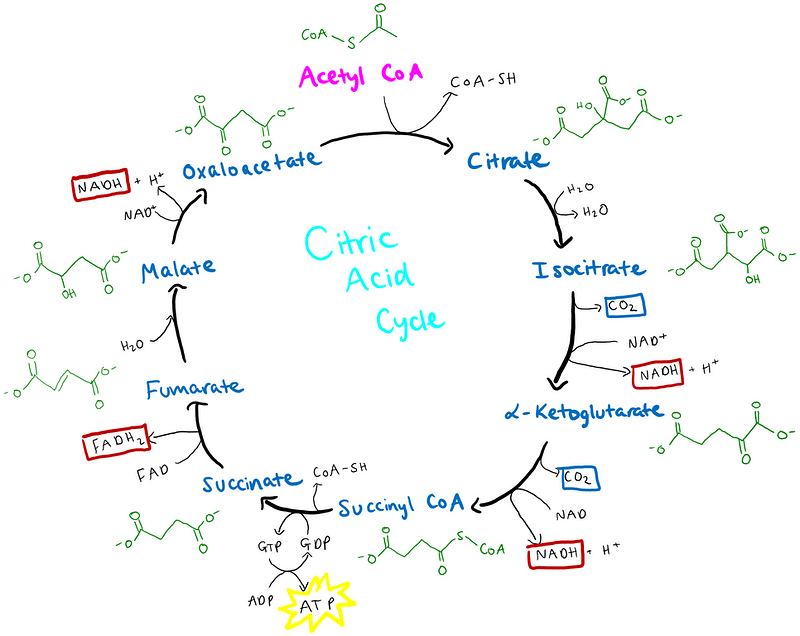
Diagram of the conventional pattern of metabolic flux, known as the Krebs cycle (aka citric acid cycle). You can see the points at which ATP (yellow star) and CO2 (blue boxes) are created. Source: Wikimedia Commons

To produce ATP, our metabolism burns various fuels, like sugars and fats. Metabolism is essentially a biochemical furnace, but instead of coal and fire creating energy for machines, a set of interdependent chemical reactions turn food into ATP.

How do we measure metabolism?

Researchers can measure metabolic activity directly when scrutinizing cells in a dish. But when we talk about metabolism for a person, this sort of approach obviously won’t do.

Researchers had to develop other ideas, and over the last hundred years or so, people worked out various indirect methods.

The classic strategies involve measuring concentrations of chemicals that are known byproducts of metabolism, like CO2 in our breath. However, this approach has weaknesses that undermine its accuracy.
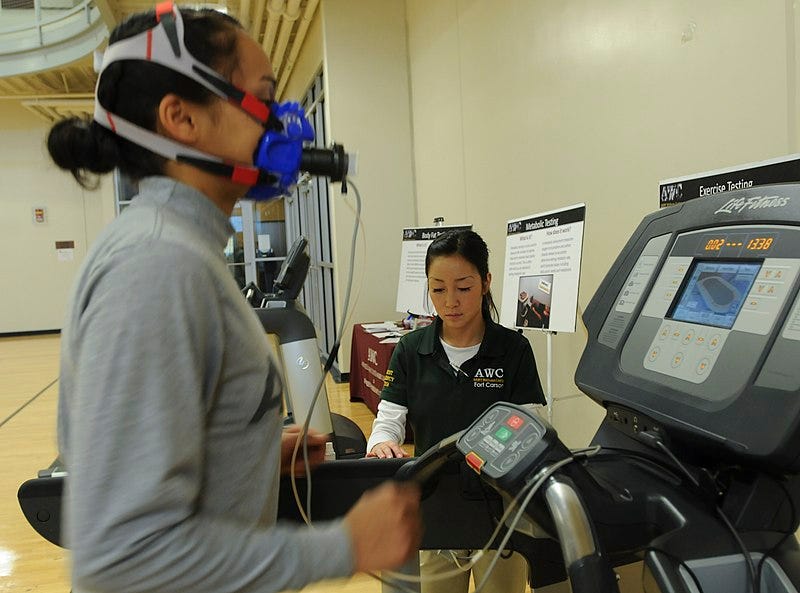
A member of the United States military runs on a treadmill during the VO2 Max (aerobic capacity) competition, which determines who is the fittest Soldier at Fort Carson. The contraption she’s connected to measures CO2 output in breath as a proxy for metabolic activity. Source: Wikimedia Commons

Currently, the gold standard in metabolic science is known as the doubly-labeled water method. The doubly-labeled water method estimates metabolic activity by measuring the rate at which certain chemicals leave our bodies.

People drink water that contains unusual (but totally harmless) versions of hydrogen and oxygen — hence the name doubly-labeled water. People give urine and other samples, and researchers can estimate metabolic activity based on how quickly the doubly-labeled water leaves our system.

In principle, this is similar to recording CO2 in breath. But thanks to decades of tenacious research, the doubly-labeled water method gives much more accurate estimates of metabolic activity.

Basal metabolic rate (BMR)

Using doubly-labeled water, researchers have shown that basal metabolic rate (BMR) is very important.

BMR is the energy we need to support vital functions, not including physical activity. That in itself isn’t too interesting, but it turns out that BMR also determines the ceiling for sustained metabolic activity.

The magic number is ~2.5 x BMR. For reasons that researchers are still puzzling out, ~2.5 x BMR seems to set a fairly hard limit on sustained metabolic activity.

The energetics of pregnancy

Since ~2.5 x BMR is the ceiling for sustained metabolic activity, where does pregnancy stand in terms of BMR?

Astoundingly, pregnancy clocks in at 2.2 x BMR — verging on the upper limit of what’s humanly possible. A recent and groundbreaking study helped to show just how crazy this is.

The researchers measured energy use among people in the Race Across the USA. For 140 days, the people ran roughly a marathon a day, six days a week.

Marathon runners. Source: Unsplash

Endurance sports don’t get much more extreme than this, so how did their energy use compare to pregnancy? Their metabolic rate was about 2.4 x BMR, right at the limit of human endurance.

Cynics may point out that 2.2 x BMR is slightly lower than 2.4 and say that pregnancy actually requires slightly less energy than extreme endurance sports.

But to the cynics, I say, there’s a twist!

The details are technical and boring, but the key point is that our body seems to track our long-term metabolic demands and tries to keep our overall energy use within a narrow range.

It’s happy to splurge in the short term. But if we regularly make large withdrawals from the energy bank, our metabolic accountant soon cuts spending to keep us out of energetic debt.

The Race Across the USA was wild, but even at 140 days, it was only half the average length of pregnancy: 280 days (40 weeks). The runners also took off one day a week, and mums don’t get the same luxury.

Average timeline of pregnancy. Source: Wikimedia Commons

When you take these differences into account, pregnancy is easily on par with extreme endurance sports. As the study’s senior author, Herman Pontzer, said when interviewed:

“Pregnancy is the longest duration, highest energy expenditure thing that humans can do. Mothers probably aren’t surprised by this.”

Energetic tug of war between mum and baby

You may be wondering about the metabolic relationship between mum and baby during all this.

If you’re like me, you probably imagined teamwork full of cooperation and metabolic high-fives, but the truth isn’t quite so rosy.

Of course, there’s a lot of cooperation between mums and their babies, but their energetic relationship is also defined by a tug-of-war over resources. Growing babies try to take as much as they can, and mums try to only give as much as they can afford.

Pregnancy is a tug of war over resources between mum and baby. Self-made image

In his book Behave, the Stanford scientist Robert Sapolsky explains how greedy babies can even cause ‘gestational diabetes’.

Cunningly, babies release a hormone that makes mums less responsive to insulin. This reduces maternal access to sugar from the blood, leaving more energy for the baby but driving the mum towards poor health.

In a dastardly move, research in mice suggests that genes from dad also get in on the act. These ‘imprinted genes’ help babies to steal energy from mum, tipping the metabolic scales.

How energetic demands influence the timing of childbirth

As it turns out, this energetic tug of war may also explain the timing of childbirth. Until recently, we thought the width of the pelvis drove humans towards earlier births.

As humans evolved, our pelvis became narrower while our heads became much larger. This is partly why human childbirth is so painful.

Human babies are also pretty useless, especially right after they’re born. This makes us an ‘altricial’ species, polite jargon meaning we’re functionally hopeless when we’re born.
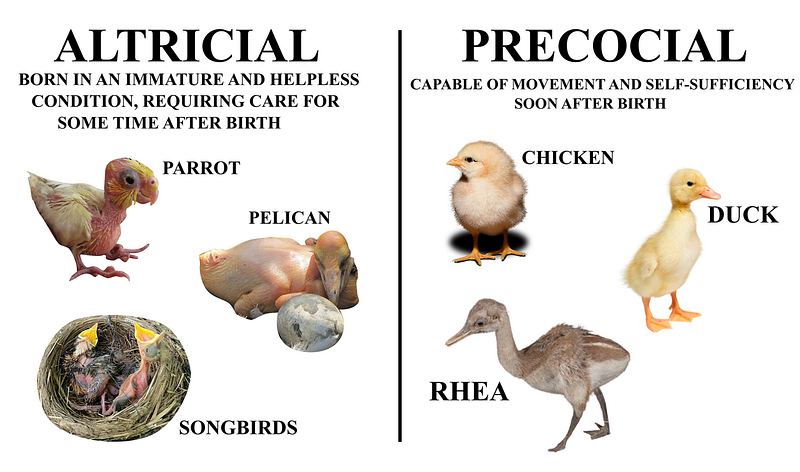
Examples of altricial and precocial species of bird. Source: Wikimedia Commons

In contrast, ‘precocial’ species like horses, deer and ducks can usually move around and follow mum within minutes of being born.

For these reasons, common wisdom is that narrower pelvises and wider heads put evolutionary pressure for earlier births, giving us ~40-week pregnancies and newborns with the body control of a drunk potato.

But more recent evidence suggests that the main factor is whether mum can supply enough energy for herself and the growing baby. This means that childbirth usually occurs when babies demand more energy than mums can provide.

Maternal health during pregnancy and health outcomes for babies

Clearly, pregnancy is a delicate metabolic dance. Mums are in a difficult position, trying to satisfy the energetic needs of greedy babies without compromising their own health.

Mums often prioritise the health of growing babies. Undernourished pregnant women illustrate this well, as many even suppress their BMR in order to maximise energy supply to their baby.

However, pregnancy isn’t zero-sum, and baby health is deeply entwined with maternal health. For example, a recent study in Nature found that high maternal blood pressure during pregnancy leads to lighter and shorter babies.

Conclusions and Takeaways

That was a lot of information, so let’s sum up and draw some practical conclusions. Pregnancy is easily one of the most metabolically demanding things a human being can do. It shouldn’t need to be said, but to all the past, present, and future mothers, thank you for your unbelievably hard work.

Source: Unsplash

Since pregnancy costs lots of energy — and babies and dads seem to collude in stealing energy from mums — pregnant women need plenty of resources at their disposal.

This means eating lots of food and limiting energy use through physical activity. I say limiting, but certainly not eliminating, as pregnant women also need to stay active in order to stay healthy.

But especially in the third trimester, when babies’ energetic demands are most extreme, physical work should be kept to a healthy minimum. Pregnant women are already running a metabolic marathon per day – no need to go nuts.

If physical work is unavoidable — as is the case for many people — then eating lots of food is all the more important. Our biology is tough and versatile, so long as we provide the fuel it needs to do its work.

Lastly, I want to highlight the power of looking at life and health from a metabolic point of view. Metabolism is one of the main factors that distinguishes us from machines, and we must understand our energetic/metabolic needs in order to understand ourselves.

Pregnancy is a striking example of this, but it’s also true for all other aspects of life. Since we depend on our metabolism, we need to treat it kindly.

Eat healthy foods that cover your nutritional needs. In the age of junk food, we’ve forgotten the old saying that “you are what you eat,” but this is evergreen advice that we should take very seriously.

Thanks to decades of tireless research, we’ve made important strides in understanding the key principles behind life and health. And while there’s always more to learn, many of the tools to build healthier lives are already in our hands — we just need to use them.

Good health and thanks for reading!

Health
Pregnancy
Energy
Exercise
Science
Recommended from ReadMedium