Growth Mindset
Praise My Efforts, Not My God-Given Abilities
Rewiring the mindset of a generation dependent on validation and rewards

“My professor is going to think that my brain is the size of an edamame, and he’ll go home tonight and tell his wife that I am the dumbest student in his class”, I judgingly told myself.
The end of my first year of college was approaching, and finals week was ripping my brain into shreds. I often pounded my fist into innocent desks because I believed that I wasn’t smart enough for this.
I would routinely ask my peers, “Who cares about a stupid balance sheet, and why do I even need to drill this useless information into my brain?”
As I flipped through the final exam of my Cost Accounting course, my sweat glands went on overdrive and I felt my forehead heat up in ways that I had never experienced. The exam was merely 6 long-form, practical questions and I couldn’t even answer one. The result?
I went to the last page and found a blank spot where I could write. I grabbed my pen and drew a king-sized sad face, and wrote:

The rest of the day, all I wanted to do was drown myself in an extra-large bucket of Tequila, and forget about that class for the rest of eternity. But how could I forget? Soon, I would get the results back and I would have to see a fat ZERO on my transcript.
A couple of days later, grades were in. I think my professor felt a little bad and decided to give me a generous 1 point out of 10. It turns out that I didn’t spell my name wrong, phew!
Although the feelings of inadequacy and shittiness were prolonged for the following weeks, this wake-up call was about to propel me onto a path that resulted in a radical shift in my thinking patterns.
There are Two Ways to Think
What we believe to be our limitations manifest as real blockages in our day to day life. Oh, you believe that your God(s) did not bless you with the magnificent ability to solve a quadratic equation? Good luck, because whether you think you suck at numbers or you can finesse math symbols with ease… you are right.
Look, I’m not easily convinced by the motivational, positive “if you believe, then you will achieve” affirmations. You will never see me shirtless in front of a mirror, jumping up and down telling myself that I am a beautiful butterfly coming out of its cocoon… at least not in public.
Recently, I came across a lovely woman on the internet by the name of Carol Dweck, a professor of psychology at Stanford University. Her research in the field of motivation has pioneered new ways of understanding how our mindset affects our outcomes in life.
She identified that there are generally two states of mind rooted in what we believe to be true: Fixed and Growth Mindset.
- Fixed Mindset. People with this perspective believe that they are either good or not good at something. Their abilities are based on their inherent nature. It’s about the traits they were born with. It’s just who they are.
- Growth Mindset. The people in this boat (minority) believe that anyone can develop skills with the right amount of effort and practice. They believe that their true potential is unknown, and it’s impossible to predict what may be accomplished with years of passion, experience, and curiosity.
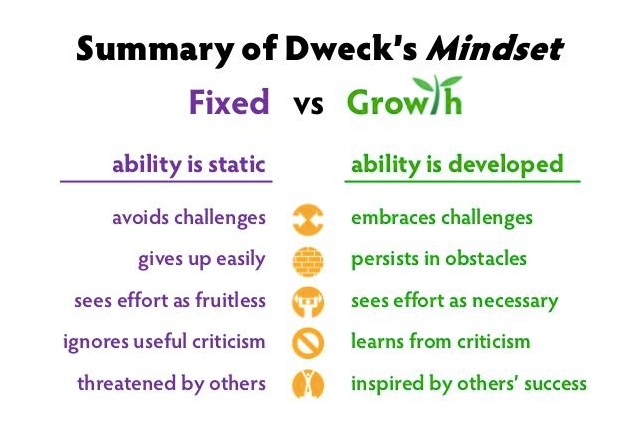
The main difference between the two is that the former creates a constant craving for approval and the latter fabricates a love for the learning process.
By taking the time to observe our mind, we conclude that there is a constant, internal dialogue between these two voices. For most, the fixed voice has formed a dictatorship in our brain. It has won the battle. This isn’t by coincidence.
Our mindset is shaped by how we are praised as children
Around the time we are 3.5–4 years old, we develop the ability to evaluate ourselves. Why? This is around the time that we begin to associate the praise that we receive with our actions. Think about the annoying aunt that wanted to burst our cheeks every time she saw us playing with our toys.
The dilemma: how we are praised will lead us down an entirely different road.
To expand on this point, Dweck and her colleagues at Stanford decided to study how young students reacted based on two types of praise. Half of them took a nonverbal IQ test, and later were told, “You got [X] many right. That’s a great score. You must be really smart at this.” The other half got their results back and were praised similarly, “You got [X] many right. That’s a great score. You must have worked really hard.”
It turns out that the last phrase made all the difference. Why was that? The first group was praised for their natural intellectual ability and the second received praise from the effort that was put in.
The results were astounding, and they reflect our abilities as parents, mentors, teachers or managers to influence what type of mindset our following generations will develop.
From this study, Carol Dweck concluded that the ability-praised children were pushed automatically towards a fixed mindset. Why?
They began to believe that their “smartness” was given to them from birth, and was carved in stone somewhere. Even when they were given a choice to take on a challenging new task that they could learn from, they fearfully rejected that opportunity. Dweck explains that,
They didn’t want to do anything that could expose their flaws and call into question their talent.
On the other hand, 90% of the group that was praised for their effort jumped on the idea of taking on a more challenging task. For them, difficulty meant that they had to put in more effort, and since they were not praised for being the next prodigy-child, they were not afraid to make mistakes and embrace the learning process. Without realizing it, the seeds for a growth mindset were planted.
The By-Product of a Fixed Mindset
As I opened my mind to this idea of a Fixed vs. Growth mindset, I’ve realized that the school system that I was brought up in was a garden for a fixed mind. I was constantly being evaluated, striving for the next A on my report card, and being told how intelligent I was in math class.
We all know the feeling of having to hide our flaws to not be judged or labeled a failure. Growing up, we are constantly getting flowers thrown at us for the things we excel at. Unconsciously, we have created an environment of performance fear.
“Fixed” minded people, being attached to the image they created for themselves, are pressured into defending their inherent qualities at all costs. They can highly relate to the phrase,
“You either got it or you don’t” .
So many people have the one consuming goal of proving themselves — in classrooms, in sports, in relationships, and the list goes on. Every situation calls for a chance to confirm our intelligence, character, strength, etc. In the face of every decision, we ask: Will I win or lose? Will I look dumb or smart? Will I be accepted or rejected? Will I succeed or fail?
The Power of “Yet”
As mentioned, when I failed that exam in college, I felt broken, unworthy, and not whole. My self-image was shattered because I no longer felt like a smart kid. Thoughts raced through my mind saying things like, “Maybe I’m in the wrong place. I won’t ever be as successful as my parents want me to be.” I was doubting myself to the point where urges to drop out and find another career floated around in my head.
After swimming in the seas of Smirnoff Vodka and trying to bury my failure in the depths of my past, a small flame somehow began to ignite. I awakened to a whole new lens from which to see my life.
After ingesting endless self-help content from the likes of Robin Sharma to the “no bull-shit shit-face” commentaries of Gary Vaynerchuk, I slowly shifted my perspective.
Without knowing it, the seeds of my growth mindset were being watered. I looked at myself and admitted that I had not given my maximum effort (too busy at the club). The failed exam was not a shot at my intelligence or memory retention. I acknowledged that I prepared myself poorly by being distracted by superficial goodies.
In a Ted Talk, Carol Dweck mentioned a college in Chicago where students who didn’t reach the required scores to prove their knowledge on a subject, got a report stating “not yet.”
Through embracing the phrase “not yet”, we accept that life throws curve balls in every direction to test us. It is our job to listen to the voice of our growth mind, and recognize when our fixed mind is trying to pull us down.
I didn’t fail, I just hadn’t passed yet. Recognizing the growth voice within, I pivoted towards a state of mind that allowed me to crave the learning process. I wanted to learn for the sake of learning, not just to pass a class. As soon as I decided to shift from the negative and fixed perspective to one of positive and growth, my brain wired itself in a new way. (I ended up getting a silky 6.7/10 on the retake. I’ll take that 570% increase from the first try).
Changing the Game We Play
This message all boils down to two things: perspective and attitude.
How we view our failures or difficulties will determine whether we choose to cultivate a growth mindset or not. Years of schooling have sucked us of our curiosity, so the question remains, how do we create a generation of effective learners?
First, we must wake up to the game that we are playing now. Currently, we rack up “points” for zooming past others and getting the right answers. We obsess over getting the best grades and the highest recognition for our God-given talents. We call ourselves stupid if we don’t reach our standards, and give up easily when the task gets too hard.
This is the old way of thinking. It’s a fixed way of thinking. Although the education system isn’t there… yet… there are abundant opportunities to change individually.
We have a choice to enter a new game… every single second of our day. We can praise ourselves for taking on a new challenge, seeking discomfort, and failing. By knowing this, we fall in love with the journey of growing as human beings.
We embrace how malleable, adaptable, and resilient we are. In an uncertain future with moonshot problems to be resolved, the ones embracing a growth mindset will thrive. Why?
They will be the ones diving into new, exciting learning opportunities. They won’t be afraid to reveal the holes in their intelligence, and failing will be seen as a good thing. They will lift others to persist during the hard times.
Remember, we are here to grow and develop as souls. Expanding the lens through which we perceive will open us up to a new world. You may start at any point. Honor your attempts and endeavors to extend your perceived limits, instead of blaming your “inadequate, innate” abilities.
I wish you the best on your journey towards welcoming a growth mindset into any aspect of your life.
Your friend,

Your time today is highly appreciated, thanks for learning with me! The growth mindset is a game-changer, so be aware of which voice you listen to.
For more insightful, half-funny articles, follow me, and I would love to connect further and hear your thoughts. My Instagram is @emilio_ortiz23, or also browse @theinnergymotto where we publish empowering content to ignite the flame within.