
MEMORY
Practical Memorization: Part 5–6 Tips to Create Powerful Symbolic Mnemonics
Converting boring abstract knowledge into exciting symbolic visual cues
Today, we’ll see one of the most crucial elements in the memorization toolbox: mnemonics. As we’ve seen in the previous parts of this series, there are many ways to memorize things easier.
We’ve seen how to:
- Create a memory palace,
- Make memorable images using techniques such as exaggeration
- Make creative associations between 2 objects to create something remarkable for our brain
But mnemonics can accelerate your retention even faster, especially if you often deal with the same abstract ideas.
Here are 6 tips to create powerful symbolic mnemonics…
What is a symbolic mnemonic?
Mnemonics are very diverse. For example, you can use an acronym to memorize a list of concepts. That’s what we do when we speak about SMART goals (goals that are Specific, Measurable, Accepted, Realistic, and Timely). Young children also use songs such as the ABC song to learn the alphabet.
Today, however, we will specifically focus on symbolic images as mnemonics. Symbolic images are often used to illustrate abstract notions. For example, justice is often portrayed as a blindfolded lady holding a balance and a sword:
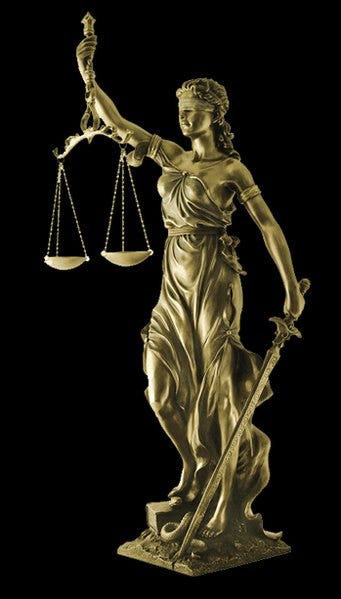
This is an allegory inherited from Ancient Roman art. But you can also create your very own collection of symbolic images.
This is especially useful when used in conjunction with the memory palace technique. We’ve talked about memory palaces from the beginning of this series. But as a refresher, a memory palace is a sequence of places — or loci — that you imagine in a familiar location such as your house. You then choose a list of loci in that location, such as a table, a chair, a sideboard, etc. Then, when you want to memorize a list of objects like a grocery list, just put these objects in the different loci of your memory palace. Then, when you want to recall these objects, you just visit your memory palace in your imagination to get the information that is contained in it.
Now, what if you want to remember abstract terms instead of groceries? Simple: just convert these abstract terms into concrete symbols, that is: symbolic mnemonics. Here are 3 ways to do it…
3 ways to create symbolic mnemonics
Here are 3 ways I’ve been using to create symbolic mnemonics to convert an abstract notion into concrete objects:
1) By word similarity. Sometimes, you are lucky, and the word is similar to a concrete object. For example:
- use a steak to remember about a stakeholder
- use a soup to remember about support
- use Justin Bieber to remember about justice — well.. maybe not.. ;)
2) By semantics. You can also use an object which has something to do with the abstract notion. For example:
- use Napoleon for strategy
- use a scale for justice
- use a magnifying glass for focus
3) Randomly. Sometimes, the word is just too complicated to think about a similar object, so just choose any memorable object you like. For example:
- use an Indian Chief for the Pythagorean theorem
- use pink cotton candy for psychology
- use a giraffe for arithmetic
3 rules to create powerful mnemonics
Here are 3 rules if you want your symbolic mnemonics to be extra powerful.
They must be:
1) Memorable. Don’t satisfy yourself with a concrete object. Try also to make it extra memorable, for example by adding bright colors. So instead of a giraffe, you can instead think about a pink giraffe. Head over to my 10 ingredients to create memorable images for further ideas.
2) Simple to imagine. Then, you must ensure the object is simple to imagine. For example, a nuclear power plant might be difficult to picture in your imagination. A simple tool like a hammer is much easier to choose as a symbolic mnemonic.
3) Unique. Also, try to vary your symbolic mnemonics, or you will confuse them. For example, I once confused Darth Vador and Batman as symbolic mnemonics, as they both have a mask and black capes. Spiderman and Batman are much easier to distinguish from each other. Remember that your memory will fade away after some time, so your images will be a bit blurry.
Creating your own mnemonic collection
Using the 6 previous tips, you will be able to create powerful symbolic mnemonics. This will help you encode abstract terms and store them in your memory palace. And you will have a great tool to memorize all kinds of ideas.
Even better, after some time, you will be able to create your own collection of symbolic mnemonics. This is especially helpful if you want to gain speed in your memorizing efforts. It works well if you are studying for a specific exam since you will use the same abstract concepts over and over again. Just assign a symbolic mnemonic to each of the core concepts, and memorizing for your exam will be a breeze!
—
Today, you have learned how to create powerful symbolic mnemonics to memorize all kinds of abstract ideas. This is especially helpful for memory palaces. Just convert your abstract ideas into physical objects, then store them in the loci of the memory palace. When you want to recall the information, just revisit the memory palace.
This is how I memorize all kinds of knowledge in my memory palaces. And you can do it too!
On February 1st, 2022, I’ve embarked on a 100 days writing challenge. This is post number 56.
Originally published at https://alexphili.com on March 30th, 2022.


