
Potent Pointers of Non-Duality from the Chinese Sage Wu Hsin
“Infinite is the canvas on which the world appears and disappears. Drops on a canvas, nothing more is man.”
Wu Hsin, whose name literally translates to No-Mind, was a Chinese sage that lived around 403 BCE. As his name suggests, he is most known for guiding seekers towards the non-dual state of No-Mind, which is a prominent pillar amongst many Eastern schools of thought such as Zen Buddhism, Taoism, and Advaita Vedanta.
Enjoy these pointers straight from Wu Hsin in the book “The Lost Writings of Wu Hsin: Pointers to Non-Duality in Five Volumes”.
Afterwards, forget ever have reading them.
“Don’t attempt to understand. Don’t deal with my words with the intellect; do not commit them to memory. Let the words pass through you, piercing through the mind and through the intellect and returning to their true source.” — The Lost Writings of Wu Hsin
- These words come out from a place devoid of concepts and doubts. As such, they are not only spontaneous, but natural and true. They are not intended to create new concepts, but, to instead, dispel old ones. The words of Wu Hsin are not meant for discussion which only distorts and pollutes. Take them in and move on.
- The attachment to beliefs is the greatest shackle. To be free is to know that one does not know.
- One is what one absorbs.
- The end of questioning is the end of seeking. Further and further explanations do not provide that which is sought. Additional information does not provide that which is sought. Drop these activities and rest in what is prior to all mental activity. Awareness.
- Sound is the same but its expression through various instruments is different. So it is with Being.
- What problems can there be that the mind did not create? The solution to problems begins with the cessation in believing in the contents of one’s thoughts.
- An event becomes an experience through personal involvement. Collecting experiences can be helpful with the daily aspects of life but it is not the road to happiness.
- The inherent nature of the mind is to process thought. To attempt the cessation of thought goes against what is natural. The goal, therefore, is not the cessation of thought. The goal is cessation of identification with thought.
- What is called peace by many is merely the absence of disturbance. True peace cannot be disturbed; it resides beyond the reach of disturbance.
- When Here becomes everywhere and Now becomes always, then one has succeeded.
- The Source and Substance of everything has no name. When Wu Hsin names it: The Eternal or The Infinite or What-Is or That or The Mystery or The Absolute, he merely points to It. Make a list of all your pains, your sorrows, your hurts and disappointments. This, too, is part of It.
- Only a fool seeks to stop the shaking of moon’s reflection on the water. The acceptance of what cannot be changed paves the way to the changeless.
- All of the world, with its past, present and future, arises every morning and sets every night, to arise again the next day. The knower of this has moved out of involvement and into the understanding that in order for this world to be known, the knower must precede it.
- The one who considers himself to be free Is free. The one who considers himself to be bound is bound. The only prison is mental.
- Controlling the mind doesn’t take one to freedom. Controlling the mind adds another link to one’s shackles.
- Whereas pain is a physical experience, suffering is a mental one. It is the sense that things should be other than they are. Its antidote is acceptance.
- When the waterwheel stops turning, what happens to the energy that turned it? Is it said to be used up or that it remains dormant, to turn again? When the body dies, what dies and what goes on? That which animated the body ceases to do so. This That is not affected and the cycle continues.
- The seeker of union must admit separation. For the knower of union, there is nothing to do.
- We are afloat in The Great River. All are carried along. Some swim against the flow. They, too, are carried along.
- Openness has no location in particular. It contains everything. It contains thoughts and the absence of thoughts. It contains feelings and no feelings, sights and no sights, sounds and silence. Within openness, everything is invited and everything is accepted. There is no way to be open because there is no difference between being open and Being.
- Truth is halved when it is told.
- A common misconception is the belief that thinking is the creation of thought. Rather, it is the reception of thought from a source which has no name and from a place that cannot be found. Since one can’t decide to think nor can one decide thoughts’ contents, why does one claim their ownership? Is every sound Wu Hsin’s because He can hear them?
- Infinite is the canvas on which the world appears and disappears. Drops on a canvas, nothing more is man.
- Let’s go upstream for a moment to a place before you and me; before all you’s and all me’s. This place is called Beginning. Empty, yet full of potential, it is from here that all emerges.
- Here is the utter simplicity of the matter: In the absence of identification with any thing, who are you? Or better still, what are you?
- There is no difference in the substance and That which animates it.
- The ultimate understanding is an impersonal event occurring in phenomenality. As such, there is no need for you, or any you to be concerned about it. Go about your business and enjoy life.
- Life is experienced as a series of events happening to an individual. Wu Hsin says: Life is happening. The individual is merely one of the series of events.
- Chasing after the things one yearns for is inferior to chasing after the source of the yearning.
- When the unbearable is recognized to be bearable, profound transformation occurs.
- Perfection contains all imperfection. The smaller within the larger. Do not chastise God for the aspects of life deemed unacceptable.
- To search for happiness implies its absence. This implication is a fundamental flaw. Happiness is ever present. It may become obscured, such obscuration being temporary.
- Although the mouse in the well knows nothing about the sparrows in the sky, in the moment of its escape everything changes.
- The preoccupation with the foreground, the sights, the smells, the sounds, takes the attention away from the background. Yet, it is in this very background The Mystery resides.
- One is carried on a raft within a floating stream. One is neither the raft nor the stream yet the perceiver of both.
- Trust that which brought you here will take you there.
- Contrary to popular belief the perceiver and that which is perceived are two ends of the same stick. The absence of one is the absence of both. The absence of everything uncovers the presence of The Seed of everything.
- Many writings speak of The Creator. Yet, in truth, this Creator is only another creation. Who created The Creator?
- One cannot acquire true knowledge and maintain a hold on ignorance. The two are mutually exclusive. Release of the latter is a precondition for the arrival of the former.
- All there is, is consciousness. Consciousness is all there is. In the absence of consciousness, what is there? All manifestation appears in consciousness, disappears in consciousness. Consciousness is the precondition for all perception. Everything perceived is perceived by consciousness as an object in consciousness, including the perceiver. Understand this and then grow your carrots.
- All experiences are transitory. The wise man neither seeks nor rejects them. In this manner, One remains rooted in The Unchanging, the stage upon which all change occurs. For many, what they believe to be their castle, is in fact their jail. The addiction to the drug called intellect, results in analysis of everything. All this perusal, evaluation and analysis complicates what is simple. Becoming purely receptive strips away the false, leaving the great gate to open, then What-Is is clearly comprehended.
- The greatest enjoyment is experienced when there is no concern for its duration.
- Utilizing the mind in the attempt to Achieve Ultimate Understanding is Akin to hiring a thief to Protect a house from burglars.
- Shadows working on shadows, Seeking to comprehend the Inconceivable immensity that is What-Is. Better it would be to Simply enjoy oneself, Doing what one is moved to do.
- The deep secret is that You are beyond time, beyond the heavens. You contact each at two points: Here and Now. Wu Hsin knows this, You do not. As such, you see yourself As separate from the Totality when, in fact, You are the very Totality You feel separate from. Change your viewpoint and change the world. Just as the eye cannot see itself, the mind cannot know itself. As such, all knowing must spring from that which is vaster.
- All emotions come and go. You remain.
- All your goodness, all your years of practice, all the prayers you have spoken, mean little to Wu Hsin. Instead, tell me if you are prepared to relinquish the control that you exercise on every aspect of your life? Are you now ready to enter into the flow of life without the oar of your seeming will?
- A free man’s life is a life that is free of demands, free of dependency. With nothing to drag along one goes where one will.
- When the mind feasts, True knowledge is lost. When the mind eats not, True knowledge manifests.
- You are a sinner, you are a saint. You are a murderer and you are a monk. The entire world that you experience is inside yourself. To fix the problems of the world, you need only fix yourself.
- Where is the line of demarcation that separates heaven from this life? Can you show it to me? Does it exist at all, anywhere, aside from inside your head?
- Do not seek to answer your questions, but to question your answers.
*All of the above statements are quotes from Wu Hsin, translated by Roy Melvyn
— Thank you for taking the time to hear from me, I greatly appreciate it and you. For more inspiring writing such as this, feel free to clap (up to 50x), subscribe, and follow. Happy Dreams, my loved ones.
Tyler C. Newman
Sources: “The Lost Writings of Wu Hsin Pointers to Non-Duality in Five Volumes” by Wu Hsin, Translated by Roy Melvyn
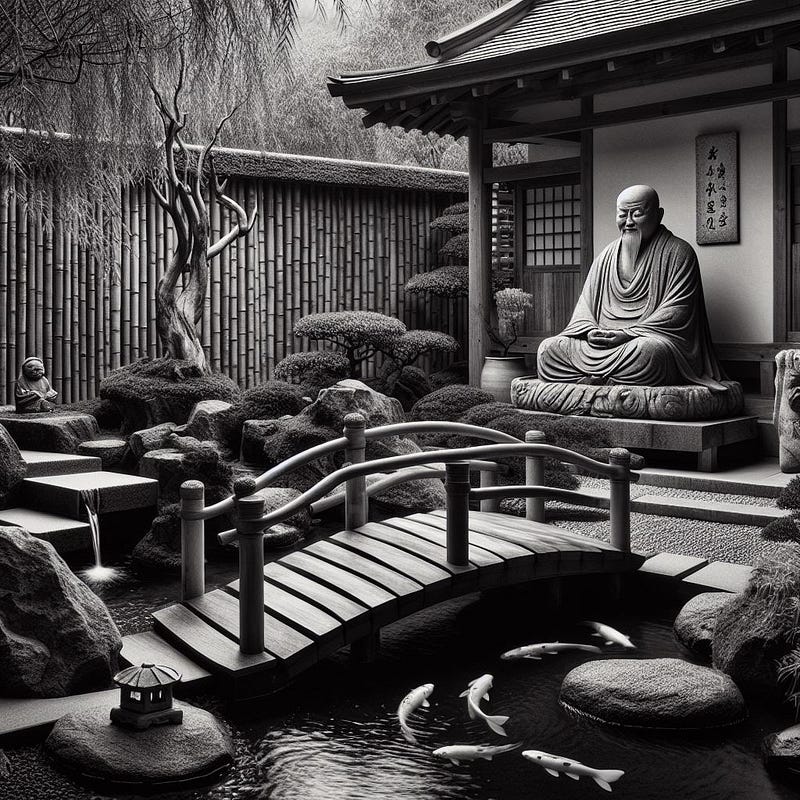
Photo: Created by Author using Bing Image Creator


