
Photography, Consciousness, Ralph Waldo Emerson
Portrait of a Rose
To truly “see” a thing, you must expand your horizons of perception
So often, we go through life noticing the “general essence” of the ideas, people and objects we come into contact with. But can we ever truly understand anything well unless we allow ourselves to look at it from multiple viewpoints?
Truthfully, every perception that we have has been skewed by the ones which we have formed before. As Ralph Waldo Emerson wrote in his essay, Circles: “ The eye is the first circle; the horizon which it forms is the second and throughout nature this primary picture is repeated without end.”
In other words, we see something — that is the first circle, the circle of perception. But then, we tend to bind our perception within another circle which we have drawn, and which we are reluctant to step out of in order to perceive things differently.
Emerson decried that “our life is an apprenticeship to the truth, that around every circle another can be drawn; that there is no end in nature, but every end is a beginning; that there is always another dawn risen on mid-noon, and under every deep a lower deep opens.”
I first encountered these words years and years ago, and, in reading them, something in my very soul resonated with the truth embedded in them. There is always another circle to be drawn — around, inside, intersecting, or completely unconnected — to the circle of reality which we perceive.
Nature holds the evidence of this within every petal, raindrop or shifting cloud. While she, herself, is constant, her expressions are continuously morphing and melding into a new tapestry.
I stepped out of the garden door this morning into a world swirling with mist. Every skin of every flower petal, every leaf, every dripping kumquat or pomegranate glistened with a sprinkling of fairy orbs.
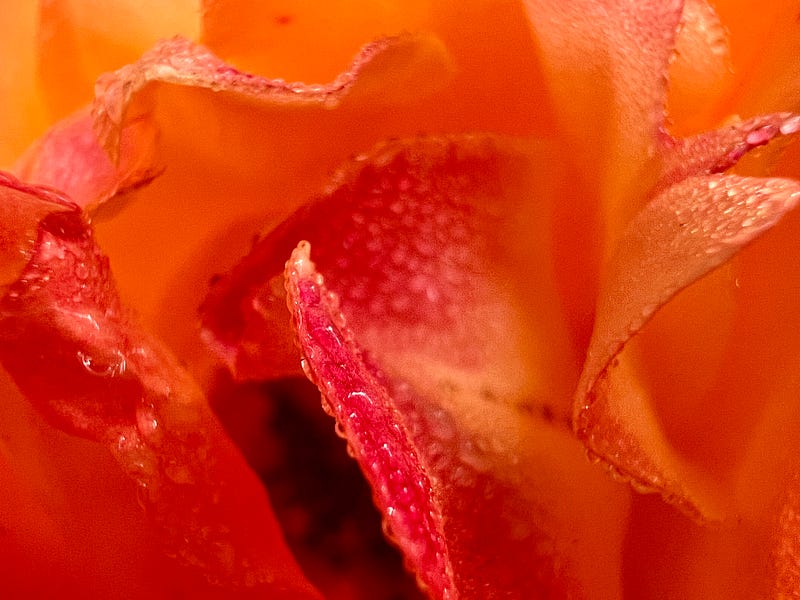
Sometime, it takes a darkened day to notice the more subtle “glowing” from within the beating breast of a flower. And this is what occurred with this solitary rose. It seemed as if it was lit from within.
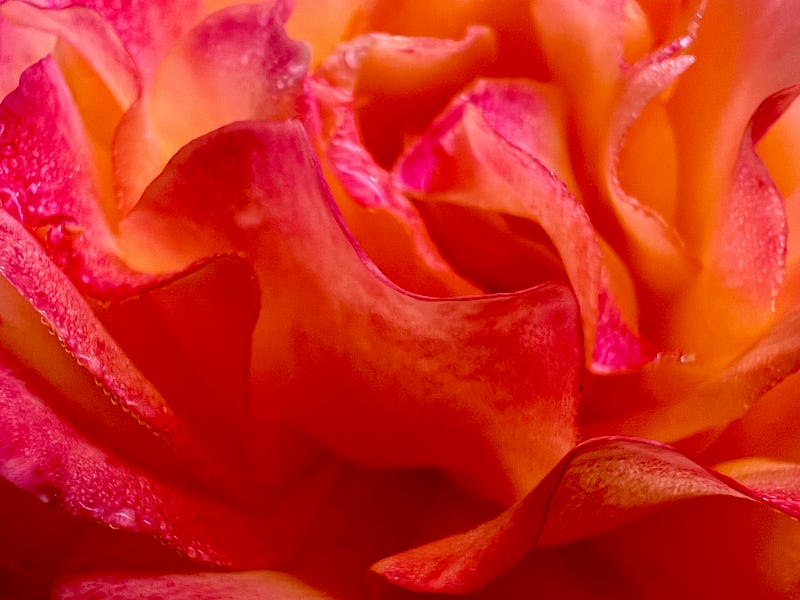
I grabbed my phone, thinking just to capture a single image, but I found myself zooming in a little more tightly, allowing my eye to descend into the ridges and valleys of the petals.
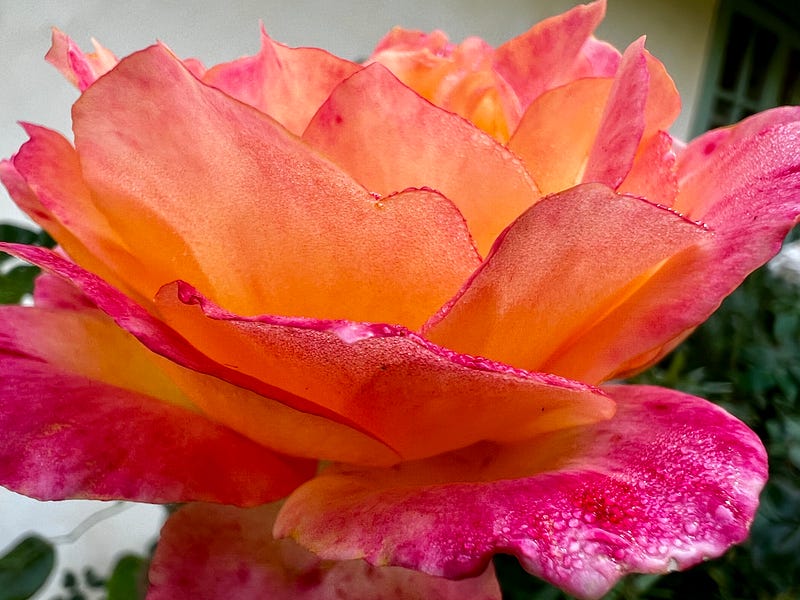
The nub of the rose, where the stamen were huddled, nestled into the still- “tight” clutch of the flower.
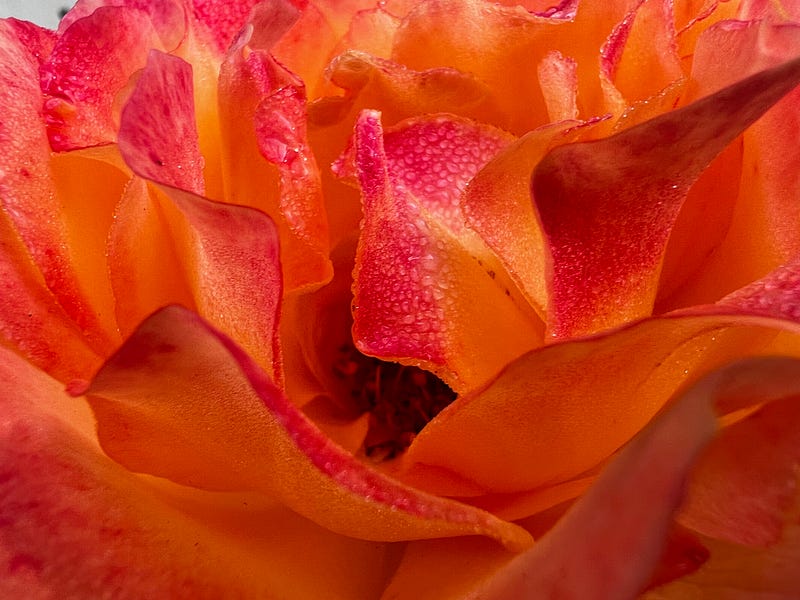
And the petals still held a bit of “frill,” like the upturned hem of a flamenco dancer’s dress as she twirls.
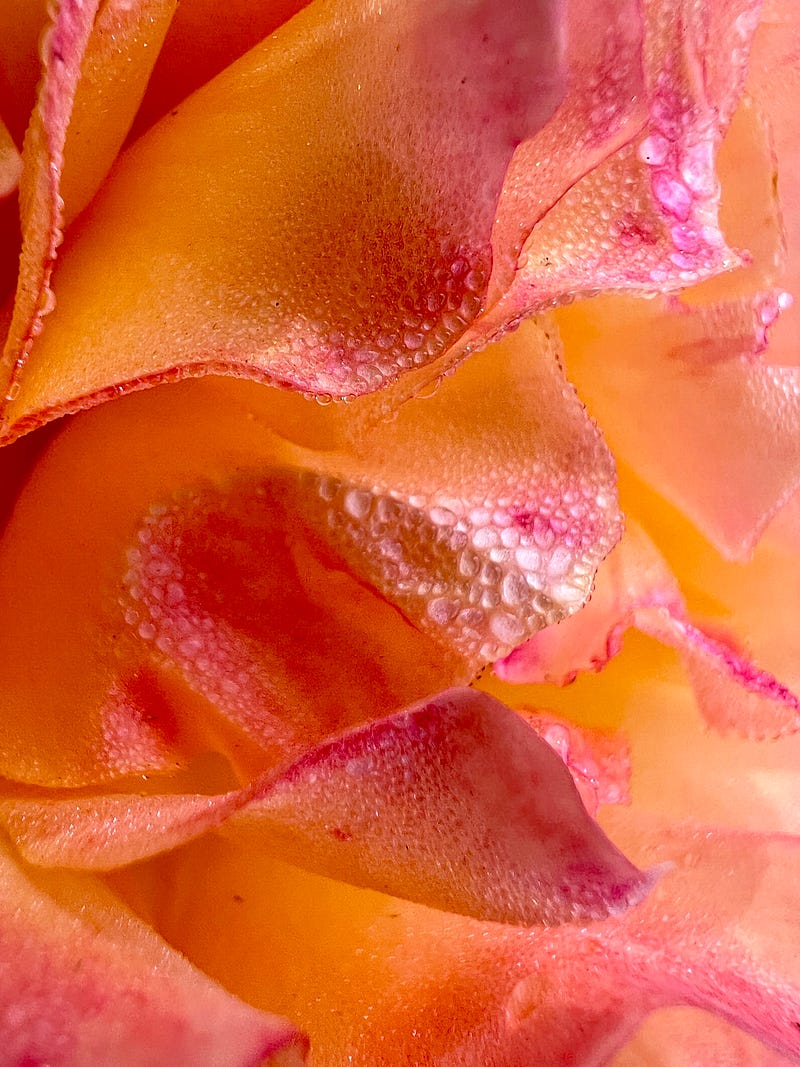
But I know that, sometimes, the beauty which blazes the most brightly often sags back into the arms of the earth the most rapidly. The heavy dusting of dew will likely cause these petals to soften and begin to wilt within hours.
Somehow this knowledge made the moment a little more precious.
William Blake, another of my favorites, once wrote:
He who binds to himself a joy Does the winged life destroy He who kisses the joy as it flies Lives in eternity’s sunrise.
I’d like to imagine a universe of sunrises within the horizons of these petals — a universe unbounded by any circles which humankind can draw.
Erika Burkhalter is a yogi, neurophilosopher, cat-mom, photographer, and lover of travel and nature, spreading her love and amazement for Mother Earth’s glories, one photo, poem or story at a time. (MS Neuropsychology, MA Yoga Studies).
Thank you for reading. I hope you enjoyed my musings and photos. You might also like:
Photos and story ©Erika Burkhalter. All rights reserved.