HISTORY
Portrait of a Revolutionary Freedom Fighter, Don Pedro Albizu Campos
Returning home is my duty. ~ DEP prompt #7 of 52
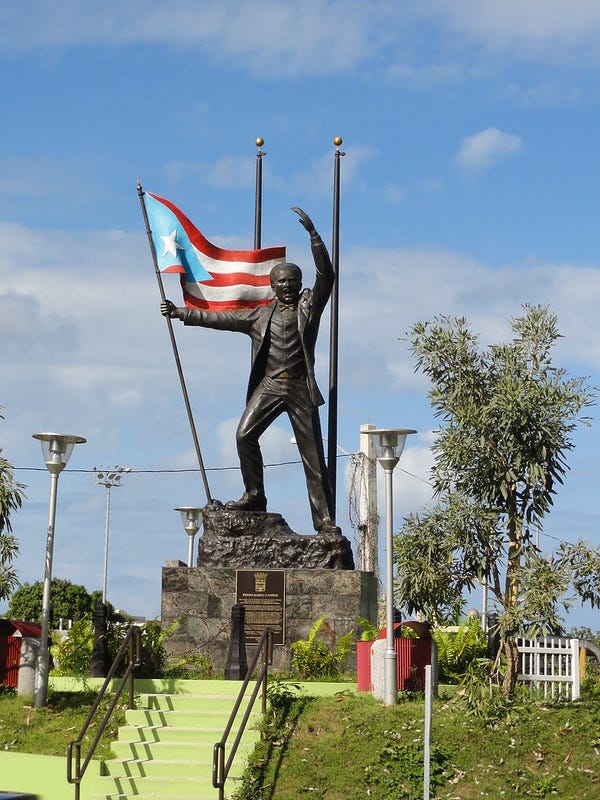
No somos pequeños, es que estamos de rodillas. ~ Pedro Albizu Campos, Puerto Rican Scholar & Patriot
Growing up in New York City, I knew about our Boricua culture. Large family gatherings are always centered around music, food, and dance. To say we’re a colorful people is quite accurate.
But what was missing from my childhood education was the true history of Borikén (our Indigenous name, and the one I prefer over our colonizer label, Puerto Rico).
It wasn’t until the evening of 21 October 2016, after attending a Latino Professionals Meet Up event for the book launch of The War Against All Puerto Ricans, that I’d get a glimpse of the U.S. role in my people’s horrific history. That night was the first time I’d learn of Pedro Albizu Campos (the “Don” is used out of respect).
Brief History of Borikén
Before diving into the life of our beloved patriot, it’s helpful to know a bit about the background of Borikén, whose name given by our Indigenous Taíno (Arawak) means “Land of the Valiant & Noble.”
With westerly neighbors of Haití and the Dominican Republic, and easterly ones of both the British and U.S. Virgin Islands, Borikén is a Caribbean archipelago consisting of three islands — smaller Vieques and Culebra, then the bigger ‘main island.’
Having been colonized twice (first by the Spaniards, then by the U.S.), it’s important to unlearn the fallacy that our land was “discovered by Columbus” (as I write in my article here, it is impossible to ‘discover’ a place where inhabitants already exist). From 1493 to 1898, Borikén was under Spanish rule, and after the Spanish-American-Cuban-Filipino war, it fell under the U.S. regime.
For a quick peek at the war’s recap, Hunter College Centro Puerto Rico gives us the following:
In 1898, the United States went to war with Spain after the second class battleship U.S.S. Maine exploded in Havana Harbor, Cuba, on February 15, 1898. Cuban rebels had been fighting for independence since 1895 and by all accounts had all but won the war. According to Valeriano Weyler, supreme commander of the Spanish forces in Cuba, the rebels “had brought the Spanish army to the brink of defeat.”[1] The rebels were so certain of their imminent victory that they rejected Spain’s offering of autonomy.[2]
Shedding further light:
There was no need to invade Puerto Rico to win the war. The U.S. had achieved such military superiority over Spain that Admiral William T. Sampson opposed Miles’ request for armored vessels to escort his transports to Puerto Rico.[iv] Still, Miles received the order to proceed to Puerto Rico on July 18, and the island was invaded seven days later. The motive for such action was to occupy the island before the end of hostilities prevented the U.S. from doing so. Quickly after the destruction of the Spanish fleet in the Pacific Assistant Secretary of the Navy and future veteran of the Cuban campaign and U.S. president, Theodore Roosevelt, wrote a personal letter to Senator Henry Cabot Lodge urging him not to make peace until ”we get Porto Rico.” Lodge assured Roosevelt that the administration was “fully committed to the larger policy we both desire.”[v] President McKinley’s administration had decided to annex Puerto Rico “in lieu of indemnities” and the physical presence of the U.S. military in the island would undoubtedly strengthen the U.S.’ position. That Puerto Rico came to be a possession of the United States did not stem from historical accident but rather from a calculated design.
(Note: the anglicized version of ‘Porto Rico’ was given by the U.S. (in 1898) to make it easier for Americans to pronounce; however, in 1931 it was reverted to Puerto Rico).
From 1898 to today, we remain under U.S. control. Though the legal term used is an unincorporated territory, the fact is that Borikén is a U.S. colony.
From Humble Beginnings to Harvard
Born in Barrio Tenerías, Ponce during the late 19th century, Don Pedro Albizu Campos came from a poor family; however, his name is seared in the minds of every patriotic Boricua. And with excellent reason.
The illegitimate son of a Boricua African-descendant Juliana Campos Campos and Basque-descendant Alejandro Albizu y Romero, the young Albizu Campos seemed to have all the odds against him. According to cultural scholar, Marisa Rosado, he didn’t enter school until the age of 12. After completing “the first eight grades in the four years between 1905 and 1909,” he finally made it to Ponce High School.
As noted by educator and author, Andre Lee Muñiz:
On his cumulative transcript, Don Pedro was documented as having taken four years of English; three years of Latin; two years of History, Spanish, and French; and one year of Algebra, Physics, Geometry, and Zoology. Besides an 88 received in the third quarter of his first year in French, all his grades were in the 90s.
At Ponce High School, Don Pedro’s opportunity to further his education was coupled with opportunities to gain recognition outside of his school. He set himself apart as a captivating public speaker and debater, one time serving as the school’s debate team captain for a contest held in English. In 1910 he was chosen to represent his school in a notable public speaking contest in Mayagüez. The contest was presided over by none other than José De Diego, a statesman, journalist, poet, and an important Puerto Rican historical figure that became known as the “father of the Puerto Rican independence movement.” Not only did Don Pedro win the contest, but De Diego personally awarded him the prize and was so impressed that he later played a role in securing Don Pedro a scholarship to attend college.
While known for having a great sense of humor, Don Pedro’s greatest reputation was as an intellectual, a skilled speaker, and a student leader. Dr. José Padín, who was a local school superintendent and then public schools commissioner in the years Don Pedro was in high school, said in a 1950 interview with the Boston Globethat he was a “child prodigy” and “oratorical spellbinder.” Don Pedro was also developing as a writer during this time. Following the death of a classmate named Mercedes Castaing in 1911, he was published in the Puerto Rico Eagle newspaper. The article, written in English at 18 years old, is an eloquent, heartfelt, and poetic display of emotion, spiritual contemplation, and reverence for the dead.
In the fall of 1912, he left his native Borikén to enter the University of Vermont (on scholarship) where he majored in agricultural engineering. Known for his “unmistakable intellect,” he eventually was recommended to attend Harvard University. Entering that Ivy-league school, he switched to chemical engineering, and “also took classes on government, economics, and languages. In June 1916 he graduated with a degree in chemical engineering in addition to a Bachelor of Arts degree in Philosophy and Letters. In good standing as a student, Don Pedro was accepted into Harvard Law School, beginning classes that following September of 1916.”
As Muñiz notes in his blog:
His decision to study law would go on to have a significant impact on his development. Studying law from several perspectives, including international law, he began to further develop his ideology regarding the situation of Puerto Rico. Despite some significant obstacles, Don Pedro eventually completed all course requirements and earned his Doctor of Law degree, at the time called a Bachelor of Laws (LL.B.). In a testament to his incredible capacity to learn, he also had a command of eight languages: his native Spanish, English, Portuguese, French, Italian, German, Latin, and Greek. During these years, Don Pedro also gained considerable attention on campus as a student leader.
The Military ~ The Attorney ~ The Husband
It is known that Don Pedro took a break in his time at Harvard to enter the U.S. Army. As this article on Hero of the Puerto Rican People offers:
After World War I broke out, Campos volunteered for the U.S. military and was commissioned Second Lieutenant in the army reserves. Upon completing his training Campos was assigned to the 375th Regiment, the unit reserved strictly for Black [persons] — an act that was in accordance with the US military policies of the time due to racial segregation. Pedro Albizu Campos would eventually be honorably discharged in 1919 with the rank of First Lieutenant.
Don Pedro eventually graduated from Harvard Law School in 1921, but he neither lived the life of a big-shot attorney nor did he remain state-side.
Flipping back to Muñiz for insight:
After graduating from Harvard Law School, several job offers were extended to Don Pedro: as an assistant in the U.S. Supreme Court, a U.S. diplomat to Mexico, and an executive position in a U.S. corporation. Upon returning to Puerto Rico, he was also offered a position as a judge in the town of Yauco. For reasons never directly addressed in public, he turned down all the jobs offered to him and decided instead to start a law practice in Ponce. Of course, the reason he refused these jobs was his decision to serve the people of Puerto Rico, a commitment that also meant avoiding collaboration with the colonial regime.
Essentially practicing poverty law, Don Pedro’s clients were by and large the working-class poor who could only afford to pay for his services in chickens, vegetables, and other items in their possession. On occasion, a simple ‘thank you’ was Don Pedro’s only form of compensation.
In her biography on Don Pedro, author Marisa Rosado wrote, “the great profession of Albizu is that of Patriot.” The secretary for Don Pedro’s law practice, Víctor Bonó Rodríguez, said that most of his time during this period was spent giving lectures. Don Pedro made a routine of speaking every Sunday on a podium in Ponce’s town square to anyone interested in hearing his analysis of current events, history, local/national affairs, and more. It was in these years following his permanent return to Puerto Rico that Don Pedro earned the title and nickname El Maestro, the teacher. During this time, he was also invited to take part in conferences and other events in Ponce as well as neighboring towns, including one in his alma mater of Ponce High School.
While at Harvard, Don Pedro had begun a committed relationship with Peruvian, Laura Emilia Meneses del Carpio (the first Latina accepted at Radcliffe College — the “all-female component of Harvard”). On 10 July 1922 they had a civil marriage in Ponce.
Independence Seeker & Nationalism
Don Pedro’s humble beginnings must have directly impacted his road to becoming a defender of the people. Along that journey he found an unwavering commitment to fight for his nation's independence.
In his adult life, Don Pedro was involved with El Partido Nacionalista de Puerto Rico (PNPR ~ The Puerto Rican Nationalist Party).
On 11 May 1930, he was elected the Party’s President. Once again, we turn to Muñiz for elaboration:
Following the elections, Don Pedro led the Nationalist Party using the principle of complete non-collaboration with the colonial regime. Instead of the Party just refusing to accept governmental positions dependent on direct appointment, the Party would now refuse to serve in any position within the colonial government, appointed or not. The Party began attracting even more militant supporters of Puerto Rican nationalism.
In January 1931, Don Pedro made his first call for workers to strike. With small- and medium-sized farmers facing foreclosure by the Federal Land Bank of Baltimore for not being able to pay their mortgage loans, he urged them to hold onto their lands at all costs and conduct a tax strike. Taking his advice, when Internal Revenue agents came to collect, the farmers refused to give any money.
In 1933, Don Pedro led an even more successful strike that put Puerto Rico in a virtual standstill. Protesting the high prices of gasoline, public transportation workers, again through the influence of Don Pedro, refused to work and achieved a significant victory against U.S.-owned gas companies. It was also the first time that troops were deployed for ‘riot prevention’ by the government in response to Don Pedro’s activities.
The above is relevant because it highlights not only what [at the time] the PNPR fought against but is reflective of what many of us condemn today — gentrification of the archipelago with non-Boricua-descended folks (largely white Americans) moving here to take advantage of tax benefits (Ley 60–2019).
Following is a February 1930 interview where Don Pedro articulates just what I’m referring to:
It is necessary to repeat always and at all times: that the land, the communication routes, the maritime fronts, and everything that represents real wealth in Puerto Rico must belong to Puerto Ricans.
Prison, Exile, and Return Home
On 24 October 1935, the police (under the command of Colonel Francis Riggs) murdered four Nationalists at the University of Puerto Rico, Río Piedras. The following year, on 23 February two pro-Independence young men, Hiram Rosado and Elías Beauchamp were murdered after they vengefully took the life of Riggs.
These events created a wave of heightened repression whereby Don Pedro and other nationalist leaders were “charged with sedition against the U.S. government.” Latinopia summarizes it thusly:
After a controversial trial in which Albizu Campos was at first acquitted and then, when a second trial was imposed, finally convicted of sedition, he was sentenced to the Federal Prison at Atlanta, Georgia.
Albizu Campos spent ten years in prison, the first seven in Atlanta, Georgia where he became dangerously ill and was then moved to a hospital in New York where he remained until the end of his sentence. In 1947, on release from prison, Albizu Campos returned to Puerto Rico and resumed his actions with the Nationalist Party.
In an effort to suppress the Nationalist Movement, the government passed Law 53, “La Ley de la Mordaza” (The Gag Law). This law laid out the following prohibitions: the display of the Puerto Rican flag, the singing of patriotic songs, and any discussion of Puerto Rican Independence.
Being the fervent revolutionary, Don Pedro remained steadfast in his protection of Borikén and the movement to free Her from U.S. colonial bondage. Uprisings in the form of armed revolts against U.S. occupation were planned.
Latinopia continues:
By staging an armed revolt, the nationalists hoped the United Nations would recognize the Nationalist Party as a valid national liberation movement from a colonial power (the United States).
In October of 1950, uprisings promoted by the Nationalist Party erupted in cities and towns throughout the island. The most successful of these uprisings took place in the towns of Jayuya (led by 24-year-old Blanca Canales) and Utuado and an attack on the governor’s mansion in San Juan.
At Utuado, nine nationalists who had surrendered to police were taken behind the police headquarters and summarily machine-gunned without a trial, an event that became known as the “Utuado Massacre.”
Eight Decades ~ Torture ~ A Legacy
While his efforts to liberate our people did not find their ultimate goal, Don Pedro never despaired. Using his powerful oratory gift, he continued to move the masses.
Turning back to Latinopia’s article for a closer look:
Following the October uprisings, the government declared Martial Law and Albizu Campos and other nationalist leaders were arrested. The sedition case against Albizu Campos was based on speeches he had delivered espousing Puerto Rican Independence. Using Law 53 as a basis, the government sentenced Albizu Campos to eighty years in prison. In 1953, Luis Munoz Marin, the governor of Puerto Rico, pardoned Albizu Campos but his freedom was short-lived. In 1954, a group of four armed Puerto Rican nationalists, led by Lolita Lebrón, attacked the gallery of the Capital Building in Washington D.C. wounding five Congressional Representatives. Albizu Campos was presumed to have been involved in the planning and his pardon was rescinded.
Albizu Campos returned to prison. In 1956 he suffered a stroke. He was transferred to San Juan’s Presbyterian Hospital where he later complained that he was being illegally irradiated with x-rays by doctors there. Though hospital authorities denied the claim, subsequent examination by the President of the Cuban Cancer Association confirmed that Albizu Campos had indeed suffered from intensive doses of radiation. Governor Luis Munoz Marin pardoned Albizu Campos again in November of 1964 and he was allowed to return home.
21 April 1965 — Don Pedro took his last breath but left us his legacy. It is one that stands as a reminder of why I returned home, to Madre Borikén. A part of that journey is sharing my poetry on colonization and social issues. Another aspect is having conversations with others who are unaware of our true history. Yet another avenue on my road home is offering community gentle yoga classes where I incorporate meditation to help in our collective healing.
We still fight for our independence, as Don Pedro did. To my understanding, today it no longer requires bloodshed. The struggle for us to become a sovereign nation starts with unity — my people must work together toward that common goal. We must always remember the words of Don Pedro:
No somos pequeños, es que estamos de rodillas. (We are not small, it’s just that we’re on our knees).
Reflections
All my life I’ve known there was something different about me. Many things, really. I don’t celebrate all things Hallmark (e.g., valentine’s day, easter, mother’s day, thanksgiving, Christmas). I avoid speaking in empty platitudes (think: ‘it is what it is,’ ‘everything happens for a reason,’ or ‘it’s gonna be ok). I know it’s healthy to cry when my soul needs it, and I’m comfortable sharing an unpopular opinion.
I also don’t believe in ‘celebrities as role models.’ They are people just like the rest of us — the mega millions and bazillion Instagram followers are what set them apart.
That I chose one of Borikén’s most beloved patriots for my article was intentional. I neither view him as a ‘celebrity’ nor as infallible, but rather as someone whose legacy continues to us of our beauty — and that we must never kneel to the yanquís or to anyone!
Special gracias goes to Andre Lee Muñiz for his contributions to our beautiful cultura and for keeping the memory of Don Pedro present in our lives. His Instagram: @RememberingDonPedro
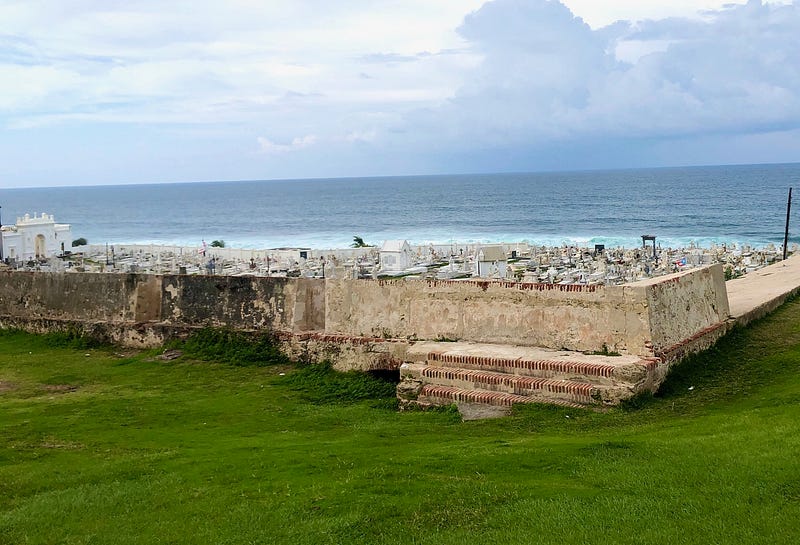
Last year my partner asked me what I wanted for my birthday. I told him my soul needed to pay respects to Don Pedro Albizu Campos. That afternoon, we visited his tomb — it was one of the most impactful experiences of my life.