
Relationships
Poppy’s Journal
Journaling Can Become a Treasured Legacy
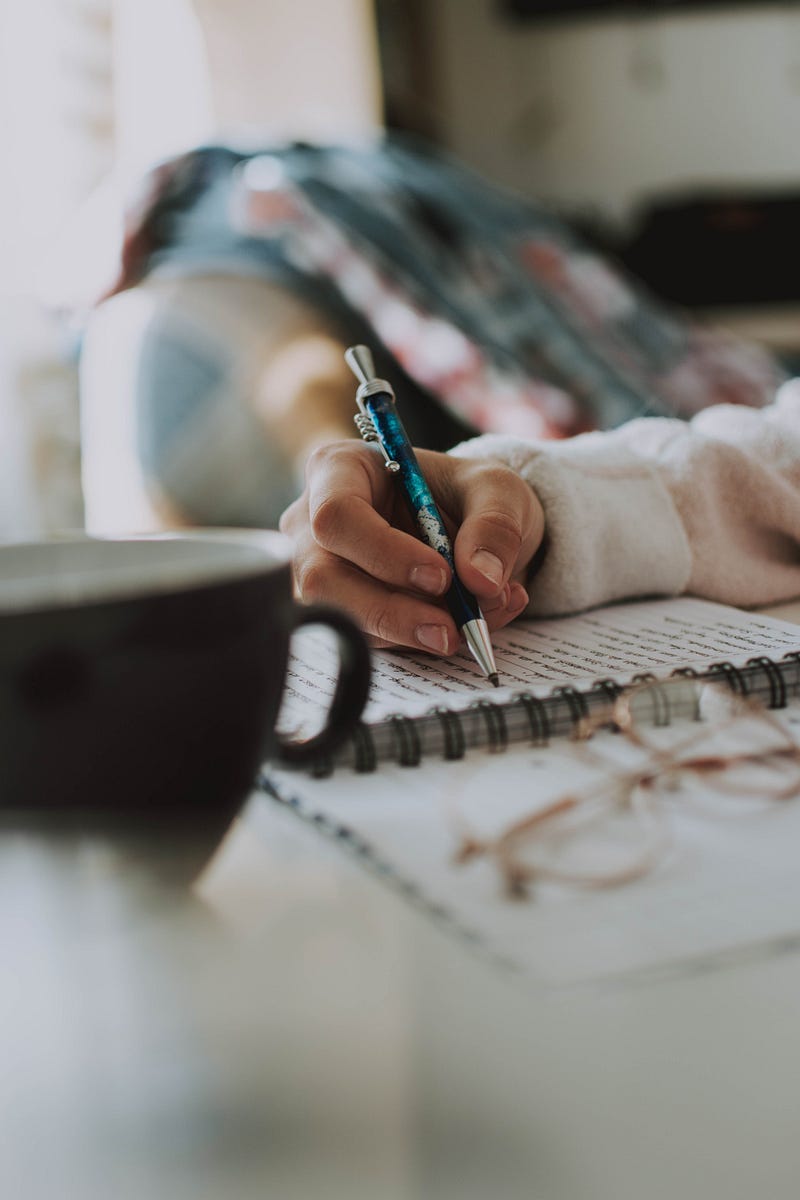
Do you journal? How do you use your journal? There are so many ways.
I run a free journaling circle and a more formal journaling course in the Garden of Neuro. Since I’ve been writing in journals my entire life, it seemed a natural progression to become Leader of the Journal. A bit like Lord of the Rings. Without the drama.
The formal journaling course comes with a beautiful new journal shipped to the student’s door.
Some people in the course and circle are seasoned journalers. Others may have taken an hiatus and are getting back into it. There are skeptics. I manage to convince everyone that journaling is a good idea, no matter what purpose you settle on for using your journal — and there are many.
Recently, I was reminded about my grandfather’s journal. The family called him Poppy.
Both my grandparents — on my maternal side — kept journals. After they both died, I inherited their journals. The edges of all of them were well worn, from opening and closing, returning to these pages again and again. The spiral bound notebooks showed rust on the pages, from being stored in a tropical climate on a volcanic island, where humidity, salty sea air and sulfur in the background mix into a mild corrosive, affecting metals adversely over time.
Those rusty bits are just one reason that remind me of why it’s important to have a beautifully bound journal — being frugal serves you well, and yes, your own journal is meant to be a tool for your own purposes. But the fact remains that when we die, someone will stumble upon these papers. If they are in good condition and gorgeous, it will enhance their experience. And it is of no importance if my journal notes are blather. That’s not the point at all.
My grandmother’s journals were full of anecdotes and inspirational quotes, stock market performance numbers — she managed the family money — and personal reflections. I treasure these, even though for many years after her death, it was difficult to go back and look at them.
I adored my grandmother, and missed her terribly, so each time I’d touch her journal it would bring me to tears. I’m happy to have them, regardless. I recall her sitting, alternatively at the kitchen or dining room table, and carefully making notes for the day. Neither of my grandparents neglected their daily journaling duties.
When I sit and look at these journals, I am instantly transported back to the images of my grandfather, sitting at his compact desk in the corner of the house, just beside the house exit door leading to the inviting warmth of the pool deck — and that vista of the Caribbean sea, island hills, and sand and bird sanctuary in the valley. They had quite a view perched on top of that hill in Foxes Bay, on the tiny island of Montserrat.
He would write about activities mostly. And he was a record keeper. He enjoyed reading history. He was writing his own version of history. Each day he would record the temperatures — the high and the low, as well as the rainfall. He kept a rain gauge outdoors, and at the prescribed hour that marked 24 hours of rain collection, he’d gather the data, then dump out the water so the collection could begin again. He’d monitor the air pressure and the humidity. He loved measuring devices. His handwriting had a meticulous typewriter font clarity to it. It was easy to read.
In the evening, he would stand on the pool deck, and sometimes I would stand with him. We would watch the sunset together. He would hold one of those simple counters that you see women use in a grocery store— for counting pennies as they shop, so they don’t overspend the amount of cash they held in their wallets, meant to be spent solely in that store that day — and with it he would count the birds — the number of egrets that flew down from all the hills in the area, to roost for the evening in the bird sanctuary which lay at our feet, in the swampy area just next to that beautiful black sand beach.
He’d record all these things in his journal. So looking at those journals now is not all that exciting of a read. Just columns and rows of numbers and symbols, and days and weeks, months and years of collected data.
But there they are — numbers standing guard against any errant memory loss or doubt that there was a meaningful life led on this tiny island, who some in the family said was pointless — as they claimed my grandparents were “dropping out” of society and the responsibility to family and others. But they were wrong. They were just being jealous and selfish and behaving as children would, whose parents abandoned them, despite that they were grown adults.
My grandparents’ doors were always open to all guests and visitors. It’s why I believe that entire island nation came to dinner or lunch at some time or another. Or to play bridge, or attend any of the hundreds of “Adventures in Listening,” a classical music evening concert that my grandfather curated monthly, and my grandmother catered.
I could go anywhere on that island and say that I was their granddaughter, and they’d know me. Because they knew my grandparents. In fact, practically no one there actually ever knew my name. I was simply “Peg and Russ’ granddaughter,” and that told everyone who I was and where I belonged. Over the entire 20 some years of visiting with them, I was okay with that.
It’s why the governor of the island one day asked my grandparents if they might be willing to entertain some officers from the Royal Navy ship that was moored off island on one occasion. To their surprise, Secret Service arrived ahead of the appointed dinner hour, and stationed themselves around the property perimeter.
When the officers arrived, one of them was Prince Charles. The stories and journal entries for that event were wonderful, and story telling about the event went on for years afterwards. Sadly, I had not been in attendance.
Those journals are a lifeline — an umbilical cord to a blissful time in my life. Knowing that I have them, even if I never pull them off the shelf, gives me the touchstone I need to go back and relive these treasured moments when I was the most happy.
Journaling can be anything we choose it to be. For me, it’s a way to process my emotions, create my future, remember my past. It’s my best friend, the friend who only listens and never judges.
Come join us in the Garden. You can reconnect to journaling. And leave a legacy for someone who will be forever grateful you did.
For women — come get a new journal and sign up for the journaling course I curated. And find an amazing community of support at the same time. There’s nothing else like this community on the planet.
Another piece I wrote recently about journaling
Susan B. is a serial entrepreneur, writer, editor, poet and ship captain. Come find her in the Garden.


