avatarBen Callif

Free AI web copilot to create summaries, insights and extended knowledge, download it at here

3268

Abstract

to analyze and interpret data in an informed way. But knowing how to source information is an equally important part of my job. I find it strange that most people (including me) are <i>terrible </i>at properly citing the underlying sources of their knowledge. I understand that it’s a laborious and unsexy process, but it never hurts to seek out the origin of information. Cross-checking at the outset makes the eventual analysis and interpretation much easier, and you never know what you might find.</p><p id="46ed">Nowadays, we <i>sorely</i> need the ability to properly cite our sources. It’s way too easy to punch a few words into the internet to validate our opinion. The sheer speed and simplicity of a Google search leaves no time to concern ourselves with the differences between primary, secondary, or tertiary sources. For example, I really thought that quote was by William James. And, thanks to Google, I found hundreds of links in under half a second that validated my belief (0.39 seconds to be precise). I only discovered the misattribution because I’m writing my second book, and the publishing process puts me in a much more rigorous mindset than usual; I raise my standards when my words will be permanently and physically printed onto a page. If I had just posted the quote online as I originally intended, I may never have found my error.</p><p id="f45b">There are many reasons why I don’t always take the time to cite my sources. But there’s one in particular that sticks out to me: society lacks mechanisms that could help nourish our natural curiosity. Google can get us the answers to a great many questions, but it doesn’t inherently teach us to think for ourselves. Similarly, modern-day educational institutions don’t really focus on learning how to learn. To the contrary, some people have argued that <a href="https://www.ted.com/talks/ken_robinson_says_schools_kill_creativity?language=en">schools actively prevent</a> the development of this competency. Humans are inherently capable problem-solvers and pattern-recognizers — it’s criminally inefficient that more academic institutions don’t tap into this natural resource of curiosity. In a way, the whole process of researching and learning — sourcing information, analyzing data, interpreting results, and synthesizing conclusions — is analogous to a <a href="https://www.youtube.com/watch?v=tThS05TdK3M">4-year-old repeatedly asking “why.”</a></p><figure id="d768"><img src="https://cdn-images-1.readmedium.com/v2/resize:fit:800/0*uEPMfnlMnyIe-Dmr.jpg"><figcaption>Image Credit: Heather Katsoulis, <a href="https://www.flickr.com/photos/52473526@N00/911016819">Flickr</a></figcaption></figure><p id="7a89">The repetitive nature of this process requires a lot of patience, but it can help us discover the limits of our knowledge. It can also help us realize that <i>how</i> we know is just as important as <i>what</i> we know. 4-year-olds don’t ask “why” just to get answers, they ask “why” to learn how to think about the world. Unfortunately, we don’t have many cultural systems that promote this kind of infinite inquisitiveness. We are more likely to think of it as an annoyance or a distraction than we are to recognize it as the miraculous process of learning how to learn. The

Options

negative reinforcement of curiosity has partially contributed to a <a href="https://www.salon.com/2017/07/11/america-hits-peak-anti-intellectualism-majority-of-republicans-now-think-college-is-bad/">growing anti-intellectualism in the United States</a>, and <a href="https://unesdoc.unesco.org/ark:/48223/pf0000261065">people the world over</a> seem <a href="https://www.reddit.com/r/AteTheOnion/top/?t=all">incapable of critically examining</a> the information they consume.</p><p id="6b40">A widespread inability to source information has caused a horrible surge in anger, fear, and ignorance. The common and stubborn resistance to knowledge on many social media platforms is truly disturbing. Scrolling through Facebook is like walking through a <a href="https://readmedium.com/alt-right-culture-jamming-and-memetic-warfare-93b646263f7d">memetic battlefield</a>. One of the problems is that no one else can source your information for you — we each have to do it for ourselves. Two people looking at the same source of information can quite easily derive completely different conclusions. Someone entrenched in their beliefs isn’t going to change their mind just because you ask them where their ideas came from. <b>We owe it to ourselves and to each other to critically examine <i>all </i>the information we’ve collected, no matter how confident we are in its accuracy. </b>As Alan Watts once said:<i> “Confusion largely results from not following feelings or ideas to their depth.” </i>And yes, that really is an Alan Watts quote. You can hear him say it in his own voice <a href="https://www.organism.earth/library/document/19">at 26:55 in this recording</a>.</p><figure id="93cc"><img src="https://cdn-images-1.readmedium.com/v2/resize:fit:800/0*oKstIMiuROq8dfo-"><figcaption>Our world is more connected than ever before. But far from ushering in a new age of enlightenment, we seem to be experiencing unprecedented levels of confusion. Image Credit: <a href="https://unsplash.com/photos/0_sMYmRHpro">Karsten Gohm</a></figcaption></figure><p id="443b">If we don’t dive deeply into the rabbit hole of an idea or a feeling, we’ll never know what we might be missing. Exploring the depth of each feeling will lead us to a preconceived notion. We may be able to support our preconceived notions with evidence, but they will persist unsubstantiated without examination. Exploring the depth of each idea will lead us into an entirely new dimension of information. Hidden dimensions of information are always available, but we can’t access them if we remain at the surface level of ideas.</p><p id="dbf9">Given all that, I hope you can appreciate the importance of finding a valid source for each and every piece of information that comes your way. It may take some extra time up front, but you’ll almost certainly save yourself time in the end. The metaphor of media <i>consumption</i> is apt, because we are what we eat. Regard for the quality of our information is regard for the quality of our health. Seeking out the primary sources of the information we consume will help us correct our mistaken beliefs, discover new ideas, and make us all-round more informed. And, right now, the world desperately needs people to be more open and informed.</p></article></body>

Poorly Sourced Information Is Poisoning Our Minds

We haven’t complemented our immense access to data with a commensurate ability to think

Image Credit: Su San Lee, Unsplash

The metaphor of media consumption is apt, because we are what we eat. Regard for the quality of our information is regard for the quality of our health.

Attitude is so much more powerful than we often realize, which is why I quite like the following quote: “The greatest discovery of any generation is that a human can alter his life by altering his attitude.”

Whether or not you’ve seen this quote before, do you know who said it? Don’t read past the next image if you don’t know. Instead, do me a favor. Open a new tab or window in your internet browser and help me find out who deserves the attribution for this quote.

Find out who said the quote before you scroll down.

I’m serious. Go do some research.

You better be scouring the web for the source of the quote! Image Credit: Andrew Neel, Unsplash

If you’ve scrolled this far I’m guessing you’ve discovered that William James is the author of this quote: “The greatest discovery of any generation is that a human can alter his life by altering his attitude.”

But did he really say this? Well, Google tells me that he did. Here’s a screenshot of my search results for that exact quote:
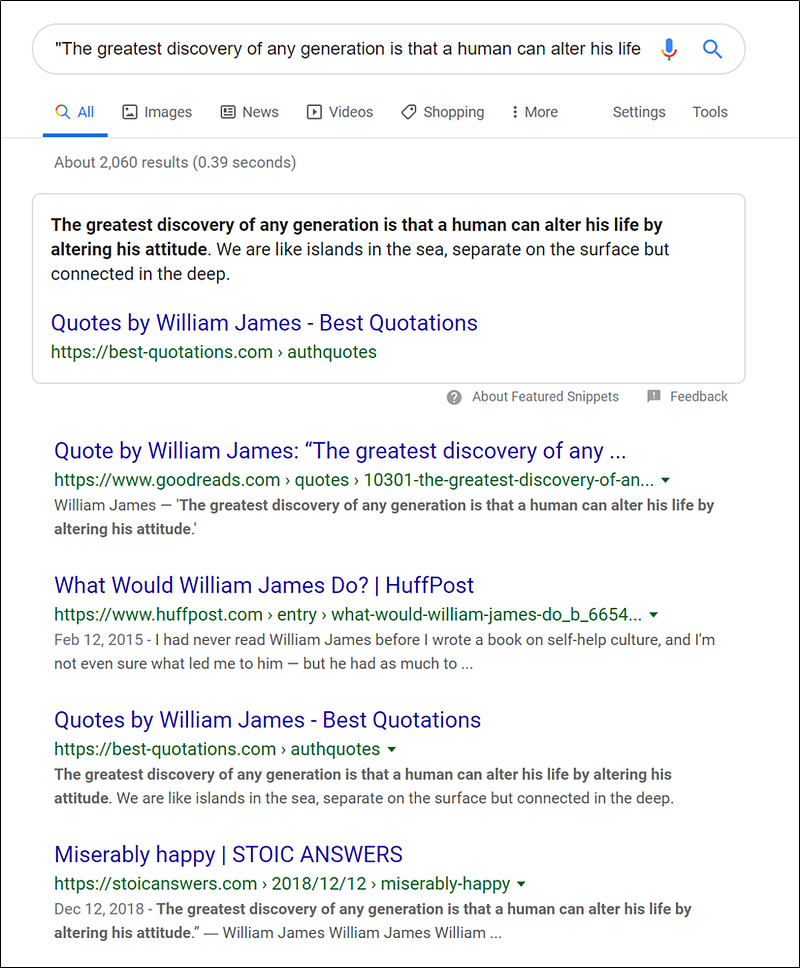
The vast majority of these 2,060 results misattribute a quote to William James. In fact, it seems as though no one ever really said this quote.

I scrolled through dozens of pages of Google search results and nearly every link attributes this quote to William James. Here’s the problem: that’s not a quote by William James. He didn’t write that in any one of his books and he never even said it out loud. In fact, there doesn’t seem to be a real record of anyone having said that quote. Turns out, it’s a heavily modified version of a different quote that was written by a completely different person nearly 60 years after William James died. And herein lies one of our biggest failures as a society immersed in the internet — we haven’t complemented our immense access to information with a commensurate ability to think.

As a researcher I get paid to know what I’m talking about (and to know what I don’t know). So it’s very important for me to be able to analyze and interpret data in an informed way. But knowing how to source information is an equally important part of my job. I find it strange that most people (including me) are terrible at properly citing the underlying sources of their knowledge. I understand that it’s a laborious and unsexy process, but it never hurts to seek out the origin of information. Cross-checking at the outset makes the eventual analysis and interpretation much easier, and you never know what you might find.

Nowadays, we sorely need the ability to properly cite our sources. It’s way too easy to punch a few words into the internet to validate our opinion. The sheer speed and simplicity of a Google search leaves no time to concern ourselves with the differences between primary, secondary, or tertiary sources. For example, I really thought that quote was by William James. And, thanks to Google, I found hundreds of links in under half a second that validated my belief (0.39 seconds to be precise). I only discovered the misattribution because I’m writing my second book, and the publishing process puts me in a much more rigorous mindset than usual; I raise my standards when my words will be permanently and physically printed onto a page. If I had just posted the quote online as I originally intended, I may never have found my error.

There are many reasons why I don’t always take the time to cite my sources. But there’s one in particular that sticks out to me: society lacks mechanisms that could help nourish our natural curiosity. Google can get us the answers to a great many questions, but it doesn’t inherently teach us to think for ourselves. Similarly, modern-day educational institutions don’t really focus on learning how to learn. To the contrary, some people have argued that schools actively prevent the development of this competency. Humans are inherently capable problem-solvers and pattern-recognizers — it’s criminally inefficient that more academic institutions don’t tap into this natural resource of curiosity. In a way, the whole process of researching and learning — sourcing information, analyzing data, interpreting results, and synthesizing conclusions — is analogous to a 4-year-old repeatedly asking “why.”

Image Credit: Heather Katsoulis, Flickr

The repetitive nature of this process requires a lot of patience, but it can help us discover the limits of our knowledge. It can also help us realize that how we know is just as important as what we know. 4-year-olds don’t ask “why” just to get answers, they ask “why” to learn how to think about the world. Unfortunately, we don’t have many cultural systems that promote this kind of infinite inquisitiveness. We are more likely to think of it as an annoyance or a distraction than we are to recognize it as the miraculous process of learning how to learn. The negative reinforcement of curiosity has partially contributed to a growing anti-intellectualism in the United States, and people the world over seem incapable of critically examining the information they consume.

A widespread inability to source information has caused a horrible surge in anger, fear, and ignorance. The common and stubborn resistance to knowledge on many social media platforms is truly disturbing. Scrolling through Facebook is like walking through a memetic battlefield. One of the problems is that no one else can source your information for you — we each have to do it for ourselves. Two people looking at the same source of information can quite easily derive completely different conclusions. Someone entrenched in their beliefs isn’t going to change their mind just because you ask them where their ideas came from. We owe it to ourselves and to each other to critically examine all the information we’ve collected, no matter how confident we are in its accuracy. As Alan Watts once said: “Confusion largely results from not following feelings or ideas to their depth.” And yes, that really is an Alan Watts quote. You can hear him say it in his own voice at 26:55 in this recording.
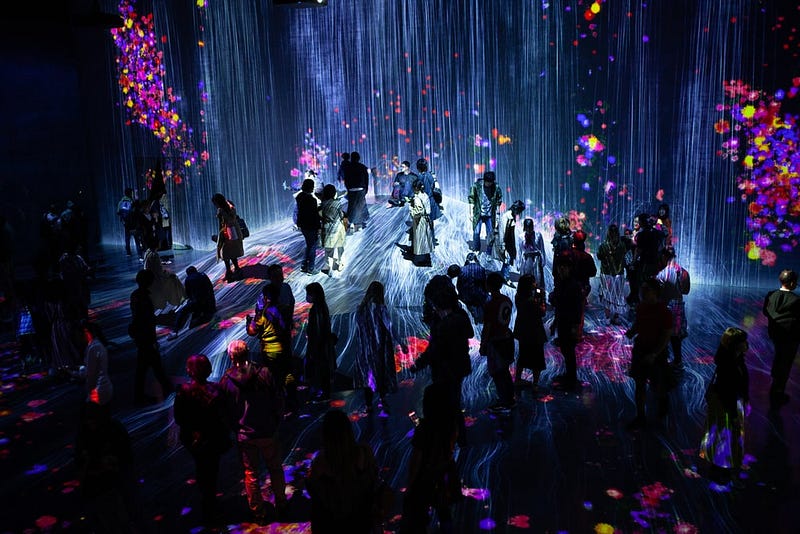
Our world is more connected than ever before. But far from ushering in a new age of enlightenment, we seem to be experiencing unprecedented levels of confusion. Image Credit: Karsten Gohm

If we don’t dive deeply into the rabbit hole of an idea or a feeling, we’ll never know what we might be missing. Exploring the depth of each feeling will lead us to a preconceived notion. We may be able to support our preconceived notions with evidence, but they will persist unsubstantiated without examination. Exploring the depth of each idea will lead us into an entirely new dimension of information. Hidden dimensions of information are always available, but we can’t access them if we remain at the surface level of ideas.

Given all that, I hope you can appreciate the importance of finding a valid source for each and every piece of information that comes your way. It may take some extra time up front, but you’ll almost certainly save yourself time in the end. The metaphor of media consumption is apt, because we are what we eat. Regard for the quality of our information is regard for the quality of our health. Seeking out the primary sources of the information we consume will help us correct our mistaken beliefs, discover new ideas, and make us all-round more informed. And, right now, the world desperately needs people to be more open and informed.

Sourcing
Research
Information
The Internet
Curiosity
Recommended from ReadMedium