
Political Correctness & Cultural Appropriation -Confused
I was reading an article by Barry Robinson (link below), and it had the unfortunate effect of making me think first thing in the morning. I am not sure that this is a good thing because we all know that too much thinking is bad for us. Smiling.
Political Correctness
We are all human beings, and we must learn to live with each other, care for each other, and protect each other.
But if we want to change the world, we must first change ourselves. That is the default position.
Cultural Appropriation
Some people talk about cultural appropriation, suggesting that we are doing something wrong if we adopt some of the cultural traditions of other people and try to make them our own.
It is natural that we will find much to admire and appreciate in other cultures. If this were not true, the divide between different peoples would be wide and unbridgeable.
When we talk of cultural appropriation, what exactly are we talking about?
Consider, for a moment, the Mediterranean diet.
It is widely accepted that the kinds of foods eaten in the Mediterranean area aid longevity and good health.
But because this diet comes from a different culture, does that mean that we have no right to adopt this kind of diet for ourselves?
There are so many different elements within each culture, so the question becomes, where should we draw the line between what is OK to do and what is culturally offensive?
I think the answer comes back to intent. If we are acting in the world to deliberately offend others, then that is obviously wrong, and offenders should rightly be castigated for their bad behavior.
It is not a simple matter of whether we accidentally hurt someone’s feelings or not.
It seems to me that there are three possibilities.
First, we deliberately act in the world to hurt others. That is unacceptable.
Second, we inadvertently do something that offends others. This is regrettable, but mistakes do happen, and it should be possible to apologize and move on.
Third, we simply act in the world to express our own natures and enjoy the same rights that everyone has to be in the world in a way that is true to ourselves.
Let’s use sombreros as an example. Now, sombreros may well be a cultural feature of one group of people, but they are also just another kind of hat.
If our aim is to protect ourselves from the sun or make a fashion statement saying I think I look cool in this hat, I cannot for the life of me see anything wrong with doing so.
As individuals, we have our own rights to do things that bring us happiness, and if we have no intention to harm others, then it is just an expression of our own rights.
I think that there are two different things here.
The first is that we have a right to express ourselves naturally in the world if we have no intention of offending others.
Secondly, there is how others think and feel. As hard as it may be, people are going to feel whatever it is they are going to feel, and that is outside of our control. We are not responsible in every situation for what someone else feels. If we can avoid offending people or making them think negatively, then we should do so, but we still have our own right to self-expression.
In my mind, everything comes back to intention, and if we foolishly make a huge issue of such things, everyone gets hurt, because everyone has a right to wear whatever hat they want to wear.
My own understanding is that thongs, a type of footwear, were invented in Australia. If we take cultural appropriation to its extremes, then does that mean no one else in the world has the right to wear thongs?
Of course, in both of these situations, there are other considerations. For example, I am sure that the inventor of thongs actually wanted to sell as many of them as he or she could to make as much money as he or she could, in the same way, that the manufacturers of sombreros want to sell as many of these hats as they can.
Perhaps then, we are not talking about things like this when we talk about cultural appropriation.
What about other kinds of traditions? That are, more centered on doing something customarily done on special occasions by a particular cultural group?
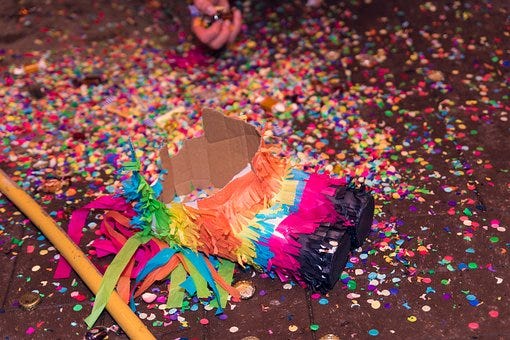
Consider hitting and breaking open a pinata. This custom, as I understand it, involves hanging a pinata during special celebrations such as birthdays during Las Posadas and then breaking it open with a stick.
It is great fun for children, and everyone enjoys it immensely.
But if someone in some other country thought, "Wow!" This is a wonderful way to make our children happy and celebrate their birthdays, would they really be doing something culturally wrong?
Again, to my mind, everything comes back to intent. What could possibly be wrong with kids enjoying themselves?
At the heart of this is not something special about culture, but rather how people think and believe. If someone chooses to think it is wrong, then it is wrong for that person, but does that really mean that everyone else should stop enjoying themselves so that one person won’t be offended?
The final point that I want to make is that in these kinds of incidences, it seems like there is only a small group of people involved in such cultural transgressions, which raises the concern that there is a tendency to blame society as a whole for what happens and not, as we should, the people concerned. Why does everyone need to carry the guild for what a few misguided people might do?
Our own Thinking Determines Everything
I want to talk about two examples from my own direct experience concerning how people’s own thinking and attitudes can determine if they are offended or not.
First, when I worked for the government some time ago, someone complained about one of the daily quotes on our day-by-day calendars.
Suddenly, this was a big thing, and it was being talked about nationally. The argument was that no one wanted anyone to be offended, and so in the future, we, as an organization, should only buy calendars without daily quotes.
However, when we think about the regrettable fact that someone was offended, does that really mean that the right of everyone else to read the daily quotes, amuse themselves, and break up the monotony of their day should be denied because one person became upset?
I think our employer said yes and acted to make sure this could not happen again. But to be honest, I cannot recall now one way or the other if this actually happened.
But the fact that it could have happened is what interests me most.
Does one individual, or a few, have the right to change everyone’s reality?
If so, it seems to me that the balance is very wrong.
The second example also happened at work. Most people know about the Gruen Factor. It is where, at supermarkets, they put small things like chocolates at the checkouts because they know, psychologically, that we are more inclined to buy chocolates or whatever as we pay our bills.
In a similar way, small chocolates at work were on sale and placed by the entry door to the floor I worked on. People would, following their own impulses, buy chocolates if and when they wanted. There was no pressure, other than the implicit psychological pressure of the Gruen Factor, as I mentioned above.
But what happened was that one woman complained because she could not control herself and wanted the chocolates moved out of sight because she was afraid of putting on weight.
The chocolates were moved, and this is a testament to the kindness and caring of people toward others. On one level, this was something easy to do, and no one had any serious objections, although some, like myself, looked at it quizzically because, in another sense, it seemed unnecessary. Because it was all about that individual's choices.
Conclusion
The larger question for me, although I always truly worry about other people’s feelings, is whether one person or a small group of people should determine what everyone else does.
It is good to worry about the sensibility of others, but at what point can this be taken too far?
My thinking may be wrong. There may be things that I have not thought about or considered. I may need to change my thinking and how I see this, and if you think so, I would appreciate your help and correction. We all need to think more clearly about all of this. So, I really would love to hear what you think.
But again, I have to ask myself why one person or a small group can determine what happens to everyone else. The heart of democracy is the will of the majority, combined with kind hearts and goodwill toward all others. At its simplest, it is up to us to control our own desires and feelings and not blame others for what happens to us. Our mental worlds are complex and difficult to understand, so there will always be people who will take offense at something that we do.
We cannot stop this, and although we may act to try to reduce it, that does not mean that it is our problem, as it is the problem of those who think negatively, and who want to tell us what we should think and do. Because it seems to me that often those who are upset are only thinking narrowly about themselves without thinking about the rights of others.
What strikes me as ironic in all of this is that someone or a group of people can be terribly upset about their rights being trampled on, but at the same time give no thought to the rights of others. Of course, life is not always that simple, and the complexity of our thinking and life experiences add richness to human existence, which is fundamentally important and critical for human social evolution.
Copyright ©️ 2023 Philip Temple. All Rights Reserved.
Finally, I would deeply appreciate any small contributions that you might be able to make to help me on my writing journey.