
Policing the Black Body: The Racist Roots of Modern Policing
The modern-day lynching of black bodies is still being carried out by the same racist system that has oppressed us since Jamestown, Virginia in 1619
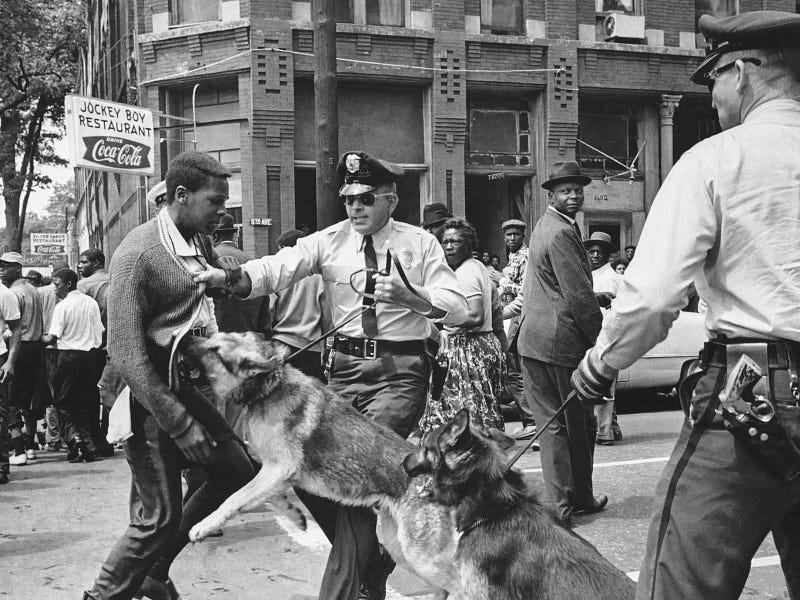
It began with slave patrols
The policing of black bodies in America has extremely disturbing historical roots that are steeped in racism, classism, and misogyny, and continuously targets people of African descent, especially those from the poorest of neighborhoods. It began with the slave patrols in the 1700s in South Carolina, which were the enforcement arms of the slave codes, the laws that regulated slave life.¹
The slave codes were the predecessors to the black codes
The slave codes then led to the black codes, which began after the Reconstruction era, and were “a legal way to put black citizens into indentured servitude, to take voting rights away, to control where they lived and how they traveled and to seize children for labor purposes.”² Both slave codes and black codes were deliberately designed to keep slaves, and former slaves, respectively, in an unremitting state of subjugation, whereby at a moment’s notice, a black person could be whipped, arrested, returned to slavery if they escaped, or even killed for being what a white person deemed as “insubordinate.”
Radley Balko, author of the book Rise of the Warrior Cop, describes how the biggest threat to public safety in the minds of white people was the possibility of slave revolts, therefore the primary responsibilities of the slave patrols were to guard against rebellions and to look for escaped slaves.³ Therefore, the enforcement of the slave codes was imperative. Author Chelsea Hansen, discusses this further. She explains this was because “the American South relied almost exclusively on slave labor and white Southerners lived in near constant fear of slave rebellions disrupting this economic status quo.”⁴
“Near Constant Fear”
This “near constant fear” stemmed not only from the fact that slave labor was the driving economic force of the South, but it was also the driving economic force of much of the North, and without it, the economic status of white people in this country would be disrupted. Not to mention that both the political status quo, and the racist hierarchical structure that maintained the fallacious social construct of white superiority over black bodies would be disrupted as well. Therefore, the control over black men, women, and children had to be maintained at all costs.
Once slavery ended, and Reconstruction began to give Black people political, economic, and social advances, a new form of racial control and racial terrorism was implemented in response. Slave patrols quickly morphed into police clubs, night riders, gun clubs, state militia, federal military, vigilante groups, and later the more violent patrollers who came to be known as the Ku Klux Klan (KKK), which often included returning Confederate soldiers who sometimes worked in collusion with the local authorities.⁵,⁶
“Vigilantes and the Klan would scare freedmen into political and social submission to Southern whites,”⁷ and with the nationwide release of the movie “The Birth of a Nation” in 1915, this not only bolstered interest in the KKK, it also reinforced the white imagination of black men as cannibalistic rapists who were a threat to all white women, causing another wave of racial violence in the form of lynching by the KKK.
Lynching
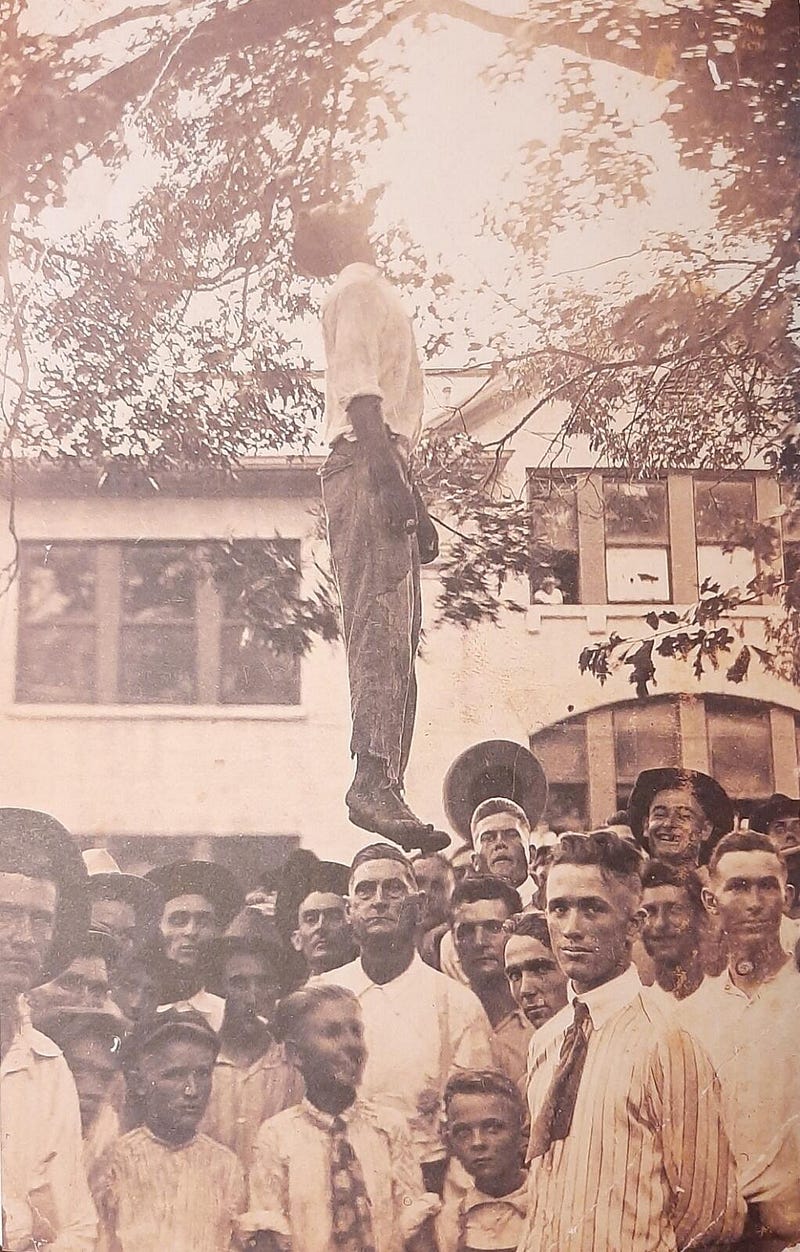
Lynching is that “southern horror” that hung black men, women, and children from nooses in trees, and it continues to carry the torturous pain of black suffering. The screams of anguish as black bodies were battered, necks were snapped, and genitals were mutilated, are juxtaposed with the looks of anticipation and joy as church announcements were made, white faces smiled, and photos were taken. This is who America was, and who America continues to be. The whip was just replaced by the noose, and the noose was replaced by the badge.
How long before the badge is replaced by right-wing extremist Trump supporters? Their violent siege on the nation’s capital was only the beginning.
Modern-day lynching
The modern-day lynching of black bodies is still being carried out by the same racist system that has oppressed us since Jamestown, Virginia in 1619. That system suffocates us with bags, shoots us in the back, kneels on our throats, kills us in our sleep, murders us while we eat ice cream, strangles us with its forearms, kills us in our grandmother’s yard, shoots us in the head, gun us down for holding wallets, murders our children for playing with toy guns, and then tells America that we deserved it.
All of this is carried out with impunity under the protection of the legal doctrine of qualified immunity and continues to be fueled by the divisive and racist rhetoric of racial terrorists, white nationalist groups, evangelical Christians, and our outgoing commander in chief, Donald Trump, who continuously refused to condemn white supremacy and racial terrorism.
Extra-legal force, unconscionable violence, and psychological intimidation have always been tactics perpetrated against the Black community and executed by those who uphold the interests of our imperialist, plutocratic nation, with its false ideology of white supremacy
As Sally Hadden so precisely puts it:
Whites who had once mistrusted their slaves but controlled them through physical intimidation now sought to control the freedmen in order to diminish their fears. Terror was the key. Aggression and insecurities emanating from emancipation were not the only psychological needs driving Southern whites after the war’s end. Freedom for slaves elevated the status of African Americans, but in the minds of Southern whites that freedom implicitly lowered the status of all whites in society. The mere fact of black freedom was psychologically damaging to the self-perceptions many whites held about themselves in the postwar era, and violence against freedmen (through the Klan or otherwise) was a means by which to repair, or at least mask, that damage.⁸
Hadden’s statement is true whether this state-sanctioned violence is executed through the slave patrols, the KKK, or our modern-day law enforcement system. Black lives are expendable to this country, even though this country was built on the backs of our ancestors. This is why we must continually proclaim that black lives matter, because the hatred, evil, and brutality that black people have endured for the past 401 years prove otherwise.
The brutality and injustice did not end with slavery
Unfortunately, slavery was only one part of the equation. The abolition of slavery simply brought on new forms of racial violence and injustice because our labor, our bodies, could no longer be exploited.
Because we demand to be treated as fully human instead of as someone’s property, or someone’s target for shooting practice, the subsequent systemic injustices have been just as ruthless, oftentimes more covert, and much more entangled, making them more difficult to dismantle.
However, until our humanity is fully realized in this country, until we see an end to violent and corrupt policing of black bodies that continuously results in cases of police brutality, false imprisonment, mass incarceration, and other forms of systemic racism and racial violence in law enforcement and the criminal justice system, black people will continue to fight for justice and continue to proclaim that our lives matter.
_________________________
¹Russell-Brown, Katheryn. “Making Implicit Bias Explicit: Black Men and the Police.” In Policing the Black Man: Arrest, Prosecution, and Imprisonment, edited by Angela J. Davis, 135–160. New York, New York: Pantheon Books, 2017.
²History.com Editors. “Black Codes.” History.com Website. Accessed December 29, 2020. Black Codes — Definition, Dates & Jim Crow Laws — HISTORY.
³Balko, Radley. Rise of the Warrior Cop: The Militarization of America’s Police Forces. New York, New York: Public Affairs, 2014.
⁴Hansen, Chelsea. “Slave Patrols: An Early Form of American Policing.” Law Enforcement Museum. Accessed September 6, 2020. https://lawenforcementmuseum.org/2019/07/10/slave-patrols-an-early-form-of-american-policing/.
⁵Ibid. Russell-Brown, Katheryn.
⁶Hadden, Sally. Slave Patrols: Law and Violence in Virginia and the Carolinas. Cambridge, Massachusetts: Harvard University Press, 2001.
⁷Ibid.
⁸Ibid.
Written by L.A. Justice. Copyright 2021. All rights reserved.
To read more from L.A. Justice, visit her Medium page