avatarBjörn Jóhann

Free AI web copilot to create summaries, insights and extended knowledge, download it at here

9561

Abstract

nline.com/doi/abs/10.1080/00224540309598458">protestors</a>, and even <a href="https://psycnet.apa.org/search/display?id=a699c0b0-065b-48c8-ae14-c36ccfcaaeb5&amp;recordId=2&amp;tab=PA&amp;page=1&amp;display=25&amp;sort=PublicationYearMSSort%20desc,AuthorSort%20asc&amp;sr=1">children</a>. <a href="https://www.ingentaconnect.com/content/sbp/sbp/1999/00000027/00000006/art00005">Anonymity</a> has even been shown to increase the desire to <i>murder</i> a member of an outgroup.</p><p id="044a">The nature of a police uniform <a href="https://psycnet.apa.org/record/1974-20822-001">also increases</a> the likelihood of outgroup bias. Think about it this way, when a cop looks around them and sees twenty people visibly dressed as cops and thirty people who aren’t, they instantly mentally differentiate those fifty people into two camps: Us and Them.</p><p id="c740">Common traits trained in new police officers — like conformity and <a href="https://psycnet.apa.org/record/1974-20822-001">cohesion</a>— have been linked to a strong in-group bias. Cops are <a href="https://www.policeone.com/police-products/less-lethal/articles/5-steps-of-riot-prep-how-to-do-crowd-control-correctly-y1ZCeeGGOfjnGaXN/">trained</a> to act as a unit, making it more likely that they prejudice an outgroup, especially in chaotic situations like a protest.</p><p id="fb52">When one cop acts violently, training and tactics will influence other cops to react violently as well. The “bad apples” can spoil an entire barrel when police act as a unit, not as individuals.</p><figure id="6a2e"><img src="https://cdn-images-1.readmedium.com/v2/resize:fit:800/0*MASAKn5Xuhq2aiHL.jpg"><figcaption>Violence in Atlanta | <a href="https://abcnews.go.com/US/tough-place-now-us-police-face-scrutiny-violence/story?id=70994492">Elijah Nouvelage</a></figcaption></figure><p id="087b">Police crowd-control tactics are dangerously misguided, based on antiquated ideas about crowd psychology.</p><p id="c82d">During the mid-twentieth century, when many police procedural methods were generated, <a href="https://scholarship.law.slu.edu/cgi/viewcontent.cgi?article=1028&amp;context=plr">criminal psychologists</a> believed that crowds behaved with no individuation. Therefore, cops needed to treat protests as a single unit. Nothing more than an angry amoeba.</p><blockquote id="db23"><p>When police strategies and tactics are based on inaccurate assumptions about how crowds function, these approaches can stimulate more conflict than they prevent, endangering both crowds and the police. — <a href="https://scholarship.law.slu.edu/cgi/viewcontent.cgi?article=1028&amp;context=plr">Edward R. Maguire</a></p></blockquote><p id="439b">Modern psychology has a much more updated model: elaborated social identity model. <a href="https://www.tandfonline.com/doi/abs/10.1080/17430437.2017.1232352?journalCode=fcss20">ESIM</a> is complicated, but it essentially acknowledges that crowds behave in nuanced ways, subject to contextual shifts.</p><p id="614e">Police, or at least, police procedure, are completely unaware of updated views on crowd psychology. Cops are unable, or unwilling, to see individuals within a protest. They treat protests as a single glob of violence. As a single outgroup. They only see “Us” and “Them”.</p><p id="7f51">No wonder violence is occurring.</p><h1 id="19b9">Cops want to be anonymous</h1><p id="3eea">Across America, cops are using the chaos as a smoke-shield to hide their badges and identifying materials. They’re desperate to increase their own perceived anonymity.</p><p id="2aba"><a href="https://twitter.com/jcourtsull/status/1267188206505725953">A cop in New York</a>, wearing a face mask, blocked out his badge number before forcefully removing a non-violent protestor and pepper-spraying his mouth.</p><p id="8ded"><a href="https://time.com/5846329/louisville-police-chief-fatal-shooting-body-cameras-protests/">A cop in Lousiville</a> turned off his bodycam before fatally shooting a barbecue owner. Bodycams, a form of police accountability, have thankfully multiplied in the last few years.</p><p id="60c4">But more than anything, cops have been attacking journalists — the antithesis of anonymity — faster than journalists can cover the carnage. They arrested a <a href="https://www.cnn.com/2020/05/29/media/reporters-arrest-minneapolis-first-amendment/index.html">CNN reporter</a> for seemingly no reason. They blinded a photojournalist named <a href="https://www.insider.com/why-rubber-bullets-dangerous-what-to-do-if-hit-2020-6">Linda Tirando</a>.</p><p id="c310">“We’re media!” an <a href="https://www.riverbender.com/sports-news/details.cfm?id=305649">MSNBC reporter</a> shouted at the cops in Minneapolis.</p><p id="a24f">“We don’t care!” retorted the police, accompanying their remarks with a barrage of rubber bullets.</p><p id="dd60">When shit hits the fan, cops hit the media.</p><figure id="a77d"><img src="https://cdn-images-1.readmedium.com/v2/resize:fit:800/0*si-DIOGDAGFL2ocd"><figcaption>A CNN reporter is arrested without just cause</figcaption></figure><p id="34f8">While this is no doubt been fomented by <a href="https://www.washingtonpost.com/lifestyle/media/a-history-of-the-trump-war-on-media--the-obsession-not-even-coronavirus-could-stop/2020/03/28/71bb21d0-f433-11e9-8cf0-4cc99f74d127_story.html">incendiary tweets</a> from President Trump, police violence against journalists during protest events has a long and storied history.</p><p id="1e40">The 1968 Task Force on Violent Aspects of Protest and Confrontation concluded that “Newsmen and photographers [in the 1969 DNC convention] were singled out for assault and their equipment deliberately damaged”. Cops react instinctively to being filmed.</p><p id="4e12">Cops don’t want to be scrutinized.</p><div id="10a1" class="link-block"> <a href="https://readmedium.com/trumps-war-on-the-first-amendment-has-drawn-first-blood-a5eef2bab043"> <div> <div> <h2>Trump’s War on the First Amendment Has Drawn First Blood</h2> <div><h3>If we lose Freedom of Speech and Press, what else does America have?</h3></div> <div><p>medium.com</p></div> </div> <div> <div style="background-image: url(https://miro.readmedium.com/v2/resize:fit:320/0*-zGZeiPRB3jb1CxC)"></div> </div> </div> </a> </div><h1 id="32ce">Police don’t want to be accountable</h1><p id="32f4">That unjust list of dead Black Americans is accompanied by an equally unjust list of cops who still roam free. Police officers are rarely held accountable for their crimes — from killing Black people to illegally suppressing the First Amendment.</p><p id="4e39">There is an unfortunate legal reason for this: <b>qualified immunity</b>.</p><p id="c583">Qualified Immunity, sometimes called <a href="https://www.law.cornell.edu/uscode/text/42/1983">Section 1983</a>, asserts that police officers cannot face legal litigation from a civilian. Basically, you can’t sue a cop. In extremely rare circumstances, if the <b><i>exact same situation</i></b> has already occurred in which the cop was found liable, you may have a case.</p><p id="ec15">But I mean exact same. In <a href="https://www.usatoday.com/story/opinion/2020/05/30/police-george-floyd-qualified-immunity-supreme-court-column/5283349002/">one case</a>, a cop unlawfully sicced a dog on a civilian. The civilian sued, citing a previous situation in which a K9 unit attacked a person. The case was thrown out — all because the civilian was <i>sitting</i> down, not <i>lying</i> down as in the previous case.</p><p id="a415">Does that sound like the law is being upheld?</p><p id="833a">This barbaric legal loophole protects police officers from all sorts of crimes — <a href="https://protect-us.mimecast.com/s/GI3uCL91K8fPozgKQIPpbao?domain=cdn.ca9.uscourts.gov">theft</a>, <a href="https://www.techdirt.com/articles/20190711/15223942573/appeals-court-says-no-rights-were-violated-when-cop-shot-non-threatening-dog-hit-kid-instead.shtml">shooting unarmed children</a>, <a href="http://www.ca5.uscourts.gov/opinions/pub/17/17-50518-CV1.pdf">abuse of a search warrant</a> — whether or not the crime was intentional.</p><figure id="ed15"><img src="https://cdn-images-1.readmedium.com/v2/resize:fit:800/0*FmWxX4u23gobc7Av"><figcaption><a href="https://www.cnbc.com/2020/06/01/george-floyd-death-police-violence-in-the-us-in-4-charts.html">cnbc.com</a></figcaption></figure><p id="dc9f"><b>Police unions</b> are another problem. The officer responsible for George Floyd’s murder was far from a first-time offender. In fact, he had <a href="https://reason.com/2020/05/30/police-unions-and-the-problem-of-police-misconduct/">17 complaints</a> and had killed before. <a href="https://www.reuters.com/investigates/special-report/usa-police-unions/">Police unions</a> are incredibly powerful organizations that regularly obscure official investigations, keep complaints vague, and prevent the discipline of rogue officers.</p><p id="c720">The phrase “<a href="https://naeye.net/13558/opinion/acab-explained-part-one/">ACAB</a> — All Cops Are Bastards” refers to the extralegal protections that police offers enjoy: from union contracts to qualified immunity. “Bad Apples” act like they’re above the law….because…well, they kinda are above the law.</p><p id="158c">Cops know about these loopholes. <a href="https://www.policeone.com/legal/articles/protecting-cops-from-frivolous-lawsuits-qualified-immunity-explaine

Options

d-SI2nJjd42TkeLI6v/#:~:text=This%20statement%20makes%20clear%20that,short%20of%20the%20constitutional%20standard.">PoliceOne</a> — the most popular online cop blog and news source — argues that qualified immunity protects cops from “frivolous” lawsuits. It’s necessary, it argues, to ensure that cops aren’t weighed down by legal battles after life-or-death decisions.</p><p id="4d28">What “frivolous complaints” does the article suggest are weighing down cops? Three counts of civilian death.</p><p id="81c9">Police officers cannot easily be charged with a crime — it’s nearly impossible. It does not need to be said that <a href="https://www.researchgate.net/publication/7504010_The_Effects_of_Reward_and_Punishment_in_Violent_Video_Games_on_Aggressive_Affect_Cognition_and_Behavior">an absence of punishment</a> psychologically increases the likelihood of violent and illegal activity. If cops know they won’t be charged with a crime, they’re more likely to commit an unjust act.</p><p id="a081">Of course, they are “good” cops out there — ones who want nothing more than to serve and protect their fellow humankind. That’s not the problem. The problem is that systemic injustice allows for bad cops to continue to besmirch the name of the entire industry.</p><h1 id="5ee1">But what about the protestors?</h1><p id="e1ef"><i>Cops are just responding to the criminals!</i></p><p id="316f"><i>Police Officers are protecting themselves from violent looters!!</i></p><p id="009e">We’ve all seen these sentiments — whether on the evenings news or in social media posts. Perhaps you think it yourself. But there is an unequivocal truth that bears repeating: cops and protestors are <i>not </i>the same. They are two groups. They have two standards.</p><p id="b088">One group has protest signs, social media hashtags, and chants. The other has batons and shields. One side throws rocks. The other throws grenades. When one side fights back, there will be bruises. When the other side fights back, there will be funerals.</p><blockquote id="65be"><p>“We are the protectors.” — <a href="https://www.policeone.com/community-policing/articles/remembering-why-we-became-police-officers-to-serve-protect-2kePEU2LXbw1XcWL/">PoliceOne</a></p></blockquote><p id="2ac1">Police officers are officers in the supposed public good. In an ideal society, they need to be an epitome of trust, stability, and virtue. They need to shield the innocent from harm that may befall them and protect us all from the perils of violence. That is their duty.</p><p id="023b">Heavy is the head that wears the helmet.</p><p id="13e6">In what world does the use of chemical warfare on a <a href="https://www.nytimes.com/2020/06/01/us/politics/trump-st-johns-church-bible.html">peaceful group of protestors</a>, all in the name of a presidential photo-op, serve the public? In what world is this just?</p><h1 id="e330">This mob mentality hurts police officers too</h1><p id="2bb8">It’s an old adage that violence begets violence, but in a crowd control setting, it’s completely true. And it can hurt police officers.</p><p id="049b">When police use aggressive tactics against protestors, the protestors are more likely to attack the police. Riot gear and military formations seem like common-sense safeguards, but they’re actually harmful to the cops’ own welfare.</p><p id="a9c6">This is because a cop is protected by a public perception of state legitimacy; state-inflicted violence violates this legitimacy and therefore, this protection.</p><p id="1d0c"><a href="https://scholarship.law.slu.edu/cgi/viewcontent.cgi?article=1028&amp;context=plr">Research</a> from the Ferguson protests of 2014 indicates that an increase in police militarization increases the violence of protestors. According to <a href="https://scholarship.law.slu.edu/cgi/viewcontent.cgi?article=1028&amp;context=plr">Edward Maguire</a>, during the Ferguson crack-down “the St. Louis County Police and other area police agencies came under intense criticism for their use of aggressive, militaristic tactics to control the protests.” The subsequent violence could have been prevented…if the police avoided a heavy-handed approach.</p><figure id="7d85"><img src="https://cdn-images-1.readmedium.com/v2/resize:fit:800/0*6wDkQ5CQkeJBTcHl"><figcaption>Protestors in Ferguson, 2014 | photo by <a href="https://www.stltoday.com/news/local/crime-and-courts/protesters-march-on-street-at-police-headquarters-in-ferguson/article_7a04468c-30f1-5d4b-928b-cbb933dc4a9f.html">Robert Cohen</a></figcaption></figure><p id="e838">The mob mentality of police officers escalates peace into violence. It can cause cops to fall in the line of duty.</p><h1 id="3007">What can be done?</h1><p id="ecc7">There is no easy or simple answer. It will require years of structural change, at minimum, and a reduction of generalized racist sentiment in America. But it is possible.</p><p id="f80d">Cops need to know that <b>their actions are being monitored</b>. Bodycams, free press, and cellphone footage are all great steps. Riot gear needs to be toned down as cops cannot easily fall into a mob mentality when they suit up.</p><p id="d79f">Cops need to know that <b>their actions have consequences</b>. Qualified Immunity needs to abolished immediately. It is unlawful and un-American. Police unions need to be de-powered to prevent “bad apples” from serving.</p><p id="c030">Cops need to know that <b>their duty is to serve</b>. Police tactics need to be updated to reflect a more modern understanding of crowd psychology. Cops need to have “softer” police riot gear, to tone down deindividuation and instead, promote a sense of guardianship among a crowd.</p><p id="6e1a">These changes are possible. After a 2009 civilian death at the hands of an English constable, <a href="https://scholarship.law.slu.edu/cgi/viewcontent.cgi?article=1028&amp;context=plr">British policy</a> updated its crowd control policies to reflect a more layered approach to crowd dynamics. Subsequently, infractions by police officers during protests have decreased.</p><p id="61e5">Even in America, there are glimmers of a more peaceful approach: something known as the “<a href="https://www.themarshallproject.org/2020/06/01/why-so-many-police-are-handling-the-protests-wrong">Madison Model</a>”, which favors communicating, listening, and empathizing.</p><p id="599b">And this method has been used. Police chiefs in <a href="https://www.toledoblade.com/local/city/2020/06/01/Protesters-gather-in-South-Toledo/stories/20200601101">Toledo</a> and <a href="https://denver.cbslocal.com/2020/06/02/paul-pazen-denver-police-chief-marches-peaceful-protesters/">Denver</a> took off their riot gear and joined the peaceful protestors. They marched, arm-in-arm, as brothers.</p><figure id="6415"><img src="https://cdn-images-1.readmedium.com/v2/resize:fit:800/0*Gd02oCsBNFrSBRkv"><figcaption>A cop from Camden, New Jersey joins the protestors | <a href="https://people.com/crime/police-join-protesters-marches-across-country/">People.com</a></figcaption></figure><p id="1fef">But these are isolated incidents, outweighed by the overwhelming national brutality. In order to stop the mob-like behavior of cops, we need the systematic change outlined above.</p><p id="0f24">Michigan Congressman Justin Amash recently submitted <a href="https://www.nytimes.com/reuters/2020/06/01/us/politics/01reuters-minneapolis-police-congress.html">a bill</a> that aims to abolish qualified immunity. The “Ending Qualified Immunity Act” is unlikely to be passed by President Trump because….well…<a href="https://www.nytimes.com/2020/05/31/opinion/trump-police-george-floyd.html">you know why</a>.</p><p id="fc7c">In the November elections, it is imperative that we vote out the <a href="https://www.cnn.com/2020/06/02/politics/what-matters-june-1/index.html">authoritarian government</a> that America is spinning towards. A police-state is the antithesis of what the Founding Fathers’ vision. Systemic change needs to occur not just at the federal level, but at the state and local levels too.</p><p id="8ad1">It’s not enough to punish egregious cops here and there. Every single police officer in America needs to know that their actions are being seen. That their actions, if out of line, have consequences.</p><p id="9273">Until the police go back to protecting civilians, there will never be peace.</p><div id="10bf" class="link-block"> <a href="https://medium.com/an-injustice"> <div> <div> <h2>An Injustice!</h2> <div><h3>A new intersectional publication, geared towards voices, values, and identities!</h3></div> <div><p>medium.com</p></div> </div> <div> <div style="background-image: url(https://miro.readmedium.com/v2/resize:fit:320/1*dvs4qJgQaFLgqlGOuphNbA.png)"></div> </div> </div> </a> </div><div id="8c49" class="link-block"> <a href="https://readmedium.com/good-apple-cops-are-a-myth-ffb2f933b6d8"> <div> <div> <h2>There Are No “Good Apples” In The Police Force</h2> <div><h3>Problems with police brutality are systemic, not localized.</h3></div> <div><p>medium.com</p></div> </div> <div> <div style="background-image: url(https://miro.readmedium.com/v2/resize:fit:320/0*DbtjNjeQ3Imb0tl6)"></div> </div> </div> </a> </div></article></body>

Police Have a Mob Mentality Problem

It’s now more apparent than ever that cops are rioters — not peacekeepers.
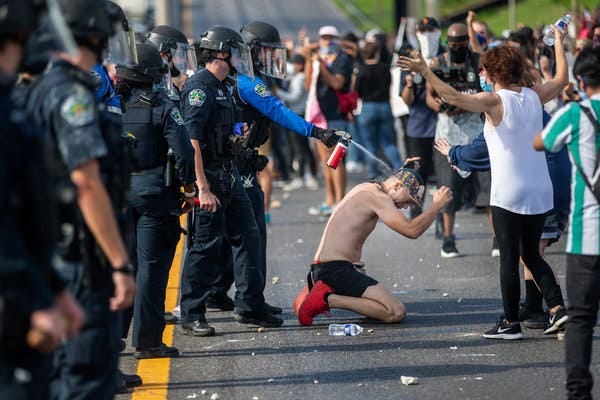
Photo from New York Times

Right now, all across America, violent mobs are taking to the streets.

They’re carrying weapons. They’re concealing their identities. They’re acting as if they’re above the law.

In virtually every city in America, these mobs are marking their territory, trying to make it clear that they’re not backing down. Wherever they march, pain, suffering, and outrage follow.

I’m speaking, of course, about the police.

American police officers are engaging in the very same ‘mob-like’ behavior that they claim to be suppressing.

America is hurting.

Racial tensions erupted last week after a cop murdered George Floyd by kneeling on his neck until he asphyxiated. Floyd was Black. His attacker was Caucasian. It’s the latest in a dire list of Black lives taken by police, a list that grows longer every week. Even though their names are immortalized in hashtags and protest signs, their deaths have carried little legal weight. Their killers walk free.

So, with all the irony of a Shakespearean tragedy, the cops responded to complaints of police violence…by enacting police violence.

“No one was looting anything in the first night of this protest, no one was lighting anything on fire on the first night of this protest, and yet the response from the police was incredibly brutal. The original provocation to street violence was from our officers.” — Minnesota City Councilman Jeremiah Ellison

In Brooklyn, two police vehicles plowed into a crowd of protestors. In Minneapolis, security forces shot paint canisters at people (many of whom were not protestors) while they were on their own property. In Lousiville, police destroyed medical supplies for wounded protestors.

Police are rioting in Minneapolis, in Atlanta, in San Antonio, in New York.

Cops — the same cops who claim to protect and serve — have pepper-sprayed lawmakers, attacked congresswomen, and gassed journalists.

They’ve violated children.

Their violence is spreading through nearly every large city in America and making waves online. The majority of their victims were protesting peacefully under the First Amendment.
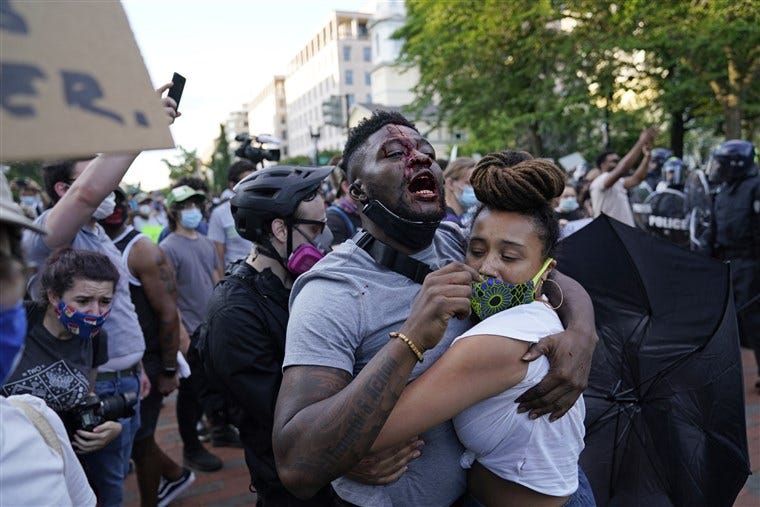
nbc.com

But their pepper spray has only made us open our eyes. We can now see what we’ve always inherently known: the malignant and insidious violence within the American police force.

This mob-like police violence is a systemic problem that disproportionally affects Black Americans. By examining the psychology and sociological underpinnings of the modern police force, we can see exactly how and why the police are rioting.

What are the police doing?

Police officers are responding to crowds of protestors across the country with pre-empted violence. They show up with riot gear, before curfew, to enforce the law. And yes, some of the protestors are committing arson or theft. But most are not. Most are peaceful.

But the police don’t seem to care.
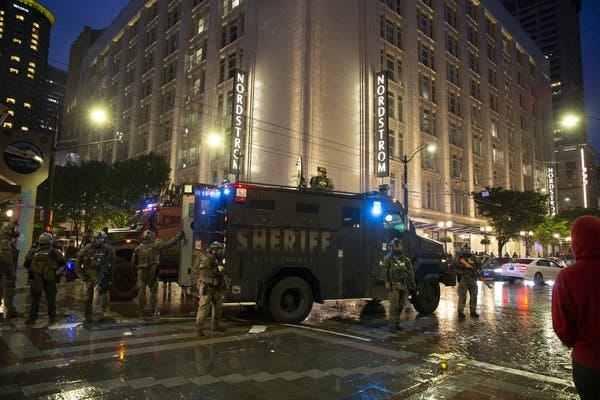
Counterprotestors in Seattle | Karen Ducey

These police aggression tactics fall under something called the ‘Miami Method’ of crowd control. It is an antagonistic method characterized by “the creation of no protest zones, heavy use of less-lethal weaponry, surveillance of protest organizations. . . preemptive arrests, and preventive detentions.” It always involves full riot gear, even when protestors are peaceful and unarmed.

Police are going into these situations without proper training. According to professor Allison Chappell, only 3% of police training is about cognitive or ethical decision-making. 90%, by comparison, is spent on operational tasks, like handling weapons and filing procedural paperwork.

Armed with bad tactics, not properly trained, these lines of cops are deteriorating into mobs of aggressors.

“Their stated goal is to keep the peace. But it’s become abundantly clear that many are far from neutral — instead, they are treating protesters like the enemy, lashing out violently, using disproportionate force, and attacking people who pose no threat to them.” — Anna North and Catherine Kim

As of now, police officers have been using primarily non-lethal weapons such as rubber bullets, tear gas, and batons.

But — as many protestors on the front lines can attest — ‘non-lethal’ is not a synonym for ‘harmless’. Rubber bullets can break bones and cause internal bleeding. Tear gas can burn your skin, sometimes for years afterward. Bones have been broken. Blood has been shed.

I shudder to think what will happen when a cop forgoes his baton for a handgun. If, as Trump promises, the military is deployed, all bets of “non-lethal” methods may be off.

The psychology behind a cop mob

“Masks make men cruel.” — Watchmen

The current tactics of crowd control renders cops deindividuated, anonymous, and complicit. They react instinctively and violently. When one cop becomes violent, it can lead other cops into doing so as well. They have the same mob mentality of the very people they claim to be protecting.

Look at a photo of riot gear. Really look at it. Can you see the police officer’s face? Can you determine their body type? Hair color? Can you the humanity of the officer beneath the black suit?
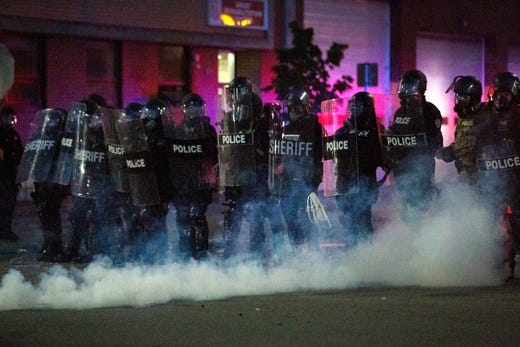
Image from desmoinesregister.com

In modern-day riot gear, a police officer’s entire body is obscured, leaving only portions of the face visible behind a clear face shield. During the COVID-19 crisis, many police officers are wearing face masks as well. In the immortal words of Adrien Veidt from Watchmen, “Masks make men cruel.”

When controlling a crowd, police officers are essentially interchangeable, stripped of identifying characteristics. They feel anonymous.

And psychological research shows that perceived anonymity increases violent actions. The anonymity-aggression link has been demonstrated with drivers, protestors, and even children. Anonymity has even been shown to increase the desire to murder a member of an outgroup.

The nature of a police uniform also increases the likelihood of outgroup bias. Think about it this way, when a cop looks around them and sees twenty people visibly dressed as cops and thirty people who aren’t, they instantly mentally differentiate those fifty people into two camps: Us and Them.

Common traits trained in new police officers — like conformity and cohesion— have been linked to a strong in-group bias. Cops are trained to act as a unit, making it more likely that they prejudice an outgroup, especially in chaotic situations like a protest.

When one cop acts violently, training and tactics will influence other cops to react violently as well. The “bad apples” can spoil an entire barrel when police act as a unit, not as individuals.
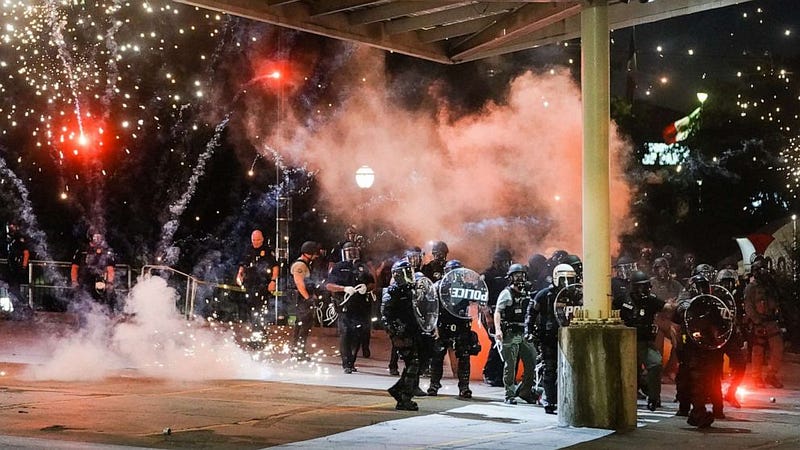
Violence in Atlanta | Elijah Nouvelage

Police crowd-control tactics are dangerously misguided, based on antiquated ideas about crowd psychology.

During the mid-twentieth century, when many police procedural methods were generated, criminal psychologists believed that crowds behaved with no individuation. Therefore, cops needed to treat protests as a single unit. Nothing more than an angry amoeba.

When police strategies and tactics are based on inaccurate assumptions about how crowds function, these approaches can stimulate more conflict than they prevent, endangering both crowds and the police. — Edward R. Maguire

Modern psychology has a much more updated model: elaborated social identity model. ESIM is complicated, but it essentially acknowledges that crowds behave in nuanced ways, subject to contextual shifts.

Police, or at least, police procedure, are completely unaware of updated views on crowd psychology. Cops are unable, or unwilling, to see individuals within a protest. They treat protests as a single glob of violence. As a single outgroup. They only see “Us” and “Them”.

No wonder violence is occurring.

Cops want to be anonymous

Across America, cops are using the chaos as a smoke-shield to hide their badges and identifying materials. They’re desperate to increase their own perceived anonymity.

A cop in New York, wearing a face mask, blocked out his badge number before forcefully removing a non-violent protestor and pepper-spraying his mouth.

A cop in Lousiville turned off his bodycam before fatally shooting a barbecue owner. Bodycams, a form of police accountability, have thankfully multiplied in the last few years.

But more than anything, cops have been attacking journalists — the antithesis of anonymity — faster than journalists can cover the carnage. They arrested a CNN reporter for seemingly no reason. They blinded a photojournalist named Linda Tirando.

“We’re media!” an MSNBC reporter shouted at the cops in Minneapolis.

“We don’t care!” retorted the police, accompanying their remarks with a barrage of rubber bullets.

When shit hits the fan, cops hit the media.
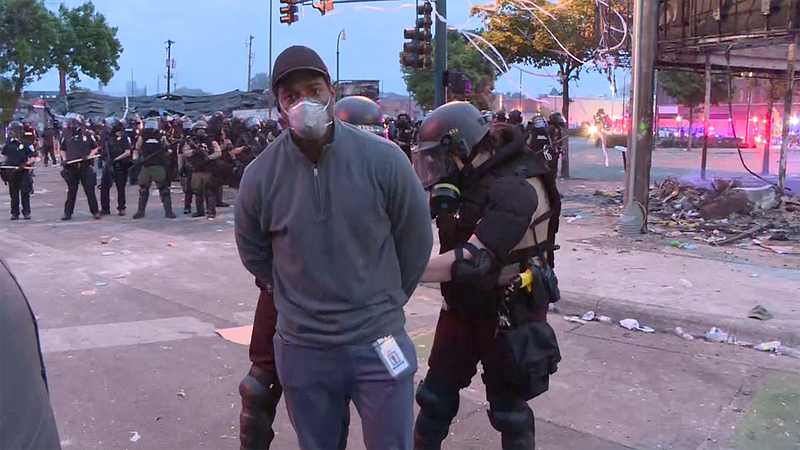
A CNN reporter is arrested without just cause

While this is no doubt been fomented by incendiary tweets from President Trump, police violence against journalists during protest events has a long and storied history.

The 1968 Task Force on Violent Aspects of Protest and Confrontation concluded that “Newsmen and photographers [in the 1969 DNC convention] were singled out for assault and their equipment deliberately damaged”. Cops react instinctively to being filmed.

Cops don’t want to be scrutinized.

Police don’t want to be accountable

That unjust list of dead Black Americans is accompanied by an equally unjust list of cops who still roam free. Police officers are rarely held accountable for their crimes — from killing Black people to illegally suppressing the First Amendment.

There is an unfortunate legal reason for this: qualified immunity.

Qualified Immunity, sometimes called Section 1983, asserts that police officers cannot face legal litigation from a civilian. Basically, you can’t sue a cop. In extremely rare circumstances, if the exact same situation has already occurred in which the cop was found liable, you may have a case.

But I mean exact same. In one case, a cop unlawfully sicced a dog on a civilian. The civilian sued, citing a previous situation in which a K9 unit attacked a person. The case was thrown out — all because the civilian was sitting down, not lying down as in the previous case.

Does that sound like the law is being upheld?

This barbaric legal loophole protects police officers from all sorts of crimes — theft, shooting unarmed children, abuse of a search warrant — whether or not the crime was intentional.
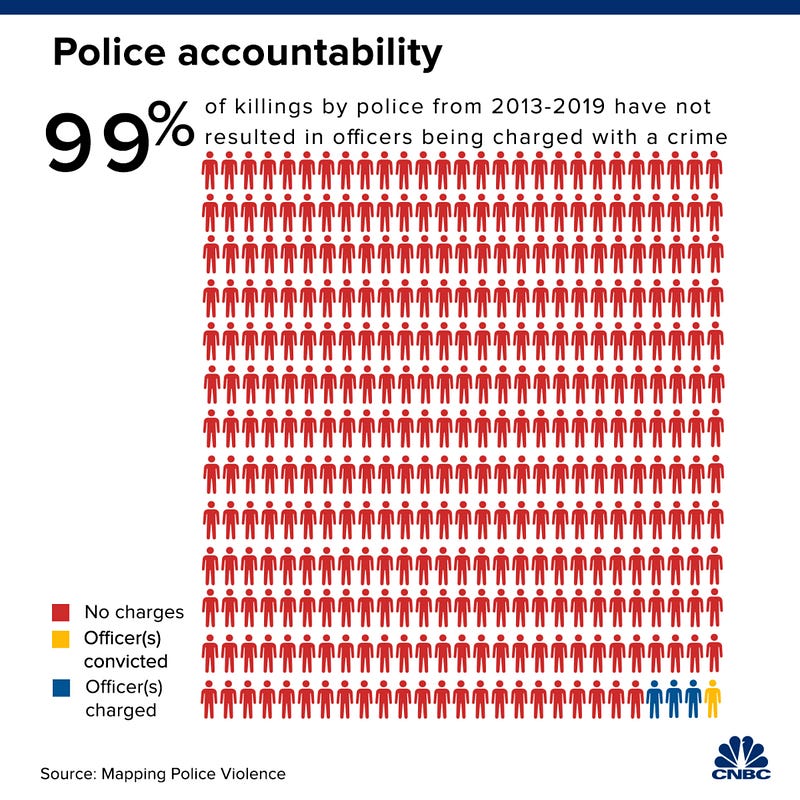
cnbc.com

Police unions are another problem. The officer responsible for George Floyd’s murder was far from a first-time offender. In fact, he had 17 complaints and had killed before. Police unions are incredibly powerful organizations that regularly obscure official investigations, keep complaints vague, and prevent the discipline of rogue officers.

The phrase “ACAB — All Cops Are Bastards” refers to the extralegal protections that police offers enjoy: from union contracts to qualified immunity. “Bad Apples” act like they’re above the law….because…well, they kinda are above the law.

Cops know about these loopholes. PoliceOne — the most popular online cop blog and news source — argues that qualified immunity protects cops from “frivolous” lawsuits. It’s necessary, it argues, to ensure that cops aren’t weighed down by legal battles after life-or-death decisions.

What “frivolous complaints” does the article suggest are weighing down cops? Three counts of civilian death.

Police officers cannot easily be charged with a crime — it’s nearly impossible. It does not need to be said that an absence of punishment psychologically increases the likelihood of violent and illegal activity. If cops know they won’t be charged with a crime, they’re more likely to commit an unjust act.

Of course, they are “good” cops out there — ones who want nothing more than to serve and protect their fellow humankind. That’s not the problem. The problem is that systemic injustice allows for bad cops to continue to besmirch the name of the entire industry.

But what about the protestors?

Cops are just responding to the criminals!

Police Officers are protecting themselves from violent looters!!

We’ve all seen these sentiments — whether on the evenings news or in social media posts. Perhaps you think it yourself. But there is an unequivocal truth that bears repeating: cops and protestors are not the same. They are two groups. They have two standards.

One group has protest signs, social media hashtags, and chants. The other has batons and shields. One side throws rocks. The other throws grenades. When one side fights back, there will be bruises. When the other side fights back, there will be funerals.

“We are the protectors.” — PoliceOne

Police officers are officers in the supposed public good. In an ideal society, they need to be an epitome of trust, stability, and virtue. They need to shield the innocent from harm that may befall them and protect us all from the perils of violence. That is their duty.

Heavy is the head that wears the helmet.

In what world does the use of chemical warfare on a peaceful group of protestors, all in the name of a presidential photo-op, serve the public? In what world is this just?

This mob mentality hurts police officers too

It’s an old adage that violence begets violence, but in a crowd control setting, it’s completely true. And it can hurt police officers.

When police use aggressive tactics against protestors, the protestors are more likely to attack the police. Riot gear and military formations seem like common-sense safeguards, but they’re actually harmful to the cops’ own welfare.

This is because a cop is protected by a public perception of state legitimacy; state-inflicted violence violates this legitimacy and therefore, this protection.

Research from the Ferguson protests of 2014 indicates that an increase in police militarization increases the violence of protestors. According to Edward Maguire, during the Ferguson crack-down “the St. Louis County Police and other area police agencies came under intense criticism for their use of aggressive, militaristic tactics to control the protests.” The subsequent violence could have been prevented…if the police avoided a heavy-handed approach.
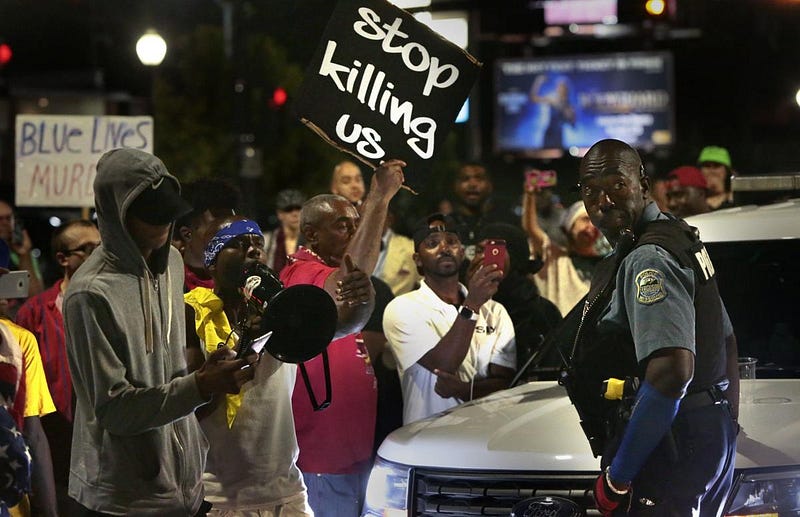
Protestors in Ferguson, 2014 | photo by Robert Cohen

The mob mentality of police officers escalates peace into violence. It can cause cops to fall in the line of duty.

What can be done?

There is no easy or simple answer. It will require years of structural change, at minimum, and a reduction of generalized racist sentiment in America. But it is possible.

Cops need to know that their actions are being monitored. Bodycams, free press, and cellphone footage are all great steps. Riot gear needs to be toned down as cops cannot easily fall into a mob mentality when they suit up.

Cops need to know that their actions have consequences. Qualified Immunity needs to abolished immediately. It is unlawful and un-American. Police unions need to be de-powered to prevent “bad apples” from serving.

Cops need to know that their duty is to serve. Police tactics need to be updated to reflect a more modern understanding of crowd psychology. Cops need to have “softer” police riot gear, to tone down deindividuation and instead, promote a sense of guardianship among a crowd.

These changes are possible. After a 2009 civilian death at the hands of an English constable, British policy updated its crowd control policies to reflect a more layered approach to crowd dynamics. Subsequently, infractions by police officers during protests have decreased.

Even in America, there are glimmers of a more peaceful approach: something known as the “Madison Model”, which favors communicating, listening, and empathizing.

And this method has been used. Police chiefs in Toledo and Denver took off their riot gear and joined the peaceful protestors. They marched, arm-in-arm, as brothers.
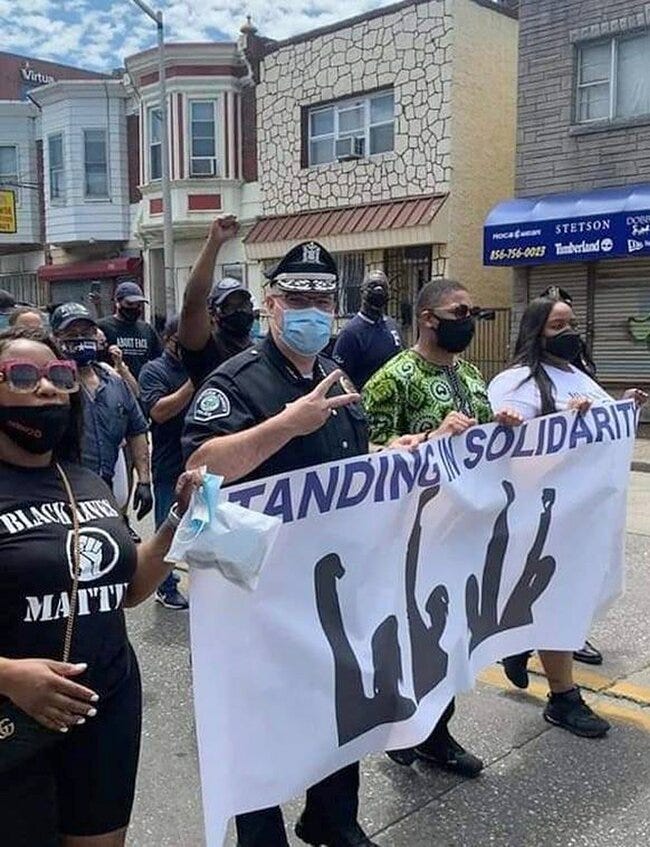
A cop from Camden, New Jersey joins the protestors | People.com

But these are isolated incidents, outweighed by the overwhelming national brutality. In order to stop the mob-like behavior of cops, we need the systematic change outlined above.

Michigan Congressman Justin Amash recently submitted a bill that aims to abolish qualified immunity. The “Ending Qualified Immunity Act” is unlikely to be passed by President Trump because….well…you know why.

In the November elections, it is imperative that we vote out the authoritarian government that America is spinning towards. A police-state is the antithesis of what the Founding Fathers’ vision. Systemic change needs to occur not just at the federal level, but at the state and local levels too.

It’s not enough to punish egregious cops here and there. Every single police officer in America needs to know that their actions are being seen. That their actions, if out of line, have consequences.

Until the police go back to protecting civilians, there will never be peace.

Racism
Psychology
Politics
BlackLivesMatter
Culture
Recommended from ReadMedium