
Point Sur Lightstation: A Haunted Ghost Town on Ocean-View Big Sur Real Estate
“One of the most haunted lighthouses in the country” — Travel Channel
Story by David A. Laws
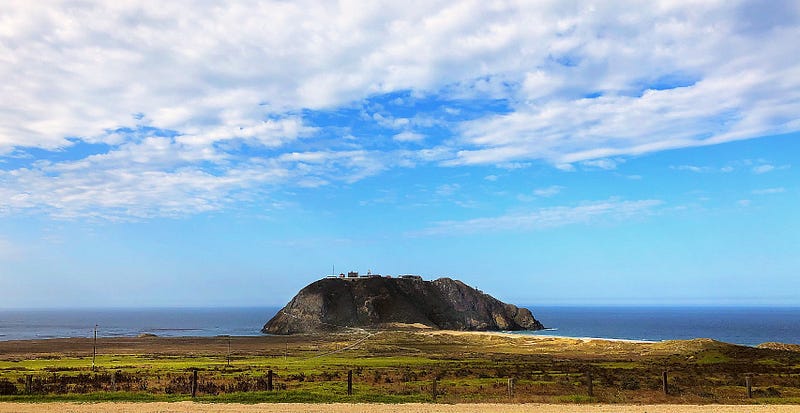
Towering three-hundred feet above the Pacific Ocean’s crashing surf, one of the West’s most faithfully restored ghost towns occupies prime ocean-view real estate just 25 miles south of my hometown of Pacific Grove, California.
Inhabited by chickens, a cow, and families with children until less than 50 years ago, the deserted barn, houses, and workshops of Point Sur Lightstation cling to the edge of a great, volcanic rock with spectacular views of the Big Sur coast and marble-topped peaks of the Ventana Wilderness. Lovers of the paranormal claim the lighthouse is one of the most haunted in the country.
Volunteers of the Central Coast Lighthouse Keepers (CCLK) non-profit organization have restored each of the structures to their appearance at a key era of their functionality and opened the site on Point Sur State Historic Park for public tours.
“A point that appears as an island”
The solitary sentinel of Point Sur, connected to the mainland by a wide sand bar known as a tombolo, lies within the Esselen coastal people’s ancestral lands.
Linguists claim that their name derives from a place known as Ex’selen, “the rock,” which is in turn derived from a phrase meaning, “I come from the rock.” Although no known archaeological resources exist within the park, the question lingers: “Could this have been The Rock?”
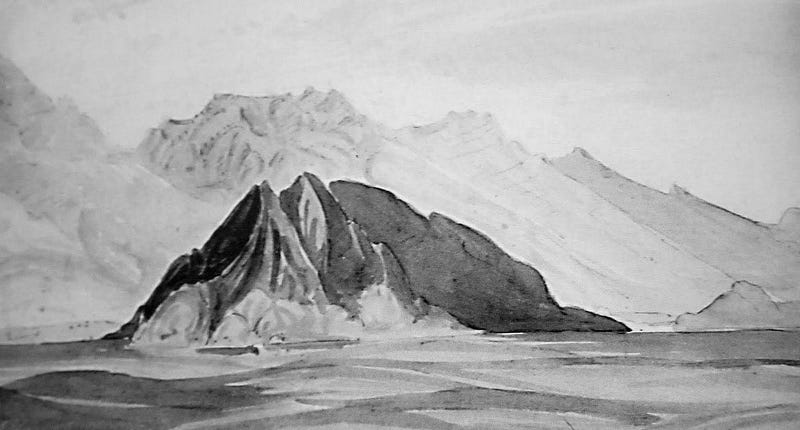
Known to Spanish navigators as the Moro Rock and described by maritime explorer Sebastián Vizcaíno in 1602 as “a point that appears as an island,” it continues as a distinctive landmark for 21st-century land-borne voyagers.
But the role of a cluster of empty habitations atop the rock is not immediately apparent. As Pacific coastal fogs typically hover above the 300-foot level, the lighthouse tower is situated at a lower elevation on the ridge’s ocean side that isn’t easy to see from the highway.
The beacon first shone in 1889. Generations of keepers and their families lived in this isolated community on the top of the rock until the Coast Guard automated the station in 1974. Without the need for constant human attention, the last residents moved out.
The light station complex at Point Sur State Historic Park is today described as a ghost town both for its collection of deserted buildings and for the shipwrecked souls and keepers-past who haunt the site. According to the Travel Channel, a tall man in dark blue, 19th-century garb often lingers around the rock.
In addition to being the only complete turn-of-the-twentieth-century light station open to the public in California, the park is the only such facility in the state to be entirely staffed and maintained by a private, non-profit organization.
We joined one of the regularly scheduled weekend tours led by CCLK volunteer Sharon who met us at the gated entrance on Highway 1, just minutes south of Bixby Creek Bridge. She ensured that we understood the rigors and hazards of the three-hour walking tour before directing us to drive carefully past grazing cattle on the private El Sur Ranch property to the base of the rock.
Road to the top
We parked by California Registered Historical Landmark plaque #951, Point Sur Light Station. This was the site of the lower station of a railway up the steep east face of the rock. Powered by a steam donkey engine, a hoist hauled building materials, food, and supplies up to the lightkeepers. Until carving a road up the slope in 1901, residents climbed nearly 400 stairs alongside the track up the 350-foot rise to reach their homes.
Stopping at intervals to allow the group to rest, Sharon led us at a leisurely pace up the 360-foot rise of the access road that winds around the edge of the rock to the light station.
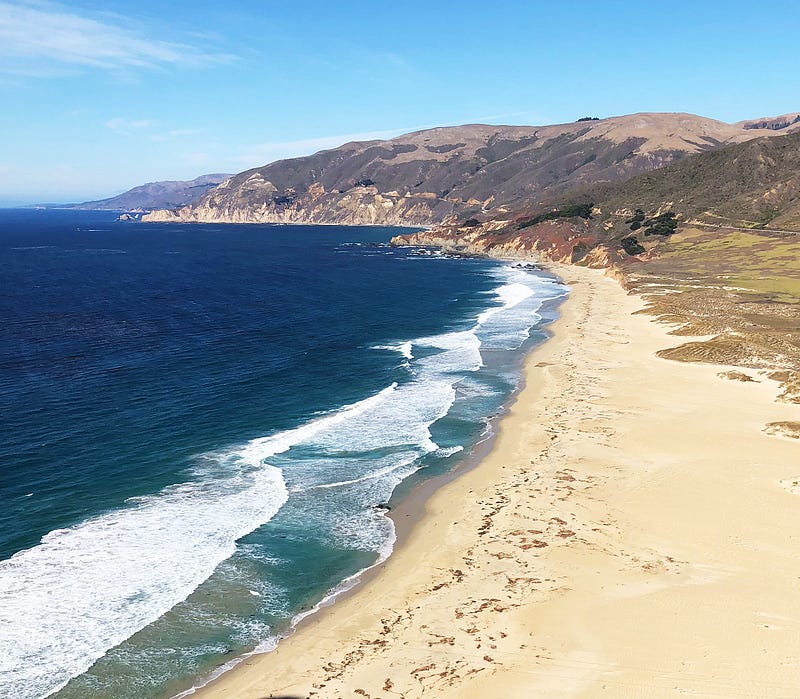
Each stop offered a new vantage point with panoramic views of the Big Sur coastline. With her remarks illustrated with early photographs, we learned much of the lighthouse’s history by the time we reached the top.
Peering over the edge to waves churning far below, she pointed out concrete supports of a dock used by a hoist railway that delivered supplies from ocean vessels before practical access from the land.
Even after the light became operational, numerous shipwrecks continued along this treacherous stretch of coast. A plaque on the side of the road memorialized one of the most unusual losses. In 1935, the USS Macon, a giant 785-foot-long, helium-filled Navy airship operating out of Moffett Field in Mountain View, crashed into the ocean just off Point Sur. unable to help in any way, the lightkeepers watched as a slow descent allowed the crew of 83 to abandon the aircraft. Just two naval personnel died.
Over the years, fishing boats snagged pieces of the frame, but the location was unknown until 1990 when technicians from MBARI (Monterey Bay Aquarium Research Institute) and the Navy found its remains on the ocean floor. Photographs of the wreckage revealed four Sparrowhawk scout biplanes she carried still largely intact.

As we rounded the next bend in the road, a powerful aroma alerted us to the presence of a sea lion colony long before we heard raucous barking echoing from the rocks far below.
These huge pinnipeds thrive in the tide pools and kelp forests of Point Sur State Marine Reserve, a diverse ecosystem fed by nutrient-rich upwelling from deep underwater canyons offshore.
Its most famous residents, sea otters, have rebounded from a single local colony after being hunted to near extinction for their fur. V-shaped squadrons of pelicans skimmed the ocean surface. Occasional spouts of foam on the horizon revealed the passage of migrating grey whales. Blue and humpback sightings are common in the summer months.
Few large plants thrive in the high winds that bathe the rock. We noted that the park’s lone, wind-sculpted Monterey cypress, known affectionately as the Point Sur National Forest, survived by sinking its roots deep into the Franciscan formation greenstone rocks of the cliff face.
At the Lightstation
Built from locally quarried sandstone blocks, the squat tower and fog signal room of the lighthouse complex feature rounded arches and random Ashlar pattern walls of the Richardson Romanesque architectural style popular in the late 1800s.
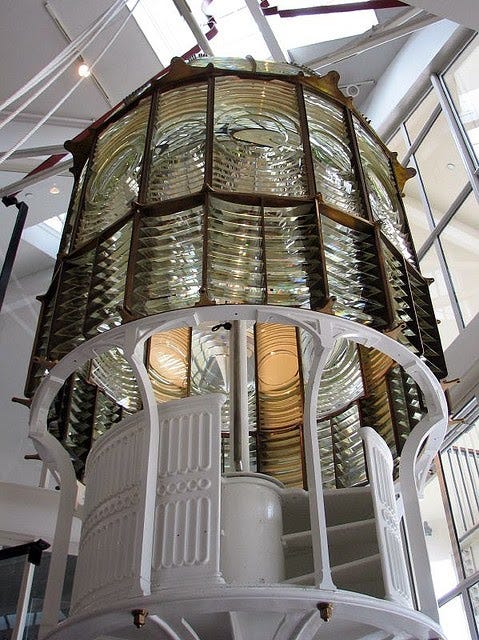
An assembly of glass prisms comprising a first-order (the largest) Fresnel lens mounted in the lantern room on top of the tower concentrated light from an oil lamp into a beam visible more than 20 miles out to sea.
Every four hours, a keeper hand-cranked 450-pound weights to drive a clock mechanism that rotated the lens to generate a unique flashing signal identifying the source as Point Sur.
We climbed the steep spiral staircase to the now-empty lantern room. The Fresnel lens was dismantled and moved to Monterey when the light station was automated.
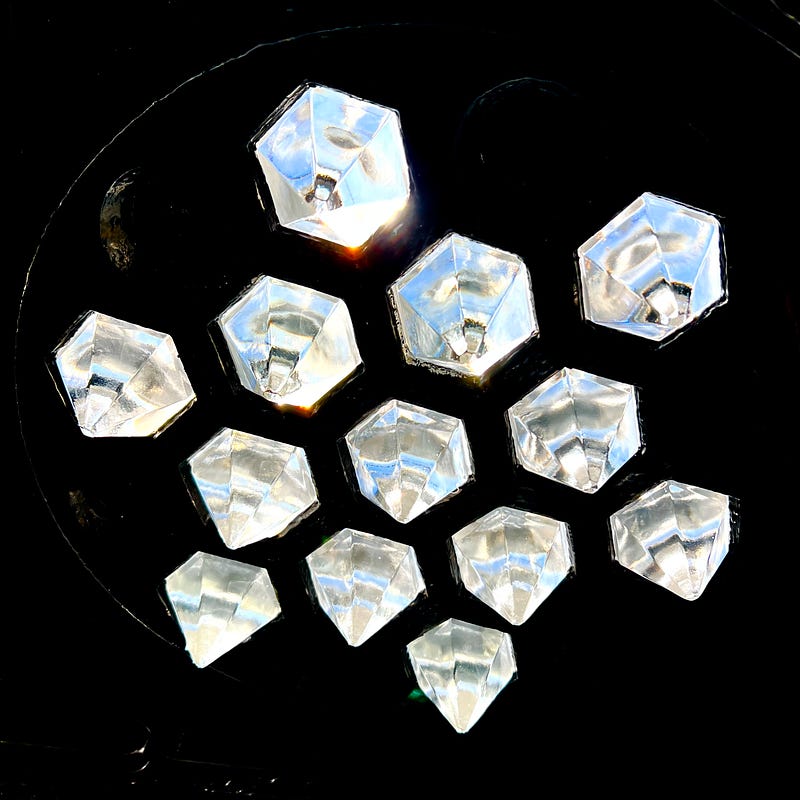
Now considered a valuable museum artifact, it is stored in a secure, climate-controlled facility awaiting restoration before it can return to Point Sur. A flashing aerobeacon initially developed for use at airfields replaced the lens assembly and was recently retired in favor of a more efficient LED system. [A gale damaged the LED mounting early in 2023. The light was still not operating as of 8.20.23]
CCLK members raised funds for the lighthouse tower’s restoration, inside and outside, by an East Coast contractor in 2001.
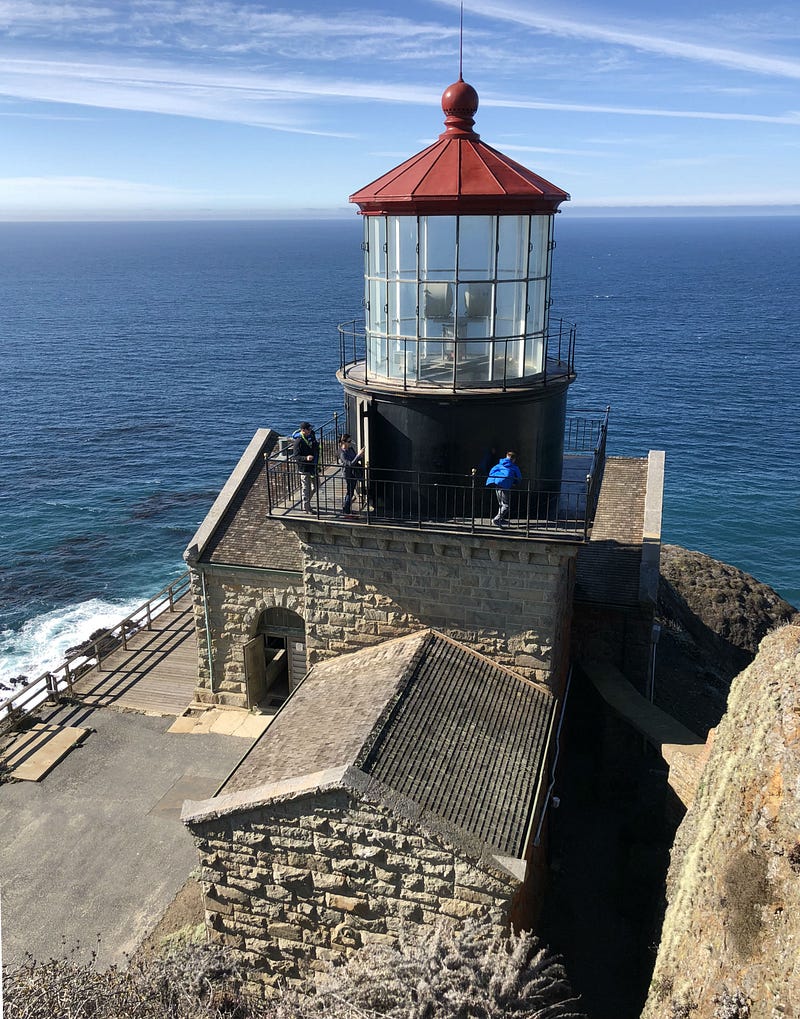
After warning us to hold onto our hats and glasses, Sharon opened the door to a deck outside the lantern room. I clung to the rail against a powerful blast of wind.
A gentle breeze at sea level had increased to whipping gale force at this altitude. It made me a believer in the story that one of the keepers routinely tethered his free-range chickens by their legs.
After admiring the extraordinary view of the ocean and coastline, I carefully worked my way back to the welcome shelter of the lantern room. Back on the ground, we relaxed in the fog signal room.
Exhibits included several generations of fog horn technology, sections of a Fresnel lens, and contemporary newspaper reports of the Macon airship disaster.
Compared to the rounded top of Morro Rock 100 miles to the south, Point Sur’s changed after workers blasted 80 feet off the top. They leveled the site to accommodate the needs of four keepers and their families. These included gardens to grow vegetables and workshops to maintain the operation of the light.
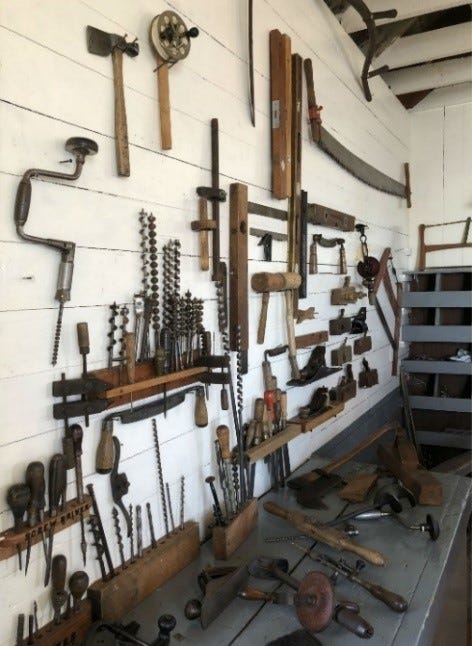
From the lighthouse, steep wooden stairs led to the now flat area that holds the station’s living quarters. In the late 1990s, CCLK members began a major project to restore these structures to their original appearance. First, to be completed in 1999, the Carpenter/Blacksmith Shop is outfitted with tools and equipment typical of the late 1920s.
A two-story wooden barn built circa 1900 that nearly toppled over the cliff in a storm presented a significant restoration challenge to the work crew. Originally designed to hold livestock and horses, the barn has also served as a garage and recreation room. Beauty, Daisy, and several other generations of cows were sheltered in the barn and provided fresh milk for the residents. One day noticing a cow staring over the cliff, a keeper rescued an 8-year-old boy who had fallen off his bike and was clinging desperately to a bush below. The barn is now a meeting room for groups and students on field trips.
The tallest building on the site is a three-story apartment for the assistant keepers and their families. Constructed in 1889 from the same solid stone blocks as the lighthouse tower, the exterior is being restored to its appearance in the early 1900s.
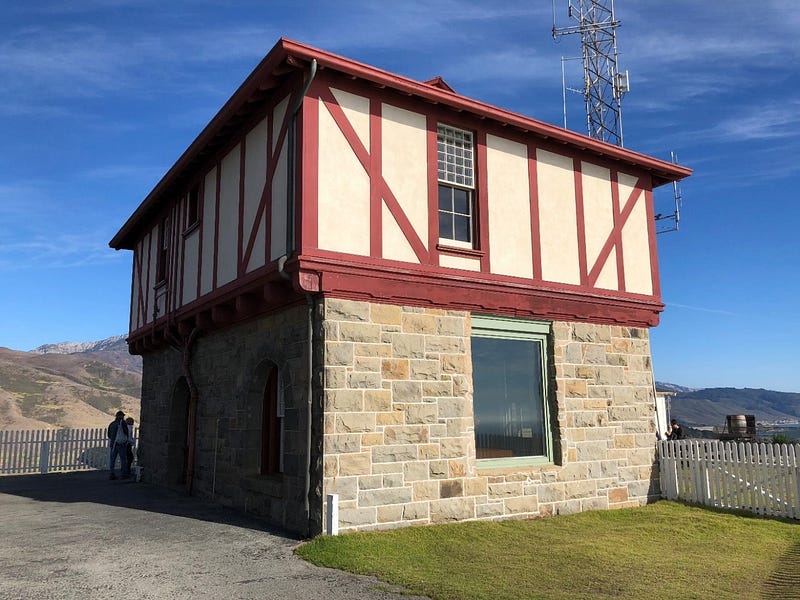
A single-story sandstone building housed a coal-fired donkey engine that powered the early hoist railway. On abandoning the railway, the keepers added a wooden second level in 1902 to convert it into quarters for the head keeper.
After restoring the unusual combination of architectural styles (Richardson Romanesque base and half-timbered Tudor upper level), volunteers decorated the interior in 1950s style. Kitchen appliances, furniture, food packaging, fabrics, and toys from that era aroused nostalgic memories for many in our group.
The tour concluded in a former mess hall for navy personnel stationed as lookouts during World War II. Today it serves as a visitor center, a gift shop, and a new home for a spectral figure dressed in a 19th-century keeper’s uniform who formerly preferred the lighthouse tower.
Return to Earth
Our walk back down the slope offered unimpeded views across the narrow coastal plain and Highway One to Pico Blanco and other peaks of the Ventana Wilderness to the east.
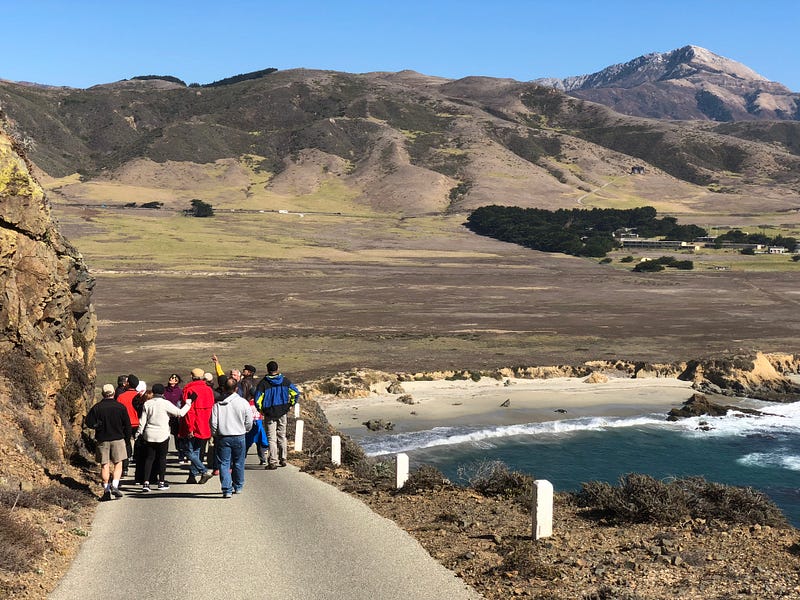
Below us and to the south, the former Point Sur Naval Facility, built in 1958 to accommodate over 100 naval personnel, occupied the slope between the highway and the ocean.
A submarine detection capability employing SOSUS (SOund Surveillance System) sonar and radar technology, operated here until 1984. Now incorporated into the State Park, the Central Coast Light Keepers also conduct tours of this former top-secret Cold War-era facility. Check the website at pointsur.org for details. See my story “Even the Logo was Phony: Big Sur Naval Base Cold War Secrets Revealed.”
Visitor Information
Access to the Lightstation is by guided tour only. Volunteers lead tours year-round. For safety and to preserve the sense of drama and isolation, no more than 40 visitors are admitted on each tour. No strollers or baby carriages are permitted.
As reservations are not accepted, prospective visitors are advised to arrive early. For current status, tour dates and times, volunteering, and other information visit the Point Sur Lightstation website at pointsur.org
Resources
Carol O’Neil, Point Sur: Images of America, Arcadia (2003)
Point Sur, State Historic Park and Lighthouse
Point Sur State Historic Park brochure
Point Sur State Historic Park Preliminary General Plan
Inside ‘haunted’ Big Sur lighthouse (Video)
[Rev: 8.21.23]


