
Poetry is Sorcery
Poetry & Hypnosis — Language in the Fractures
Why have I, a clinical psychologist, spent so much time reading and writing poetry? It is because every time I have encountered poetry in my own life, a doorway opened and each meeting brought healing and growth. I don’t mean every poem, even by poets I adore, but in each exploration, I found a truth that moved me. I, therefore, also started using poetry in my teaching and therapy work and found it had an amplifying effect. I have come to see it as true sorcery in which language is used in ways that promote life-affirming change.
Poetry is a form of sorcery because it involves the magical binding of words that allows them to go beyond the literal meaning. It is one of the few ways in which we can use words to go beyond words. When arising from the soul, poetry allows us to say the unsayable and to speak to experiences that are both universal and personal at the same time. Through poetry, we create and use language against which we have no defenses. Or rather our defenses are rendered useless as the words, rhythms, and images encountered also enter into us from below our consciousness and straight into sensation. Poems, then, are spells that live in and mend the fractures of our lives. In his way, they include our suffering even as they invite us to transcend our fragmented experiences.
For many, poetry is an attempt to say the unsayable, and some poems:
“are able to speak to something universal yet personal and distinct at the same time; to create a door through which others can walk into what previously seemed unobtainable” (David Whyte).
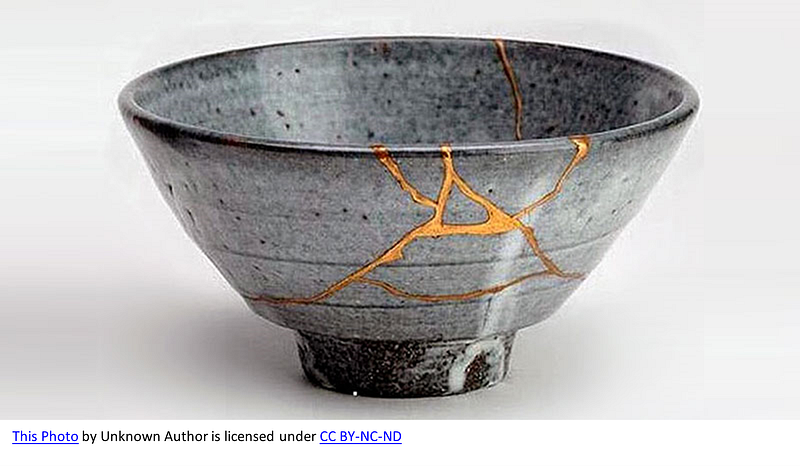
This helps heal the fragmentation people feel within themselves and between themselves and others. This type of healing is a kind of kintsugi. Kintsugi is a Japanese technique for repairing pottery such that breaks are made visible through a gold-infused enamel used to connect the broken pieces. Poems are words that live in and mend the fractures of people’s lives. Thus, the wholeness invited and facilitated is not flawless but, rather, poems include our suffering even as they invite us to transcend our fragmented experiences.
This is identical to how we attempt to use language and what we attempt to accomplish in clinical hypnosis. For these reasons I frequently use poetry in my practice as a clinical psychologist. I have even included a whole section on Poetry and Hypnosis in my book CORE Hypnosis: A Compassion Informed Therapy. For clinicians, poetry can be incorporated into clinical conversations, both in hypnotic communication and as hypnotic communication. Clients are also encouraged to use poetry in their healing because as Madison Ann stated: Poetry is Therapy.
The emphasis on language and nonverbal expression in poetry, with special emphasis on metaphor, surprise, repetition, tone, resonance, and both direct and indirect communication, overlaps with clinical hypnosis. The metaphors, images, and sounds of communication in both poetry and clinical hypnosis activate both passion (energy) and compassion (connection). Thus, our participation in a shared whole is not only made visible but is also somatically felt, thereby opening the mind-body state. In such open mind-body states, we are more receptive to suggestions that invite resources and life-affirming action.
Since all hypnosis is self-hypnosis, one can achieve the same goal by writing and reading poetry. Have you not already experienced yourself being entranced, transported, and transformed by at least one poem you have read or heard? I encourage you to explore poetry, in life and work. After all, many poems have demonstrated clear resonance to people and have stood the test of time.
Some of the poems I have shared here (in medium) were written to help me mend the fractures caused by trauma and pain in my own life. Each poem was a balm that filled in cracks and helped make me whole. The poems reflect the suffering but also the healing. Here are some examples:
You can find Madison’s article here:


