Please Stop Saying “Humans Will Go Extinct, But Earth Will Be Just Fine.”
Why we need to think more deeply about why we say this
We are many, they are not
Ours is an immensely populous and adaptable species. We can take out billions and still have remnant populations persist.
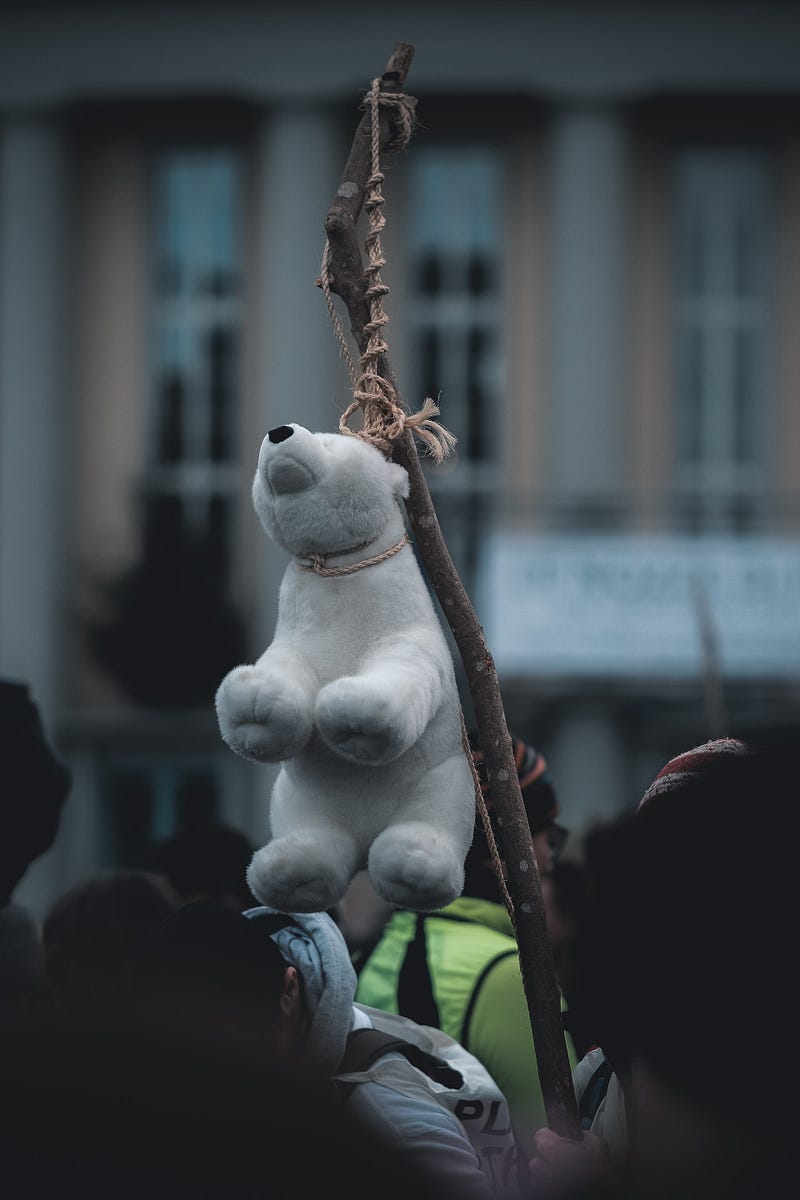
This is decidedly not the case for species like polar bears and penguins.
Of course, we could truly deplete the oceans, or blow it all up, but even then, Sapiens will not necessarily die out entirely.
We are self-destructive, but to what degree? No pun intended. So, sure. We’re killing ourselves. Sad shrug. New reports put us on track for 2.4°C of warming. Catastrophic.
Yet, it is the second part of this statement, “But Earth will be just fine,” that is so very offensive and appalling.
It smacks of denialism and also human-centric bias. What do you mean by “fine?” Fine like the billions of shellfish that cooked in their shells in the heat dome of 2021 in the Pacific Northwest? Fine, as in the millions of dead, burned up forests and grasslands and all of their ecosystems? Fine like the billion-plus animals that suffered and perished in Australia through the Black Summer?
Burned paws and skin, starvation, choking, and dying do not sound fine. I challenge you to set yourself on fire and tell me that it feels “fine” to you. We have bee colony collapse, an insect apocalypse, die-offs of birds in alarming numbers, and a vast disappearance of all wildlife biodiversity since the 1970s. Floods, famines, habitat loss, over-hunting, poaching, agricultural degradation, and invasives are rampant.
More than 2.7 million pangolins are poached and trafficked for meat and “medicine;” please don’t try to convince anyone that such an animal — in this case just one of many mammals — is fine, and that individual suffering does not count upon an interactive planet of collective resiliency.
Then there are trophies, lions, and tigers, and bears, who suffer cruel confinement and brutality, if not death, because it’s considered somehow manly, or noble, to dominate them. Add to that petting farms, zoos, and roadside attractions where you can get a photo with a wild animal, and that animal goes back to its concrete cell at the end of the day.
Let’s talk about entire ecosystems. Reefs are not doing “fine.” Drought-stricken areas where water is disappearing are suffering. Flooding and eroding areas suffer as well. The Amazon and other world carbon sinks are now emitting as much carbon as they are absorbing.
Why do we say this?
Saying that we are driving our own extinction is human-centered, but earth is strong, ignores the clear anguish that other life is undergoing.
We are concerned, day to day, not with the suffering we hide from ourselves (think of factory farming and pandemic origins). The truth is, we don’t want to think of ourselves as causing such suffering. No one wants that. So, what we do is craft this weird soundbite that makes the case that at least we can’t kill the planet.
Our biggest error is that we separate ourselves from nature, rather than seeing the whole, which is entirely interconnected. There is no “nature” to be just fine, or “Earth” that is not wholly connected to us and our actions.
There is not.
Our fellowship, as well as our leadership, is sorely needed.
Famously, the late, great George Carlin talked in 1992 about how “Earth will be fine, it is we who are ******.” We know what he meant. It was largely true, then. That is, although we had already obliterated many forms of life, including — it’s probable that we extinguished even some other human species — what he meant is that we were being primarily, horrible to one another, in 1992. Even today, people dredge up this footage to help support their bizarre theories on how the climate crisis is a hoax.
And, George was not entirely wrong, in his time. But what he meant does not apply to what is happening now. The fires, floods, storms, and extinctions. The day-to-day suffering of nature that is irrefutable. I believe George Carlin would re-assess his statement if he were alive today.
Yet, it partly remains true. On a cosmic scale, we cannot kill the planet. On a day-to-day scale, however, we do impact billions and billions of organisms.
And, we do. We must begin to level with one another and the truth, as painful as it may be. Our best chance is to see ourselves as heroes that champion the life-supportive biosphere. It is bigger than us. Yet, we influence it.
Therefore, do not go gently into that “good denial.” Go boldly to truth. Know that you do make a difference. Then choose which kind of difference you need to make. Small, daily, incremental, activist, political or monumental.
The Earth, is not doing just fine.