
Please, Please Call Me Filipino
And not Filipinx

Recently, in an Instagram story, my buddy and I got labelled as Filipinx. It went a little like this, “karaoke with my filipinx friends”.
I saw the post when I got home, so I replied with a, “???”,
I was thinking it could be a typo, but I was still curious nonetheless, so I asked,
“what’s filipinx?”
“it’s a gender neutral term.”, the person said.
“since when?” ..was what I wanted to say,
instead I went with “I see.”
October is Filipino Heritage month in the U.S. It celebrates the long, intertwined and sometimes tumultuous history of Filipinos and Americans. Filipinos — through the Spaniards — have already been living in north american soil tending to farms as far as Louisiana even before the Americans brought the “Manong generation”, Filipino houseboys, and the Filipino nurses into the fold.
As for my two cents on the Filipinx issue, I’m not a big fan of the term. It’s even unheard of back in the Philippines. The Filipino language, as well as the original Filipino alphabet doesn’t even have the letter ‘x’ to begin with. Infact, if you ask a random passerby in the Philippines if he knows what the word means, they’d probably have no idea. Most first generation Filipinos such as I am had rather gotten acquainted with the usual “Filipino” label. The word, Filipino, is already gender neutral as it is — well, apparently not until recently, with the emergence of Filipinx.
Filipinx is supposed to be a gender-neutral term for a person that hails from the Philippines and an alternative to Filipino.
According to FIERCE, “the use of the term ‘Filipino’ can be harmful to genderqueer-identified people because it assumes that there are only two genders. Using the term ‘Filipino’ also uses a masculine term to encompass a diverse array of gender identities who may be excluded and overlooked.”
But the word is not commonly used by first generation filipinos. It is mostly used by second, third and beyond generations that have more or less been already westernized, aka the Filipino diaspora. Filipinx might have been inspired from the progressive latino community championing the use of Latinx, wherein majority of latinos speak Spanish, a non-gender-neutral language.
And yes, I do get where the LGBTQ2+ is coming from — that adding the suffix ‘o’ at the end, especially in spanish-rooted cultures, signifies that the word is masculine, while adding ‘a’ is feminine. i.e. Americano means american male, while Americana means american female.
But the Filipino language — although having traces of spanish — is not Spanish, and the idea that it needs to be gender-neutralized is unnecessary.
Filipinx wrongly implies that the Filipino language is not gender-neutral
In the Filipino language, we do not use masculine or feminine pronouns like “he/she” or “his/her” to begin with,
instead, we use “siya” (sometimes pronounced ‘sha’),
which is already gender neutral, as well as a great equalizer.
“Smart siya.”, translates to: “he/she is smart.”
In its purity, the Filipino language is already gender neutral.
Although some may argue that there are a few exemptions. The Philippine version of Adam and Eve for instance, where both of them sprouted from a tube-like craft or a piece of bamboo that split in half. Malakas is Adam’s counterpart, which is also translates to “strong” and mostly used for the male population, while Eve’s counterpart is named Maganda, which translates to “beautiful” which is mostly used for females.
We’ve already been called too many things
Throughout the world’s history, we Filipinos have been called a myriad of things.
We have been called :
- Negritos — Native Filipinos that were dark skinned and short. (Negro+ito) literally “Black and little”.
- Indios — Native Filipinos that were austronesian ancestry. Also means natives/“indians”
- Insulares — Born in Philippines, but spanish by blood
- Sangley — Native-Chinese mix
- Mestizo —Native-Spanish mix
- Tornatrás — Mixture of Native-Chinese-Spanish, Arguably nearly all Filipinos of today
As well as many more. The fact of the matter is, the sea turtle-shaped archipelago that is the Philippines is a giant blender of all the other ethnicities. I’m gonna use myself as an example, my mother’s side is of south-asian-spanish and native origin, while my father’s side is of chinese-japanese-spanish-american and native origin.
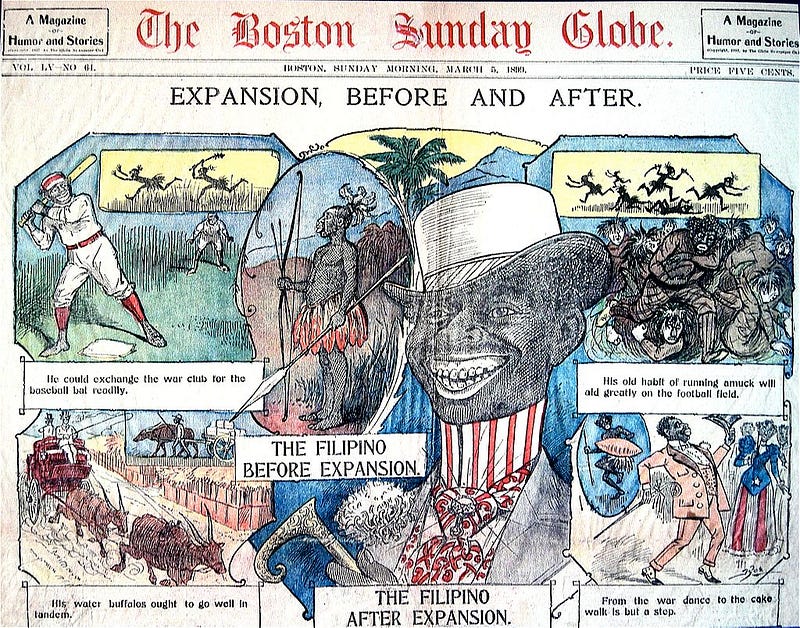
The use of Filipinx might be considered progressive and just, especially in the Filipino diaspora, but in the same way it harms gender-queer identified people, it also harms the pride of Filipinos back home. Many national heroes like General Luna, Jose Rizal, and Apolinario Mabini have fought and died to end the rule of the different colonizers in the name of the Filipino people — in order to be a united country and
to be no longer be called something else but Filipino.
And now we have Filipinx — the latest in a long list of names added to the pantheon.
There are also some derogatory terms and slurs that have surfaced in the last century:
- Flip — origins are varied, but it’s commonly referred to american-born filipinos/filipinx.
- Pee-noise — derogatory term used mostly in online gaming and forums
- Huan-a —Used by Chinese to foreigners, domestic workers have often encountered this word.
- Gugus — Used by American troops to refer to Guerilla fighters.
- Gooks — Also used by American troops, but has also been used towards other asians.
- Pilak — Used by the Malay
Added to Dictionary?
Around mid 2020, the words Filipinx and Pinxy (similar alternative to pinoy and pinay) were added to Dictionary.com, legitimizing its use as an alternative to Filipino, Filipina, Pinoy and Pinay, albeit pissing off the entire Filipino Twitterverse in the process.
“ It was almost expected that while Filipinx was welcomed by the Filipinx diaspora, it was almost unanimously condemned by Filipinos living in the Philippines.”
— Anri Ichimura from Esquire
This ignited a Twitter war between both the ‘Filipinx’ and ‘Filipino’ aficionados alike.
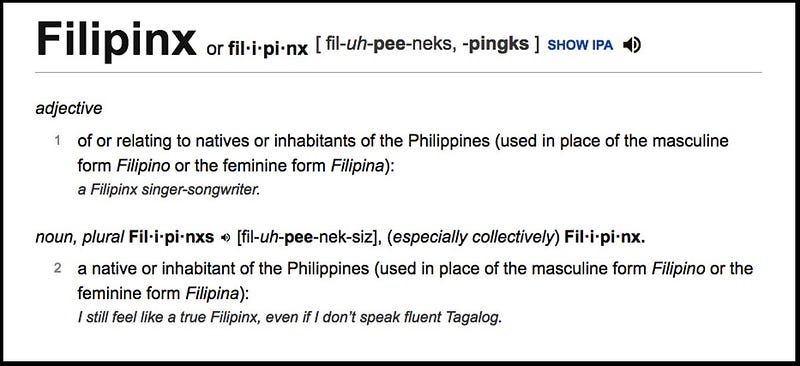
The recent and sudden move was instantly and unanimously condemned by Filipinos living in the Philippines. It just came out of nowhere, you can’t just change the identity of 107 million people in the Philippines and 10 million more living abroad overnight.
But as a person of Filipino descent living in North American soil myself, I can see why the need for such term arose. Children of immigrants living in western countries have had little to no knowledge of their own cultures and languages back home. Although most Filipino immigrants speak at least three languages from birth: their regional language, the tagalog language — which is the official language, and the english language; their children might not have had ample time to develop linguistic fluency in anything but English. How could they, when most of these immigrant parents have had to work double jobs just to have an ounce of financial stability. Although many immigrants have had professional jobs back in the Philippines, they just don’t transition well coming into the tribal nature of Western job markets, and most of these immigrants will often resort to settling on multiple low-skilled jobs in order to survive. There’s a running joke that’s often used by foreign comedians that the best place to have a heart attack is at the back of a taxi cab, because the driver is likely a foreign doctor. It’d be more funny if it weren't the sad reality. The children of these immigrants will have to face a perpetual balancing act that involves their heritage and their western upbringing. This often makes them question their own identity well into their adulthood, and so, have sought the company of children with similar experiences.
In a way, using Filipinx distinguishes themselves from other individuals of Filipino descent. However, championing it into dictionary.com to encompass the entire Filipino population is going a little too overboard, and may stem from their own privilege.
“It’s easy to assume that the Filipino diaspora in charge of championing Filipinx all the way to the dictionary is clueless and disconnected from the realities of Filipinos in the Philippines, especially when some have the audacity to call Filipinos in the Philippines living on “the mainland.” (To those who tweeted that, this is not China). The disconnect from (not of) the diaspora is clear and only perpetuated with the assumptions that they are the privileged ones. And these “Fil-Ams” (as we love to call them) are only trying to push their westernized, colonized ideals onto the greater Filipino community.”
Anri Ichimura from Esquire
Dictionary.com Changed it
Due to backlash brought about by Filipinos (in the Philippines), Dictionary.com has recently changed its definition as of October, 2020. When you access the website, the definition will no longer mean that it encompasses the whole Filipino population. Instead, it puts emphasis on those living in the United states, which is slightly better imo.
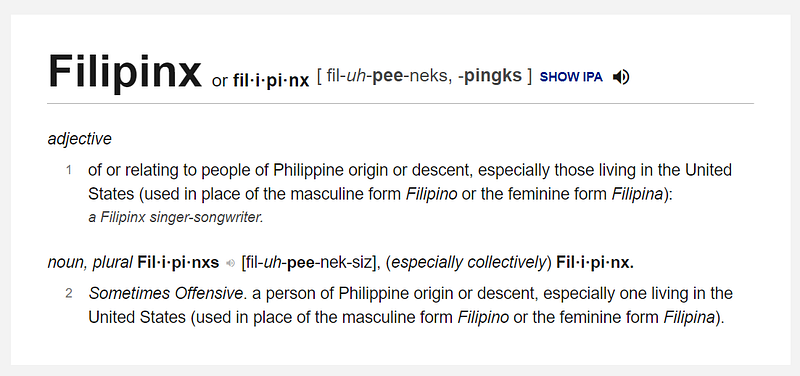
I think this is a much better approach — an approach that meets down the middle.
I suggest that as a default, especially in government documents, news institutions, and the media, individuals that are native to or citizens of the country of the Philippines, regardless of gender, are to be called “Filipinos”. However, if they are part of the Filipino/Filipinx diaspora, and if they wish to be addressed as so, then they shall be called Filipinx.
but please, please, as for me, don’t call me indio, or flip, or yellowman, or pee-noise, or any other names. I’m tired of these labels.
Just call me Filipino.