
Playing With Rocks
Three stories about one of the best toys nature has to offer
In September I found myself spending five days at a local elementary school. Our outdoor centres weren’t open, so the school board decided to temporarily redeploy me to a school to help out. Fortunately, the principal thought of the perfect way to put me to use—facilitating outdoor play!
I spent time with lots of different classes throughout the day, mostly during their outdoor break time. That meant there wasn’t a need for me to cover curriculum or teach anything specific. My task was to help them find fun things to do, because their usual options weren’t on the table and no one even seemed totally clear on what all the rules were. They couldn’t play on the playground equipment, had to stay in designated sections of the yard, and were only allowed to play with their own class. They also didn’t have access to sports equipment or toys, and weren’t supposed to touch each other (which took all the tag games off the table).
There were a couple of classes that wanted me to teach them some games that worked with all the criteria and one class that loved bug hunting in the grass, but not everything was so activity-specific. If a group of kids had ideas often all they needed me to do was to give them permission and engage with them.
One of the things I noticed was how many different ways kids were engaging with rocks. It was truly joyful! So, if you ever thought there wasn’t any fun to be had with rocks here are three anecdotes that might help to change your mind. Perhaps, like many adults, you just need to take a cue from these kids and get a bit more creative!
Line Them Up
This was a big school with a huge schoolyard, so multiple classes would be outside at once. A handful of classes would be on outdoor break, but there were also classes out there for phys ed or another subject that the teacher was choosing to teach outside. Because of this, combined with a need for classes to not mix to limit the number of contacts each student had, each class kept to a contained space. Although personally I was partial to the field, some supervisors preferred to have their class on the blacktop, which had been divided into two areas by a yellow line down the middle.
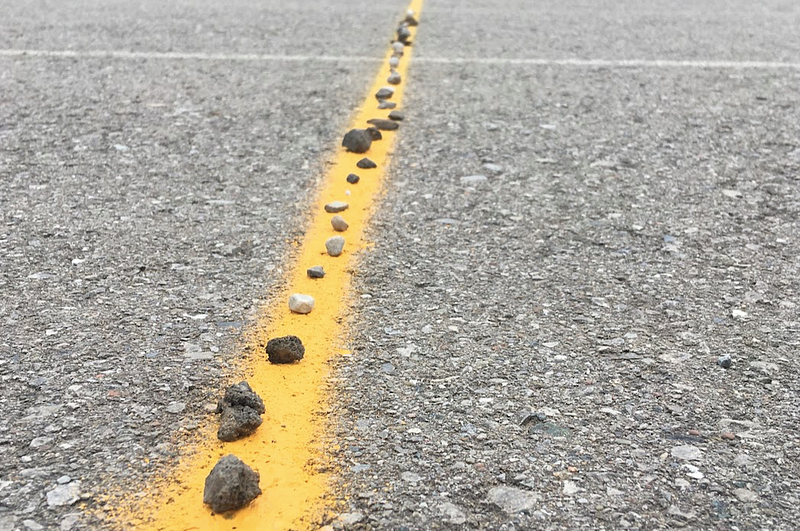
Unlike the field, which was filled with neat plants and cool bugs, there wasn’t much to find on the blacktop. But there were little rocks to be found, and kids always managed to find them! They would make little rock piles or toss them around or, as shown in the header photo, they would line the rocks up along the yellow line. I saw this happen multiple times, with different students from different classes and different grades. And they always looked like they were having so much fun (way more fun than I’m sure you could possibly have putting rocks in a line). My personal favourites were two friends who were in different classes, out for break on opposite sides of the blacktop, who worked on this task together by finding stones on their respective side.
1, 2, 3, JUMP!
One of my favourite features of this schoolyard is a group of landscaping boulders lined up behind the portables. One of the grade two classes I worked with were also huge fans, often spending their entire twenty-minute break playing on them. Fortunately, at this school, no one seemed opposed to this, which made my outdoor educator heart sing!
The students would sometimes walk back and forth along the row of boulders, but their favourite thing to do was jump off them. Now, to be clear about risk, the height would be similar to jumping off the second-to-bottom step of a staircase and they were jumping onto grass, so it wasn’t exactly a high-risk activity. However, that didn’t make it any less fun and thrilling!
Any time I was able to be with them during their break all they wanted me to do was jump with them. Specifically, they liked teaching me different kinds of jumps—180 spins, 360 spins, and jumping extra far were amongst their favourites. They would show me a jump then ask me to replicate it, though almost every time I’d be told, “Nooooo! Not like that, silly! Let me show you again.” This was the response I got regardless of how perfectly I’d matched their jump and it made us all laugh together every time.
Power Stones
In the kindergarten play space, there were some sections filled with small stones. I don’t think the intention was necessarily that they would be something the kids would play with, but that’s what seemed to happen quite often. One day I noticed a group of kids sitting in the stones. They seemed to be picking them up and inspecting them, putting some of them aside. Intrigued, I wandered over.
The kids were so excited to not just tell me what they were up to, but show me. “Look! Power stones!” They had discovered that some of the stones had sparkly crystal bits in them and had concluded that these stones must have special powers. And, of course, if you had the stones then you got their powers! After a couple of days searching for power stones (and trying to convince them not to pocket every single one), I brought in the most magical rock I own—a hunk of obsidian.
I also had a day where another group of kids decided that the small stones were dinosaur eggs. We spent time picking up different stones and predicting what kind of dinosaur would hatch from that egg.
There’s endless fun to be had with a pile of stones and a little imagination!
Do you have an intergenerational story or conversation you want to share? We would love to hear it! Contribute to Mind in the Gap, and join the team!